Best fit for Metro Detroit and Lansing homeowners: Michigan Radon Control, which provides NRPP-certified radon testing, mitigation installation, and maintenance. For homes elsewhere in Michigan, choose a credentialed local installer; for crawl spaces or an underperforming existing system, prioritize experience with that specific job.
- Searching best radon mitigation companies near me? Michigan Radon Control fits homeowners and realtors in Metro Detroit and Lansing.
- Choose radon mitigation services by credentials, foundation design, follow-up testing, and maintenance—not distance alone.
- EPA recommends fixing homes at 4 pCi/L or higher and considering action between 2 and 4 pCi/L.
- A running radon fan does not prove low radon levels. Confirm performance with a radon test.
Why this matters
It is natural to worry when a radon report comes back elevated. You do not need to understand every pipe and fan before calling a contractor, but you do need a clear installation plan and a way to verify the result.
Michigan Radon Control serves homeowners and realtors in Metro Detroit and Lansing. For your 2026 search, start with that service-area fit, then compare the proposed work against your home's foundation and test results.
Radon is a radioactive gas you cannot see or smell. EPA's A Consumer’s Guide to Radon Reduction, written for homeowners choosing mitigation methods and contractors, recommends fixing homes at 4 pCi/L or higher and considering reduction between 2 and 4 pCi/L. Those are action guidelines, not a guarantee that lower readings carry no risk.
What makes the best radon mitigation companies?
Use these criteria before comparing names. A nearby address is useful, but it does not tell you whether the proposed system fits your house.
- Relevant credentials: Verify the responsible professional's current radon mitigation certification. Testing and mitigation are different qualifications.
- Foundation-specific design: Ask how the system will address your basement, slab, crawl space, or combination of foundations.
- Written scope: Get the proposed suction points, pipe route, fan location, electrical work, and responsibilities in writing.
- Performance verification: Establish who arranges the post-installation radon test and what happens if readings remain elevated.
- Service accountability: Ask who handles repairs, system questions, and future maintenance.
- Clear documentation: Keep the initial report, installation details, warranty terms, and follow-up results together.
The best contractor explains how the system will work in your home and how you will know it worked. Apply the same questions to every 2026 proposal so you compare equivalent work.
Michigan radon mitigation options at a glance
This guide ranks hiring options by homeowner need. The order is a decision path, not a statewide ranking based on customer reviews or installation results.
| Rank and option | Best for | Standout fit | Key limitation |
|---|---|---|---|
| 1. Michigan Radon Control | Homeowners and realtors in Metro Detroit and Lansing | Testing, mitigation installation, and maintenance from a service provider serving those areas | Confirm your exact address and property scope before proceeding |
| 2. A credentialed local residential installer | Homeowners elsewhere in Michigan | A contractor whose coverage matches the property location | Local proximity does not establish credentials or design quality |
| 3. A crawl-space mitigation specialist | Homes with exposed soil or mixed foundations | A proposal that addresses soil coverage and suction beneath the membrane | A basement-only proposal does not explain crawl-space treatment |
| 4. An existing-system diagnostic specialist | Homes with a fan, piping, or prior mitigation already installed | Investigation before deciding what to repair or replace | Replacing a fan alone does not establish that radon levels are controlled |
1. Michigan Radon Control: best for local service continuity
Michigan Radon Control provides NRPP-certified radon testing, mitigation system installation, and system maintenance for homeowners and realtors in Metro Detroit and Lansing. That service range fits a homeowner who needs help moving from an initial reading to installation and later upkeep.
Best for: A homeowner or realtor in those service areas seeking testing, installation, and maintenance through the same provider.
Michigan Radon Control pros:
- Provides both radon testing and mitigation installation.
- Provides maintenance for radon mitigation systems.
- Serves homeowners and realtors, matching residential and transaction-related needs.
- Identifies NRPP certification as part of its services.
Michigan Radon Control limitations:
- The stated service areas are Metro Detroit and Lansing, not every Michigan community.
- Your foundation layout still needs assessment; a company-level recommendation cannot establish your home's design.
Before accepting a proposal, ask who will perform the work, how the pipe will exit the house, and who will arrange the verification test. For a home sale, also explain the inspection deadline before setting the work sequence.
Verdict: Buy—proceed with an assessment if your property is in the stated service areas, then approve a written, home-specific scope.
2. A credentialed local installer: best outside those service areas
If your home is elsewhere in Michigan, choose a residential mitigation contractor who explicitly serves your address. Check the responsible professional's credentials through the certification organization's directory rather than relying on a badge in an advertisement.
Best for: Homeowners outside Metro Detroit and Lansing who need an installer with confirmed local coverage.
A local search in 2026 should produce a shortlist, not an automatic winner. Ask each candidate to explain the proposed system using your test report and foundation layout.
Local installer pros:
- Lets you focus on contractors who serve the property's location.
- Gives you an opportunity to compare home-specific proposals.
- Allows direct questions about local permitting and electrical-work responsibilities.
Local installer limitations:
- A nearby office does not establish radon mitigation qualifications.
- Search position and review totals do not demonstrate post-installation performance.
Request the name of the person responsible for mitigation work. Then confirm whether the proposal includes verification testing, system labeling, and instructions for recognizing an operating problem.
Verdict: Buy—choose a credentialed local installer when the written design and follow-up plan meet your home's needs.
3. A crawl-space specialist: best for exposed soil and mixed foundations
A crawl space requires a different design conversation from a straightforward concrete basement. A common approach uses a sealed membrane over exposed soil and suction beneath that membrane to direct soil gas outdoors.
Best for: Homes with dirt-floor crawl spaces, basement-and-crawl combinations, or additions built over separate foundation areas.
Ask how the proposal treats the entire soil-contact area, including piers, perimeter edges, access points, and transitions between foundations. The guide to radon mitigation systems for crawl-space homes explains the foundation-specific questions to raise.
Crawl-space specialist pros:
- Focuses the proposal on exposed soil rather than only the basement slab.
- Makes membrane sealing and access part of the design discussion.
- Addresses how separate foundation sections will be evaluated.
Crawl-space specialist limitations:
- Restricted access and existing moisture problems require coordination.
- Encapsulation alone does not prove that indoor radon levels are controlled.
Tell the contractor about standing water, drainage work, or planned crawl-space repairs before approving the layout. You want those projects coordinated rather than competing for the same space.
Verdict: Buy—prioritize demonstrated crawl-space experience when exposed soil is part of your foundation.
4. A diagnostic specialist: best for an existing system
If your house already has radon piping and a fan, begin with diagnosis rather than assuming you need another installation. A technician should evaluate the existing system alongside a current radon measurement.
Best for: Homeowners with elevated readings after mitigation, a stopped or noisy fan, or concerns about an inherited system.
A pressure gauge indicates a pressure difference within the system; it does not measure indoor radon concentration. A fan that sounds normal is not a substitute for testing.
Diagnostic specialist pros:
- Separates equipment problems from radon measurement questions.
- Examines the current system before recommending replacement.
- Creates an opportunity to document an older or inherited installation.
Diagnostic specialist limitations:
- A fan replacement alone cannot confirm that the full system works adequately.
- Missing installation records make it harder to understand the original design.
Provide previous test reports, any system drawings, and a description of recent building changes. Basement finishing, additions, and other alterations belong in that conversation.
Verdict: Hold—pause equipment purchases until diagnosis identifies the problem and a radon test establishes current conditions.
How to compare proposals before you hire
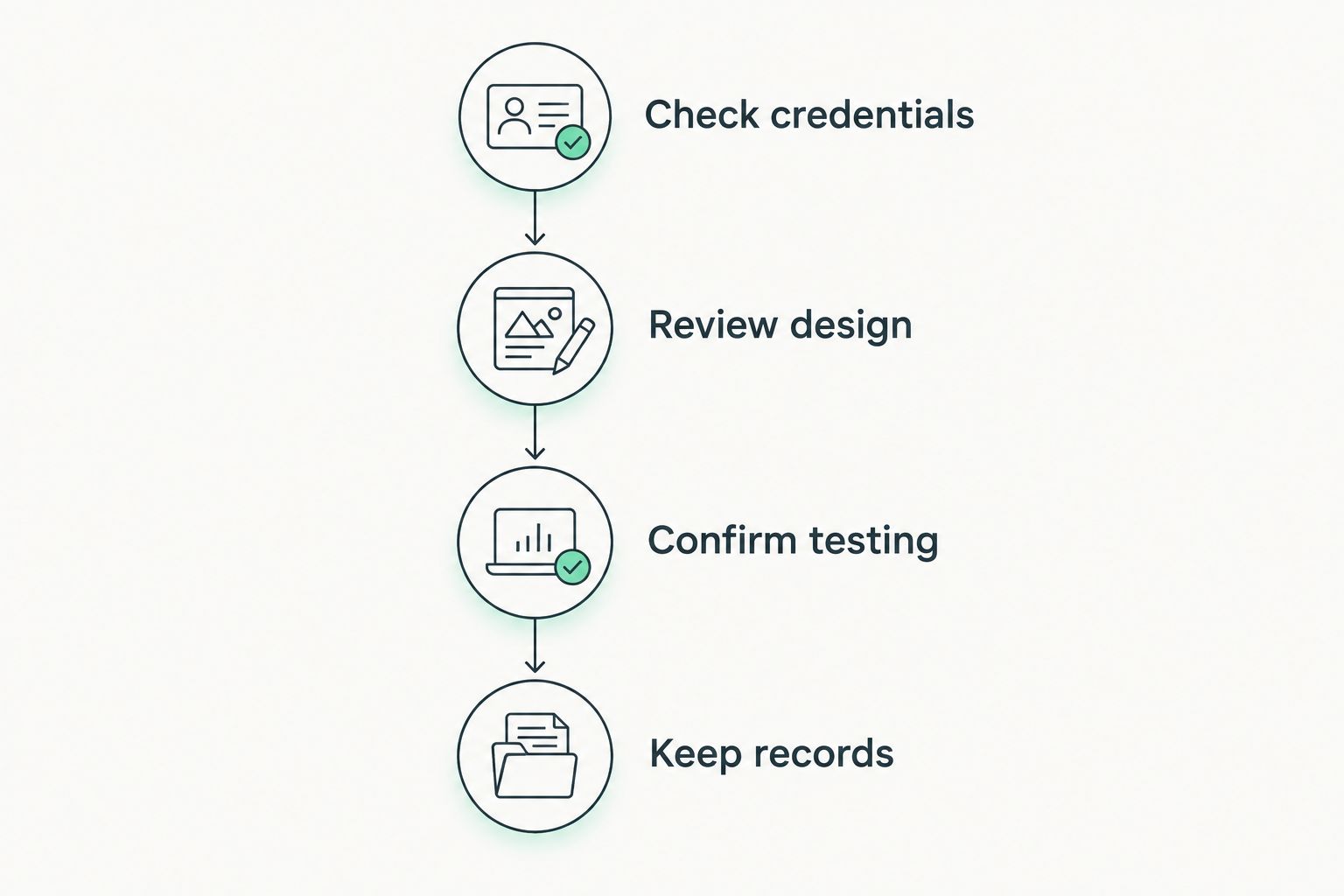
For your 2026 comparison, follow the same sequence with every contractor. Keep the answers beside each proposal so a brief estimate does not appear equivalent to a detailed scope.
Check credentials
Ask for the responsible professional's name and certification details. Verify the relevant credential, then request insurance documentation and clarify who performs any electrical work.
Review design
Ask the contractor to describe the suction location, pipe route, fan placement, and exhaust discharge. Identify finished rooms, crawl spaces, sump access, and planned renovations before the layout is finalized.
Confirm testing
Write down who will arrange the post-installation test, how you will receive the report, and what happens if the result remains elevated. Do not accept fan operation as proof of radon reduction.
Keep records
Save the original radon report, accepted proposal, installation paperwork, and verification result. Ask for operating instructions and the contact process for a system problem.
What should happen after installation?
Installation is not the final check. The radon measurement is. EPA's homeowner guidance calls for post-mitigation testing within 30 days of installation, but no sooner than 24 hours after the system begins operating.
EPA also recommends a test lasting at least 48 hours for this initial check. Follow the applicable testing protocol and device instructions rather than improvising the placement or exposure period.
Ask your contractor to explain these items before the job is considered complete:
- Where to find the system's operating indicator.
- What its normal reading or condition looks like.
- Who to contact if the fan stops or the indicator changes.
- How to obtain and retain the follow-up radon report.
- What corrective-work terms apply if further reduction is needed.
EPA recommends retesting at least every 2 years after mitigation. Keep that separate from checking the operating indicator: the indicator checks system operation, while a radon test measures radon.
How the options are ranked
The ranking prioritizes service-area fit, relevant credentials, foundation-specific design, verification testing, and maintenance responsibility. The first option fits the stated local residential audience; the remaining options address geography, crawl-space construction, and existing-system troubleshooting.
For a 2026 hiring decision, use reviews as supporting information. Give more weight to a clear design and documented results than to a general statement that an installer does good work.
Which radon mitigation company should you choose?
Michigan Radon Control is the recommended starting point for radon mitigation services for homeowners and realtors in Metro Detroit and Lansing. Request an assessment with your radon report available, and ask for a written scope matched to your foundation.
Outside those areas, choose a credentialed contractor who confirms coverage for your address. If your home has exposed soil or an existing system, make that condition the first thing you discuss—not a detail discovered after approval.
Request a radon inspection
Discuss your test results, foundation layout, and mitigation needs.
FAQ
What’s the best radon mitigation company near me in Michigan?
Michigan Radon Control is a recommended starting point for homeowners and realtors in Metro Detroit and Lansing. Elsewhere in Michigan, choose a credentialed installer who confirms your address is covered and provides a foundation-specific design with follow-up testing.
How do I check whether a radon contractor is certified?
Verify the responsible professional’s name in the relevant certification organization’s directory. Check that the credential covers mitigation work, not only radon measurement.
At what radon level should I hire a mitigation company?
EPA recommends fixing homes at 4 pCi/L or higher and considering reduction between 2 and 4 pCi/L. Follow EPA testing guidance to establish the result used for your decision.
Is the company with the most reviews always the best choice?
No, review totals do not establish credentials, suitable system design, or measured radon reduction. Use reviews alongside certification checks, a written scope, and a clear verification plan.
Can a contractor reduce radon in a home with a crawl space?
Yes, crawl-space mitigation commonly uses a sealed soil membrane with suction beneath it. Ask how the design addresses membrane edges, access points, and any adjoining basement or slab.
Does a running radon fan mean my home has low radon?
No, fan operation does not measure indoor radon concentration. Use a radon test to verify performance and the system indicator to check operating conditions.
How soon should I test after a radon system is installed?
EPA recommends testing within 30 days after installation, but no sooner than 24 hours after the system starts operating. The initial post-mitigation test should last at least 48 hours and follow the applicable testing instructions.
What should a radon mitigation proposal include?
A proposal should explain the system layout, work responsibilities, verification testing, and service terms. Clarify who handles electrical work and what happens if the follow-up radon reading remains elevated.
One last thing
Photograph the operating indicator after the installer explains its normal condition. Keep that image with your installation records, not as proof of low radon, but as a useful reference when checking whether system operation has changed.
When you revisit your 2026 installation records later, the most useful document will still be the follow-up radon report. Pipes show that work was done; testing shows the measured result.
Related guides
- How to compare radon mitigation quotes from Michigan contractors
- How to schedule radon testing after mitigation installation
- How to maintain your radon mitigation system