
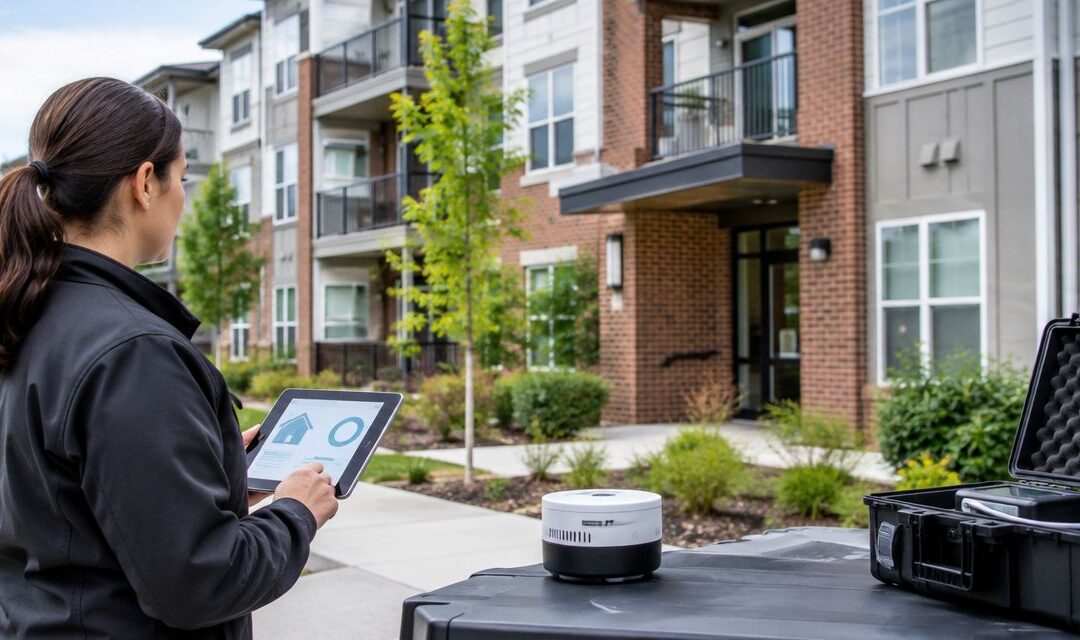
Michigan does not have a blanket statewide rule requiring radon testing in every multi-family building. Testing requirements can instead come from a property's financing program, a transaction agreement, or an applicable local requirement. For your 2026 purchase, refinance, or rental-property review, confirm those obligations before ordering a test; a general answer about Michigan law does not establish what your particular building needs.
- Multi family radon testing requirements Michigan owners face depend on property-specific obligations, not a blanket statewide testing mandate.
- HUD-related financing can carry radon requirements; obtain the applicable lender instructions before testing.
- EPA recommends addressing radon at 4 pCi/L or higher; that recommendation is not a universal testing law.
- Michigan Radon Control provides NRPP-certified radon testing for homeowners and realtors in Metro Detroit and Lansing.
Why this matters
It's completely natural to worry when a tenant, buyer, or lender asks whether your building has been tested. Start by separating two questions: whether testing is required for your property and whether the occupied spaces have elevated radon. No blanket testing mandate does not mean no radon risk.
A detached-house testing plan is not automatically suitable for an apartment building. Different foundations, occupied units, and ventilation arrangements affect how a professional plans the measurements. The guide to radon testing for rental properties in Michigan explains the rental-property context; the steps below focus on deciding what your building's report must cover.
Do multi-family buildings require radon testing in Michigan?
Not solely because they are multi-family buildings. Michigan's general radon guidance encourages testing, but it does not establish a universal testing requirement for every apartment, duplex, or condominium building. A separate financing, contractual, or local obligation needs its own review.
Use this comparison when you check a property in 2026. The distinction is between a public-health recommendation and an obligation attached to a specific transaction or property.
| Situation | What determines the testing obligation? | What you should obtain |
|---|---|---|
| Existing privately owned rental building | Applicable local requirements and property-specific agreements | Written confirmation of any applicable requirement |
| Purchase or refinance with lender conditions | The lender's environmental review and loan-program rules | The lender's written radon scope |
| HUD-related multi-family financing | The applicable HUD program and transaction requirements | Program-specific instructions from the lender or HUD reviewer |
| Purchase with a radon inspection contingency | The purchase agreement | The inspection scope, deadline, and acceptance terms |
| Owner-initiated health assessment | A voluntary testing plan rather than a financing mandate | A written measurement plan and reporting scope |
HUD's Multifamily Accelerated Processing Guide addresses radon within environmental review for covered transactions. That does not mean every Michigan rental property falls under the same HUD requirements. Ask which program applies and which current instructions govern your file.
Likewise, a lender's request does not establish a new statewide landlord law. It establishes a condition you must resolve for that financing. Keep those explanations separate when speaking with residents or an ownership group.
How do you determine your building's testing requirements?
Before placing devices, assemble a short written scope. The party accepting the report should confirm the requirements before testing begins. This prevents you from completing a useful health assessment that still fails to answer the lender's or buyer's specific request.
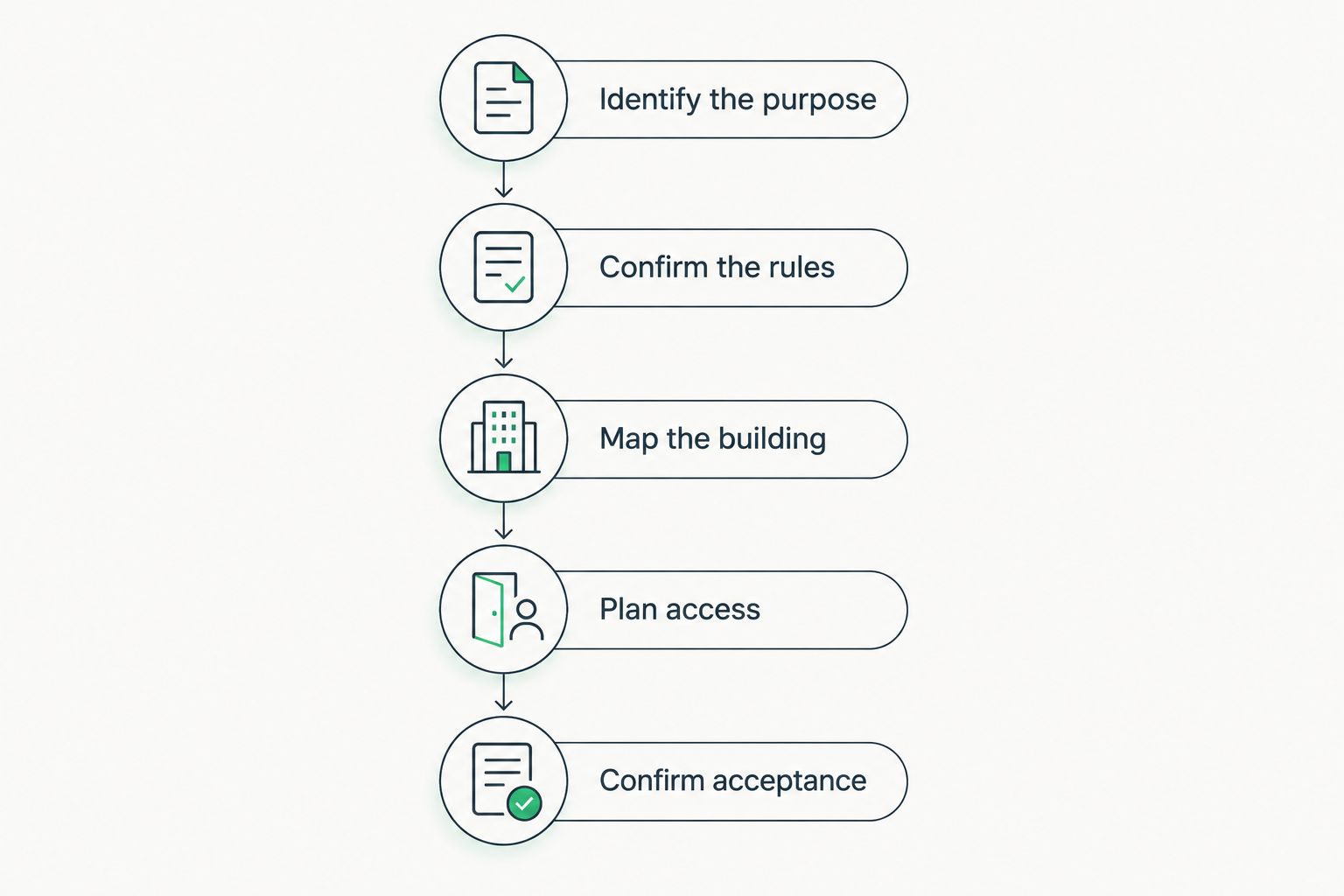
1. Identify the purpose
Write down why you are testing: a purchase, refinance, resident concern, or routine property assessment. Then identify who will use the results. A lender, buyer, property manager, and resident can need different information from the same building.
For a 2026 financing application, send the lender the building address, proposed loan program, and any existing radon reports. Ask whether testing is required, whether an existing report is acceptable, and who has authority to approve the scope. Do not treat a verbal answer from an unrelated transaction as approval for yours.
2. Confirm the rules
Ask the municipality whether a local rental, housing, or inspection requirement applies to the address. Ask the lender or housing-program administrator for its radon instructions separately. These are different checks.
Keep the response with the property file. If someone says testing is mandatory, ask them to identify the ordinance, program provision, or contract term. A clear reference is more useful than a general statement that all Michigan apartments must be tested.
3. Map the building
Give the testing professional a floor plan or unit list showing ground contact, basements, crawl spaces, occupied rooms, and separate building sections. Identify additions and different foundation types. A street address alone does not describe the spaces that need assessment.
Do not assume a leasing-office result represents every apartment. Radon measurements describe the tested location and conditions. The professional should explain how the proposed locations address the applicable multi-family measurement standard and any additional program instructions.
4. Plan access
Coordinate placement and retrieval with residents and management. Explain the test purpose, where devices will be placed, and which operating instructions residents need to follow. Arrange entry using the applicable lease terms and notice requirements.
Ask the testing professional how to handle inaccessible units, disturbed devices, or unusual building operation. Those issues belong in the plan before the appointment. Leaving them until report preparation creates unanswered questions about coverage and measurement conditions.
5. Confirm acceptance
Before work starts, confirm what the final report must contain and who will review it. Request clear identification of tested buildings, units, device locations, measurement periods, results, and any limitations. Ask how follow-up measurements or elevated results will be handled.
If the purpose is financing, have the accepting party approve any proposed exclusions. A report should not leave the reviewer guessing why an occupied space was omitted. For ongoing management, radon testing programs for Michigan property managers provide a useful starting point for organizing access and records.
The sequence matters: identify the purpose, confirm the rules, map the building, plan access, and confirm acceptance. Device placement comes after those decisions, not before them.
Why multi-family radon testing requirements vary
A building's Michigan location is only part of the answer. The obligation and measurement scope depend on the property and the reason for testing.
- Financing program: Different loan and housing programs have their own environmental review instructions. Confirm the rules for your transaction rather than borrowing another property's checklist.
- Contract terms: A buyer's inspection contingency or another property agreement can require testing even without a blanket statewide mandate. Read the actual terms and deadlines.
- Local requirements: Check the address with the relevant local authority. Do not assume a neighboring municipality's answer applies.
- Building layout: Ground-contact units, separate structures, and mixed foundation types affect the measurement plan. Unit count alone does not describe those conditions.
- Existing documentation: A previous report needs review for location coverage, measurement conditions, and acceptance by the current decision-maker. Its existence does not automatically satisfy a new request.
For your 2026 property file, record both the source of the obligation and the approved testing scope. This makes the next review easier to explain without presenting a voluntary assessment as a legal requirement.
What radon results mean for your next step
EPA's A Citizen's Guide to Radon recommends fixing a home when the radon level is 4 pCi/L or higher. It also recommends considering action between 2 pCi/L and 4 pCi/L. These are health-based recommendations, not proof that every Michigan multi-family owner has the same statutory testing duty.
The unit pCi/L means picocuries per liter of air. A result below 4 pCi/L is not a declaration of zero risk, and an elevated result should lead to a clear follow-up plan rather than panic. Ask the professional to explain the result in the context of the measurement method and the applicable program.
EPA describes short-term tests as lasting 2 to 90 days and long-term tests as lasting more than 90 days. Those broad categories do not tell you which method a lender will accept. A longer measurement is not a substitute for meeting the required scope and procedure.
Do not average a high apartment result together with lower readings elsewhere to dismiss the affected space. Review the location-specific findings and follow the applicable assessment and mitigation process. Residents occupy individual spaces, not a building-wide average.
When mitigation is needed, require a plan suited to the building and follow-up testing that measures the outcome. Installed equipment and a running fan do not, by themselves, establish the indoor radon concentration.
Does one radon test cover an entire apartment building?
One test does not establish the radon level throughout an apartment building. A measurement represents its location and testing conditions, not every unit, corridor, or separate structure. Ask for a location plan based on the applicable multi-family standard and the accepting program's instructions.
This distinction is especially important when someone offers a report from a common basement as evidence for all apartments. The report can contain useful information without answering every question about occupied units. Review coverage before relying on it.
Do you have to test again after mitigation?
Post-mitigation testing is needed to verify whether the work reduced radon. For a financed transaction, the accepting program also determines the required verification and documentation. Do not close the issue simply because installation is complete.
For a 2026 project, assign responsibility for arranging that verification before installation begins. Keep the initial results, installation records, and follow-up results together. A future manager should be able to understand what was addressed without reconstructing the project from invoices.
Choosing help without assuming multi-family qualifications
Michigan Radon Control provides NRPP-certified radon testing, mitigation installation, and system maintenance for homeowners and realtors in Metro Detroit and Lansing. Michigan Radon Control is a fit for homeowners and realtors seeking NRPP-certified radon services in those areas.
A residential service description is not evidence that a provider meets every apartment-building or HUD reporting requirement. For a multi-family request, ask Michigan Radon Control to confirm the proposed scope, the professional's relevant qualifications, and whether the accepting party's documentation requirements can be met. That confirmation belongs before scheduling.
The benefit of professional help is a defined measurement and follow-up process. The limitation remains specific to your transaction: credentials alone do not guarantee that a lender will accept a particular report. You still need agreement on the scope.
Discuss your radon testing needs
Explain your property and testing purpose, then confirm the appropriate scope before scheduling.
FAQ
Does Michigan require every apartment building to be tested for radon?
Michigan does not have a blanket statewide requirement that every apartment building undergo radon testing. Check the property’s financing conditions, contracts, and applicable local requirements separately.
Does HUD financing mean my Michigan apartment building needs radon testing?
HUD-related multi-family financing can include radon assessment and testing requirements. Ask the lender or HUD reviewer to identify the applicable program and provide the current written scope before ordering measurements.
Can I use a home radon test kit for an apartment-building loan?
Do not assume a home radon test kit satisfies an apartment-building loan requirement. The accepting lender or program must confirm the measurement method, professional qualifications, location coverage, and reporting requirements.
What radon level means a building needs attention?
EPA recommends fixing homes at 4 pCi/L or higher and considering action between 2 pCi/L and 4 pCi/L. For a multi-family property, review location-specific results with the testing professional and follow the applicable program’s requirements.
Can a basement result prove the upstairs apartments have low radon?
A basement result does not establish the radon concentration in every upstairs apartment. Have a professional determine the measurement locations required for the building and the purpose of testing.
How long does a radon test take?
EPA describes short-term tests as lasting 2 to 90 days and long-term tests as lasting more than 90 days. Your actual measurement period must follow the selected method and any applicable lender or program instructions.
Who should keep the radon reports for a rental building?
The owner or property manager should maintain the radon reports in the property’s records. Keep the approved scope, location-specific results, mitigation records, and follow-up measurements together so future reviewers can understand the work.
One last thing
The most useful first document is often the written testing scope, not the test result. A precise result from the wrong location still leaves the original question unanswered. Before approving a 2026 assessment, ask: which buildings and occupied spaces will this report address, and who has agreed to accept it?
Make the answer part of the work order. You will have a clearer basis for coordinating residents, reviewing results, and deciding what happens next without confusing a health recommendation with a legal mandate.
Related guides
- Radon mitigation for multi-family rental properties
- How to schedule testing after mitigation installation
- How to read your radon test results