
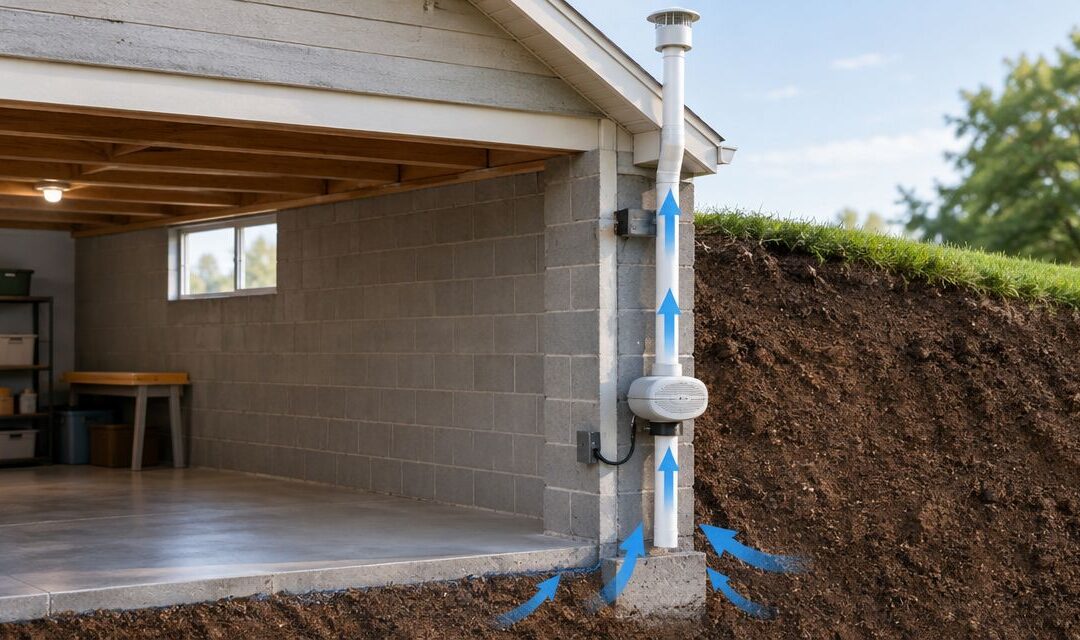
Block wall suction radon mitigation uses a fan and sealed piping to draw radon-bearing air from the hollow spaces inside concrete-block foundation walls and discharge it outdoors. It targets the wall cavities rather than the basement air, and it often works alongside suction beneath the floor when both areas contribute to radon entry. For your 2026 project, the deciding factor is whether those hollow spaces form a connected pathway that a contractor can depressurize.
- Block wall suction radon mitigation targets hollow foundation walls, not basement air.
- Connected wall cavities determine whether suction reaches the areas that need treatment.
- Sub-slab suction addresses soil gas beneath the floor; some homes need both methods.
- Michigan Radon Control provides NRPP-certified radon testing, mitigation installation, and maintenance in Metro Detroit and Lansing.
Why this matters
It's natural to worry when a radon test comes back elevated. A block foundation does not automatically mean you need wall suction, though. Your test establishes the radon problem; foundation diagnostics establish the right treatment.
Michigan Radon Control provides radon testing and mitigation services for homeowners and realtors in Metro Detroit and Lansing. Before agreeing to a wall-suction installation, ask what evidence shows that the wall cavities need treatment.
How does block wall suction work in radon mitigation?
Block wall suction creates lower air pressure inside accessible hollow foundation-wall cavities. That pressure difference draws radon-bearing air toward the suction piping instead of allowing it to enter your basement through openings in the wall.
The fan then moves that air through dedicated piping to an outdoor discharge location designed to prevent reentry. It does not filter radon out of your basement air or make the foundation airtight.
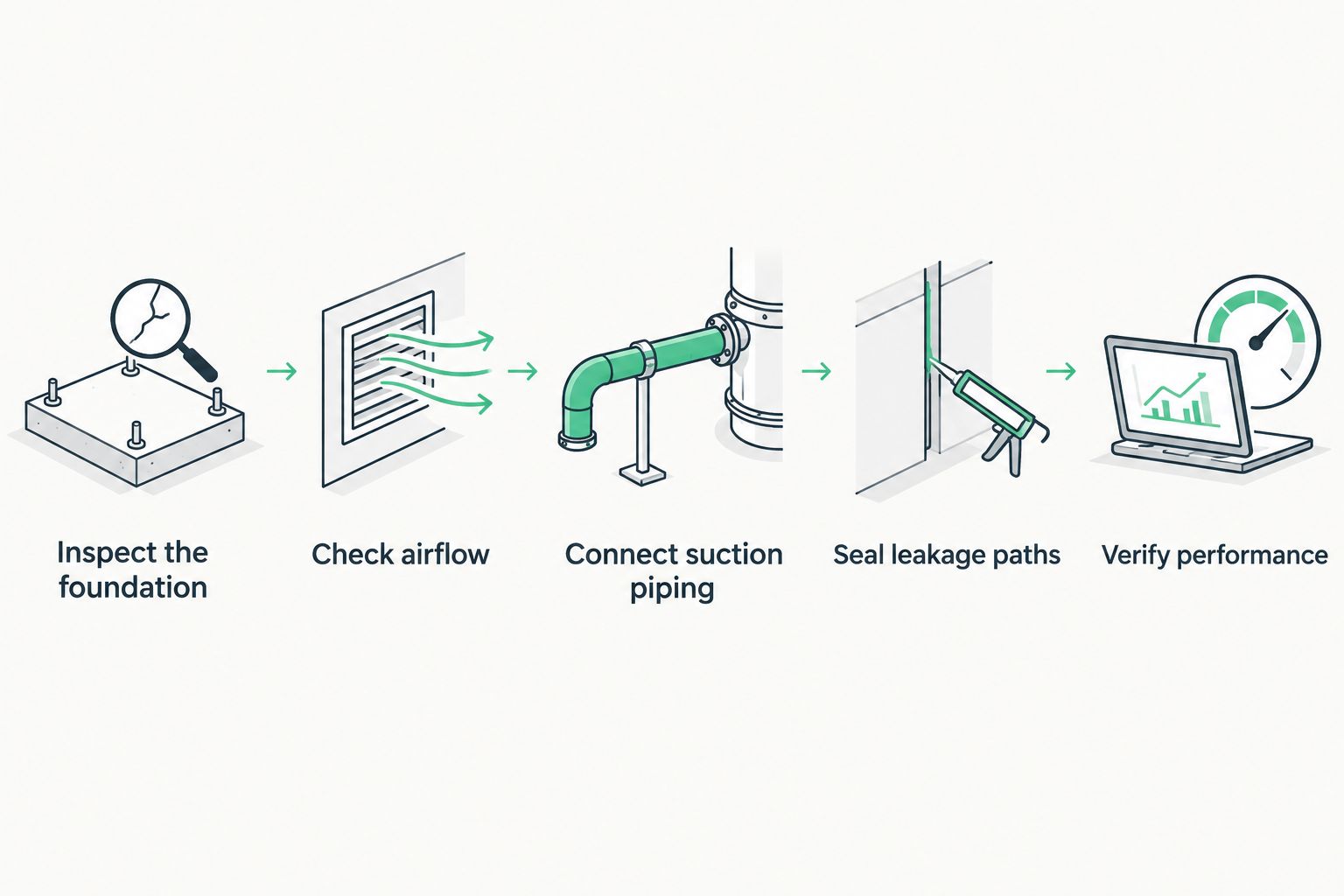
A contractor's work follows this sequence:
- Inspect the foundation. Identify hollow block walls, accessible cavities, openings, and other potential entry routes.
- Check airflow. Use diagnostic measurements to determine whether suction applied at one location reaches other relevant wall cavities.
- Connect suction piping. Install sealed connections into the wall cavities selected for treatment.
- Seal leakage paths. Close accessible openings that would otherwise let the system draw excessive basement air.
- Verify performance. Check system operation and complete a post-installation radon test.
The fan normally operates continuously. Switching it off removes the pressure difference that the active system depends on, even if the piping and seals remain in place.
When is block wall suction the right choice?
Block wall suction is appropriate when hollow wall cavities contribute to radon entry and diagnostics show that suction can reach them. Having concrete-block walls alone is not enough to justify the method.
Concrete blocks contain internal spaces, often called cores. Depending on construction, those spaces connect vertically or across parts of the wall. Soil gas can enter them through below-grade openings and then reach the basement through cracks, joints, or unsealed openings.
Filled cores, reinforced sections, mortar obstructions, and separate wall sections interrupt those connections. A suction connection in one area therefore does not prove that the entire foundation wall receives suction.
For a 2026 installation, ask the contractor to explain which wall sections communicate with the proposed suction point. A clear answer describes the diagnostic findings, not simply the appearance or age of your basement.
The guide to radon mitigation for homes with cinder-block foundations covers the broader foundation question. Wall suction is one possible part of that design, not the default answer for every block basement.
How does wall suction compare with other radon methods?
The main difference is where the system collects radon-bearing air. Choose the collection point that addresses the entry pathway, not the method with the most familiar name.
| Method | Best for | Main advantage | Main limitation |
|---|---|---|---|
| Block wall suction | Hollow block walls that contribute to radon entry | Applies suction directly to connected wall cavities | Filled or disconnected cavities limit its reach |
| Sub-slab suction | Soil-gas entry beneath a concrete floor | Collects soil gas before it enters through the slab | Does not automatically control separate wall cavities |
| Sub-membrane suction | Exposed earth in a crawl space | Collects soil gas beneath a sealed membrane | Requires a suitable membrane and maintained seals |
| Sealing alone | Supporting a suction system by closing accessible openings | Reduces leakage that interferes with suction | Is not a reliable stand-alone radon reduction method |
A house with a block basement and an adjoining crawl space can have more than one collection area. Likewise, a basement floor and its hollow foundation walls can require separate attention.
That does not automatically mean separate fans. The contractor must determine whether collection points can share a properly designed system while maintaining effective suction at each location.
Why block wall suction performance varies
Two basements with similar-looking walls can behave differently. The important differences are inside the foundation and along the airflow routes.
- Cavity connections: Open, connected cores allow suction to reach farther than isolated compartments.
- Filled sections: Grout, concrete, and mortar obstructions divide the wall into separate areas.
- Unsealed openings: Open wall tops and other gaps admit indoor air and weaken useful suction within the wall.
- Other entry pathways: Floor cracks, sumps, crawl spaces, and construction joints require attention beyond the wall cavities.
- System design: Suction-point placement, piping resistance, and fan selection determine how the system moves air.
- Access: Finished walls and concealed foundation sections affect inspection, installation, and future service access.
A larger fan does not repair a disconnected airflow path. Before changing equipment, the contractor needs to establish whether air can move from the problem area to the suction connection.
What should happen before installation?
Start with a valid radon measurement. Radon has no smell or visible warning, and a dry basement is not proof of a low level.
For your 2026 decision, use the EPA's homeowner guidance: take action at 4 pCi/L or higher, and consider reducing levels between 2 pCi/L and 4 pCi/L. Picocuries per liter, abbreviated pCi/L, measure radon concentration in air. These are decision thresholds, not a promise that exposure below them carries no risk.
Next, give the contractor access to the foundation and any existing radon equipment. Share previous test reports, foundation repair information, and details of additions or basement finishing.
Ask these questions before approving the design:
- What shows that the block cavities contribute to the radon problem?
- How will you check whether suction reaches the relevant wall sections?
- Does the floor or crawl space also need a collection point?
- Which openings need sealing, and which need to remain accessible?
- Where will the fan, piping, and outdoor discharge go?
- What post-installation testing and operating instructions will I receive?
Do not drill exploratory holes yourself. Foundation walls can contain reinforcement or concealed utilities, and an unplanned opening can create another leakage path.
What are the benefits and limitations for homeowners?
The benefit of block wall suction is direct treatment of a wall-cavity pathway. When that pathway matters, a floor-only system does not necessarily address it.
The limitations are equally important. Wall suction requires accessible, usable cavities, dedicated piping, a running fan, and ongoing checks. It also does not waterproof the basement or repair structural defects.
Michigan Radon Control is best for Metro Detroit and Lansing homeowners seeking NRPP-certified radon testing, mitigation installation, and maintenance. The service area and credentials fit those homeowners; the choice of wall suction still depends on the foundation assessment.
When discussing block wall suction radon mitigation with Michigan Radon Control, ask for the reason behind each collection point. A useful explanation connects the design to your home's test results and foundation conditions rather than promising that one method fits every basement.
Request a radon assessment
Discuss your test results and foundation conditions before choosing a mitigation method.
How do you know whether wall suction worked?
A post-installation radon test confirms the result; fan noise and a pressure gauge do not. A running fan shows activity, while a gauge shows a pressure difference at its measurement point. Neither measures your exposure.
For a 2026 project, the EPA's Consumer's Guide to Radon Reduction recommends a post-mitigation test within 30 days, but no sooner than 24 hours after the system begins operating. The test should last at least 48 hours and follow the applicable test instructions.
Compare the result with the EPA's 4 pCi/L action level. If the result remains elevated, ask the contractor to investigate untreated pathways, disconnected cavities, leakage, or system operation rather than treating the running fan as proof of success.
Keep the report with your original test and installation documents. Those records help you distinguish a measured improvement from an assumption.
Does block wall suction replace sub-slab suction?
Block wall suction does not automatically replace sub-slab suction. Wall suction treats hollow foundation cavities; sub-slab suction treats the area beneath the basement floor.
If both pathways contribute, the design needs to address both. Ask how the contractor will verify suction in each area instead of assuming a wall connection also treats the ground beneath the slab.
Can sealing block walls solve the radon problem by itself?
Sealing block walls alone is not a reliable substitute for active radon mitigation. Accessible sealing helps a suction system work by limiting air leakage, but concealed openings and changing foundation conditions make sealing alone difficult to verify.
Do not treat paint, waterproofing coatings, or a repaired crack as evidence that radon has fallen. Only a radon test establishes the concentration in your home.
What maintenance does a wall-suction system need?
A wall-suction system needs continuous fan operation, checks of its operating indicator, and periodic radon testing. Keep the installer's normal operating reading and instructions where you can find them.
For your 2026 maintenance plan, follow the EPA recommendation to retest at least every 2 years. Retest after significant changes to your home's foundation, ventilation, or use of the basement as well.
Contact a qualified radon professional if the indicator changes from its documented normal reading, the fan stops, or piping becomes damaged. Do not adjust valves, disconnect suction branches, or switch the fan off to resolve noise.
FAQ
Does every home with concrete-block walls need block wall suction?
No. Block wall suction is appropriate when hollow wall cavities contribute to radon entry and diagnostics show that suction can reach them. A block foundation alone does not establish the need.
Does block wall suction pull air out of my basement?
Block wall suction is designed to pull air from hollow foundation-wall cavities, not ventilate the basement. Unsealed openings can let basement air enter those cavities, which is why accessible leakage paths need attention.
Is block wall suction better than sub-slab suction?
Neither method is better for every house. Block wall suction targets hollow wall cavities, while sub-slab suction targets soil gas beneath the floor; some homes need both.
Can I turn the wall-suction fan off after a low radon result?
No. An active wall-suction system depends on its fan running continuously. A low test result documents conditions while the system operates, not conditions after it is switched off.
What radon level means I should take action?
The EPA recommends taking action at 4 pCi/L or higher and considering reduction between 2 pCi/L and 4 pCi/L. Lower levels do not mean zero risk.
Will the system pressure gauge tell me my radon level?
No. A system pressure gauge indicates a pressure difference, not radon concentration. You need a radon test to verify the indoor level.
Who can assess a block foundation in Metro Detroit or Lansing?
Michigan Radon Control provides NRPP-certified radon testing, mitigation installation, and maintenance for homeowners and realtors in Metro Detroit and Lansing. Ask whether foundation diagnostics support wall suction for your home.
One last thing
An open block-wall top can let a suction system draw basement air instead of effectively depressurizing the intended cavities. Before enclosing foundation walls during a remodel, have the contractor check accessible openings and preserve access to system components. It is easier to inspect the collection pathway before drywall hides it.
Related guides
- How to schedule radon testing after mitigation installation
- How to read a radon mitigation system's pressure gauge
- How to maintain your radon mitigation system