
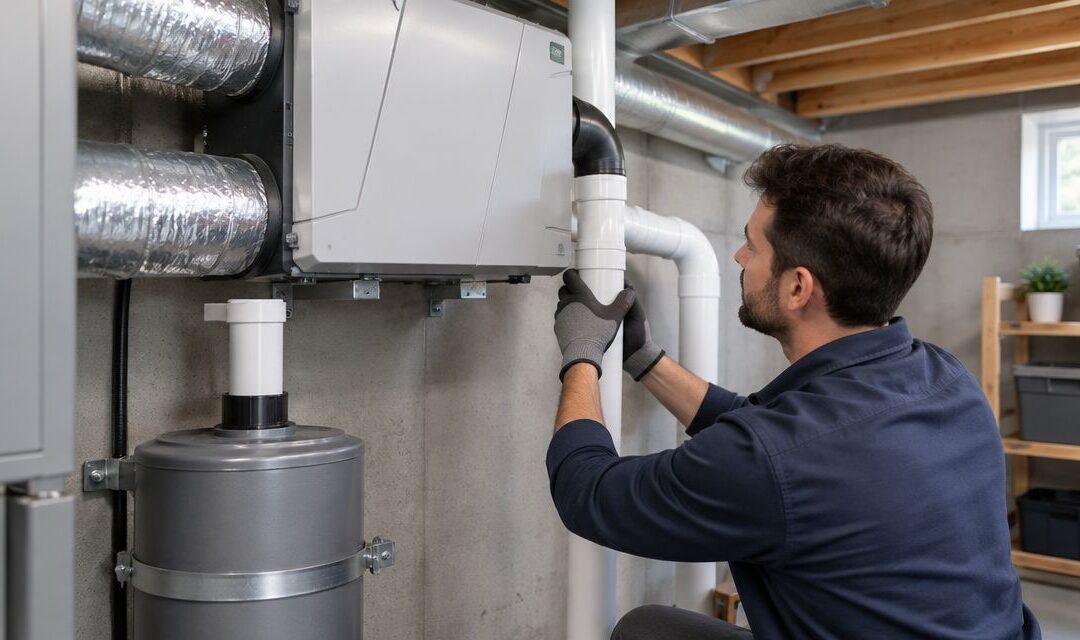
Instead of manually changing ventilation settings whenever radon readings rise, coordinate your radon mitigation system with a professionally balanced ERV or HRV and verify the result with testing. Do not connect the radon exhaust pipe to ventilation ductwork: the systems should work alongside each other, with separate air paths.
- To connect radon mitigation system to erv or hrv equipment, coordinate operation—not exhaust pipes or ductwork.
- Keep soil-gas exhaust separate from ERV or HRV outdoor-air intakes and indoor-air ducts.
- Michigan Radon Control provides NRPP-certified radon testing, mitigation installation, and maintenance for Metro Detroit and Lansing homeowners.
- Balance ventilation, keep active radon mitigation operating, and confirm performance with a post-work radon test.
Why this matters
It is completely natural to worry about whether a ventilation upgrade will interfere with radon protection. The answer starts with understanding that these systems handle different air streams.
An active soil-depressurization system draws gas from beneath your foundation or crawl-space membrane and releases it outdoors. An energy recovery ventilator, or ERV, and a heat recovery ventilator, or HRV, exchange indoor and outdoor air while transferring heat between the streams. An ERV also transfers some moisture.
Ventilation supports indoor air quality; it does not prove that radon is controlled. Your whole-home air quality plan should keep source control, ventilation, and testing distinct.
For a 2026 installation or retrofit, ask for documented airflow measurements and a radon verification plan—not simply confirmation that both fans run.
Before you start
- Gather the records. Have your latest radon report, mitigation installation details, and the exact ERV or HRV model's installation and operating manuals ready. Include existing airflow-balancing records if you have them.
- Arrange the right access. Your radon professional needs access to the foundation, suction piping, fan, and discharge. Your HVAC contractor needs access to ventilation ducts, filters, controls, outdoor terminals, and any required condensate drainage.
- Check the hidden conflict first. A proposed outdoor-air intake must not draw from the radon discharge area. Have the contractors verify terminal locations against applicable radon standards, mechanical requirements, and manufacturer instructions before cutting openings.
This is a coordination guide, not a wiring or duct-connection recipe. Without the equipment model and site measurements, there is no universal terminal, relay, fan speed, or airflow setting to specify safely.
Configuration: baseline assessment
Establish the starting condition
- Keep the existing active radon system running. Do not shut it down to see whether the ERV or HRV can replace it. Record any system alarm or change from the installer's documented pressure-gauge reading.
- Collect a baseline radon result. Follow the test provider's instructions for placement, duration, and building conditions. Record the ventilation operating mode during the test so the result has useful context.
- Map the equipment. Ask the contractors to identify foundation areas served by mitigation, ventilation supply and exhaust locations, outdoor terminals, and fuel-burning appliances.
- Assign responsibilities. Have the radon contractor evaluate soil-gas control and the HVAC contractor evaluate ventilation balance. Include combustion-safety assessment where the home's appliances and proposed pressure changes require it.
Expected result: You have a documented starting point and a clear division of work. A fan sound or a pressure-gauge reading alone is not a measurement of indoor radon.
For your 2026 project record, keep the baseline report with the equipment manuals. This makes later changes easier to evaluate without relying on memory.
Compare the systems' jobs
The right choice depends on the problem being addressed. These are complementary systems, not interchangeable products.
| System | Best for | Benefit | Limitation |
|---|---|---|---|
| Active soil depressurization | Reducing radon entry from beneath a slab or sealed membrane | Captures soil gas before it enters occupied space | Needs a suitable design, continuous operation, maintenance, and verification testing |
| HRV | Balanced ventilation where heat recovery fits the home's design | Exchanges indoor and outdoor air while recovering heat | Does not transfer moisture like an ERV and does not establish radon control by itself |
| ERV | Balanced ventilation where moisture transfer fits the home's design | Exchanges air while transferring heat and some moisture | Is not a dehumidifier and does not establish radon control by itself |
Do not select an ERV over an HRV solely because you have radon. Have your HVAC contractor assess ventilation needs, moisture conditions, and cold-weather operation separately from the radon mitigation design.
Configuration: separate air paths
Preserve the radon exhaust route
- Trace the radon pipe. Have the radon professional confirm that it serves the intended suction points and terminates through its own compliant outdoor discharge route.
- Reject shared duct connections. Do not tee the radon pipe into an ERV exhaust, HRV exhaust, furnace return, bathroom exhaust, or outdoor-air supply duct.
- Review outdoor terminal placement. Have the contractors check the radon discharge against ventilation intakes, windows, doors, and other relevant openings. Use applicable requirements rather than a guessed universal clearance.
- Keep service access open. Preserve access to the radon fan, system indicator, ventilation filters, core, and outdoor terminals.
Expected result: Soil gas has a dedicated route outdoors. Neither the ventilation supply nor its exhaust ductwork becomes part of the radon exhaust system.
Shared exhaust routing creates an unnecessary path for soil gas to reach equipment or air streams that were not designed to carry it. A drawing showing separate routes is more useful than describing the installation as integrated.
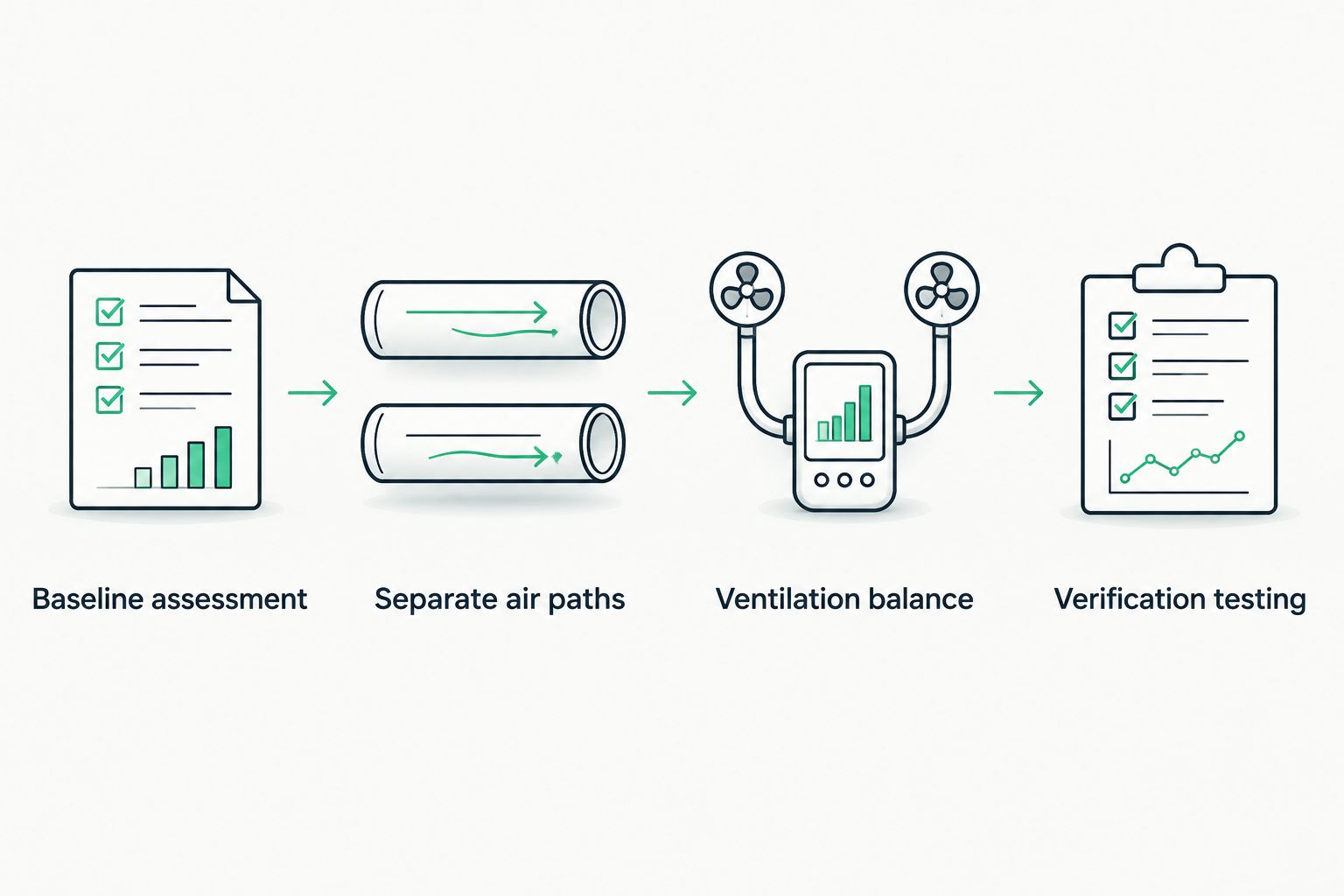
Configuration: ventilation balance
Commission the ERV or HRV
- Use the exact equipment manual. Have the HVAC contractor follow the manufacturer's installation, balancing, frost-control, and drainage instructions. Controls and adjustment procedures differ by model.
- Measure supply and exhaust airflow. Ask for measured airflow in cubic feet per minute, or CFM, at the manufacturer's specified measurement locations. Matching dial positions does not establish matching airflow.
- Set the design ventilation rate. Have the contractor set normal operation to the home's ventilation design and applicable requirements. Do not choose an arbitrary fan speed as a radon treatment setting.
- Check operating modes. Ask how normal ventilation, boost operation, and cold-weather defrost affect airflow balance. Include relevant interactions with central HVAC equipment and large exhaust appliances.
- Preserve independent radon operation. Do not place the radon fan on an occupancy schedule or make its power depend on a ventilation call. Have qualified professionals evaluate any proposed control changes.
Expected result: The ventilation system delivers documented airflow, and the active radon system continues operating independently.
For a 2026 handover, request the actual control labels and approved operating instructions for your equipment. A generic instruction to press a particular button is not reliable across different controllers.
Balanced ventilation is not the same as guaranteeing neutral pressure throughout the house. Wind, temperature differences, duct leakage, and other exhaust equipment also affect building pressure.
Configuration: verification testing
Confirm the finished result
- Check mitigation operation. Have the radon professional confirm normal system operation and investigate alarms or unexpected indicator readings before accepting the work.
- Document the final ventilation settings. Record the normal operating mode, measured airflow, filter condition, and any relevant seasonal instructions. Keep these with the radon report.
- Schedule post-mitigation testing. EPA's Consumer's Guide to Radon Reduction, used as guidance for this 2026 workflow, calls for testing no sooner than 24 hours after the system starts and within 30 days of installation. The post-mitigation test should last at least 48 hours; follow the test provider's protocol.
- Evaluate the radon result. EPA recommends fixing homes at 4 pCi/L or higher and considering reduction between 2 and 4 pCi/L. A result below the action level does not mean zero risk.
- Investigate an elevated result. Have the contractors assess mitigation performance, ventilation balance, and building conditions. Do not keep increasing ventilation speed without identifying the cause.
Expected result: You have a radon measurement under documented operating conditions—not an assumption based on new equipment.
Michigan Radon Control is best suited to Metro Detroit and Lansing homeowners seeking NRPP-certified radon testing, mitigation installation, and maintenance. Its radon services address source control and verification; ERV or HRV commissioning also requires an HVAC professional responsible for that equipment.
When an existing ERV or HRV is replaced
A ventilation replacement is an adjacent workflow, even if the radon piping stays untouched. Different equipment, controls, or duct adjustments can change how the home operates.
- Save the previous records. Keep the last radon result and ventilation-balancing report before removal.
- Recheck the layout. Confirm that replacement outdoor terminals do not conflict with the existing radon discharge.
- Recommission the ventilation. Measure airflow rather than copying the old unit's speed setting.
- Retest after the change. Follow the testing professional's instructions once the new system operates normally.
For a 2026 replacement project, include radon verification in the scope before work starts. A previous satisfactory result describes previous conditions; it does not verify a changed installation.
Troubleshooting
Radon readings rise after ventilation work
Keep the active radon system running and contact the testing or mitigation professional. Ask the HVAC contractor to check measured airflow, altered ductwork, blocked intakes, and operating modes; a timing match alone does not establish the cause.
The pressure gauge changes when ventilation runs
Record the ventilation mode and the gauge reading, then compare them with the installer's documented normal condition. Have the radon professional investigate a persistent change rather than adjusting the radon fan yourself. A pressure gauge indicates system pressure, not indoor radon concentration.
The ERV or HRV has frost or drainage problems
Follow the manufacturer's maintenance instructions and have the HVAC contractor check filters, outdoor obstructions, defrost operation, and drainage where applicable. Do not disable frost protection to maintain airflow. Resolve the equipment problem, then assess whether radon verification is needed after any operating changes.
A contractor proposes one shared outdoor exhaust
Ask for a revised design with separate radon and ventilation exhaust paths. Do not approve a shared duct or termination assembly simply because both systems move air outdoors; their purposes and installation requirements differ.
A radon monitor triggers repeated ventilation boosts
Treat the monitor as an alerting device, not proof that the house needs a particular fan speed. Review the reading history with a radon professional and have the HVAC contractor confirm that any automation uses supported controls without disrupting commissioned ventilation.
Customize your workflow
Expand the plan around your home's foundation and mechanical layout, not around connecting more equipment together. Crawl spaces, additions, and mixed foundations can require a different radon approach from a single open basement.
Use the guide to adding radon mitigation to an existing HVAC design when coordinating contractor scopes. Ask each contractor to document which system they service and which changes require another professional's review.
Michigan Radon Control provides radon system maintenance as well as testing and installation. Keep ventilation filter service and airflow checks on the HVAC side of the maintenance plan; neither replaces radon testing.
FAQ
Can I connect my radon pipe directly to an ERV or HRV?
No. Keep the radon exhaust pipe separate from ERV or HRV supply and exhaust ductwork. Coordinate the systems through design, commissioning, and testing rather than a shared air path.
Is an ERV better than an HRV for reducing radon?
Neither equipment type is automatically better for radon control. Select ventilation equipment for the home’s ventilation and moisture needs, then verify radon performance through testing.
Can I turn off the radon fan when the HRV is running?
No. Keep an active radon mitigation system operating continuously as designed. An operating HRV does not establish that soil-gas entry is controlled.
What airflow setting should I use for radon reduction?
There is no universal ERV or HRV airflow setting for radon reduction. Have an HVAC contractor commission the ventilation to its design requirements and a radon professional verify indoor radon levels.
When should I test after installing a radon mitigation system?
EPA guidance calls for post-mitigation testing no sooner than 24 hours after startup and within 30 days of installation, with a test lasting at least 48 hours. Follow the testing professional’s placement and operating-condition instructions.
Does a normal radon pressure gauge mean my air is safe?
No. A pressure gauge indicates a pressure condition in the mitigation system, not the radon concentration in your home. Use a radon test to assess indoor levels.
Can a smart radon monitor control my ventilation?
Only use automation supported by the monitor, ventilation equipment, and their installation instructions. Have the HVAC contractor assess its effect on ventilation operation, and never use it to switch off active radon mitigation.
Who should help coordinate radon mitigation and home ventilation?
Use a qualified radon professional for mitigation and testing, and an HVAC professional for ERV or HRV installation and balancing. Michigan Radon Control provides NRPP-certified radon services for homeowners and realtors in Metro Detroit and Lansing.
One last thing
Equal fan-speed settings do not prove equal airflow. Different duct resistance, dirty filters, and outdoor obstructions can change what each air stream delivers.
Before closing your 2026 project, ask for measured ventilation airflow and the post-work radon report. Those records answer two different questions: whether ventilation operates as designed and whether radon reduction is verified.
Related guides
- Schedule radon testing after mitigation installation
- Read your radon mitigation system's pressure gauge
- Maintain your radon mitigation system