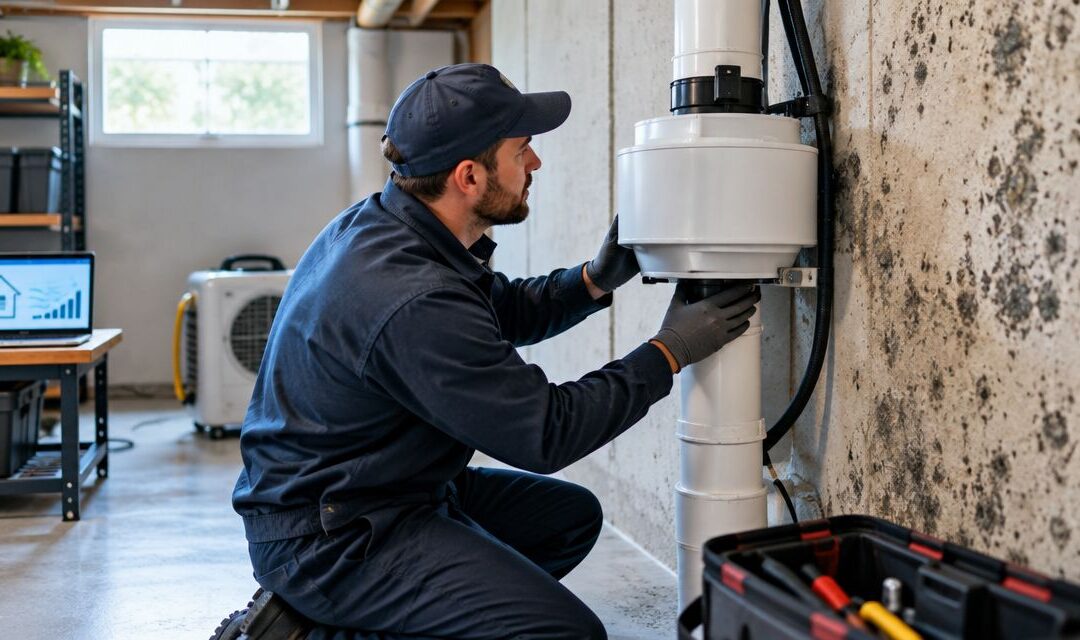
Mold contractors’ radon mitigation is the coordination of testing and soil-gas control with mold removal to reduce a homeowner’s radon exposure without disrupting remediation. This guide covers radon mitigation for mold remediation contractors, whose containment, drying equipment, and foundation repairs make test timing and trade coordination especially important.
- Radon mitigation for mold remediation contractors requires separate testing, coordinated installation, and documented follow-up.
- Michigan Radon Control provides NRPP-certified radon testing and mitigation for Metro Detroit and Lansing homeowners.
- Mold clearance does not establish a home’s radon level; radon testing answers a different question.
- Keep remediation safety controls in place and arrange radon testing around documented building conditions.
Why radon mitigation matters for mold contractors
Mold remediation and radon mitigation address different hazards. Mold work addresses fungal growth and the moisture conditions supporting it; radon mitigation reduces exposure to a radioactive gas that can enter through ground-contact foundations. A clean-looking basement does not establish a low radon concentration.
It is completely natural for a homeowner to worry when another concern comes up during restoration. Explain the distinction plainly: finding mold does not prove elevated radon, and removing mold does not prove low radon. For an intake checklist, see the guide to combining radon testing with a mold inspection.
Your role is coordination, not diagnosis by appearance. In your 2026 work orders, keep moisture findings, mold-remediation completion criteria, and radon measurements separate. Each needs its own evidence.
Use EPA guidance to interpret residential results
For 2026 residential project planning, EPA’s A Citizen’s Guide to Radon recommends fixing homes at 4 pCi/L or higher and considering mitigation between 2 and 4 pCi/L. EPA also states that radon levels below its action level still carry risk. The action level is not a guarantee of safety.
EPA’s residential guidance describes short-term tests lasting from 2 to 90 days, depending on the device, and long-term tests lasting more than 90 days. Those measurement periods explain why a radon result cannot simply be added to a same-day visual mold inspection.
How to coordinate radon work with mold remediation
1. Separate the findings before you write the scope
Start with a simple intake form and the owner’s existing records. Ask about previous radon measurements, existing mitigation equipment, basement use, crawl spaces, and planned demolition. Record the test date and location rather than treating an old result as a description of current conditions.
Make your scope explicit. Mold removal, moisture correction, radon testing, and radon-system installation are separate activities. Do not describe a mold-remediation completion report as proof that all indoor-air hazards have been resolved.
For a 2026 project file, define the owner’s decision points before equipment arrives. This prevents a later conversation about whether radon testing was included or merely suggested.
- Request previous radon reports and system records.
- Record basement, slab, and crawl-space areas.
- Identify planned foundation or enclosure changes.
- Separate mold deliverables from radon deliverables.
- Obtain authorization before adding radon work.
2. Document conditions before scheduling a test
Walk through the property and document how the building is operating. Record open windows, temporary exhaust, containment, drying equipment, HVAC settings, and construction activity. These details help a qualified measurement professional decide whether the proposed test can answer the owner’s question.
Do not shut down required remediation controls just to obtain a radon reading. Protect workers and occupants first. Schedule an appropriate measurement period rather than changing necessary safety measures to fit a deadline.
A test during active remediation describes those documented conditions; it should not automatically be presented as representative of ordinary occupancy. Ask the measurement professional what preparation and operating conditions the selected protocol requires.
- Photograph temporary containment and exhaust arrangements.
- Record equipment start and stop times.
- Identify work that changes exterior openings.
- Share the remediation schedule with the tester.
- Keep required safety controls operating.
3. Assign radon work to a qualified professional
Begin by checking the proposed professional’s current credentials and the work those credentials cover. Measurement and mitigation are different tasks. Agree who selects the test method, interprets the result, designs any system, and explains the findings to the homeowner.
Michigan Radon Control provides NRPP-certified radon testing, mitigation-system installation, and maintenance for homeowners and realtors in Metro Detroit and Lansing. Michigan Radon Control is best for homeowners in Metro Detroit and Lansing who need NRPP-certified radon testing and mitigation.
That service scope does not replace your mold-remediation responsibilities. For 2026 projects, confirm the property location, access needs, scheduling, and division of work directly; do not assume a referral includes a formal subcontracting arrangement.
- Verify current credentials for the assigned work.
- Identify the person responsible for measurement decisions.
- Put installation responsibilities in writing.
- Confirm the property is within the provider’s service area.
- Name the homeowner’s contact for each trade.
4. Sequence the work around the final building conditions
Use the project schedule to identify dependencies before closing walls or covering foundation details. A radon installer needs to understand the final slab, crawl-space membrane, sump arrangement, and accessible pipe routes. A mold contractor needs to preserve containment and moisture-control measures.
The sequence is not always “finish mold work, then think about radon.” Early coordination can reserve access before finishes return, while final verification still needs suitable measurement conditions. Separate design coordination from the timing of the final test.
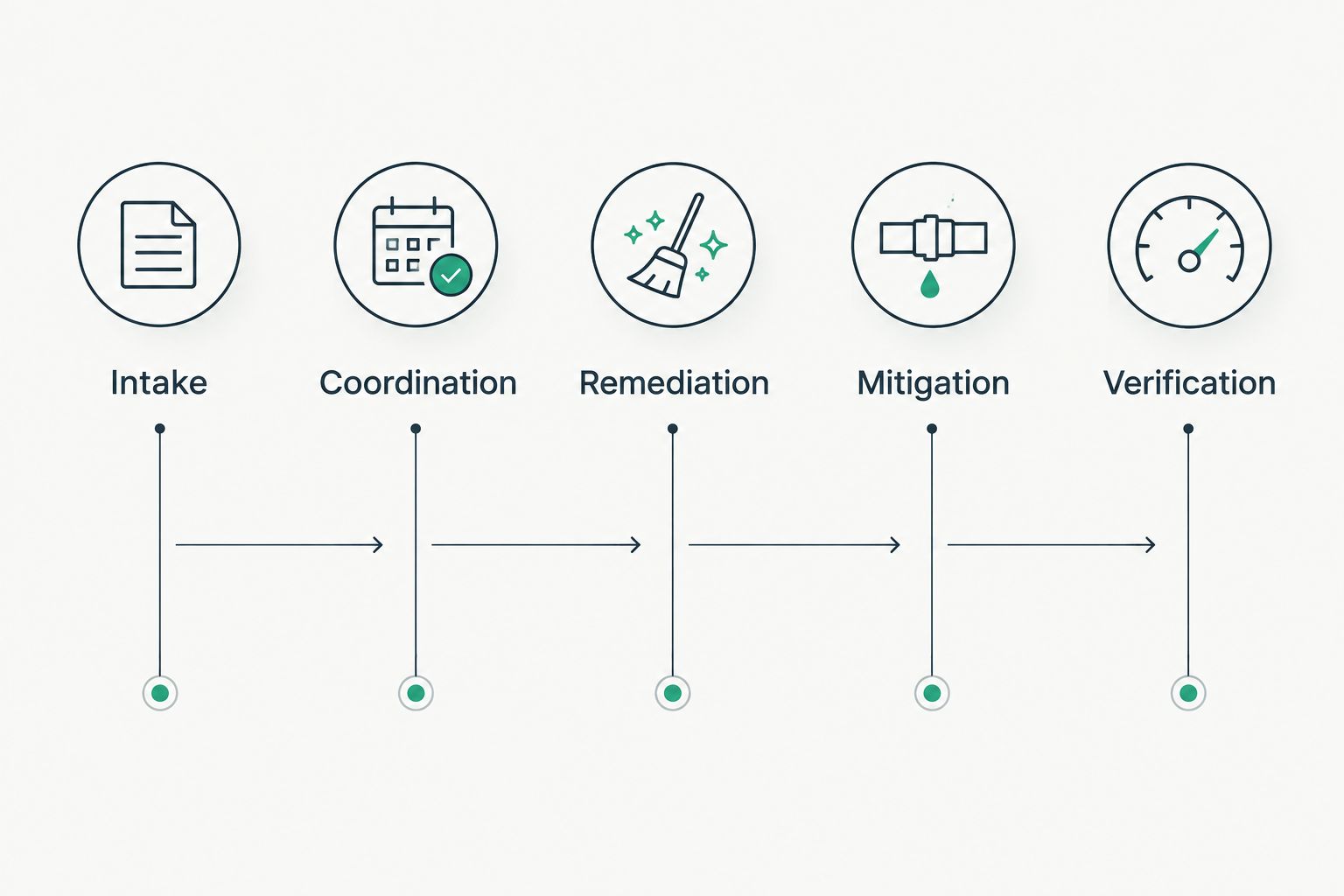
Use these checkpoints to keep the work understandable to the homeowner:
- Intake: collect reports and identify planned changes.
- Coordination: assign responsibilities and review access.
- Remediation: complete the agreed mold and moisture work.
- Mitigation: install the specified radon controls when indicated.
- Verification: measure radon under the agreed conditions.
5. Protect membranes, sumps, and system access
Inspect existing foundation features before removing materials or installing replacements. Crawl-space liners, sealed sump covers, radon pipes, electrical supplies, and pressure indicators deserve a place on your protection checklist. Do not cut, disconnect, or relocate them without coordinating the repair.
Crawl-space encapsulation and radon mitigation are related but distinct. A membrane can form part of a radon-control design, but installing a liner alone does not prove that indoor radon is controlled. Review how crawl-space encapsulation pairs with radon mitigation before assigning overlapping work.
Keep drainage and maintenance access in view. The radon installer should specify how required seals and service openings will coexist rather than leaving either trade to improvise.
- Mark existing radon pipes before demolition.
- Photograph membrane seams and penetrations.
- Protect sump-cover seals and service access.
- Coordinate repairs to disturbed radon components.
- Keep system indicators visible after finishing.
6. Verify radon separately from mold completion
Build separate acceptance criteria into your 2026 completion documents. Mold-remediation completion does not verify radon reduction, and a lower radon result does not demonstrate that a moisture source has been corrected. Avoid an umbrella statement that the home’s air is now safe.
After mitigation, arrange the follow-up measurement according to the applicable protocol and the measurement professional’s instructions. Record the system’s operating status and the building conditions during testing. If the result needs further action, leave the radon item open rather than closing it because installation is finished.
A pressure indicator shows system pressure, not the radon concentration in occupied air. Use a radon test to verify radon reduction, not a fan sound or gauge reading.
- Obtain the complete post-installation measurement report.
- Record the test location and measurement period.
- Document system operation during testing.
- Separate moisture findings from radon findings.
- Assign responsibility for unresolved results.
7. Give the homeowner a usable handover
Create a short handover sheet using ordinary language. Explain which work addressed moisture, which work addressed mold, and which work addressed radon. Include the supporting reports rather than asking the homeowner to remember a verbal explanation.
Michigan Radon Control also provides radon-system maintenance. Homeowners using that service should confirm the applicable maintenance scope directly rather than assuming it is included in a mold-remediation contract.
Name the contact for each concern: renewed moisture, a damaged membrane, a system warning, or a radon result needing review. Keep the explanation calm. A clear next step is more useful than a broad reassurance that nothing will ever change.
- Provide mold and radon documents separately.
- Identify equipment that should remain operating.
- Explain who handles system warnings.
- Flag future foundation or remodeling work for review.
- Give the homeowner the agreed follow-up plan.
Discuss your home’s radon needs
Ask about NRPP-certified testing and mitigation in Metro Detroit and Lansing.
Compare options for your remediation project
Choose the option that answers the radon question, not the one that most closely resembles your existing mold equipment. Owner-managed testing, professional measurement, and mitigation serve different purposes. Moisture-control equipment remains necessary where moisture conditions require it, but it does not replace radon-specific work.
| Option | Best for | Main advantage | Key limitation |
|---|---|---|---|
| Owner-managed radon test kit | Homeowners able to follow device and laboratory instructions | Gives the owner a direct measurement route | Placement, timing, handling, and building conditions require attention; testing does not reduce radon |
| Professional radon measurement | Projects with containment, construction changes, or difficult scheduling | Assigns measurement planning and reporting to a qualified professional | A measurement alone does not correct elevated radon |
| Professionally designed radon mitigation | Homes where results indicate a need for reduction | Addresses radon entry through a system selected for the foundation | Requires installation, continued operation, and verification |
| Dehumidification and mold remediation | Moisture correction and mold-removal scopes | Addresses the separate moisture and mold problem | Does not establish or verify radon reduction |
For radon testing and mitigation, Michigan Radon Control’s stated service area is Metro Detroit and Lansing. Confirm location and scope before recommending the company for a particular property. Its residential radon services do not establish commercial mold-remediation qualifications or a contractor partnership program.
Common mistakes mold contractors make
Treating filtration as radon control
A HEPA air scrubber serves a particulate-control purpose; it is not a substitute for a system designed to control radon gas. Keep the equipment explanation specific so homeowners do not mistake remediation machinery for a radon solution.
Testing without describing temporary conditions
A report loses practical meaning when nobody records that windows were open or exhaust equipment was running. Give the measurement professional the actual work schedule, and let the professional determine how those conditions affect the test plan.
Calling an encapsulated crawl space radon-safe
A new liner is a construction detail, not a radon result. Coordinate membrane design and penetrations with the radon installer, then verify performance through measurement rather than appearance.
Closing the job when the fan starts
Installation is a milestone, not proof of the indoor radon concentration. Separate the installer’s equipment checks from the measurement needed to evaluate radon reduction, and tell the homeowner which documentation is still outstanding.
Promising a whole-home air-quality clearance
A mold report and a radon report answer different questions. State exactly what was evaluated, what was completed, and what remains outside the agreed scope; do not extend either report beyond its evidence.
FAQ
Does mold in a basement mean the home also has high radon?
No. Mold does not establish a home’s radon concentration. Moisture and radon require separate evaluation, even when both concerns involve the basement or crawl space.
Can mold remediation lower radon without a mitigation system?
Mold remediation is not a reliable substitute for radon mitigation. Test the home and use the results to determine whether radon-specific controls are needed.
Should we test for radon while negative-air equipment is running?
Ask the qualified measurement professional to determine the appropriate test conditions. Do not disable required remediation safety controls to obtain a reading; document temporary equipment and schedule testing accordingly.
What radon level calls for mitigation in a home?
EPA recommends fixing homes at 4 pCi/L or higher and considering mitigation between 2 and 4 pCi/L. A result below the action level does not mean there is no radon-related risk.
Can a dehumidifier or HEPA scrubber replace radon mitigation?
No. Dehumidifiers control moisture, and HEPA scrubbers filter particles; neither is a substitute for a system designed to reduce radon gas exposure. Keep moisture control and radon control as separate work scopes.
Who can handle radon testing alongside a Michigan mold project?
Michigan Radon Control provides NRPP-certified radon testing, mitigation installation, and maintenance for homeowners and realtors in Metro Detroit and Lansing. Confirm the property’s location and project scope directly before arranging work.
Does a running radon fan prove the remediation project is complete?
No. A running fan does not establish the home’s radon concentration, and radon testing does not establish mold-remediation completion. Document each scope against its own acceptance criteria.
One last thing
Add a foundation-change question to every 2026 closeout: Did this project change a slab opening, sump cover, crawl-space membrane, or the way the home exchanges air? Give that answer to the radon professional. The important handover detail is not simply that work occurred, but what changed between the earlier measurement and the finished home.
Related guides
- Schedule radon testing after mitigation installation
- Test for radon after basement flood restoration
- Verify a radon contractor’s NRPP certification