
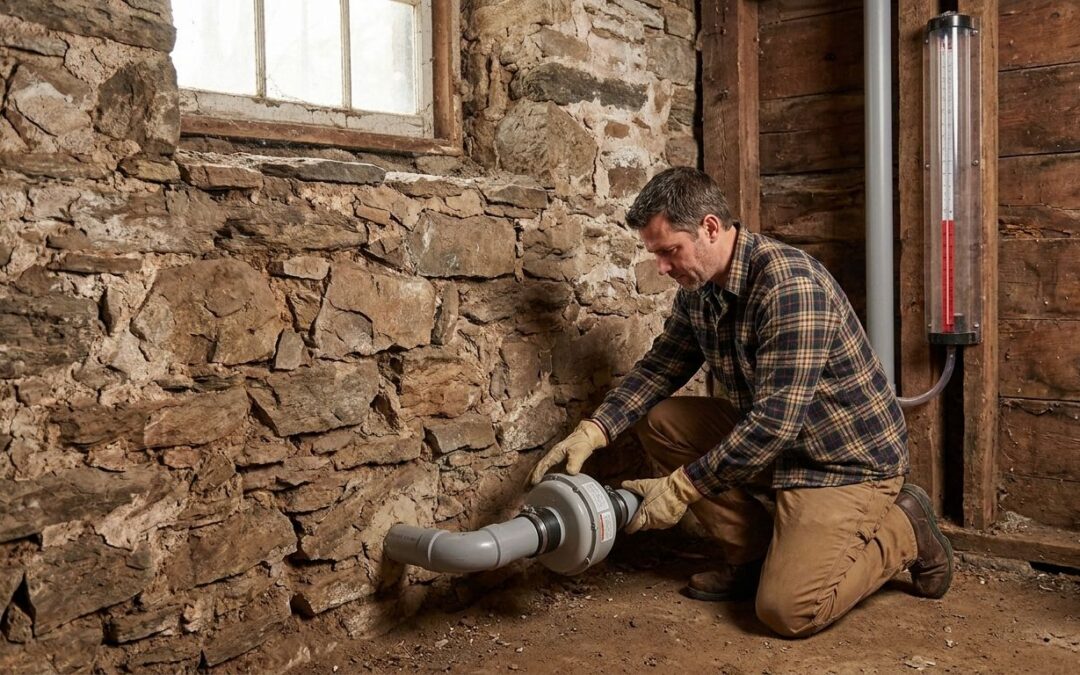
Fieldstone foundation homes in Michigan need radon mitigation that treats the foundation as a patchwork, not a single slab, because rubble walls, dirt floor sections, and uneven mortar joints all leak soil gas differently. A standard sub-slab system designed for a poured basement often underperforms in a fieldstone home unless the contractor accounts for the gaps between stones and the sections where there's no concrete at all.
- Fieldstone foundations need a hybrid or sub-membrane system more often than standard sub-slab suction, because rubble walls and dirt floor sections don’t seal like poured concrete.
- Radon mitigation for a fieldstone foundation in Michigan starts with sealing mortar joints and dirt-to-stone transitions before a fan is even sized.
- Michigan Radon Control tests before and after installation on fieldstone homes because irregular foundations produce uneven pressure fields.
- Homes above the EPA action level of 4 pCi/L with a fieldstone foundation usually need a combination system, not a single suction point.
Why radon mitigation matters for homes with fieldstone foundations
Fieldstone foundations are common in older Michigan farmhouses, lake cottages, and homes built before poured concrete became standard practice. The stone-and-mortar construction rarely forms a continuous air barrier, and radon gas moves through open joints, gaps around fieldstone footers, and dirt floor sections in ways a poured slab never allows.
That matters because a mitigation system built for a modern slab foundation can miss most of the entry points in a fieldstone basement. A fieldstone foundation is a multi-entry-point problem, and it needs a system designed around that, not a generic sub-slab install. Homes with additions built at different decades often mix fieldstone with poured concrete or block, which means the mitigation plan has to cover more than one foundation type in the same house.
Inspect every foundation transition point
Before any system gets designed, the foundation needs a full walk of every section, joint, and transition where materials change.
- Map where fieldstone meets poured concrete, block, or a dirt floor
- Check for open mortar joints wider than a pencil, common in stone laid before the 1950s
- Look for gaps around old coal chutes, root cellar openings, and hand-dug sump pits
- Note any sections with exposed dirt or gravel instead of a floor slab
- Flag cracks in any poured additions tied into the original fieldstone wall
Test before you assume the foundation is the problem
A fieldstone foundation raises suspicion, but the only way to know the actual radon level is a test — not a guess based on the house's age. Testing your home for radon is the step that tells you whether you're dealing with a 3 pCi/L nuisance or a level well above the EPA's 4 pCi/L action threshold.
- Run a short-term test in the lowest lived-in or regularly-used level of the home
- Keep windows and doors closed for the duration specified with the test kit
- Retest after any major foundation repair, since sealing work changes airflow patterns
- Avoid testing during unusually high wind or storm activity, which skews readings
Seal the fieldstone joints and dirt floor sections
Sealing comes before fan sizing on a fieldstone foundation, because an unsealed rubble wall will pull in outside air and rob the system of the negative pressure field it needs to work.
- Seal open mortar joints with a flexible polyurethane sealant rated for below-grade use
- Cover exposed dirt floor sections with a heavy-gauge vapor barrier membrane
- Seal around utility penetrations — water lines, drain pipes, electrical conduit — where they pass through stone
- Address any visible foundation cracks separately; sealing foundation cracks to reduce radon levels is a distinct step from sealing stone joints
- Check that sump pit covers are airtight, since open sumps are a common bypass in older homes
Choose the right depressurization method for a fieldstone foundation
Four mitigation approaches cover most residential foundations: sub-slab depressurization, sub-membrane depressurization, drain-tile suction, and block-wall suction. A fieldstone basement rarely fits neatly into just one.
- Use sub-membrane depressurization under sealed dirt floor sections instead of sub-slab suction, since there's no slab to drill into
- Use drain-tile suction where an existing perimeter drain tile system already runs beneath the foundation
- Combine two methods in homes with mixed fieldstone and poured additions, running separate suction points to each foundation type
- Avoid a single suction point serving the whole foundation unless a smoke test confirms even pressure across every section
Size the fan for a rubble or multi-section foundation
Fan sizing on a fieldstone home depends on how many sections need coverage and how leaky the sealed membrane still is after sealing work.
- Expect a higher-capacity fan than a comparable poured-basement system, since rubble walls resist a clean pressure field
- Plan for two fans on homes with fieldstone plus a separate crawl space or slab addition — see how crawl space homes are handled when a house combines foundation types
- Route fan discharge above the roofline per code, same as any other system
- Confirm fan placement doesn't sit directly above a bedroom or living space, since older homes have less predictable joist layouts
Verify the system with a post-mitigation test
An installed system on a fieldstone foundation needs verification more than a standard slab job does, because uneven suction across rubble walls can leave pockets untreated.
- Schedule the follow-up test according to post-installation radon testing timelines
- Check the system's pressure gauge at multiple points if the system runs more than one suction pipe
- Retest at least once during the first heating season, since Michigan's freeze-thaw cycle shifts fieldstone joints
- Compare results against the EPA action level of 4 pCi/L, not against the pre-mitigation number alone
Maintain the system through Michigan's freeze-thaw cycle
Fieldstone mortar moves more than poured concrete as the ground freezes and thaws, which means seals that held in October can open by March.
- Inspect sealed joints every fall before the ground freezes
- Watch the pressure gauge for a shift that signals a new leak path
- Re-seal any joint that shows fresh mortar cracking after a hard winter
- Keep the fan running year-round; shutting it off seasonally lets radon levels climb back up within days
Comparison: mitigation options for fieldstone foundation homes
| Option | Best for | Key limitation |
|---|---|---|
| Sub-membrane depressurization | Dirt floor sections under a sealed vapor barrier | Needs a durable, well-sealed membrane or suction weakens |
| Sub-slab depressurization | Poured additions attached to a fieldstone original | Doesn't reach true rubble-wall sections at all |
| Drain-tile suction | Homes with an existing perimeter drain tile | Only works if the tile loop is intact and accessible |
| Combination / hybrid system | Homes mixing fieldstone with slab or crawl space additions | Higher cost and more suction points to maintain |
Homes that mix a fieldstone basement with a slab addition often fit the pattern covered in radon mitigation for hybrid slab and crawl foundations — the same logic of treating each foundation section separately applies.
Common mistakes homeowners with fieldstone foundations make
- Assuming one fan covers the whole foundation. Rubble walls don't transmit suction evenly, so a single point often leaves sections untreated.
- Skipping the joint sealing step. A fan fighting an unsealed stone wall works harder and still leaves gaps in coverage.
- Ignoring a high water table under an old fieldstone basement. Homes with wet basement history need the approach covered in radon mitigation for homes with a high water table before a standard system gets installed.
- Not retesting after the first winter. Freeze-thaw movement in mortar joints changes airflow, and a system that passed its post-install test in July can drift by February.
- Treating a historic foundation like new construction. Fieldstone homes, especially those covered under radon mitigation for historic homes in Michigan, need sealing and structural review before any fan gets sized.
Get a fieldstone foundation assessed
NRPP-certified inspection and a mitigation plan built for your foundation type.
FAQ
Does a fieldstone foundation always need a different radon system?
Not always, but most fieldstone foundations need a hybrid or sub-membrane approach instead of a standard sub-slab system because rubble walls and dirt floor sections don’t seal the same way a poured slab does. A full foundation inspection determines the exact method.
Is radon worse in homes with fieldstone foundations?
Fieldstone foundations don’t automatically produce higher radon readings, but the open mortar joints and dirt floor sections common in these homes create more entry points for soil gas. Testing is the only way to confirm the actual level in your home.
How much does radon mitigation cost for a fieldstone foundation in 2026?
Costs vary by how many foundation sections need separate suction points and how much sealing work the joints require. Check current estimates directly, since a hybrid system for a mixed fieldstone-and-slab home costs more than a single sub-slab install.
Can I seal fieldstone joints myself before mitigation?
Basic sealing of visible gaps is a reasonable DIY step before a professional test, but sealing every entry point in a rubble wall without disrupting the mitigation plan takes experience. Most homeowners get a joint inspection done alongside the radon test.
What radon level is considered dangerous in Michigan homes?
The EPA action level is 4 pCi/L, and mitigation is recommended at or above that number. Some homeowners choose to mitigate between 2 and 4 pCi/L as well, especially in a fieldstone home where levels can shift with the seasons.
Do old farmhouses with fieldstone basements need two mitigation fans?
Many do, particularly when the original fieldstone section connects to a poured concrete addition with a different airflow pattern. A single fan often can’t maintain even suction across both foundation types.
How do I know if my fieldstone foundation’s radon system is still working?
Check the system’s pressure gauge regularly and retest after major seasonal temperature swings. A gauge reading that drops to zero or a retest above 4 pCi/L both signal the system needs attention.
One last thing
The detail most homeowners miss on a fieldstone foundation isn't the fan — it's the seasonal drift. A system that tests clean in July can show a different reading by February once Michigan's freeze-thaw cycle has worked on those mortar joints for a few months, so the smart move for any fieldstone home in 2026 is a retest during the first full heating season, not just the standard post-install check.
Related guides