
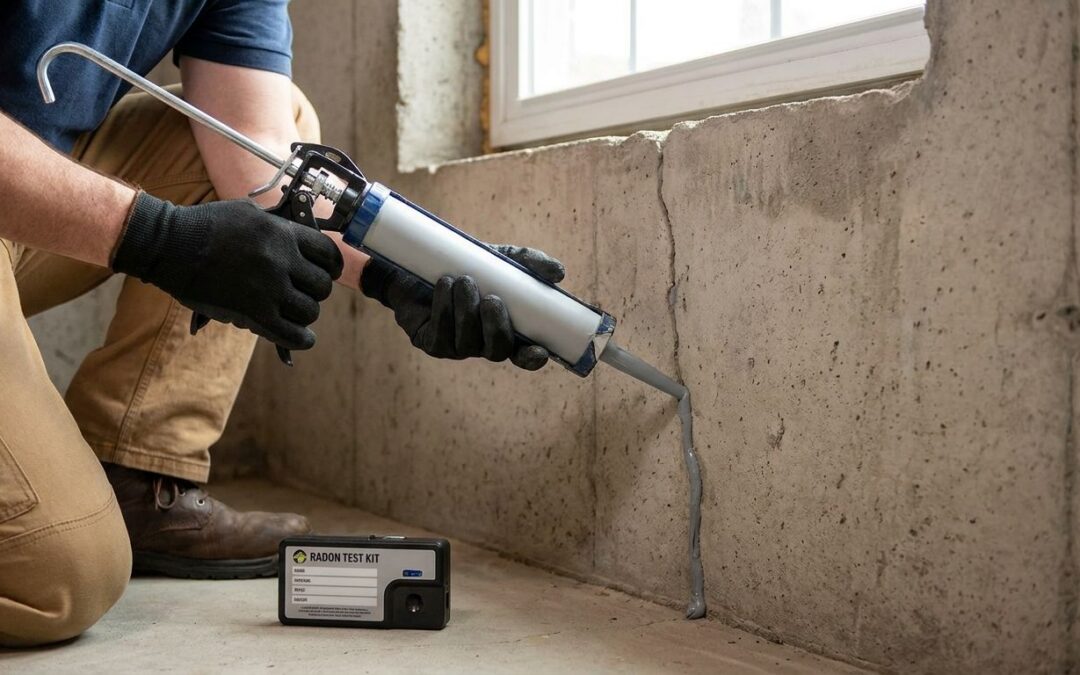
Sealing foundation cracks helps close one entry point for soil gas, but it will not reliably bring radon below the EPA action level of 4 pCi/L on its own. The EPA's own testing on crack sealing found reductions of less than 50%, often far less, because soil gas finds new paths through the concrete once the pressure difference between your basement and the soil stays the same. A sub-slab depressurization system paired with sealing is the combination that actually gets Michigan homes to safe numbers in 2026.
- Sealing foundation cracks radon fixes alone cut levels less than 50% per EPA data, not a standalone solution.
- Sub-slab depressurization plus sealing is the combination that reliably drops radon below 4 pCi/L.
- Cracks reopen with concrete shrinkage and seasonal freeze-thaw, so caulk-only fixes fail within a year or two.
- Michigan Radon Control seals crack entry points as part of a full mitigation install, not as a substitute for one.
Why this matters
Homeowners searching for a DIY fix land on caulk and epoxy because it looks cheap and fast compared to a mitigation system. The problem is physics, not effort: your basement runs at slightly lower pressure than the soil beneath it, and that pressure difference pulls radon gas through any opening, sealed or not, including pores in the concrete itself that no caulk gun reaches. Picking the right radon mitigation system type for your foundation matters more than how thoroughly you seal cracks, because the system addresses the pressure difference directly instead of chasing every gap.
Michigan's glacial till soil and freeze-thaw cycles make this worse than in warmer states. Concrete foundations here crack and re-crack every winter as the ground heaves, so a crack sealed in October can reopen by March 2026.
How to seal foundation cracks to reduce radon levels
Sealing is a real step in a mitigation plan, just not the whole plan. Here's how the two approaches compare when used alone versus together.
| Method | What it does | Typical radon reduction | Best for | Verdict |
|---|---|---|---|---|
| Crack sealing alone | Caulks visible cracks, sump lids, and utility penetrations | Under 50%, often much less | Homes already below 4 pCi/L looking for a small buffer | Skip as a standalone fix |
| Sub-slab depressurization alone | Vents soil gas from under the slab before it enters the home | 80-99% in most installs | Homes at or above 4 pCi/L on any foundation type | Buy |
| Sealing plus sub-slab depressurization | Sealing reduces the fan's workload; the fan handles what sealing misses | Highest and most consistent reduction | Any home undergoing full mitigation | Buy |
The process for sealing itself is straightforward:
- Locate visible cracks in the slab, foundation walls, and around the sump pump lid.
- Clean debris from each crack so sealant bonds to bare concrete.
- Apply polyurethane caulk or hydraulic cement, not standard latex caulk, which shrinks and cracks under freeze-thaw stress.
- Seal around plumbing penetrations, floor drains, and the sump basin lid with a gasketed cover.
- Retest radon levels after 2026's next heating season to see if sealing alone moved the number.
Step five is the part most homeowners skip, and it's the step that tells you whether you need a fan system.
Why radon levels vary even after sealing cracks
- Foundation type — cinder block walls have hollow cores that channel soil gas horizontally, bypassing surface-level crack sealing entirely.
- Sump pump openings — an unsealed sump basin acts as a direct pipe from the soil into your basement air, often the single largest entry point in the house.
- Stack effect — warm air rising through upper floors in winter pulls basement air upward, increasing the pressure pull on soil gas below.
- Soil permeability — sandy or gravelly soil under the slab lets radon move more freely than dense clay, regardless of how well the concrete is sealed.
- Seasonal concrete movement — Michigan's freeze-thaw cycle reopens hairline cracks every year, undoing sealing work done the previous fall.
- HVAC pressure balance — a return duct located in the basement can depressurize that space further, pulling in more soil gas than a neutral-pressure basement would.
If your home has a sump pump, that single fixture often needs a sealed lid tied into the mitigation system's vent pipe before sealing anywhere else makes a measurable difference.
When sealing alone isn't enough
If a retest after sealing still shows levels at or above 4 pCi/L, the next move is a sub-slab depressurization system, not more caulk. NRPP-certified installers drill a suction point through the slab, run PVC pipe to a roof or side-wall exhaust, and add a fan sized to your foundation's soil conditions. Homeowners preparing for that step can review how to prepare a home for a radon mitigation system before a crew arrives, since a few hours of prep work shortens install day.
The direct answer for most Michigan homeowners in 2026: seal what you can see, then let a fan-driven system handle what sealing can't reach. That combination is what NRPP-certified technicians install and what keeps levels below the EPA action level long-term.
“If a fan-driven system isn’t part of the plan, crack sealing is a stopgap, not a fix.”
Can I seal foundation cracks myself to reduce radon?
Yes, sealing visible cracks and the sump lid is a reasonable DIY step, but it caps out below a 50% reduction per EPA testing. Use polyurethane caulk or hydraulic cement rather than standard caulk, since regular caulk fails under Michigan's freeze-thaw cycle within a season or two.
How long does it take to see if crack sealing lowered radon levels?
Retest with a short-term kit running 48 hours to 7 days after sealing is complete, per standard EPA testing protocol. Waiting through one full heating season before retesting gives a more accurate read, since concrete movement and stack effect both peak in winter.
Is crack sealing enough before selling a home in Michigan?
No, most buyers and their agents rely on a current radon test result, not a description of sealing work performed. A test showing levels at or above 4 pCi/L after sealing alone typically still requires mitigation before or after closing, depending on the purchase agreement terms.
FAQ
Does sealing foundation cracks lower radon levels?
Sealing foundation cracks lowers radon levels by less than 50% on average, according to EPA testing, and often far less depending on the foundation. It’s a supporting step, not a standalone fix for levels at or above 4 pCi/L.
What’s the best way to seal foundation cracks for radon?
Polyurethane caulk or hydraulic cement applied to clean, debris-free cracks holds up best against Michigan’s freeze-thaw cycle. Sump pump lids need a gasketed cover, since an open sump basin is often the largest single radon entry point in a basement.
Is sealing cracks better than installing a radon mitigation system?
No, a sub-slab depressurization system reduces radon 80-99% in most installs, compared to under 50% for sealing alone. Sealing works best as a complement to a fan-driven system, not a replacement for one.
How much does it cost to seal foundation cracks for radon?
Costs vary by the number and size of cracks and the sealant used, so get a current estimate from a licensed contractor. Budgeting guidance for a full mitigation system, if sealing alone doesn’t resolve levels, is available separately.
Will sealing foundation cracks pass a home inspection for radon?
A home inspection radon test measures current indoor levels, not the presence of sealed cracks. If the test result sits at or above 4 pCi/L after sealing, most transactions still require mitigation regardless of what sealing work was done.
How often do sealed foundation cracks need to be redone?
Sealed cracks in Michigan foundations often need attention again within 1-2 years due to freeze-thaw movement in the concrete. This is one reason sealing alone isn’t treated as a permanent radon fix.
Can a sump pump be sealed to reduce radon?
Yes, a gasketed sump lid tied into a mitigation system’s vent pipe closes off one of the largest soil gas entry points in a basement. Sealing the sump lid without a connected vent pipe only partially reduces the pull of soil gas into the space.
Do cinder block foundations need different crack sealing for radon?
Yes, cinder block walls have hollow cores that move soil gas horizontally, so surface sealing on visible cracks misses that internal pathway entirely. These foundations typically need a sub-slab or sub-membrane system rather than sealing-only approaches.
One last thing
The EPA has stated for years that sealing alone "has not been shown to lower radon levels significantly or consistently" because it's nearly impossible to find and permanently close every entry route into a foundation. That's the detail most DIY guides leave out: the visible cracks you can caulk are rarely the only, or even the largest, source of soil gas entering your basement in 2026.
Get a radon mitigation estimate
NRPP-certified installers evaluate your foundation type before recommending sealing or a full system.
Related guides
- Lower radon levels below the EPA action level
- Radon mitigation for homes with cinder block foundations
- Radon mitigation for homes with sump pumps