
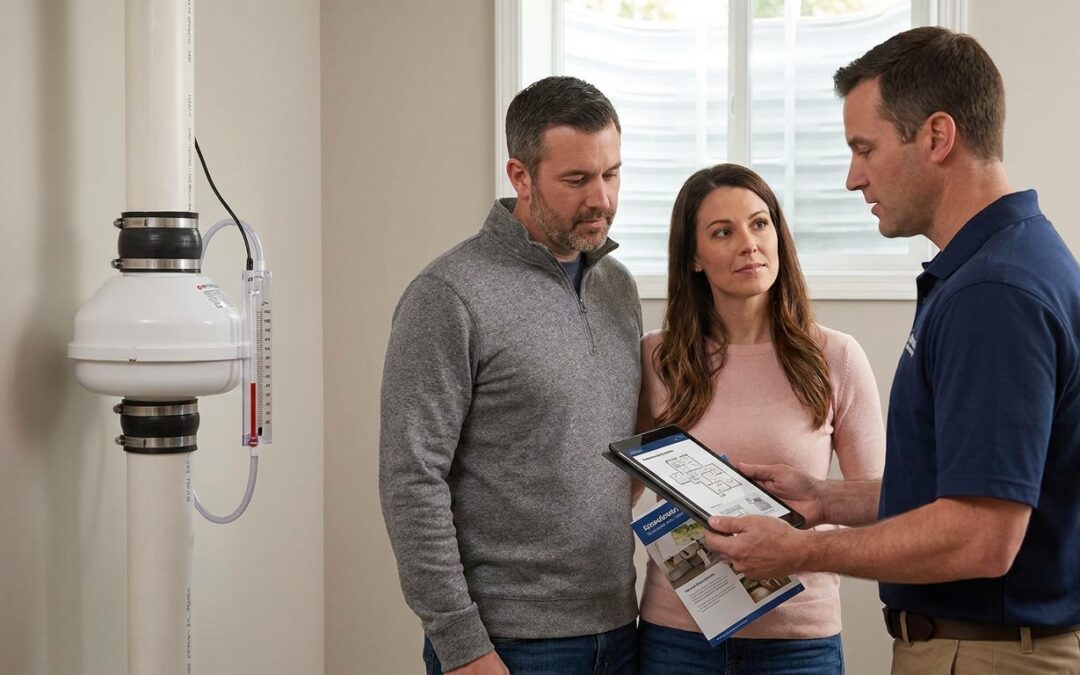
Choosing the right radon mitigation system type comes down to one variable most homeowners overlook: what's under your house. This guide walks through the four main system types, how foundation style dictates which one works, and what to ask a contractor before you sign a quote.
- Foundation type, not radon level, decides which mitigation system type you need — basements usually get sub-slab suction.
- Crawl spaces need sub-membrane suction with a sealed vapor barrier, not a standard sub-slab pipe.
- Sump pumps require a sealed lid and a dedicated radon fan tie-in or the system underperforms.
- New construction homes can install a passive system for under half the cost of a retrofit active system.
- Michigan Radon Control verifies system type against foundation before quoting installation, not after.
Why this matters
A radon mitigation system installed for the wrong foundation type will run, hum, and still leave your test results above the EPA action level of 4 pCi/L. That's the most common complaint homeowners bring to Michigan Radon Control in 2026 after hiring a low-bid contractor who installed a generic sub-slab system on a house with a crawl space or a high water table.
The fix isn't a bigger fan. It's matching the mitigation method to the foundation from the start. Get that wrong and you pay twice — once for the install, once for the rework.
What you'll need
- Your most recent radon test result (short-term or long-term, in pCi/L)
- A basic map of your foundation: basement, crawl space, slab-on-grade, or a mix
- Knowledge of whether you have a sump pump, sump pit, or French drain
- Photos or notes on your soil type if you know it (clay vs. sand affects suction efficiency)
- A contractor quote that names the specific system type, not just "radon mitigation system"
- 30-60 minutes to walk your basement or crawl space with a contractor before installation
The steps
1. Confirm your radon number before you shop for a system
Don't pick a mitigation system type off a quote until you know your actual reading. A result of 4.2 pCi/L and a result of 22 pCi/L can both need sub-slab suction, but the second one may need two suction points or a larger fan to hit safe levels reliably. If you haven't tested yet, testing your home for radon is the step that has to come first — everything downstream depends on that number.
Common mistake: skipping straight to "get a mitigation system" without a baseline test, which makes it impossible to verify the system actually worked.
2. Identify your foundation type — this is the real decision point
Basements get active sub-slab suction: a pipe through the slab, a fan in the attic or exterior, venting above the roofline. Crawl spaces need sub-membrane suction under a sealed vapor barrier instead of a pipe through concrete, because there's no slab to drill. Homes with crawl space foundations almost always need this different approach, and a contractor who quotes standard sub-slab suction for a crawl space hasn't actually looked at your house.
Slab-on-grade homes with no basement or crawl space use a modified sub-slab system with the suction point placed carefully relative to interior footings. If your home sits on a slab-on-grade foundation, expect a different pipe routing plan than a basement home would get.
3. Flag any sump pump, French drain, or high water table
A sump pit is a direct pathway for soil gas into your basement if it's not sealed as part of the system. Homes with sump pumps need an airtight lid with a tie-in to the radon fan, not a standalone mitigation pipe elsewhere in the slab — sealing the sump pit without connecting it to suction just moves the leak point.
High water tables in parts of Metro Detroit and Lansing limit how deep a suction pit can go before it fills with groundwater, which changes which system type performs. Verdict: get this flagged during the site visit, not after installation starts.
4. Decide between active and passive systems if you're building new
New construction gives you an option retrofits don't: a passive system installed during framing, before the slab is poured, at a fraction of the retrofit cost. A passive system uses stack effect instead of a fan to vent soil gas, and can be upgraded to active later if a post-construction test comes back above 4 pCi/L. If you're building in 2026, installing a passive radon system during new construction is worth doing regardless of your pre-construction soil radon estimate — it's cheap insurance while the foundation is open.
5. Check for finished basements or limited attic access
A finished basement restricts where a suction pipe can run without cutting into drywall or flooring, which pushes some installers toward exterior routing instead of interior. Limited attic access can rule out attic fan placement, which shifts the system to an exterior-mounted fan instead — same suction principle, different hardware location.
Common mistake: assuming pipe routing is identical for every basement. Finished basements change labor and sometimes cost, and that should show up on the quote before installation day, not as a change order after.
6. Verify the contractor's certification and system-type reasoning
Ask directly: "Why this system type for my foundation?" A contractor who can answer in one sentence — foundation type, water table, sump status — has actually assessed your house. One who can't should not be installing anything. Michigan Radon Control's technicians hold NRPP certification, and if you want to check any contractor's credentials before hiring, here's how to verify a contractor's NRPP certification.
7. Set the retest date before the crew leaves
Every mitigation system type gets validated the same way: a retest 24-48 hours after activation, then again longer-term. If the number doesn't drop below 4 pCi/L, the system type or fan sizing needs adjustment, not a second unrelated system stacked on top of the first.
Get the right system type quoted correctly
A site visit confirms foundation type before you pay for installation.
Troubleshooting
- System runs but retest is still above 4 pCi/L. The suction point may be undersized for your soil type, or a second foundation zone (like an attached garage slab) isn't connected to the same system.
- No accessible spot for a sub-slab suction pit. This usually means the system type needs to shift to an exterior installation or a different suction point layout, not that mitigation is impossible.
- Fan noise is louder than expected. Attic-mounted fans transmit vibration into ceiling joists; an exterior mount or vibration-dampening mount usually fixes it without replacing the fan.
- Sump pump alarm goes off after sealing. The sealed lid is trapping pressure that used to vent through the pit — the fix is a proper check valve, not removing the seal.
- High water table home has a fan that runs constantly with no radon drop. The suction pit may be flooding intermittently; this needs a site revisit, not a bigger fan.
- Finished basement owners get quoted exterior routing they didn't expect. That's normal for finished spaces, but it should be disclosed on the estimate, not discovered during install — see how to budget for a radon mitigation system installation for what routing changes typically add to cost.
Tools and resources
- Your most recent short-term or long-term radon test result
- A foundation walkthrough with a contractor before quoting
- How to prepare your home for a radon mitigation system — what to clear out and expect on install day
- A post-install continuous monitor if you want ongoing verification instead of a one-time retest
- Records of your system type and installation date for future resale disclosure
What to do next
Once your system is installed and verified below 4 pCi/L, the job isn't finished — mitigation systems need periodic checks. Read how to maintain your radon mitigation system to know what to check every year and when to call for service instead of troubleshooting yourself.
FAQ
What’s the best radon mitigation system type for a basement?
Active sub-slab suction is the standard choice for basements in 2026 — a pipe through the slab connects to a fan that vents soil gas above the roofline. It’s the most common and most reliable system type for homes with a full basement foundation.
Is a passive radon system as effective as an active system?
A passive system relies on natural stack effect instead of a fan, so it’s generally less powerful than an active system. It works well for new construction homes with lower baseline radon, but any home testing above 4 pCi/L after installation should upgrade to active.
How do I choose a radon mitigation system for a crawl space?
Crawl space homes need sub-membrane suction under a sealed vapor barrier, not standard sub-slab piping, because there’s no concrete slab to drill through. This system type seals the crawl space floor and draws soil gas out from beneath the barrier.
Do sump pumps need a special radon mitigation system?
Yes — a sump pit has to be sealed with an airtight lid and tied into the radon fan’s suction, not left as a separate opening. Sealing the pit without connecting it to suction just relocates the soil gas leak point elsewhere.
How much does a radon mitigation system cost in Michigan in 2026?
Cost depends heavily on system type and foundation complexity, with finished basements and high water tables typically adding to labor. A detailed breakdown by system type and home layout is covered in the budgeting guide linked above.
Can one mitigation system cover a basement and an attached garage slab?
Not automatically. If the garage slab is a separate pour from the basement foundation, it often needs its own suction point tied into the same fan system to get full coverage.
How soon after installation should I retest for radon?
Retest 24 to 48 hours after the system is activated to confirm the initial drop, then follow up with a longer-term test. This two-step verification is standard practice for confirming any mitigation system type actually worked.
Does a high water table rule out radon mitigation?
No, but it limits how deep a suction pit can be dug before groundwater interferes, which changes system design. Homes on high water tables need a site-specific plan rather than a standard sub-slab layout.
One last thing
The system type that fixes your neighbor's radon problem might do nothing for yours if your foundations differ — a slab-on-grade home and a crawl space home three doors apart can need completely different hardware even with identical starting radon numbers. Foundation type, not the reading on the test kit, is what should drive the decision in 2026.
Related guides
- Radon mitigation systems for crawl space homes
- Radon mitigation for slab-on-grade homes
- How to budget for a radon mitigation system installation
- How to prepare your home for a radon mitigation system
- How to maintain your radon mitigation system