
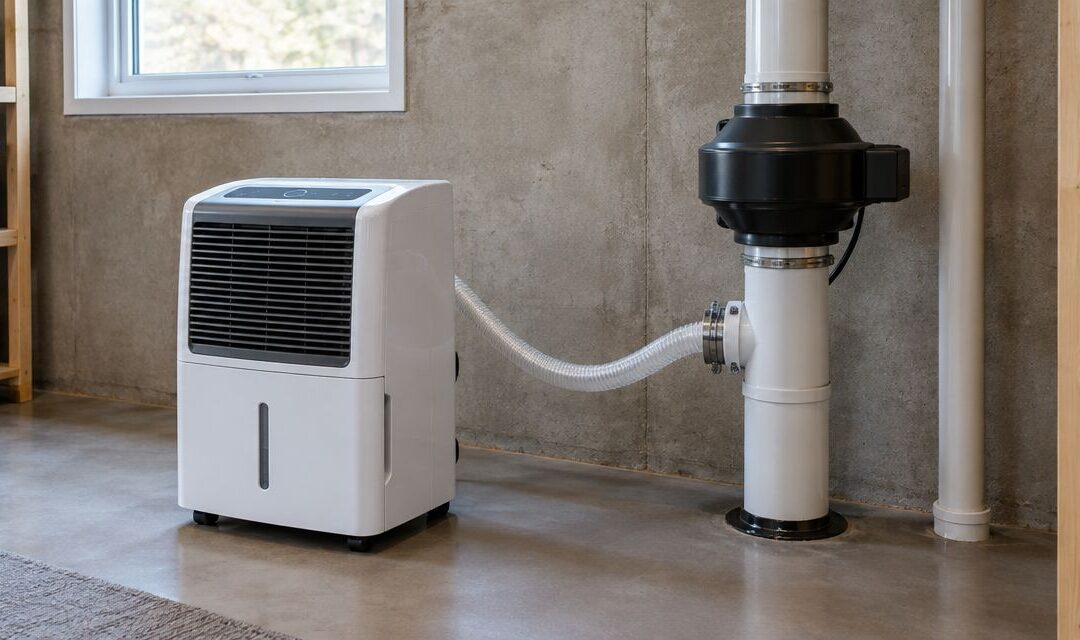
Running a dehumidifier in the same basement or crawl space as your radon mitigation system is safe, but the two units should never share plumbing or a power circuit. Instead of guessing where to plug in the dehumidifier or where to run its drain hose, follow a setup order that protects your fan's airflow and keeps your pressure readings accurate.
- A dehumidifier never plumbs into the radon vent pipe — the two systems share a room, not a line.
- Plug the dehumidifier into its own circuit; a shared breaker trips and kills your radon fan along with it.
- Check the U-tube pressure gauge before and after the dehumidifier runs so you catch airflow interference early.
- Route condensate drains away from the radon system’s water trap and away from freeze-prone areas in winter.
Why This Matters
Michigan basements run humid for most of the year, and a damp basement with a radon mitigation system installed is common, not unusual. Homeowners add a dehumidifier after mitigation to protect wood framing, stop musty odors, or bring humidity down for a finished lower level.
The two systems solve different problems. Your radon mitigation system pulls soil gas from under the slab and vents it above the roofline, keeping indoor radon below the EPA action level of 4 pCi/L. A dehumidifier pulls moisture out of the air in the room. Neither one does the other's job, and if you set them up carelessly they can interfere with each other.
The fastest way to protect both systems is to maintain your radon mitigation system on its own schedule and treat the dehumidifier as a completely separate appliance that happens to live in the same room.
Before You Start
- Know your fan model and confirm the vent pipe has a visible U-tube manometer you can read without moving anything.
- Line up a dedicated 15-20 amp circuit for the dehumidifier. Never share the radon fan's outlet or a power strip with it.
- The gotcha: installers and homeowners often zip-tie or rest a dehumidifier's drain hose against the radon vent pipe for support. That transmits vibration into the pipe joints and can loosen a seal over a year or two, so give the hose its own path from day one.
Check Your Baseline Pressure Reading
- Find the U-tube manometer mounted on the radon vent pipe, usually a small clear tube with colored liquid.
- Write down the current reading before you place or plug in the dehumidifier.
- Expected result: you have a baseline number to compare against once the dehumidifier is running.
Pick a Placement That Clears the Vent Pipe
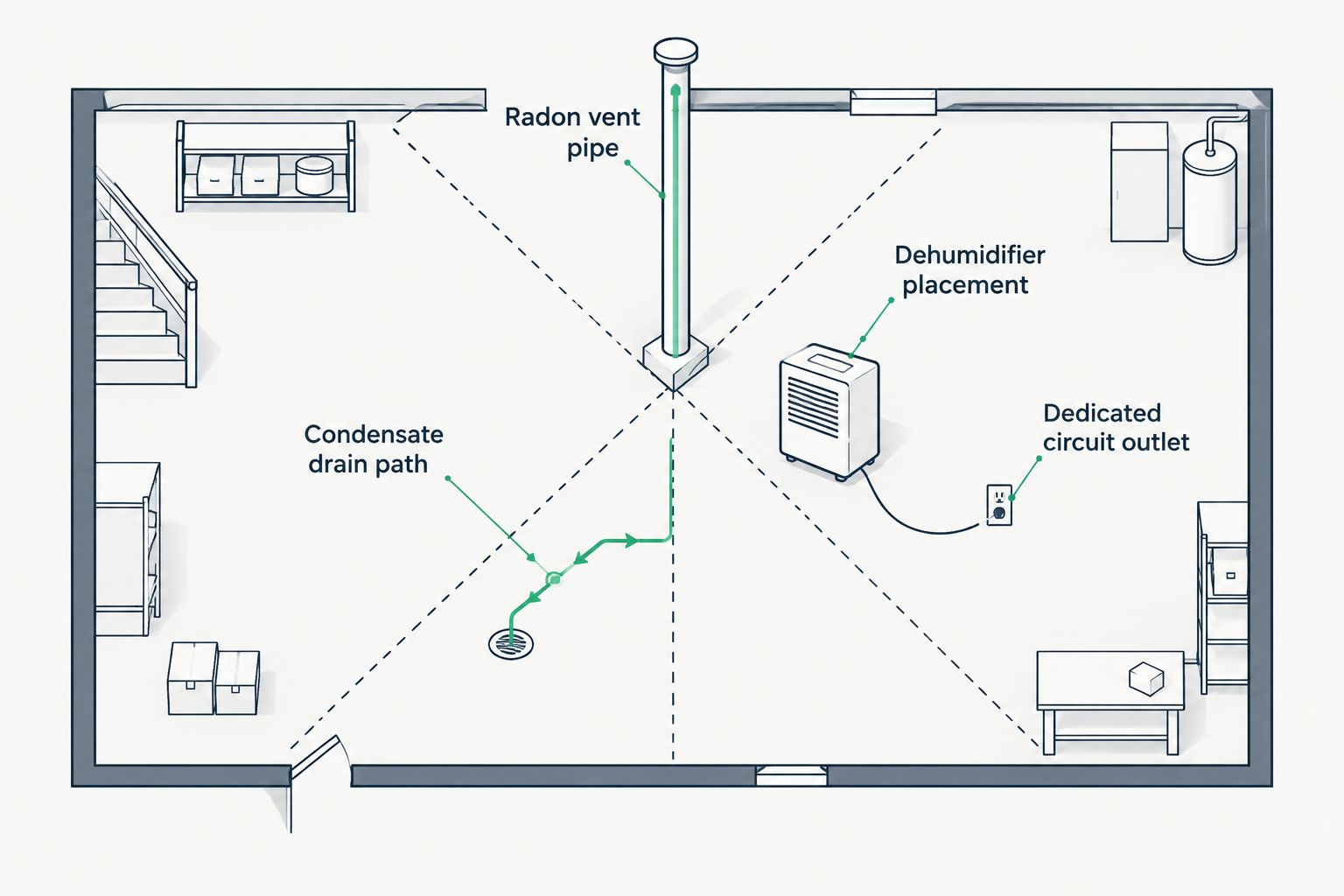
- Set the dehumidifier at least 2 feet from the radon vent pipe run, including any horizontal sections near the ceiling.
- Never let the unit's exhaust louver blow directly onto the pipe or its support brackets.
- Expected result: the pipe's seals and supports stay undisturbed, and airflow around the unit isn't restricted by a wall or cabinet.
Route the Condensate Drain Away From the Radon Line
- Connect the dehumidifier's drain hose to a nearby floor drain, sump basin, or condensate pump — never to the radon system's water trap or into the vent pipe itself.
- If a gravity drain isn't within reach, install a small condensate pump and run its discharge line to a sump basin or an exterior drain point.
- Expected result: two completely separate drainage paths, with zero shared plumbing between the appliance and the mitigation system.
Wire the Dehumidifier on Its Own Circuit
- Plug the unit into a dedicated GFCI outlet, not into the same outlet or power strip as the radon fan.
- Confirm the breaker feeding that outlet is labeled separately in your panel, not shared with basement lighting or the sump pump.
- Expected result: if the dehumidifier's breaker trips, the radon fan keeps running without interruption.
Running a Dehumidifier in a Crawl Space System
Crawl space setups work the same way with one added step: encapsulation. If your system uses a sealed vapor barrier and a sub-membrane fan, the dehumidifier usually hangs from the joists above the membrane, not on top of it. Route its drain line to the exterior or a sump basin outside the encapsulated area so condensate never pools under the barrier. For homes with this setup, radon mitigation systems for crawl space homes covers how the vapor barrier and vent pipe are laid out before you add a dehumidifier to the mix.
“A dehumidifier controls moisture; only the mitigation system controls radon — running both just fixes two different problems in the same room.”
Troubleshooting
Pressure gauge reading drops after the dehumidifier starts. Check whether the dehumidifier's outlet shares a breaker with the radon fan, or whether the exhaust airflow is blowing near a sealed penetration point. A drop of more than a small fraction on the pressure gauge means something changed in the pipe's seal, not the dehumidifier itself.
Radon fan hums louder once the dehumidifier is nearby. This is usually vibration transfer through a shared stud or joist, not an electrical issue. Add a rubber isolation pad under the dehumidifier or move it a few inches from the pipe's support bracket.
Condensate line freezes in an unheated crawl space in winter. Route the drain line to a heated area before it exits the structure, or insulate the exposed section. This is the same freeze risk your radon vent pipe faces outdoors in 2026's cold months.
Humidity stays high even with the dehumidifier running. The unit is likely undersized for the square footage, or the space isn't sealed well enough for the unit to keep up. Check for open crawl space vents or gaps in the encapsulation before assuming the dehumidifier is broken.
Basement smells musty despite both systems running. Radon mitigation removes gas, not moisture or mold spores. If odor persists, the humidity source (a sump pump lid, a foundation crack, or standing water) needs to be addressed directly, not just dehumidified.
Customize Your Setup
Once both systems are running independently, fold the dehumidifier into your seasonal routine instead of treating it as a one-time install. Check the manometer reading monthly and note it alongside your dehumidifier's humidity setting. Pair this with a whole-home air quality plan if you're also managing ventilation, filtration, or a sump pump in the same basement — treating radon, moisture, and air exchange as one system instead of three separate projects catches problems faster.
Get your system checked before winter
Michigan Radon Control verifies fan performance and moisture control together.
FAQ
Can I connect a dehumidifier directly into my radon mitigation system’s pipe?
No. A dehumidifier should never be plumbed or ducted into the radon vent pipe. The two appliances share a room, not a line, and connecting them into the same pipe can cause condensation buildup and pressure loss in the radon system.
Will a dehumidifier lower my home’s radon level?
No. A dehumidifier removes moisture from the air; it doesn’t reduce radon gas. Only an active mitigation system with a fan and vent pipe lowers radon levels below the EPA action level of 4 pCi/L.
Can a dehumidifier and radon fan share the same electrical circuit?
They shouldn’t. Put the dehumidifier on its own dedicated circuit so a tripped breaker on one appliance never shuts down the other, especially the radon fan, which needs to run continuously.
Does running a dehumidifier affect my radon mitigation system’s pressure gauge reading?
It can if the dehumidifier’s exhaust airflow disturbs a seal near the vent pipe or if placement blocks airflow around a joint. Check the gauge before and after installing the dehumidifier to confirm nothing changed.
Where should a dehumidifier’s drain hose go in a basement with a radon system?
Route it to a floor drain, sump basin, or condensate pump — never into the radon system’s water trap or vent pipe. Keep the drain hose at least a couple feet from the pipe run itself.
Is it safe to run a dehumidifier in a crawl space with a radon mitigation system?
Yes, as long as the dehumidifier sits above the sealed vapor barrier, not resting on it, and its drain routes outside the encapsulated area rather than pooling condensate underneath.
How often should I check both systems once they’re set up?
Check the radon system’s pressure gauge monthly and note the dehumidifier’s humidity reading at the same time. Catching a change in either number early prevents a small issue from becoming a bigger repair.
Can a dehumidifier be installed on the same wall as the radon vent pipe?
Yes, as long as it sits at least 2 feet away and its airflow or drain hose doesn’t touch the pipe or its support brackets.
One Last Thing
The fan on your radon mitigation system moves soil gas, not indoor air, so it will never dry out a damp basement no matter how long it runs. A dehumidifier and a radon fan solve two separate problems in the same square footage, and keeping their wiring, drainage, and placement independent in 2026 is what keeps both running without a service call.
Related Guides
- Radon mitigation as part of a whole-home air quality plan
- How to winterize your radon mitigation system in Michigan
- Radon testing for Michigan homes with high indoor humidity