
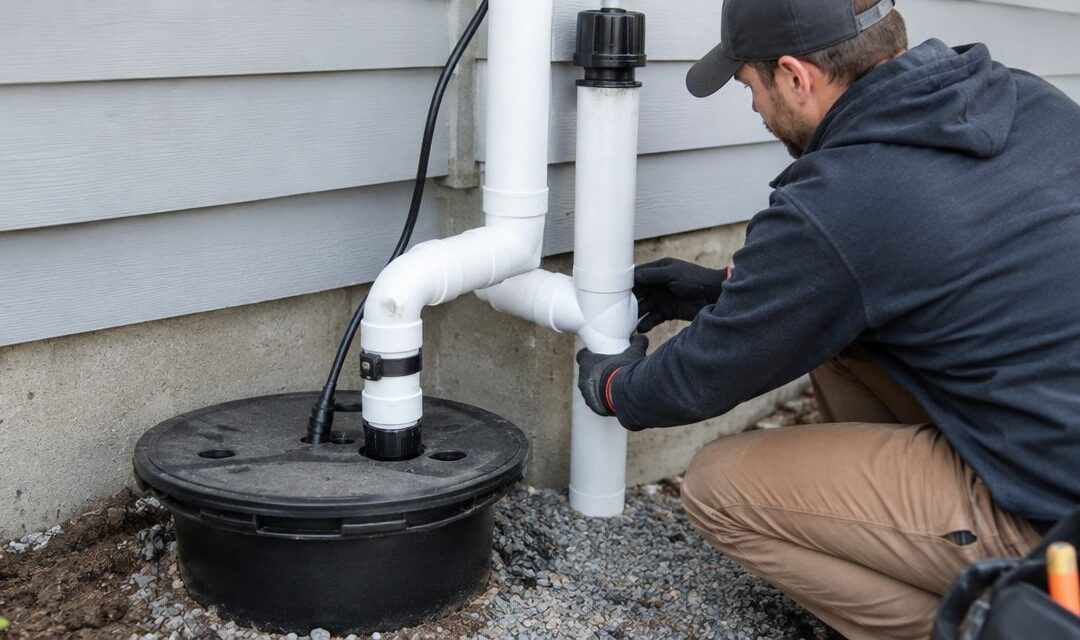
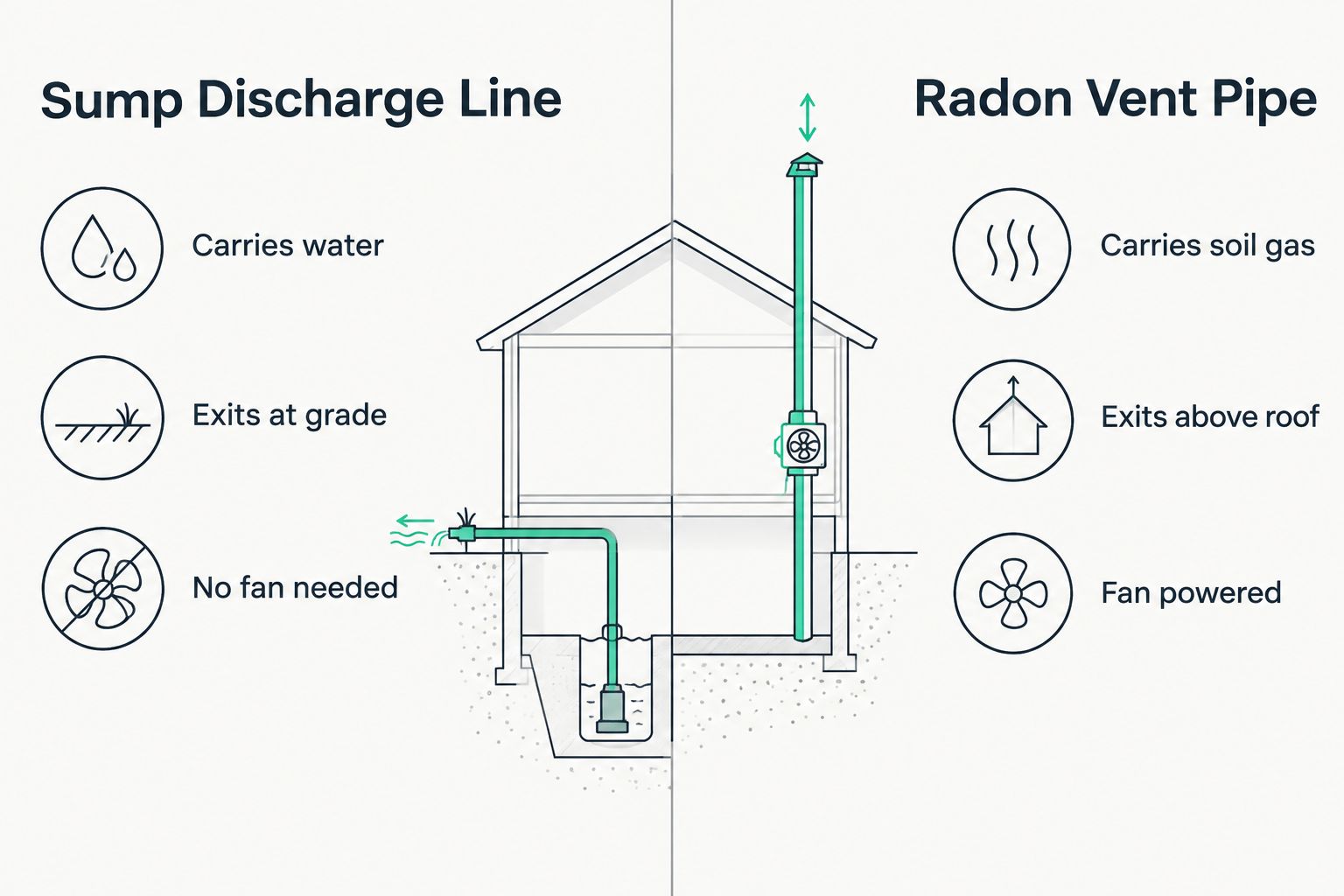
Tying a radon vent pipe straight into your sump pump's discharge line seems like the efficient move — one hole in the wall, one pipe run, done. It's also a code violation and a mechanical mistake: the discharge line carries water out to the yard under pump pressure, while a radon vent pipe carries soil gas up to the roofline under constant fan suction. Instead of merging the two, you seal the sump pit airtight and run a separate PVC riser through the lid — a workflow every NRPP-certified installer in Michigan follows on radon mitigation for homes with sump pumps.
- A radon vent pipe never ties into the sump pump discharge line — they carry different things under different pressures.
- The correct radon mitigation sump pump discharge line setup seals the sump pit airtight and runs a separate PVC riser to the roof.
- Vent pipe termination must clear the roofline by at least 12 inches and stay 10 feet from windows or doors, per ASTM E2121.
- Battery backup sump pumps need a second sealed grommet in the lid, not a shared penetration.
- Test the finished system with a pressure gauge reading before scheduling a post-mitigation radon test in 2026.
Why this matters
A sump pit is usually the lowest, most open point in a Michigan basement's floor — which makes it the path of least resistance for soil gas, and also the reason it's already plumbed with a pump and a discharge line. Homeowners see the existing pipe running out through the rim joist and assume the radon system should share it. It shouldn't.
The sump discharge line moves liquid water, sized and sloped for drainage, with a check valve that only opens one way. A radon vent pipe moves gas continuously, pulled by an inline fan running 24/7, and needs a straight or gently-elbowed run to clear the roof. Cross the two and you either flood the radon fan with water or push exhaust gas back down the drain line into your yard at ground level, right where people walk.
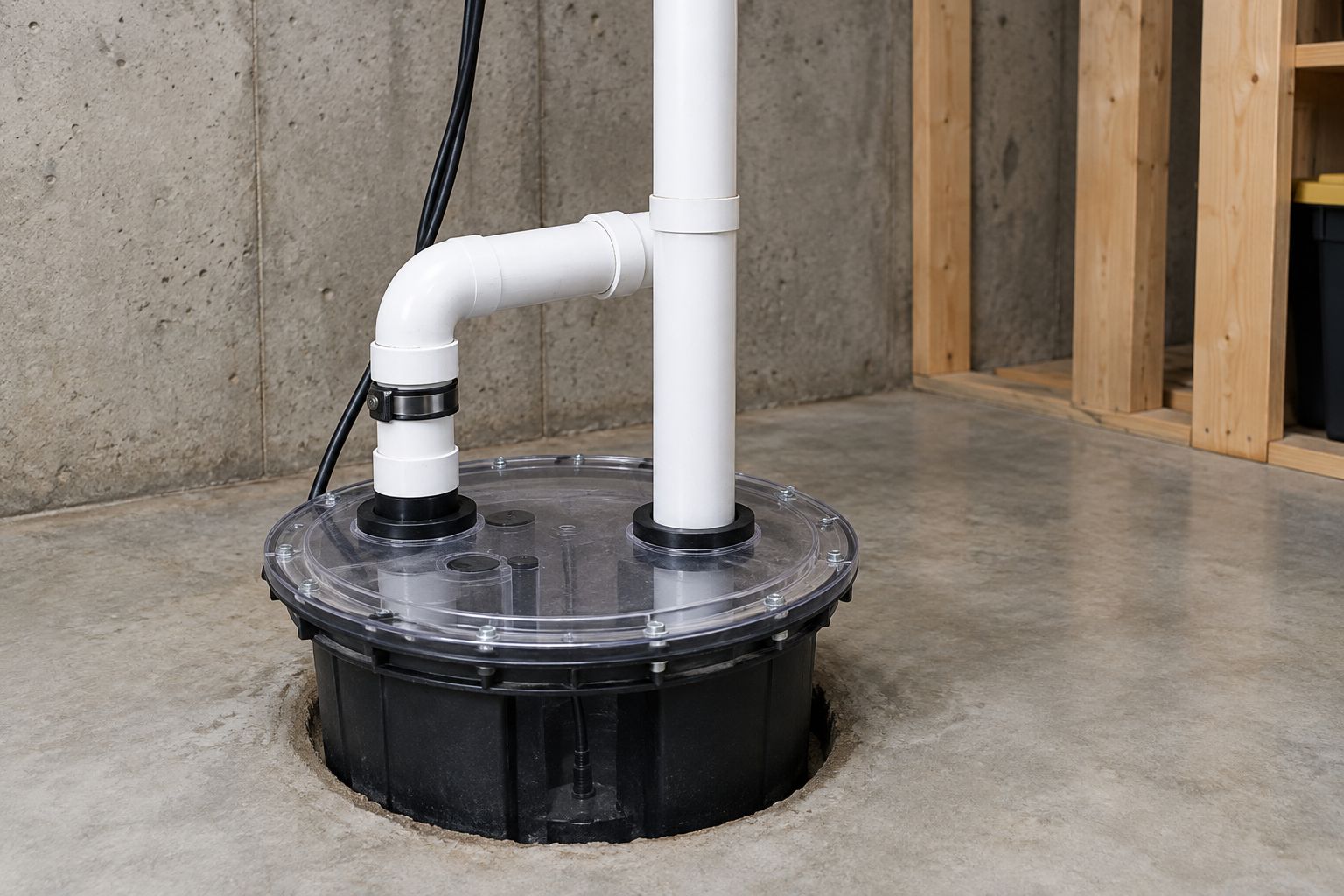
The fix that actually works: seal the sump pit lid airtight, then run a dedicated PVC riser through a grommet in that same lid, up through the basement, out through the rim joist or up through a chase, and above the roofline. The sump pump keeps discharging water through its own line exactly as before. The two systems share a location, not a pipe.
Before you start
- Know your sump pit dimensions — measure the pit diameter and the discharge pipe's exit point before ordering an airtight lid, since off-the-shelf lids come in a handful of standard sizes.
- Have the sump pump running — you need to see the discharge cycle at least once during setup to confirm the check valve seats correctly after the lid goes on.
- The gotcha: if the pump has a battery backup, it likely has its own discharge tube exiting the pit separately from the primary pump. Most single-penetration airtight lids don't account for this — order a lid with a second sealed grommet or you'll be back at the hardware store mid-install.
Seal the sump pit
- Shut off power to the primary sump pump at the outlet.
- Remove any existing loose-fitting cover and clean the pit rim of debris and old caulk.
- Set the new airtight lid over the pit, routing the existing discharge pipe and pump power cord through their designated grommets.
- Apply a bead of polyurethane sealant around the lid's perimeter where it meets the basement floor.
- Restore power to the pump and run a test cycle by adding water to the pit — confirm the float switch still triggers and the discharge line clears water normally.
Expected result: the pit is sealed airtight around every penetration, and the sump pump cycles normally with the lid on.
Install the vent riser
- Fit a 3-inch or 4-inch PVC coupling into the lid's dedicated vent grommet, sized to match your fan's rating.
- Run PVC pipe from that coupling straight up through the basement ceiling, using long-sweep elbows instead of sharp 90-degree turns to keep airflow resistance low.
- Support the pipe every few feet with plastic pipe hangers so it doesn't rely on the lid connection for weight-bearing.
- Install the inline radon fan in an unconditioned space — attic or exterior wall cavity — never inside living space, per manufacturer labeling.
Expected result: a continuous, supported PVC run from the sealed sump pit to the fan location, with no gaps or unglued joints.
Route the pipe to the roofline
- Continue the PVC run from the fan through the attic to the roof deck.
- Cut the roof penetration and install a roof boot flashing rated for the pipe diameter.
- Extend the pipe at least 12 inches above the roof surface, and confirm it sits at least 10 feet from any window, door, or other opening into the building — or at least 2 feet below such an opening if it's closer, per ASTM E2121 guidance.
- Cap the termination with a rain collar, angled to shed water without restricting airflow.
Expected result: exhaust exits above the roofline, clear of windows and doors, with no water intrusion at the penetration.
Wire and test the fan
- Have a licensed electrician wire the fan to a dedicated GFCI-protected circuit — this isn't a step to skip, since fan wiring is one of the most common code failures inspectors flag.
- Install a U-tube manometer or digital pressure gauge on the vent pipe near the fan.
- Power on the fan and confirm a visible pressure differential on the gauge within a few minutes.
- Check for any whistling or gurgling at the sump lid seal — that sound means suction is pulling through a gap, not through the soil.
Expected result: steady negative pressure on the gauge and a silent seal at the sump lid.
If your sump pump has a battery backup
Run the primary discharge line and the backup discharge tube through two separate sealed grommets in the same lid rather than trying to share one fitting. Test both pump modes — line power and battery — with the lid sealed to confirm neither discharge path leaks air into the vent system. This is the same sump pit, doing two pump jobs and one radon job, without any of the three interfering with each other.
Troubleshooting
- Gurgling or whistling from the sump pit: the lid seal has a gap. Re-caulk the perimeter and any grommet that wasn't fully seated.
- Sump pump alarm triggers after install: the float switch may be pinched against the new lid. Reposition the switch arm with slack.
- Musty smell returns weeks later: check the lid gasket for shrinkage or cracking — polyurethane sealant lasts years, but cheap foam gaskets don't.
- Pressure gauge reads zero: the fan isn't running. Check the breaker first, then the wiring connection at the fan housing.
- Water pooling near the sealed lid: that's usually condensation on the cold PVC pipe in summer, not a leak — insulate the pipe run through conditioned space if it recurs.
Customize your workflow
Once the sump pit is sealed and the vent riser is running, the same setup supports a few upgrades: a continuous monitor wired near the manometer for real-time tracking, or a second fan added later if the pressure gauge shows the system is underperforming on a larger footprint. If you're not sure the lid seal and vent run were done to spec on an existing setup, verify the mitigation system is still working before assuming it's fine.
Get your sump pit sealed correctly
NRPP-certified installers handle the pit, the riser, and the code-required wiring in one visit.
FAQ
Can you connect a radon vent pipe to a sump pump discharge line?
No — a radon vent pipe should never tie into the discharge line. The discharge line carries water under pump pressure while the vent pipe carries soil gas under constant fan suction, and combining them floods the fan or vents gas at ground level.
Does sealing the sump pit affect how the sump pump works?
No, a properly installed airtight lid routes the existing discharge pipe and power cord through sealed grommets, so the pump cycles exactly as it did before. Test a full pump cycle after sealing to confirm the float switch and check valve still work.
How high above the roof does a radon vent pipe need to extend?
At least 12 inches above the roof surface, and 10 feet from any window or door — or 2 feet below one if it’s closer than that. These clearances come from ASTM E2121, the standard most Michigan installers follow.
Can a battery backup sump pump still work under a sealed radon lid?
Yes, but the lid needs a second sealed grommet for the backup pump’s discharge tube. A single-penetration lid built for one pump won’t accommodate a backup system without modification.
What happens if the sump discharge line freezes in a Michigan winter?
A frozen discharge line backs water up into the sealed pit, which can trip the float switch repeatedly or flood the pit. Discharge lines should exit below the frost line or with a freeze-resistant fitting in Michigan climates.
How do you know the radon mitigation system is still working after installation?
Check the pressure gauge on the vent pipe for a steady reading and listen for the fan running continuously. A gauge reading of zero or a silent fan means the system needs service.
Is a permit needed to run a radon vent pipe through the roof in Michigan?
Requirements vary by municipality, so check with your local building department before cutting the roof deck. Many jurisdictions in Metro Detroit and Lansing require an electrical permit for the fan circuit specifically.
Why does the sump pit need to be airtight at all if the vent pipe already pulls suction?
An unsealed pit lets the fan pull room air instead of soil gas, which wastes suction and lowers how much radon actually gets pulled from beneath the slab. The seal is what makes the suction effective.
One last thing
The single most common callback on this type of install isn't the vent pipe or the fan — it's a battery backup sump pump nobody mentioned during the estimate, discovered only when the lid doesn't fit. Tell your installer about every pump, alarm, and backup device tied into that pit before the airtight lid gets ordered, in 2026 lids still ship in fixed sizes and a mismatched grommet means a return trip.
Related guides
- Radon mitigation for homes with sump pumps
- How to read a radon mitigation system's pressure gauge
- How to verify your radon mitigation system is still working
- How to fix a noisy radon mitigation fan
- How to prepare your home for a radon mitigation system