
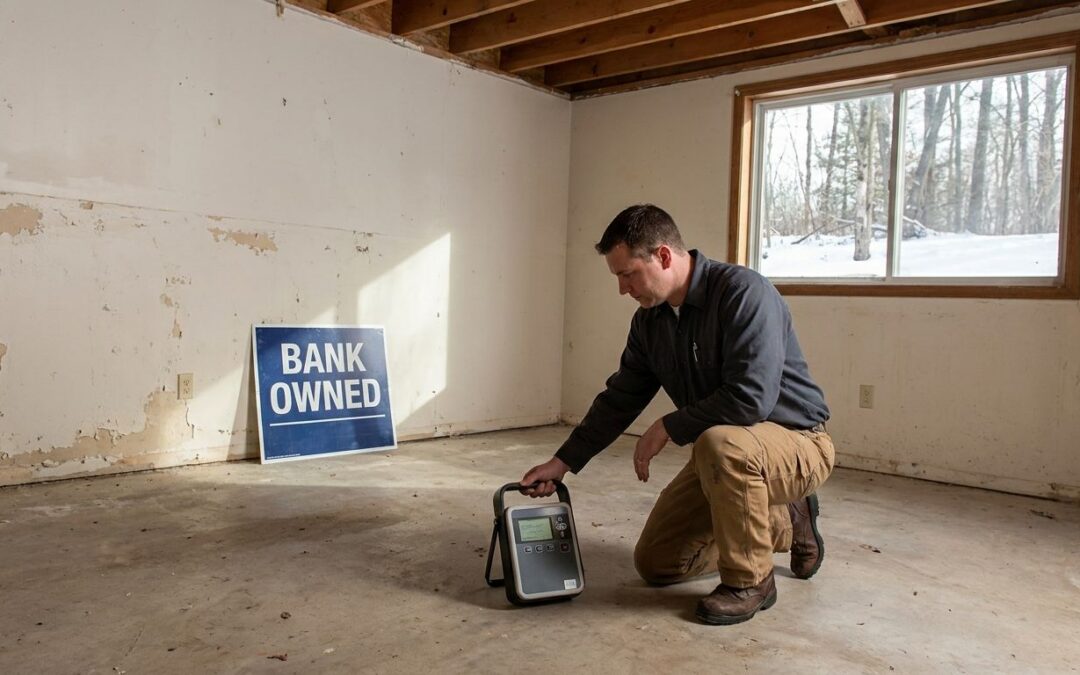
Foreclosed and bank-owned homes in Michigan carry a radon blind spot most buyers never see coming: the property sat vacant, unheated or minimally heated, for months before you toured it, and nobody legally had to tell you what the air inside was doing. Radon testing foreclosed home Michigan buyers actually need looks different from a standard resale test, and getting it wrong costs you leverage at the closing table.
Why this matters
Michigan sits almost entirely inside EPA Radon Zone 1, the agency's highest-risk category, which means elevated readings aren't rare exceptions here — they're the baseline assumption. Bank-owned sales compound the problem because most REO transactions close under "as-is" addendums that waive standard seller disclosure, so the radon history of the house, if anyone ever tested it, doesn't travel with the sale.
A vacant home with the furnace set to 55 degrees for six months actually produces some of the most reliable closed-building test conditions you'll find — doors stay shut, windows stay locked, nobody's opening the back slider to let the dog out. That's good news for test accuracy and bad news if you skip testing because you assumed "nobody's living there" meant "nothing to worry about." If you work these deals regularly, the radon testing guidance for Michigan real estate agents breaks down how disclosure gaps play out deal by deal.
- Radon testing foreclosed home Michigan deals should run a 48-hour closed-building test before waiving the due-diligence period.
- An NRPP-certified professional test is the safe pick for REO closings — Buy.
- A continuous radon monitor catches tampering or an opened window in vacant bank-owned homes — Buy.
- FHA and VA financed foreclosures need lender-compliant radon documentation before the 2026 closing date, not after.
Who this is for
This is for real estate investors bidding on Michigan REO listings, agents representing buyers on bank-owned deals, and anyone closing on a foreclosure in Metro Detroit or the Lansing area in 2026 who won't get a seller disclosure form and needs their own radon data before they sign off on the purchase agreement.
What to look for in radon testing for foreclosed homes
Turnaround time that matches the closing clock
Foreclosure due-diligence windows run shorter than a typical resale contract, sometimes as tight as 10 days. A test that takes two weeks to return lab results is useless if your window closes before the results do — confirm the lab's processing time before you schedule.
Vacant-property test protocols
A closed-building test assumes doors and windows stay shut for 12 hours before and during the test. Vacant bank-owned homes usually meet that condition by default, but confirm the utilities are on — a radon fan or HVAC system needs power, and a dead thermostat in January skews readings in ways a lived-in home wouldn't.
Lender documentation for FHA and VA files
If your buyer is financing the foreclosure with an FHA or VA loan, the appraisal file often needs radon documentation that meets specific formatting and reporting standards. Skipping this step means a second test later, on the lender's timeline instead of yours.
NRPP certification and chain of custody
An REO seller (the bank or its asset manager) will push back on any result they can dispute. A test performed and reported by an NRPP-certified technician, with a documented chain of custody from placement to lab, holds up in negotiation. A charcoal kit you mailed yourself doesn't carry the same weight.
Mitigation cost clarity before you bid
If you're buying multiple distressed properties this year, you need a rough mitigation number before you close, not after. Levels above 4 pCi/L typically call for a sub-slab depressurization system, and knowing that cost range before you finalize your offer protects your margin on the flip.
Schedule a test before your due-diligence period ends
NRPP-certified radon testing for Metro Detroit and Lansing REO closings.
Top picks for testing a foreclosed or bank-owned home
NRPP-certified professional test — the safe pick. A 48-hour short-term test run under EPA closed-building protocol by a certified technician gives you a result that holds up if the bank's asset manager pushes back on the number. Michigan Radon Control's certified technicians document placement, retrieval, and lab chain of custody, which matters more on an REO file than on a standard resale. Buy for any foreclosure closing where you need a defensible number fast. See NRPP-certified radon mitigation companies in Michigan for what certification actually covers.
Continuous radon monitor — the vacant-property specialist. Instead of a single average, a continuous monitor logs hourly readings for the full test period, which catches a door propped open by a lockbox showing or a furnace that cut out overnight. Bank-owned homes get walked through by multiple parties during a sale, and a continuous log shows you exactly when a spike happened. Buy if the property will see foot traffic — inspectors, appraisers, other buyers — during your test window. Details at continuous radon monitors for Michigan homes.
FHA/VA-compliant test package — the financing requirement. If your buyer's loan is federally backed, the lender's file needs radon documentation formatted to their standard, not just a lab printout. Skipping this adds weeks to closing when the underwriter kicks the file back. Buy if financing is FHA or VA; Skip the generic kit route entirely for these files. Requirements are laid out at FHA and VA radon testing requirements in Michigan.
Investor mitigation bundle — the multi-property play. For investors closing on more than one distressed Michigan property this year, a pre-negotiated test-and-mitigate package keeps costs predictable across a portfolio instead of getting a fresh quote every time. Consider this route once you're past your second or third REO purchase in a calendar year; it's not worth the setup for a single one-off flip. Compare options at radon mitigation companies for Michigan real estate investors.
What to avoid
- Assuming no disclosure means no radon. Bank-owned sales are frequently exempt from Michigan's standard seller disclosure form. "As-is" doesn't mean "tested and clean" — it means nobody checked, or nobody's telling you if they did.
- Testing with the HVAC off in a Michigan winter. A vacant home with the furnace set to 50 degrees or lower doesn't circulate air the way a closed-building test protocol expects. Confirm heat is running before you place the monitor, or the reading skews unreliable in either direction.
- Waiving your test to speed up an REO bid. Banks favor fast, clean offers, which tempts buyers to drop contingencies including radon testing. That trade-off forfeits your only chance to negotiate a mitigation credit if the number comes back above 4 pCi/L.
Verdict comparison
| Option | Turnaround fit | Vacant-property fit | Lender compliance | Verdict |
|---|---|---|---|---|
| NRPP-certified 48-hour test | Fast, matches short REO windows | Strong | Standard, widely accepted | Buy |
| Continuous radon monitor | Fast, live data | Strongest — flags tampering | Standard | Buy |
| FHA/VA-compliant package | Moderate, added paperwork | Strong | Required for federal financing | Buy if financed |
| Investor mitigation bundle | Depends on volume | Strong | Standard | Consider for repeat buyers |
| Unsupervised mail-in kit only | Slow | Weak, no chain of custody | Often rejected by lenders | Skip for REO deals |
FAQ
Do I need to test for radon on a foreclosed home in Michigan?
Yes, because bank-owned sales typically waive standard seller disclosure, so no radon history comes with the property. A closed-building test before your due-diligence period ends is the only way to know what you’re buying into in 2026.
Is radon testing more accurate in a vacant house?
Vacant homes often meet closed-building test conditions more consistently than occupied ones since doors and windows stay shut, but only if the heat or HVAC is still running. A dead thermostat during a Michigan winter can skew results.
How fast can I get radon test results for a Michigan REO closing?
A short-term closed-building test runs a minimum of 48 hours, with lab turnaround adding a few more days depending on the provider. Confirm the lab’s processing time against your due-diligence deadline before scheduling.
What radon level requires mitigation in Michigan?
The EPA action level is 4 pCi/L; readings at or above that level call for a mitigation system, typically sub-slab depressurization. Many Michigan homes test above this line given the state’s Zone 1 classification.
Do FHA and VA loans require radon testing on foreclosures?
FHA and VA financed purchases often require radon documentation formatted to the lender’s standard as part of the appraisal file. Confirm this with your lender before closing to avoid a delay.
Can I use a DIY radon kit on a bank-owned property?
A DIY kit can give you a rough read, but it lacks the chain of custody and NRPP certification that hold up if the bank’s asset manager disputes the number. For negotiation leverage, a certified technician’s test carries more weight.
What happens if a foreclosed home tests above 4 pCi/L?
You have grounds to negotiate a mitigation credit or system installation before closing, provided your contract still has an active contingency. This is why waiving the radon contingency to speed up a bid is a costly shortcut.
One last thing
The detail most buyers miss on REO deals: a vacant home's empty rooms and shut-off systems don't reduce radon risk, they often preserve it, since nobody's opening windows or running exhaust fans to dilute anything. Test before you close, not after — once you own the file, the bank's exemption from disclosure becomes your problem.