
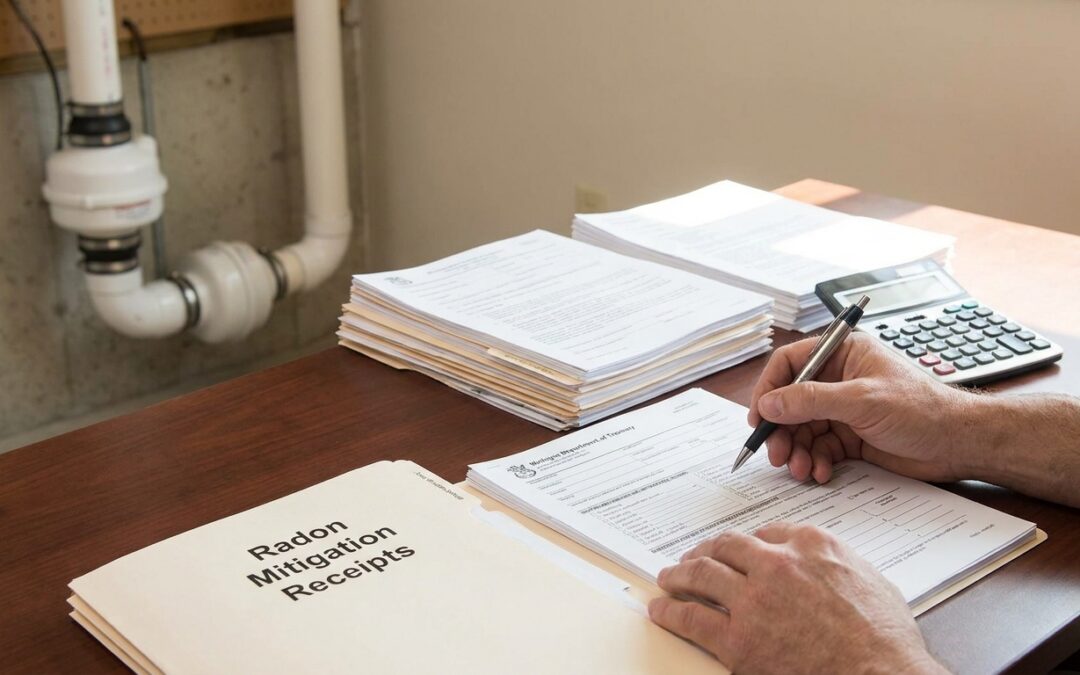
Filing for a radon mitigation tax deduction in Michigan comes down to one federal rule most homeowners never hear about until they've already paid for the system – and getting the paperwork right before you install beats scrambling for it in April.
- Radon mitigation tax deduction in Michigan runs through the federal medical expense rule, not a state credit.
- You need total medical costs above 7.5% of your adjusted gross income before any of it counts on Schedule A.
- Michigan has no standalone state radon tax credit in 2026 – the federal Schedule A route is the only path.
- Keep your contractor’s itemized invoice and pre/post radon test results – the IRS wants a paper trail.
- If mitigation raised your home’s appraised value, only the cost above that increase is deductible.
Why this matters
There's no line on a Michigan state tax form that says radon mitigation credit. People search for one every year and come up empty, then assume the cost is a dead loss. It isn't – it just lives in a different place than most homeowners expect.
The IRS treats radon mitigation as a potential medical expense deduction under the same rule that covers ramps, air filtration systems, and other home modifications made for health reasons. That rule has real conditions attached. Miss one and the deduction disappears, or worse, gets flagged.
What you'll need
- An itemized invoice from your mitigation contractor, labor and equipment listed separately
- Pre-mitigation and post-mitigation radon test results, in pCi/L
- Documentation of medical necessity if you're claiming this as a medical expense – a physician's note or records of an existing respiratory condition
- Your Adjusted Gross Income (AGI) figure, current or prior year
- A completed Schedule A (Form 1040) – the standard deduction won't work here
- An appraisal or comparable sales data if the mitigation system might have bumped your home's resale value
Start at Michigan Radon Control before you sign a contract, not after – the invoice format your contractor uses affects how clean this deduction is later.
The steps
1. Confirm the medical-expense angle actually applies to you
This deduction isn't automatic just because you installed a mitigation system. The IRS treats it as a medical expense only when the cost is primarily for the prevention or treatment of a diagnosed condition, not a general home upgrade. Common mistake: assuming any radon system qualifies simply because radon is a known carcinogen – the IRS wants medical necessity, not just health awareness.
2. Get the paperwork lined up before you file, not after
A doctor's note tying the mitigation to a diagnosed respiratory issue, prior radon exposure, or a physician's recommendation strengthens the claim substantially. Waiting until tax season to chase this documentation from a physician who saw you a year ago rarely goes smoothly. Common mistake: treating the doctor's note as optional paperwork instead of the backbone of the claim.
3. Verify your installer's certification and get an itemized invoice
You'll want a contractor who can verify their NRPP certification and break the invoice into labor, equipment, and permitting costs. A vague lump-sum invoice makes it harder to substantiate the deduction if the IRS asks questions later. Common mistake: accepting a one-line receipt that just says radon mitigation system – paid in full.
4. Separate medical necessity cost from home-value increase
If the mitigation system increased your home's fair market value, only the portion of the cost that exceeds that value increase is deductible – the rest gets treated as a capital improvement instead. Most radon systems (a PVC pipe, a fan, a discharge point) add negligible resale value, so this step often resolves in the homeowner's favor. Common mistake: skipping this comparison and assuming the whole invoice is deductible.
5. Total your medical expenses and check the 7.5% AGI floor
Radon mitigation doesn't stand alone – it gets added to your other unreimbursed medical expenses for the year (doctor visits, prescriptions, other home medical modifications). Only the amount above 7.5% of your AGI is deductible. Common mistake: forgetting to add radon mitigation to the medical expense total and evaluating it as a standalone deduction, which it isn't.
6. Itemize on Schedule A instead of taking the standard deduction
This deduction only exists if you itemize. If your total itemized deductions (medical, mortgage interest, state taxes, charitable giving) don't beat the standard deduction, the radon mitigation cost effectively contributes nothing. Common mistake: claiming the deduction on a return that ends up taking the standard deduction anyway – run both scenarios before you file.
7. File and keep records for at least three years
Hold onto the contractor invoice, the physician documentation, pre- and post-mitigation radon test results, and your AGI calculation. The IRS's general statute of limitations for audits runs three years from filing, longer if there's a substantial understatement of income. Common mistake: tossing the paperwork once the refund lands.
8. Loop in a CPA before the system goes in, not after
A tax professional familiar with Section 213 medical expense rules can tell you in five minutes whether your situation qualifies – before you spend money on a system assuming it's deductible. Common mistake: making the installation decision based on an assumed tax benefit that never gets confirmed.
Get a documented radon mitigation quote
An itemized invoice starts with the estimate – request one before you file anything.
Troubleshooting
My tax software has no line item for radon mitigation. Enter it under medical and dental expenses as a home improvement for medical care – most software (TurboTax, H&R Block) has a generic field for this, not a radon-specific one.
My CPA says I don't qualify. Without documented medical necessity, the IRS treats the system as a general home improvement, not a medical expense – it may still adjust your home's cost basis for capital gains purposes later, just not this year's deduction.
The mitigation system increased my appraised value. Subtract the value increase from the total cost before claiming anything – only the difference is deductible under the medical expense rule.
I took the standard deduction this year. No deduction is available unless you itemize. Run the math both ways before you file – if your total itemized deductions don't clear the standard deduction, radon mitigation adds nothing to your return this year.
I don't have receipts from the installation. Contact your contractor for a retroactive itemized invoice. A reputable NRPP-certified installer keeps job records and can usually reissue documentation.
I sold the home the same year I installed the system. The capital improvement basis adjustment interacts with capital gains calculations – this is a case where a CPA conversation is worth the fee before you file.
Tools and resources
- IRS Publication 502 (medical and dental expenses) – the federal rule governing this deduction
- Schedule A, Form 1040 – the form you'll actually file on
- How to budget for a radon mitigation system installation – for estimating costs before you commit
- Your contractor's itemized invoice and NRPP certification number
- Pre- and post-mitigation radon test results, dated and in writing
What to do next
If you're still deciding whether mitigation makes sense for your home at all, start with your current radon numbers, not the tax angle – the deduction is a bonus, not the reason to act. Review how to read your radon test results to confirm where your home actually stands before you talk to a contractor or a CPA.
FAQ
Is radon mitigation tax deductible in Michigan?
Yes, but only through the federal medical expense deduction on Schedule A, not a Michigan-specific credit. You need documented medical necessity and total medical expenses above 7.5% of your AGI in 2026.
Does Michigan offer a state tax credit for radon mitigation?
No, Michigan does not have a standalone state-level radon mitigation tax credit as of 2026. The only route available is the federal medical expense deduction, claimed on your federal return.
What IRS form do I use for a radon mitigation deduction?
You’ll itemize the expense on Schedule A (Form 1040) under medical and dental expenses. The deduction only applies to the portion of your total medical costs above 7.5% of your AGI.
Do I need a doctor’s note to deduct radon mitigation costs?
You need documentation showing the system was primarily for medical care, and a physician’s note is the strongest form of that. Without it, the IRS is more likely to treat the system as a general home improvement instead of a medical expense.
How much of my radon mitigation cost can I deduct?
You can deduct the portion of your total medical expenses, including the mitigation cost, that exceeds 7.5% of your AGI. If the system increased your home’s appraised value, subtract that increase from the cost first.
Can I deduct radon testing costs too?
Radon testing costs tied to the same medical necessity claim generally follow the same rule as the mitigation system itself. Keep test results and invoices together with your mitigation paperwork for a single, consistent claim.
What happens if radon mitigation increases my home’s value?
Only the cost above the value increase is deductible as a medical expense; the rest is treated as a capital improvement that adjusts your home’s cost basis. Most radon systems add minimal resale value, so this usually affects a small portion of the total cost.
Can renters deduct radon mitigation costs?
Renters generally can’t claim this deduction since they don’t own the property or bear the capital cost of the system. Landlords who install mitigation systems may have separate business expense rules that differ from the homeowner medical deduction.
One last thing
The IRS medical expense test doesn't require your radon reading to clear the EPA's 4 pCi/L action level before mitigation qualifies as a deduction – it requires documented medical necessity. That means a physician's recommendation can support a claim even at borderline radon levels, while a home reading well above 4 pCi/L with no medical documentation might not qualify at all. The number on your test report matters less than the paper trail behind it.
Related guides
- How to meet Michigan's radon disclosure requirements when selling
- How to read your radon test results