
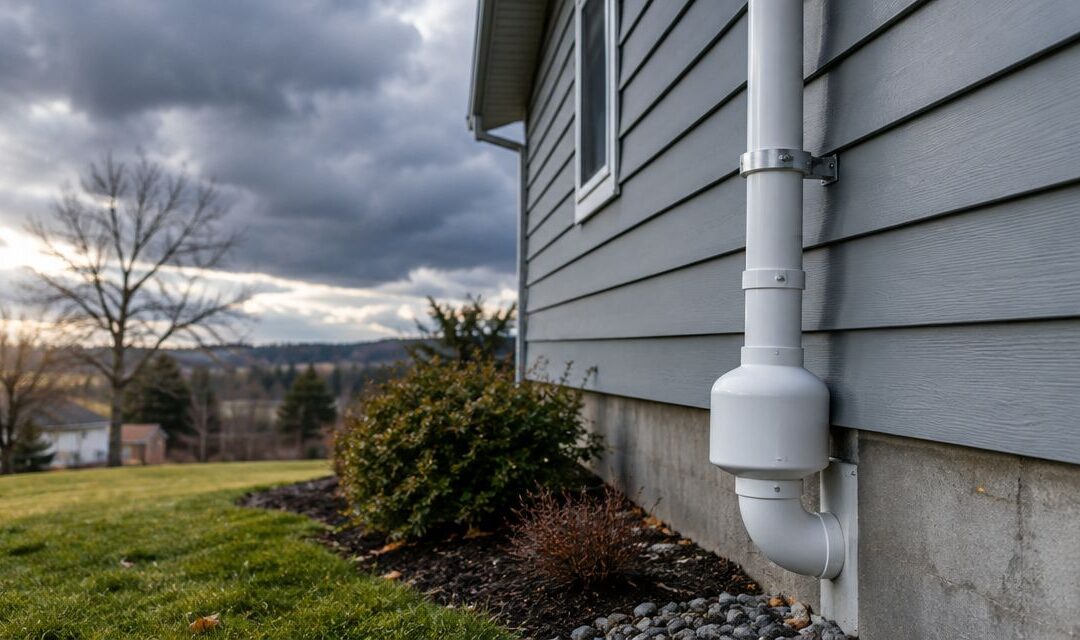
Yes, weather can affect radon mitigation system performance by changing soil moisture, pressure differences around your home, and airflow through the system. Rain, cold, wind, and ice can also change indoor radon readings even when the fan is working. A weather-related increase does not prove the system has failed, but persistent elevated readings or a changed system indicator need attention.
- Can weather affect radon mitigation system performance? Yes; weather changes soil conditions, building pressure, and sometimes system airflow.
- A running radon fan does not prove indoor radon levels are low; confirm performance with radon testing.
- EPA recommends fixing homes at 4 pCi/L or higher, regardless of the weather.
- Michigan Radon Control provides NRPP-certified radon testing and mitigation maintenance for Metro Detroit and Lansing homeowners.
Can weather affect how a radon mitigation system performs?
Weather affects both the amount of radon entering a house and the conditions a mitigation system must overcome. Those are different problems. Before assuming your fan needs replacement, verify your radon mitigation system is still working and compare the system indicator with its documented normal reading.
| Weather condition | What changes | What it means for your system | Your next move |
|---|---|---|---|
| Heavy rain | Soil moisture and soil-gas pathways change | Suction beneath the foundation can behave differently | Record readings and check for water intrusion |
| Cold weather | Warm indoor air rises, increasing pressure differences | More soil gas can be drawn toward foundation openings | Keep the fan running and confirm indoor radon levels |
| Strong wind | Pressure around the building and vent outlet changes | Short-term readings and airflow can fluctuate | Check trends rather than one isolated reading |
| Snow and ice | Frozen ground changes gas pathways; ice can obstruct exhaust | An obstruction can restrict system airflow | Observe from the ground and request inspection if blocked |
| Storm-related outage | The fan loses power | An active system stops drawing soil gas while power is off | Confirm operation after power returns |
Weather is a reason to check performance, not a reason to dismiss a high radon result. The useful evidence is the radon measurement, the system indicator, and any visible or audible change in the equipment.
Why this matters
It's completely natural to worry when your radon monitor climbs after a storm. You do not need to diagnose the fan yourself. Start by separating a changing indoor reading from a clear equipment problem.
For your 2026 home checks, use the EPA's residential guidance: fix a home when a valid radon test result is 4 picocuries per liter, written as 4 pCi/L, or higher. The EPA also recommends considering reduction when levels are between 2 pCi/L and 4 pCi/L. Below the action level does not mean zero risk.
Radon risk comes from exposure over time. A monitor spike deserves context, while a stopped fan, damaged pipe, or system alarm deserves a service check without waiting for another season.
Why weather-related performance varies
The same storm does not affect every house in the same way. The foundation, soil, and installed system determine how weather changes reach the air you breathe.
- Soil moisture: Rain and snowmelt change how easily air moves through the ground. Saturated areas can redirect soil gas and alter suction beneath the slab.
- Indoor-outdoor temperature differences: Rising warm air creates lower pressure near the bottom of a heated home. This stack effect can draw soil gas through foundation openings.
- Wind and atmospheric pressure: Wind changes pressure around walls and the exhaust outlet. Weather-related pressure changes also influence soil-gas movement.
- Frozen ground and exhaust icing: Frozen soil changes escape pathways. Ice at the discharge can restrict airflow if an obstruction develops.
- Foundation openings: Cracks, sump openings, and crawl-space membrane gaps provide entry routes. Pressure changes matter more when those routes remain open.
- Power availability: A fan-driven system needs electricity continuously. A weather-related outage interrupts active suction.
There is no universal weather adjustment you can subtract from a radon result. A winter reading cannot be converted into a summer reading using a fixed percentage, and rainfall does not establish how much a particular home's radon will rise.
Cold weather: higher radon does not automatically mean fan failure
Cold weather increases the temperature difference between your house and the outdoors. As warm air escapes through upper parts of the building, replacement air enters lower down. Some of that replacement air can come from the soil through foundation openings.
A properly designed active system draws soil gas toward its collection point instead of letting it enter the living space. The fan should remain on during winter. Turning it off removes the suction that helps control radon entry.
For winter 2026, keep two checks separate: is the equipment operating, and is the indoor radon concentration adequately reduced? The first check concerns the fan and system indicator; the second requires a radon test. One cannot replace the other.
Do not cover the exhaust, fit an improvised cap, or change pipe routing to keep snow out. Changes to the discharge can restrict airflow or create other installation problems. Have a qualified radon professional assess recurring icing instead.
Rain and snowmelt: check the foundation as well as the fan
Rain affects the ground around your foundation, not just the exposed equipment. As soil fills with water, the paths available for soil gas change. Radon readings can rise or fall because the effect depends on local conditions.
Water beneath a slab can also affect how suction spreads from the system's collection point. If your basement floods, a sump cover shifts, or a crawl-space membrane is damaged, the system needs more than a weather explanation. Those changes can alter the entry routes the installation was designed to control.
Record what happened. Note the storm, any standing water, and whether the pressure indicator changed. Do not assume the fan is defective merely because radon increased after rain. A service assessment should consider the foundation and drainage conditions too.
Avoid opening a sealed sump cover to investigate airflow yourself. That cover can be part of the radon-control system, and disturbing it changes the conditions you are trying to evaluate.
Wind and ice: separate fluctuating readings from restricted airflow
Wind can affect pressure at the vent outlet and around your home. A brief change in a radon monitor reading does not establish an exhaust problem. Look for a continuing pattern and compare it with the system indicator.
Ice is different when it physically obstructs the discharge. Restricted airflow can interfere with the system's ability to move soil gas. Check the visible exterior piping from a safe ground-level position; do not climb onto an icy roof or insert tools into the exhaust.
A pressure gauge does not measure radon concentration or directly prove adequate airflow. A blocked system can still show suction. If you notice an obstruction, an unfamiliar gauge reading, or a new fan noise, arrange an inspection rather than relying on the indicator alone.
After a storm-related outage, confirm that the fan has resumed operation. If electrical equipment is wet or damaged, keep away from it and have the electrical hazard addressed before handling the system.
What should you do when radon rises after bad weather?
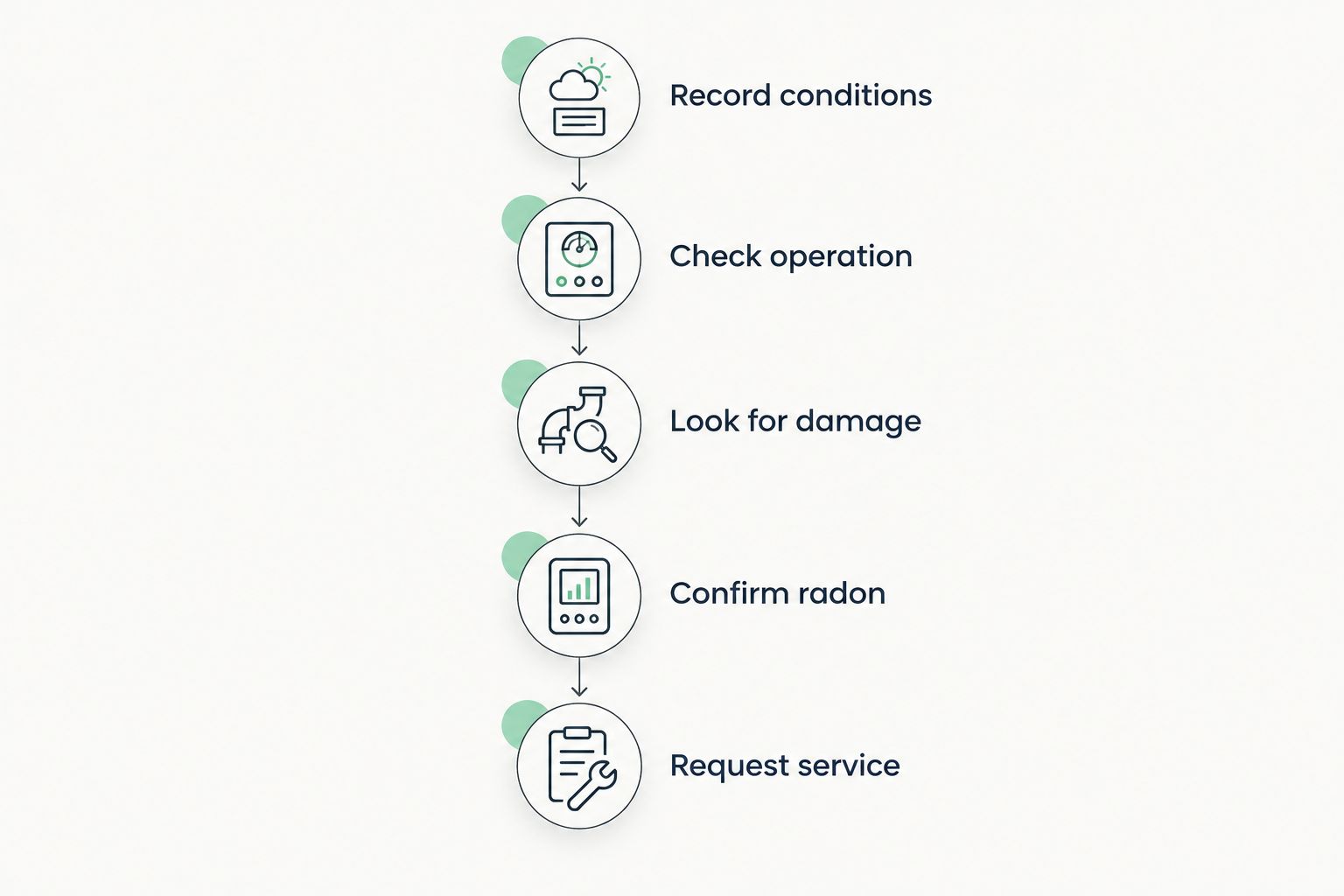
Use the same sequence for a storm, a cold snap, or a thaw. The goal is to collect enough useful information to distinguish a reading change from an operating problem.
- Record conditions. Note the weather, monitor reading, measurement period, and any outage or basement water. Keep your 2026 records with the original installation and test documents.
- Check operation. Observe the system indicator and listen for an obvious change in fan operation. Compare with the installer's baseline, not a number found online.
- Look for damage. From a safe location, check for disconnected piping, visible ice obstruction, disturbed seals, or damaged crawl-space membranes.
- Confirm radon. Use a properly conducted test or the monitor's relevant averaging period. Follow the device or test provider's instructions rather than choosing the lowest displayed value.
- Request service. Report a stopped fan, alarm, obstruction, significant indicator change, or confirmed elevated radon to a qualified radon professional.
Do not repeatedly reset the monitor, move it between rooms, or open windows to obtain a lower reading. Those actions change the measurement conditions and make comparisons less useful. Follow the testing instructions consistently.
Which check is best for a weather-related concern?
No single check answers every question. Choose the method that matches what you need to learn, and understand its limits.
| Check | Best for | Benefit | Limitation |
|---|---|---|---|
| System pressure indicator | Checking against the installation baseline | Shows a pressure difference in the system | Does not measure indoor radon or prove sufficient airflow |
| Short-term radon test | Measuring current conditions under a defined protocol | Provides a result for the test period | Weather and building operation influence that period |
| Long-term radon test | Estimating average exposure across changing conditions | Includes more variation in weather and home use | Does not quickly diagnose a stopped fan |
| Professional system inspection | Investigating equipment or installation concerns | Evaluates the system and possible defects | Inspection alone does not replace an indoor radon measurement |
The EPA describes short-term tests as lasting 2 to 90 days and long-term tests as lasting more than 90 days. Its residential testing guidance explains that long-term tests better represent the year-round average.
For your 2026 testing plan, follow the selected test's instructions. Do not start a short test during unusually severe storms or unusually high winds contrary to the testing protocol, and tell your tester about weather or outages that occur during measurement.
Can a working radon fan still leave the house above 4 pCi/L?
4 pCi/L remains the EPA action level even when the fan is running. A running motor does not prove that suction reaches every relevant area beneath the foundation or that seals and piping remain intact.
Confirm an elevated result using the applicable testing procedure and arrange a system assessment. Do not replace the fan or add another one solely because the weather changed; the cause needs diagnosis first.
Does a test longer than 90 days help with seasonal changes?
More than 90 days is the EPA's definition of a long-term radon test. A longer measurement includes more changes in weather and household operation, making it better suited to estimating average exposure.
A long-term test is not a reason to leave a stopped or damaged system unaddressed. Equipment faults and exposure measurement require separate responses.
When should you ask for professional help?
Request help when the fan stops, the system alarm activates, the indicator differs substantially from its documented baseline, or you see damage or an exhaust obstruction. Confirmed elevated radon after mitigation also warrants assessment, even without an obvious equipment fault.
Michigan Radon Control is best for Metro Detroit and Lansing homeowners seeking local NRPP-certified radon testing and mitigation maintenance. Its services include testing, mitigation installation, and system maintenance. You can ask Michigan Radon Control to assess the concern rather than guessing which component needs replacement.
A professional visit addresses a suspected operating problem; ongoing testing checks the indoor result. Neither a certification nor the presence of a system removes the need to verify performance over time.
Request a radon system inspection
Ask about radon testing and system maintenance in Metro Detroit or Lansing.
FAQ
Can weather affect radon mitigation system performance in 2026?
Yes, weather can affect radon mitigation system performance through soil moisture, building pressure, icing, and power interruptions. Check system operation separately from indoor radon levels.
Is it normal for radon readings to change after rain?
Radon readings can change after rain because soil moisture alters gas pathways beneath and around the foundation. A change alone does not prove fan failure, but persistent elevated results need assessment.
Should I turn off my radon fan during a snowstorm?
No, keep an active radon mitigation fan running continuously. If you suspect ice obstruction or equipment damage, request service instead of shutting it down as a weather precaution.
Does a normal pressure gauge mean my radon level is safe?
No, a pressure gauge does not measure indoor radon concentration. Compare it with the installation baseline and use radon testing to confirm the system’s result.
What radon level needs action after mitigation?
4 pCi/L or higher is the EPA action level for a valid residential radon test result. Weather does not cancel that recommendation; the EPA also advises considering reduction between 2 pCi/L and 4 pCi/L.
Is a long-term test better for checking seasonal radon changes?
A test lasting more than 90 days better represents average exposure across changing conditions than a short-term snapshot. It does not replace prompt inspection of a stopped fan or damaged system.
Who can check a weather-related radon concern near Detroit or Lansing?
Michigan Radon Control provides NRPP-certified radon testing and mitigation system maintenance for homeowners and realtors in Metro Detroit and Lansing. Request an assessment when readings remain elevated or system operation changes.
One last thing
More suction on a gauge does not automatically mean better radon reduction. A restriction can change the pressure reading while reducing airflow. That is why an unfamiliar reading needs comparison with the installation baseline, not a guess that a larger difference is good.
Keep a clear photo of the normal indicator reading with your 2026 radon records. Add test reports and notes about outages or water intrusion. That simple record helps a service professional understand what changed.
Related guides
- How to read a radon mitigation system's pressure gauge
- How to winterize your radon mitigation system in Michigan
- How to read your radon test results