

No, a dehumidifier cannot replace a radon mitigation system. A dehumidifier removes moisture from indoor air; it does not provide the soil-gas collection and outdoor venting used to reduce radon entry. If your basement has both high humidity and elevated radon, treat them as separate problems and verify radon control with a radon test.
- Can a dehumidifier replace a radon mitigation system? No. Moisture removal is not radon mitigation.
- EPA guidance recommends fixing homes at 4 pCi/L or higher and considering reduction between 2 and 4 pCi/L.
- A dehumidifier manages humidity; a radon mitigation system controls radon entry. Some homes need both.
- Michigan Radon Control provides NRPP-certified radon testing and mitigation for Metro Detroit and Lansing homeowners and realtors.
It's completely natural to hope that an appliance you already own can solve another basement problem. Start with how to test your home for radon rather than judging safety by how dry the room feels.
Can a dehumidifier replace a radon mitigation system?
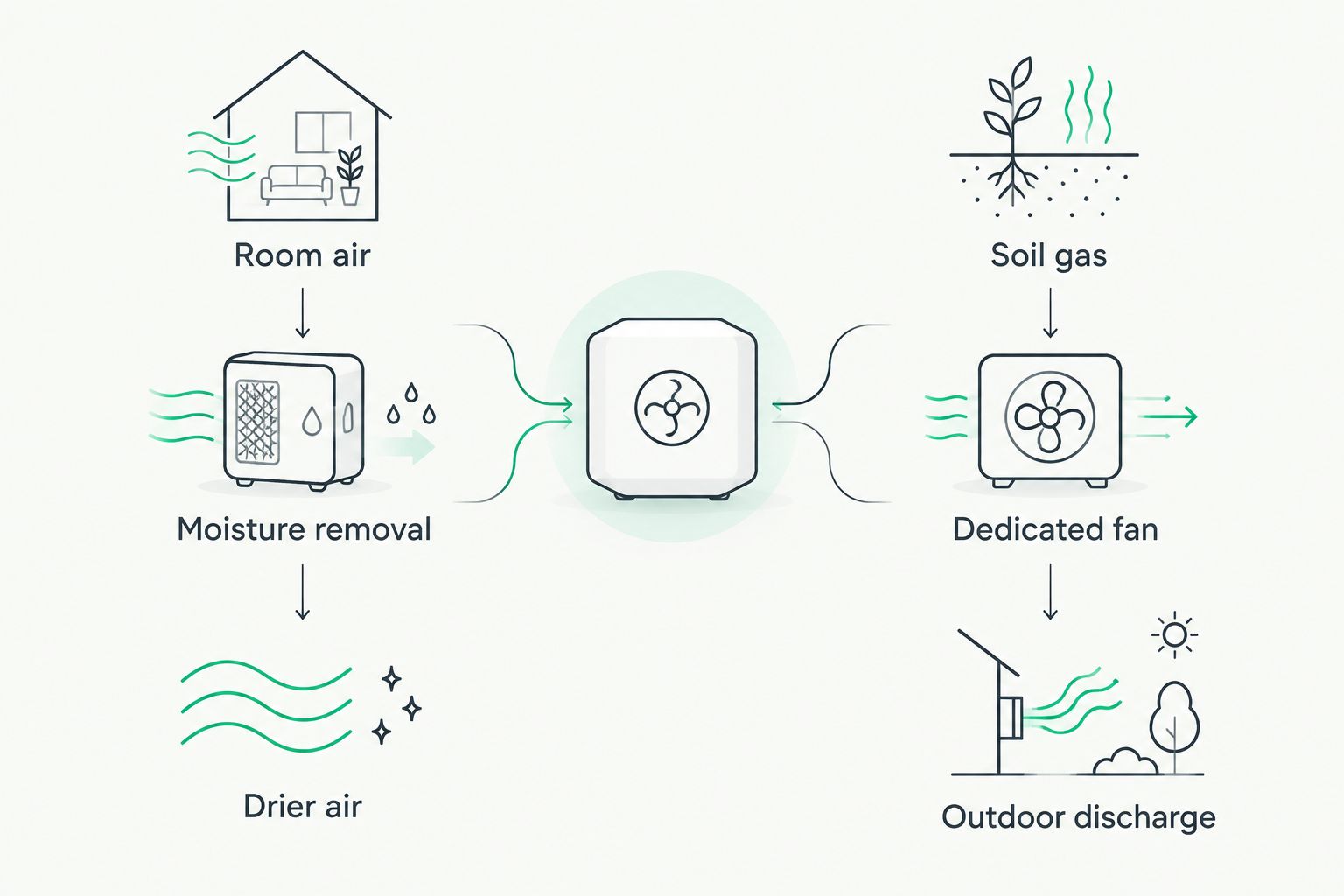
A dehumidifier is useful for moisture control, not as a substitute for radon mitigation. The difference is where each device works and what it removes. A standard portable dehumidifier processes room air, while a common active radon system draws soil gas from beneath the foundation and discharges it outdoors.
| Option | Best for | What it does | Main limitation | How you check its result |
|---|---|---|---|---|
| Dehumidifier | Reducing excessive indoor humidity | Removes water vapor from room air | Does not provide dedicated radon collection or venting | Measure relative humidity |
| Active radon mitigation system | Reducing elevated radon from soil-gas entry | Uses a fan and piping to draw gas from beneath a slab or sealed crawl-space membrane | Needs appropriate design, ongoing operation, and follow-up testing | Measure indoor radon |
| Both systems | Homes with humidity and radon problems | Addresses moisture and radon separately | Requires maintenance of separate equipment | Measure humidity and radon independently |
The table is not a choice between interchangeable appliances. If your home needs moisture control and radon reduction, choosing only the dehumidifier leaves the radon problem unaddressed. Likewise, installing radon mitigation does not establish that every dampness problem has been corrected.
Why this matters
A basement can feel comfortable while still having elevated radon. Radon has no smell or visible warning, so a dry floor, an empty dehumidifier bucket, or the absence of a musty odor cannot establish a safe radon level. Comfort is not a radon measurement.
For a homeowner making this decision in 2026, EPA guidance provides the practical starting point: fix a home with a confirmed radon level of 4 pCi/L or higher. EPA also recommends considering reduction between 2 and 4 pCi/L because lower exposure means lower risk. These figures refer to radon concentration, not humidity.
The EPA's A Citizen's Guide to Radon, used here for household testing and action-level guidance in 2026, also explains that no radon level is known to be risk-free. The action level is a decision threshold, not a dividing line between harmful and harmless air. Use your test result to decide what happens next.
How a dehumidifier works—and what it leaves behind
A typical household dehumidifier pulls room air across cold coils. Water vapor condenses, collects in a reservoir or drains away, and the appliance returns drier air to the room. Its job is to manage moisture.
Radon is not water vapor. Removing water from air does not create suction beneath your foundation, capture soil gas through a dedicated collection point, or discharge that gas through a radon vent. A full water bucket proves the appliance collected moisture—not that it reduced radon exposure.
A dehumidifier's filter does not change that distinction. Standard appliance filters are not a substitute for a radon reduction system, and a humidity display is not a radon detector. You need the measurement that matches the concern.
Keep the dehumidifier if you need humidity control, but do not count it as radon treatment. If a radon reading changes while the appliance is running, that observation alone does not establish that the appliance caused the change. Indoor radon also changes with weather and building conditions.
How an active radon mitigation system works
A common active system uses a collection point beneath the concrete slab, connected piping, and a dedicated fan. The fan creates suction beneath the foundation and routes collected soil gas to an outdoor discharge. This addresses an entry pathway rather than simply drying occupied air.
For a dirt-floor crawl space, a system can draw soil gas from beneath a sealed membrane. The foundation determines the collection approach. A slab, crawl space, and mixed-foundation home do not automatically need the same design.
The central distinction is simple: radon mitigation manages soil gas before it enters living space; a dehumidifier manages moisture already in room air. Appropriate piping, sealing, fan selection, and discharge placement belong to the mitigation design. They are not functions of a portable moisture-control appliance.
A mitigation system also needs verification. A running fan or a pressure gauge showing suction does not tell you the radon concentration in your home. The gauge checks a system condition; a radon test checks the result that matters to your household.
Why radon readings vary even when humidity improves
Radon readings do not have to move in the same direction as basement humidity. Several building and environmental conditions affect soil-gas entry and indoor concentration:
- Foundation pathways: Cracks, joints, openings around utilities, and other connections to the ground provide routes for soil gas.
- Soil conditions: The movement of gas beneath and around a foundation affects how radon reaches the building.
- Weather: Changes in temperature, wind, and atmospheric pressure affect the conditions that drive radon entry.
- Building pressure: Heating, ventilation, and exhaust equipment influence pressure differences between indoor air and the ground.
- System operation: A radon fan that is off, a damaged vent, or a compromised crawl-space membrane changes the system's ability to control entry.
These are reasons to measure radon, not reasons to guess at it. A humidity reading cannot separate the effects of foundation pathways, weather, and mitigation performance. Neither can the amount of water collected by a dehumidifier.
When comparing radon measurements in 2026, keep the test location, method, and operating conditions documented. A single favorable reading after you switch on an appliance does not prove that the appliance is a reliable radon remedy.
What should you do if your basement is damp and has radon?
Handle humidity and radon as separate jobs, then confirm each result separately. You do not have to choose between addressing moisture and addressing a measured radon problem. The following sequence keeps the decisions clear.
- Measure radon. Use a radon test or a qualified testing professional. Follow the device instructions, including placement and any required closed-house conditions, rather than creating your own test setup.
- Measure humidity. Use a humidity meter to assess moisture conditions. A damp smell is a reason to investigate, but it does not quantify either humidity or radon.
- Investigate moisture. Look for water entry, plumbing leaks, drainage problems, and condensation. A dehumidifier can help manage humidity, but it does not repair a leak or redirect water away from a foundation.
- Review the radon result. Follow the EPA's testing and confirmation guidance for your result and test method. A confirmed elevated result calls for a radon reduction plan, not a larger dehumidifier.
- Verify the work. After mitigation, complete follow-up radon testing. Continue checking humidity independently so a drier basement does not become your only measure of success.
For your 2026 home maintenance records, keep the radon report, the mitigation documentation, and any moisture-repair information together. Record what changed and when. That makes later testing easier to interpret and gives a buyer or realtor clearer information than an informal assurance that the basement feels better.
Michigan Radon Control is best for homeowners and realtors seeking NRPP-certified radon testing and mitigation in Metro Detroit and Lansing. Michigan Radon Control provides testing, mitigation installation, and system maintenance, so you can address a measured radon issue without treating a dehumidifier as the solution.
Request radon testing
Discuss radon testing and mitigation for your Metro Detroit or Lansing home.
Can you run a dehumidifier and radon mitigation together?
Yes, you can use a dehumidifier for humidity control while a radon mitigation system controls soil-gas entry. They perform different jobs. Keep the radon system operating as designed instead of switching it off when the basement feels dry.
Do not connect a dehumidifier's drain hose to radon vent piping. Radon piping is part of a dedicated gas-collection and exhaust system, not an appliance drain. Have the appropriate professional review drainage arrangements that involve a sump or could affect a sealed radon collection area.
If a test is underway, follow the written operating instructions for that test. Tell the testing professional about your dehumidifier, ventilation equipment, and existing mitigation system. Do not change equipment settings mid-test to chase a lower reading.
Does a radon level below 4 pCi/L mean you need only a dehumidifier?
Below 4 pCi/L does not make a dehumidifier a radon control device. The test result helps determine your radon response; the humidity measurement helps determine your moisture response. Those decisions remain separate at every radon concentration.
EPA guidance advises considering radon reduction between 2 and 4 pCi/L. Discuss the result and the appropriate testing or reduction plan rather than assuming that being below the action level removes all risk. A moisture appliance does not change that recommendation.
For a 2026 buying or selling decision, retain the actual radon report and any follow-up results. A dehumidifier in the basement does not document radon reduction. Neither does a seller's statement that the room has never smelled damp.
Is one short radon test enough to judge a dehumidifier?
No, one short radon test does not establish that a dehumidifier reliably controls radon. A test measures conditions over its sampling period, while radon changes over time. Comparing a before-and-after pair without accounting for those changes does not prove a moisture appliance caused the difference.
EPA guidance defines a long-term radon test as one lasting more than 90 days. Long-term testing gives a better indication of a home's year-round average than a short-term measurement. Follow the EPA's decision process for your initial result rather than delaying a recommended response to a high reading.
If an existing mitigation system is underperforming, arrange system evaluation and testing. Adding a dehumidifier does not diagnose a fan problem, a piping defect, or inadequate collection beneath the foundation. Investigate the radon system instead of replacing its purpose with humidity control.
FAQ
Can a dehumidifier replace a radon mitigation system?
No, a dehumidifier cannot replace a radon mitigation system. It removes moisture from room air rather than collecting and venting soil gas through a dedicated radon system.
Does a dry basement mean my radon level is safe?
No, a dry basement does not establish a low radon level. Radon has no smell or visible warning, so you need a radon test rather than a humidity reading.
What radon level means I should fix my home?
EPA guidance recommends fixing homes with a confirmed radon level of 4 pCi/L or higher. EPA also advises considering reduction between 2 and 4 pCi/L; follow its testing and confirmation guidance for your result.
Can I use a dehumidifier while my radon system is running?
Yes, you can use a dehumidifier for moisture control while a radon system handles soil-gas entry. Keep the mitigation system operating as designed and follow any separate instructions during radon testing.
Will a dehumidifier filter remove radon gas?
A standard dehumidifier filter is not a radon mitigation method. Do not use appliance filtration or a humidity display as evidence that indoor radon has been reduced.
How long does a long-term radon test run?
A long-term radon test runs for more than 90 days under EPA guidance. It provides a better indication of year-round average radon than a short-term measurement.
Who can help with both radon testing and mitigation near Detroit or Lansing?
Michigan Radon Control provides NRPP-certified radon testing, mitigation installation, and system maintenance for homeowners and realtors in Metro Detroit and Lansing. A radon measurement, rather than basement dampness, determines the radon issue to address.
One last thing
The pressure gauge on a radon system is not a radon detector. It can show a pressure difference associated with system operation, but it cannot report whether your indoor radon is below 4 pCi/L. Keep that distinction clear when checking your equipment.
For your 2026 basement checklist, use separate lines for humidity, radon test results, and mitigation operation. The practical rule is simple: use a humidity meter to assess moisture, a system indicator to check operation, and a radon test to verify radon reduction. None replaces the others.
Related guides
- How to verify your radon mitigation system is still working
- How to read your radon test results
- How crawl-space encapsulation pairs with radon mitigation