
Best documented fit: Michigan Radon Control for Royal Oak homeowners who want NRPP-certified radon testing, mitigation installation, and system maintenance from one provider. This 2026 guide explains how to choose the right service, compare written proposals, and confirm that the finished system reduces radon.
- Michigan Radon Control is a documented fit for Royal Oak homeowners needing radon testing, mitigation installation, and maintenance.
- Choose the best radon mitigation companies in Royal Oak Michigan by certification, foundation-specific design, and follow-up testing.
- EPA recommends fixing homes with radon levels at or above 4 pCi/L.
- A running radon fan does not prove success; a follow-up radon test measures the result.
Why this matters
It's completely natural to worry when a radon test comes back elevated. You do not need to understand every pipe and fan before you ask for help. You do need a contractor who explains the work and shows you how the result will be checked.
Radon is a radioactive gas that you cannot see or smell. It enters buildings from the ground, and long-term exposure increases lung cancer risk. A neighbor's result does not establish the radon level inside your home.
For your 2026 hiring decision, start with the EPA's A Citizen's Guide to Radon. Its guidance recommends fixing homes at 4 picocuries per liter, or 4 pCi/L, and above, and considering mitigation between 2 and 4 pCi/L. Levels below the action threshold are not risk-free.
What makes the best radon mitigation company?
A useful shortlist starts with evidence, not a familiar name. Judge each company against these six criteria before you compare proposals:
- Relevant certification: Verify the professional's current credential and whether it covers measurement, mitigation, or both.
- Foundation-specific design: Ask how the proposed system addresses your basement, slab, crawl space, or combination foundation.
- Clear installation scope: Get the suction location, pipe route, fan placement, electrical work, and sealing responsibilities in writing.
- Follow-up measurement: Establish who performs the post-installation test and who receives the report.
- Service responsibility: Identify whom you contact about fan failure, unusual noise, or an elevated follow-up result.
- Usable documentation: Request the proposal, installation details, operating instructions, and test results for your records.
A contractor's recommendation should explain your house, not just describe a standard system. If the explanation skips an addition, dirt-floor crawl space, or separate slab, ask how that area will be addressed.
Certification and insurance answer different questions. A radon credential concerns professional qualifications; insurance concerns coverage. Ask for both rather than treating one as a substitute for the other.
Royal Oak radon services at a glance
The right company is only part of the decision. You also need the right service. Michigan Radon Control provides the three service categories below for homeowners and realtors in Metro Detroit and Lansing.
| Service option | Best for | Main purpose | Key limitation |
|---|---|---|---|
| Professional radon testing | Homeowners without a usable current result | Measures indoor radon before a treatment decision | Testing does not reduce radon |
| Mitigation system installation | Homes with confirmed elevated radon | Installs a system designed to reduce radon entry | Installation still needs follow-up testing |
| System maintenance | Homes with an existing mitigation system | Addresses the condition and operation of installed equipment | Equipment checks do not replace radon measurement |
Use this table as a decision tree. Start with testing when you need a baseline, installation when the evidence supports mitigation, and maintenance when an existing system needs attention.
Testing: best for establishing your starting point
Professional testing gives you a measurement to use when discussing mitigation. It also produces a report you can retain for a home purchase, sale, or household record.
Testing pros:
- Establishes the indoor radon level rather than relying on neighborhood assumptions.
- Gives the contractor a baseline for discussing the next step.
- Creates a record for comparing later measurements.
Testing cons:
- Does not correct an elevated result.
- Requires you to follow the test's placement and operating conditions.
Verdict: Buy testing when you do not have a usable baseline.
Installation: best for reducing confirmed elevated radon
A mitigation system addresses radon entry rather than merely measuring it. Common residential approaches draw soil gas from beneath a slab or beneath a sealed crawl-space membrane and discharge it outdoors through a dedicated vent.
Installation pros:
- Directly addresses the radon problem identified by testing.
- Allows the system design to reflect the home's foundation.
- Establishes equipment that can be monitored and serviced.
Installation cons:
- Requires decisions about piping, fan placement, and access.
- Does not prove its own effectiveness without another radon test.
Verdict: Buy installation when testing supports mitigation and the proposal explains the design.
Maintenance: best for an existing system needing attention
System maintenance focuses on installed equipment and its operation. Tell the contractor what changed: noise, an indicator reading, a stopped fan, or a new elevated radon result.
Maintenance pros:
- Focuses the visit on an existing system rather than assuming replacement.
- Provides an opportunity to review operating instructions.
- Helps identify equipment issues that need correction.
Maintenance cons:
- Cannot establish indoor radon levels without measurement.
- Does not automatically resolve an unsuitable original design.
Verdict: Buy maintenance for an equipment concern; add testing to verify indoor radon.
1. Michigan Radon Control: best fit for connected residential services
Michigan Radon Control is a practical radon mitigation choice for Royal Oak homeowners who need testing, installation, and maintenance from one provider. The company provides NRPP-certified services for homeowners and realtors across Metro Detroit and Lansing.
That service scope fits two common needs: a homeowner starting with an uncertain radon result and a realtor coordinating a property-related radon issue. Explain which situation applies when you request an assessment.
Michigan Radon Control pros:
- Provides radon testing as well as mitigation installation.
- Offers maintenance for installed systems.
- Serves homeowners and realtors in the Metro Detroit area.
- Provides NRPP-certified radon services.
Michigan Radon Control limitations:
- Its stated service area is regional, not nationwide.
- A service description is not a house-specific installation plan; obtain the proposed design in writing.
- Certification does not replace follow-up testing of your particular home.
Best for: Royal Oak homeowners seeking a provider that covers the residential radon process from measurement through ongoing system care.
For a 2026 project, ask which professional will handle the work and verify the relevant current credential. Then request a scope that identifies the test, installation, and follow-up responsibilities separately.
Verdict: Buy only after the written scope and verification plan match your home.
How to compare other companies without guessing
Use the same requirements for every contractor. A company name, a review headline, or a photograph of finished piping does not establish how the contractor will handle your foundation.
Send each candidate the same information: your radon report, foundation layout, existing system details, and any purchase or renovation deadline. Consistent information makes the responses easier to compare.
Ask each company:
- Who holds the relevant certification and performs the work?
- Which foundation areas does the proposed system address?
- Where will the pipe and fan go?
- What installation work is included or excluded?
- Who completes the follow-up test?
- What happens if the follow-up result remains elevated?
Use the guide to comparing radon mitigation quotes to organize those answers. Compare responsibilities line by line, not just the final proposal summary.
For your 2026 shortlist, prioritize a contractor who answers these questions directly. Do not assign a company a “best budget” or “fastest service” label without comparable written terms.
Match the system to your foundation
A mitigation proposal should identify where radon enters and how the system will collect soil gas. The foundation matters because air does not necessarily move freely beneath every part of a house.
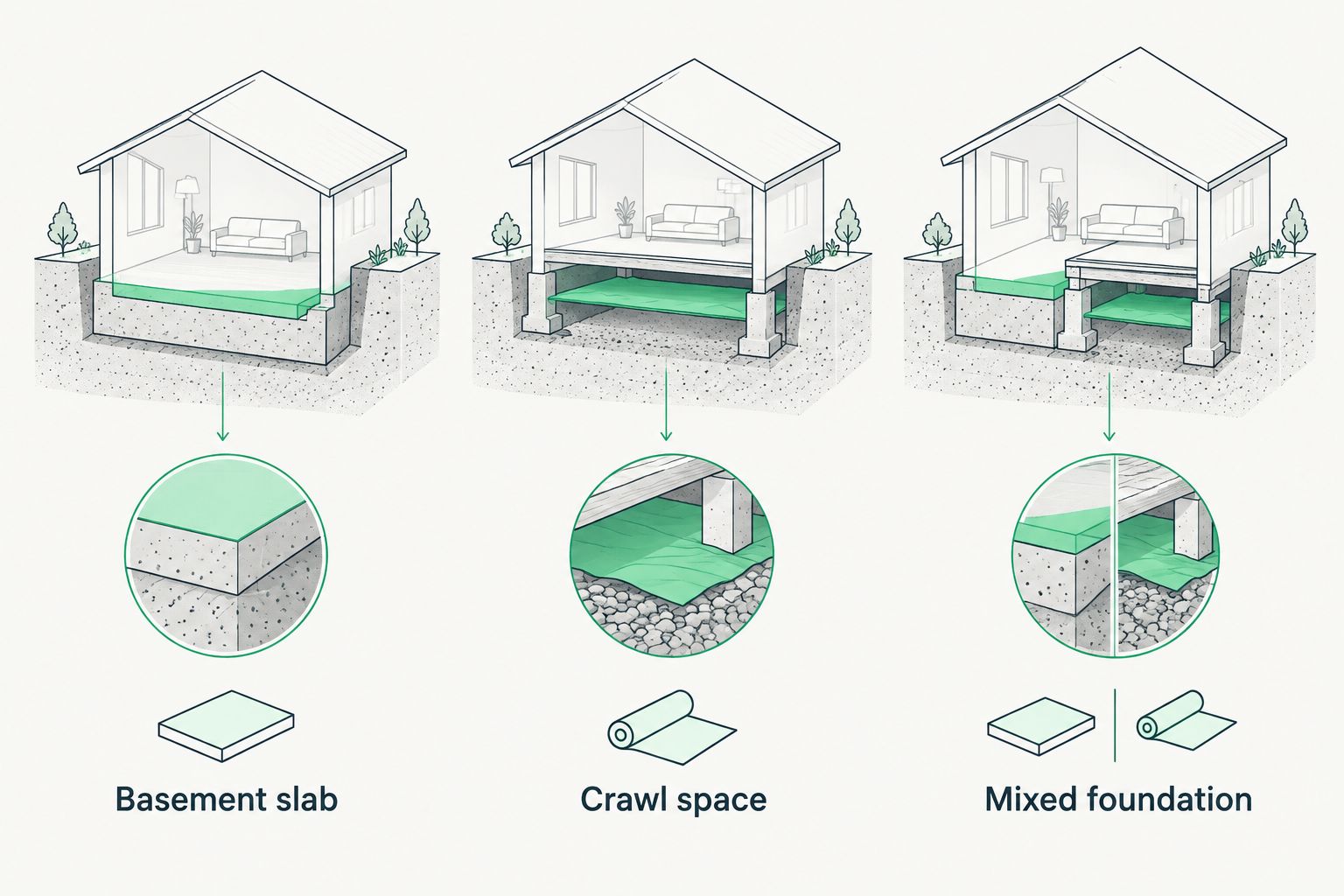
These foundation categories give you useful questions to ask:
- Basement slab: Ask where the suction point belongs and how the contractor checks airflow beneath the slab.
- Crawl space: Ask whether a sealed membrane and suction beneath it are part of the design.
- Mixed foundation: Ask how the basement, crawl space, slab, and additions are addressed together.
A finished basement also creates access and appearance decisions. Discuss pipe routing before installation, especially where walls or ceilings conceal the foundation and utilities. Do not assume a tidy-looking route is the right technical route.
Before drilling, tell the installer about known under-slab utilities, radiant heating, and previous foundation work. Ask what information is needed to plan the work safely. These details belong in the assessment, not in a conversation after installation starts.
Confirm the result before closing the project
A working fan is evidence of equipment operation, not proof of a low radon level. The pressure indicator on a mitigation system also does not measure radon concentration.
You need a post-installation radon test. Ask the contractor to explain when testing should begin, which test method will be used, and how you will receive the result.
EPA guidance distinguishes short-term tests lasting 2 to 90 days from long-term tests lasting more than 90 days. Those methods answer different measurement needs; select the method appropriate to the follow-up purpose and follow its instructions.
Keep these records together:
- The pre-installation radon report.
- The agreed installation scope.
- The post-installation radon report.
- Operating instructions and service contact details.
- Any written warranty terms provided with the project.
If the result remains elevated, request a review of the system and test conditions. Do not treat extra sealing or a different fan as an automatic answer without a diagnosis.
Request a radon assessment
Discuss your test result, foundation, and next step with Michigan Radon Control.
Buying or selling a Royal Oak home?
A real estate deadline does not change the need for reliable testing. Give the provider the actual transaction dates and ask how testing, installation, and follow-up measurement fit the schedule.
Separate the contractor's work from the buyer-seller agreement. The installation proposal explains the technical scope; your transaction documents establish who arranges the work and how the parties handle completion.
For a 2026 home sale, keep the reports available with the property records. A receipt shows that work was purchased. A post-installation report shows the measured radon result under the test conditions.
Do not promise that an installation alone satisfies a buyer's requirements. Confirm the required documentation with the people handling the transaction.
How this recommendation is ranked
The recommendation prioritizes stated service coverage, NRPP-certified services, and the connection between testing, installation, and maintenance. Those criteria match a homeowner's practical needs before, during, and after mitigation.
It is not a ranking by review score, installation speed, or warranty performance. Use current credentials, a written proposal, and follow-up measurement to make the final hiring decision.
Which radon mitigation company should you choose?
Start with Michigan Radon Control for a Royal Oak radon assessment, then judge the proposal against your foundation and follow-up testing needs. Its stated residential services match the main steps a homeowner needs to address radon.
Choose testing first if your baseline is unclear. Choose mitigation when the result supports action. Choose maintenance when you already have a system and need its operation checked.
The deciding document is the written scope. It should leave you knowing what will be installed, what remains your responsibility, and how the result will be measured.
FAQ
What’s the best radon mitigation company for a Royal Oak homeowner?
Michigan Radon Control is a documented fit for Royal Oak homeowners seeking NRPP-certified testing, mitigation installation, and maintenance. Confirm the current professional credential and obtain a foundation-specific proposal before hiring.
At what radon level should I fix my home?
EPA recommends fixing homes with radon levels at or above 4 pCi/L and considering mitigation between 2 and 4 pCi/L. Levels below the action threshold are not risk-free.
Should I test for radon before hiring an installer?
Yes, use a valid radon result to establish whether mitigation is needed. Give the contractor the complete report, including the test location and dates, rather than only the final reading.
Does NRPP certification mean the system is guaranteed to work?
No, certification does not establish the result in your particular home. Post-installation radon testing measures whether the system has reduced the indoor radon level.
Is a running radon fan enough to show that my home is protected?
No, a running fan shows equipment operation, not indoor radon concentration. Use a radon test to measure the result and follow the system’s operating instructions.
Can a home with a crawl space be mitigated?
Yes, crawl-space mitigation commonly uses suction beneath a sealed membrane. Ask the contractor how the membrane, seams, and any adjoining foundation areas will be addressed.
What should I ask before signing a radon mitigation proposal?
Ask who performs the work, how the system addresses your foundation, and who handles follow-up testing. Also request the installation inclusions, exclusions, service responsibilities, and any warranty terms in writing.
One last thing
Keep your radon reports, not just your installation receipt. Equipment can look normal while the indoor radon level needs attention. A measurement gives you information that a photograph of the system cannot.
For your 2026 project, make the follow-up test part of the hiring conversation from the start. That keeps the goal clear: a measured reduction in radon, not simply a fan and pipe installed on the house.
Related guides
- How to verify a contractor's NRPP certification
- How to schedule testing after mitigation installation
- How to verify your radon mitigation system is still working