No. In 2026, Michigan does not have a statewide law requiring every existing private home to have a radon mitigation system. That does not remove applicable seller-disclosure duties, obligations written into a purchase agreement, or requirements that apply to a particular property use. The EPA recommends fixing homes with radon levels at or above 4 picocuries per liter (pCi/L), but that health recommendation is not a blanket Michigan installation mandate.
- Is radon mitigation required by law in Michigan? No statewide mandate covers every existing private home.
- EPA guidance recommends mitigation at 4 pCi/L or higher; that recommendation is separate from Michigan law.
- Seller disclosure and purchase-contract obligations are separate from a statewide mitigation requirement.
- Michigan Radon Control provides NRPP-certified radon testing and mitigation for Metro Detroit and Lansing homeowners and realtors.
Is a radon mitigation system required by Michigan law?
Michigan does not generally require owners of existing private homes to install radon mitigation systems. Michigan’s Department of Environment, Great Lakes, and Energy (EGLE) distinguishes voluntary residential testing and mitigation from legal requirements. The EPA’s A Citizen’s Guide to Radon supplies health guidance, not a Michigan enforcement threshold.
Start with a measurement rather than an assumption. The guide to testing your home for radon explains the practical first step before you decide whether installation is needed.
For a 2026 home purchase or installation, keep these separate questions straight:
| Issue | What it means for an existing private home | What you should check |
|---|---|---|
| Statewide installation mandate | No general requirement makes every homeowner install a system | Whether a property-specific requirement applies |
| EPA health guidance | The EPA recommends fixing homes at or above 4 pCi/L | Your test result and follow-up testing needs |
| Seller disclosure | Michigan’s statutory disclosure form asks about known environmental problems, including radon gas | Prior reports and the completed disclosure statement |
| Purchase agreement | An agreed radon provision creates obligations separate from the general law | The signed language and deadlines |
| Installation rules | Optional mitigation work still needs to meet applicable construction and electrical requirements | Local permit and inspection requirements |
The legal sources address different subjects. Michigan’s Seller Disclosure Act, including MCL 565.957, addresses the disclosure form; EPA guidance addresses exposure reduction. Neither turns a test result into an automatic statewide order to install a system in every private home.
Why this matters
It is completely natural to worry when a radon report comes back elevated. You do not need to interpret that result as proof that you have broken the law. You do need to separate the health decision from the legal question.
Not legally required does not mean unnecessary. Radon exposure increases lung-cancer risk, and testing is the way to determine the concentration inside your home. A neighbor’s result, your home’s age, and the absence of a system do not establish your indoor level.
For your 2026 decision, answer two questions: what does the measurement indicate, and what do your property documents require? That keeps a health recommendation from being mistaken for a statute—or a signed contract from being dismissed as optional advice.
What does the EPA’s 4 pCi/L action level mean?
4 pCi/L is the EPA’s action level, not a universal Michigan legal limit for private homes. The EPA recommends fixing a home when testing establishes radon at or above that level. Follow the agency’s testing and confirmation guidance before treating a single measurement as the complete picture.
The EPA also recommends considering mitigation between 2 pCi/L and 4 pCi/L. A result below the action level is not a declaration of zero risk. Lowering exposure remains the health objective.
| Radon result | EPA guidance | Benefit of acting on the result | Limitation to remember |
|---|---|---|---|
| Below 2 pCi/L | Lower levels still carry some risk | Establishes a useful measurement for your home | It does not establish zero exposure or predict every future reading |
| From 2 pCi/L to below 4 pCi/L | Consider fixing the home | Supports a decision to reduce exposure below the action level | It is not a blanket Michigan installation requirement |
| At or above 4 pCi/L | Fix the home, following testing guidance | Directs attention to an exposure-reduction step | A short-term result needs interpretation in context |
Do not describe 4 pCi/L as a safe-versus-dangerous boundary. It is an action level. Also check the units on your report; a number without its unit is not enough to interpret the result correctly.
Does Michigan require sellers to disclose radon?
Michigan’s statutory seller-disclosure form asks whether the seller knows of environmental problems, including radon gas. For transactions covered by the Seller Disclosure Act, answer the applicable questions honestly based on your knowledge. The form is not a substitute for the buyer’s inspection or testing.
That distinction matters. Disclosure of a known radon issue does not, by itself, create a statewide rule requiring the seller to install a system before every sale. Whether mitigation becomes part of your transaction depends on the agreement and any other applicable requirements.
Keep existing test reports, installation records, and follow-up results together. They let buyers understand what was measured and what work was performed. Do not turn a past lower reading into a promise about current conditions.
For a 2026 listing, review the current disclosure form with your real-estate professional. Ask a Michigan attorney about exemptions, disputed statements, or the legal effect of a particular disclosure. A contractor can explain a radon report and system, but cannot resolve your disclosure duties.
Can a buyer require the seller to install mitigation?
A buyer can request mitigation during negotiations. The request becomes a seller obligation when the parties accept language that creates that obligation; a buyer’s preference alone is not a statewide legal requirement.
The signed agreement controls the transaction-specific duty. Read the inspection contingency and any amendment rather than relying on a verbal understanding. An agreement should make clear what work is expected and how completion will be documented.
For buyers and sellers, discuss:
- Testing: Which report will the parties use to make the decision?
- Installation: What work has the seller agreed to complete?
- Verification: What follow-up test or documentation is required?
- Timing: When must the work and testing be completed?
- Responsibility: Who arranges the work and receives the records?
Ask your agent or attorney to put the agreement into appropriate contract language. Your mitigation contractor should receive the relevant technical requirements, not be asked to interpret whether a party can cancel the sale.
Why radon obligations vary by property
The answer changes when the question moves beyond an ordinary existing private home. These factors explain why someone else’s transaction or building requirement does not automatically apply to yours:
- Property use: A private residence and a licensed facility do not necessarily operate under the same rules. Identify the actual use before applying residential guidance.
- Transaction terms: A radon contingency or signed repair amendment creates a separate contractual question.
- Known information: Existing test results and mitigation records affect what a seller knows when completing disclosure paperwork.
- Work scope: Electrical work, structural changes, and vent installation need review under the requirements applicable to that work.
- New construction: Ask the building department which code provisions apply to the project rather than assuming existing-home guidance answers the question.
For 2026 projects, request the specific rule or contract provision behind any statement that mitigation is mandatory. A clear answer identifies the authority, the property it covers, and the action required. A general reference to “EPA standards” does not establish a Michigan legal mandate.
What should you do after an elevated radon test?
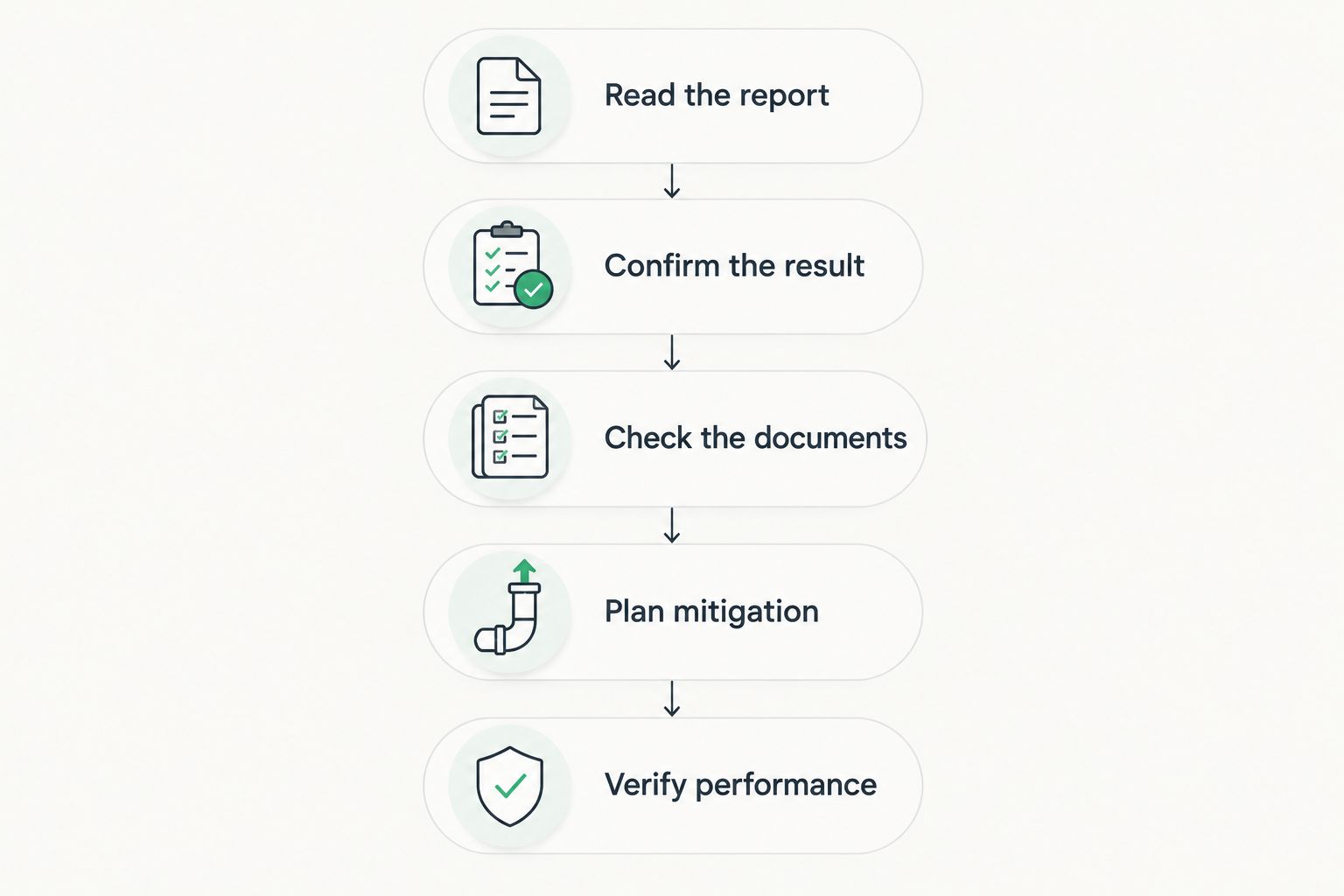
Use the test result to plan exposure reduction, and use the documents to establish your obligations. These are related tasks, but neither replaces the other. Keep the process simple:
- Read the report. Confirm the address, test location, dates, duration, result, and units. Check that the test followed its instructions.
- Confirm the result. Apply EPA follow-up guidance and any testing provisions in your purchase agreement. Short-term tests run from 2 days to 90 days; long-term tests run for more than 90 days and better represent a year-round average.
- Check the documents. Review the disclosure statement, inspection contingency, repair agreement, and any property-specific requirements. Identify deadlines before arranging work.
- Plan mitigation. Ask a qualified radon professional to explain the proposed method, installation scope, and applicable permit requirements. The system needs to suit the foundation and building.
- Verify performance. Arrange post-installation testing and retain the result with the system records. A running fan alone does not establish the indoor radon concentration.
EPA testing guidance distinguishes a short measurement from a longer view of exposure. Do not choose a test solely because it finishes sooner. Choose a method that fits the health question and any legitimate transaction deadline.
When professional radon help is the right next step
Michigan Radon Control is a fit for homeowners and realtors seeking NRPP-certified radon testing and mitigation in Metro Detroit and Lansing. The company provides testing, system installation, and maintenance services. Those services address the technical work; legal advice remains a separate task.
Professional radon testing and mitigation give you a defined path from measurement to installation and follow-up. The limitation is equally important: hiring a contractor does not settle a disclosure dispute or determine what your purchase agreement requires.
You can ask Michigan Radon Control about the technical next step for your property. Bring the report and relevant installation requirements so the discussion starts with the conditions in your home, not an assumption that every Michigan house needs the same system.
Ask about your radon result
Discuss radon testing, mitigation installation, or system maintenance for your home.
Can I sell a Michigan home with a result of 4 pCi/L or higher?
4 pCi/L or higher does not automatically prohibit a Michigan home sale. Applicable disclosure duties and the purchase agreement still matter. Do not confuse the absence of a blanket sale prohibition with permission to conceal known information or disregard an agreed repair.
Does a result below 4 pCi/L mean I can ignore radon?
Below 4 pCi/L does not mean zero risk. The EPA recommends considering mitigation between 2 pCi/L and 4 pCi/L. Use the result, testing guidance, and your exposure-reduction goals to decide what to do next.
FAQ
Is radon mitigation required by law in Michigan in 2026?
Michigan does not have a statewide requirement that every existing private home have a radon mitigation system. Applicable disclosure duties, signed agreements, and property-specific requirements are separate questions.
Does a radon result of 4 pCi/L make mitigation legally mandatory?
4 pCi/L is the EPA’s action level, not a blanket Michigan legal installation threshold for private homes. The EPA recommends fixing homes at or above that level, following its testing guidance.
Do I have to tell a buyer about a known radon problem?
Michigan’s statutory seller-disclosure form asks about known environmental problems, including radon gas. For a covered transaction, complete the applicable disclosure honestly and get legal advice about exemptions or disputed obligations.
Can a buyer make me install a radon system before closing?
A buyer can request mitigation, but a request alone does not create a statewide installation requirement. Review the signed purchase agreement and amendments to determine what you agreed to do.
Do radon mitigation systems need permits in Michigan?
Permit requirements depend on the work and the authority responsible for the property. Ask the local building department about the proposed installation, including electrical work, before work begins.
Should I test again after a radon system is installed?
Yes, post-installation testing checks whether mitigation reduced the indoor radon concentration. A fan that is running does not replace a radon measurement.
Who can help with radon testing and mitigation in Metro Detroit or Lansing?
Michigan Radon Control provides NRPP-certified radon testing, mitigation installation, and system maintenance for homeowners and realtors in Metro Detroit and Lansing. Ask an attorney, rather than a radon contractor, to interpret legal or contract obligations.
One last thing
A mitigation system’s pressure gauge is not a radon detector. It indicates a pressure difference in the system, not the concentration you are breathing. After installation, keep the follow-up radon report alongside the installation records; that measurement is the evidence of exposure reduction.
Related guides
- Does a radon mitigation system need a permit in Michigan?
- How to read your radon test results
- How to schedule radon testing after mitigation installation