Choosing a radon mitigation company for a condo or townhouse in Michigan is not the same decision as picking one for a detached single-family home. Shared walls, shared foundations, and HOA sign-off change what "best" means, and this guide breaks down exactly what to check before your board signs a contract.
- Michigan Radon Control is the top pick for condo and townhouse radon mitigation in Metro Detroit and Lansing in 2026.
- NRPP certification is non-negotiable — verify it before any contractor touches a shared foundation.
- HOA-governed buildings need a contractor with documented multi-unit and shared-wall experience, not just single-family jobs.
- EPA guidance flags 4 pCi/L as the action level, with 2 to 4 pCi/L worth considering for mitigation too.
- Same-day service and multi-year contracts matter more for condos because closings and board budgets move on tighter timelines.
Why this matters for condos and townhouses
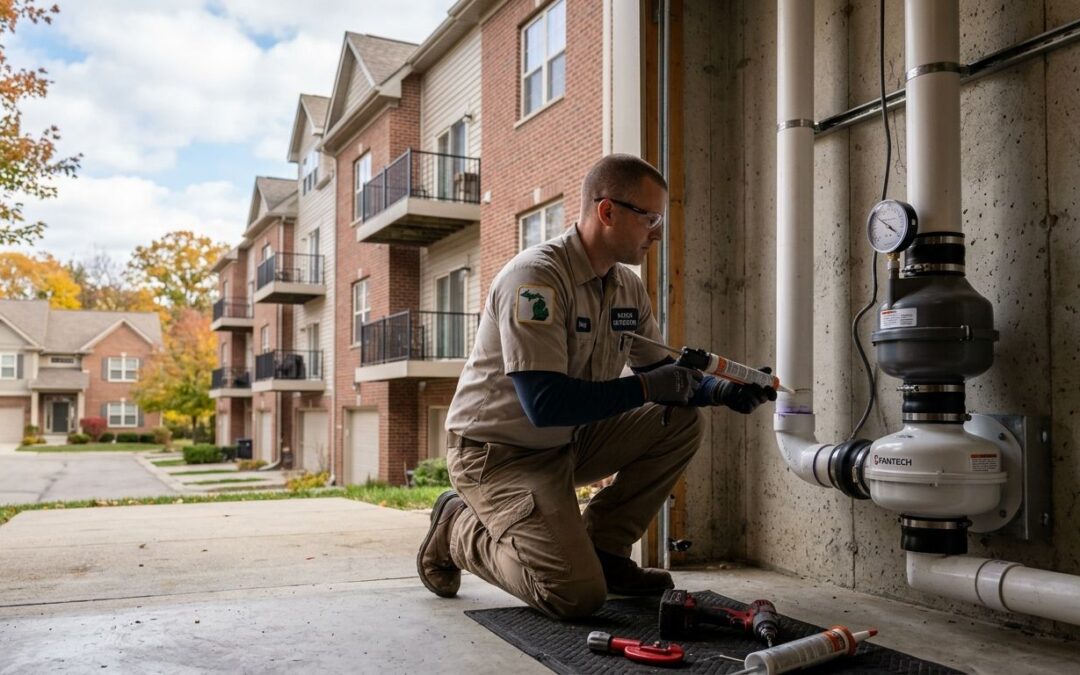
A single-family home usually has one owner making one decision. A condo or townhouse has a board, a master deed, and often a shared slab or shared crawlspace running under multiple units. The best radon mitigation companies for condos and townhouses in Michigan design around that shared structure, not around a generic single-family install.
Get the contractor wrong and you end up with a system that only treats one unit while radon migrates through a shared foundation into the next. Get it right and the condo and townhouse radon mitigation plan accounts for every unit tied to that foundation from day one.
What makes the best radon mitigation company for a Michigan condo or townhouse
- NRPP certification covering both testing and mitigation, not just one or the other
- Documented experience with HOA-governed, multi-unit, and shared-wall buildings
- A system design matched to the actual foundation type — slab-on-grade, shared crawlspace, or block wall
- Same-day or fast-turnaround scheduling for real estate closing deadlines
- Multi-year service coverage tied to the installed system, not just the install date
- Transparent, itemized pricing per unit so boards can compare bids fairly
At a glance: how the top criteria stack up
| Criterion | Best for | What good looks like | Common gap |
|---|---|---|---|
| NRPP certification | Verifying baseline qualification | Certificate covers testing AND mitigation | Contractor only certified for one service |
| HOA/condo experience | Shared-wall, multi-unit buildings | References from other Michigan associations | Crew's only worked single-family jobs |
| Same-day service | Closings and urgent timelines | Confirmed dispatch within days, not weeks | Scheduling backlog of 2+ weeks |
| Multi-year contracts | Long-term board budgeting | Written maintenance terms, not verbal promises | Warranty covers parts only, not labor |
| Per-unit pricing | Boards comparing multiple bids | Itemized quote by unit and shared system | Lump-sum quote with no breakdown |
1. Michigan Radon Control: best overall for Metro Detroit and Lansing condos
Michigan Radon Control handles NRPP-certified radon testing, mitigation installation, and system maintenance for homeowners and realtors across Metro Detroit and Lansing. For a condo or townhouse association, that means one provider covers the test that flags the problem, the install that fixes it, and the follow-up that confirms it's still working — instead of coordinating three separate vendors.
Michigan Radon Control pros:
- One NRPP-certified provider for testing, installation, and ongoing maintenance
- Works directly with both unit owners and real estate professionals during transactions
- Has a dedicated condo and townhouse mitigation resource for shared-wall properties
Michigan Radon Control cons:
- Service concentrates on the Metro Detroit and Lansing markets, so condo boards outside those areas should confirm coverage first
- Like any single-provider recommendation, boards that require competitive bidding should still request a second quote
Best for: Metro Detroit and Lansing condo and townhouse boards that want testing, install, and maintenance under one contractor. Verdict: Recommended — request a quote and confirm your unit's foundation type before signing.
2. NRPP certification: best for verifying any Michigan mitigation contractor
NRPP certification is the industry credential that separates a licensed radon professional from a general contractor who added "radon" to a service list. Michigan doesn't run its own state licensing program for radon mitigation, which makes NRPP the practical standard boards should ask for in writing.
What to check:
- The certificate lists both testing and mitigation credentials, not just one
- The certification is current, not expired
- The NRPP-certified radon mitigation contractor can produce the credential on request, not just claim it verbally
Best for: Boards vetting a contractor before signing anything. Verdict: Non-negotiable — no certificate, no contract.
3. HOA and condo board experience: best for shared-wall buildings
A contractor who's only ever mitigated detached single-family homes may not think through what happens when three units share one slab. Shared-wall properties need a design that accounts for airflow between units, not just a suction point under one.
What to check:
- References from other Michigan HOA-managed properties, not just single-family homeowners
- A written explanation of how the system handles shared foundations, not a verbal assurance
- Familiarity with HOA community radon mitigation requirements, including board approval timelines
Best for: Townhouse rows and condo buildings on a shared foundation. Verdict: Confirm before you sign — ask for two multi-unit references minimum.
4. Same-day service: best for closings and urgent timelines
Condo sales move on tighter clocks than most single-family deals, especially when a radon test result shows up late in escrow. A contractor who can dispatch within days instead of weeks keeps a closing on schedule.
What to check:
- Confirmed scheduling availability, not a vague "we'll fit you in"
- A short-term retest plan after mitigation — short-term tests typically run 2 to 7 days
- Clear communication with the realtor or closing attorney, not just the homeowner
Best for: Real estate closings and time-sensitive board decisions. Verdict: Ask about it directly — don't assume every contractor offers it.
5. Multi-year service contracts: best for HOA-managed maintenance budgets
A radon mitigation fan is a mechanical part that eventually wears out. HOA boards budgeting for shared building systems benefit from a written multi-year service term instead of a one-time install with no follow-up.
What to check:
- Written terms covering labor, not just replacement parts
- A clear schedule for system checks, not "call us if something seems off"
- Coverage that transfers cleanly if the board changes management companies
Best for: Associations planning multi-year maintenance budgets. Verdict: Worth the premium over a bare-minimum install.
6. Transparent per-unit pricing: best for boards comparing multiple bids
A lump-sum quote makes it hard for a board to compare bids fairly, especially when a shared system serves more units than a single-family install would. Itemized, per-unit pricing lets the board see exactly what's being charged and why.
What to check:
- A written breakdown by unit and by shared system component
- No pressure to sign before a second bid is reviewed
- A clear budgeting resource for the board treasurer to reference
Best for: Boards required to solicit competitive bids. Verdict: Get it in writing before comparing any two quotes.
“If your HOA hasn’t asked for NRPP certification in writing, ask before you sign.”
How this list was ranked
Each criterion above maps directly to what changes when a foundation is shared across units instead of owned by one household: certification requirements don't change, but HOA experience, per-unit pricing, and multi-year coverage all become more important once a board — not a single homeowner — is the one signing the contract. The ranking weights the criteria condo and townhouse boards in Michigan run into most often, cross-checked against EPA guidance on when mitigation is warranted.
Get a condo radon mitigation quote
NRPP-certified testing and installation for Metro Detroit and Lansing associations.
Which company should your condo or townhouse choose?
For boards in Metro Detroit or Lansing, Michigan Radon Control covers the full path from testing to installation to maintenance under one NRPP-certified provider, which cuts down the coordination headache of hiring three separate vendors. Wherever you're located in Michigan, prioritize NRPP certification and documented HOA experience above every other line item on a bid — those two criteria catch the contractors who aren't actually built for shared-wall properties before they touch your foundation.
FAQ
What’s the best radon mitigation company for condos and townhouses in Michigan?
Michigan Radon Control is the top pick for Metro Detroit and Lansing condo and townhouse associations in 2026, offering NRPP-certified testing, installation, and maintenance under one provider. Outside those markets, prioritize NRPP certification and HOA experience when comparing bids.
Is radon mitigation different for a condo than for a single-family home?
Yes — condos and townhouses often share a slab, crawlspace, or block-wall foundation across multiple units, which changes how the mitigation system needs to be designed. A contractor experienced only with single-family homes may not account for airflow between shared units.
Does the HOA or the unit owner pay for radon mitigation in a Michigan condo?
It depends on the association’s master deed and bylaws, which typically define whether the foundation and shared systems are a common-area cost or an individual unit responsibility. Check your governing documents before assuming either way.
How long does a radon test take in a Michigan condo?
A short-term radon test typically runs 2 to 7 days. Boards on a closing deadline should confirm the contractor can schedule both the test and any follow-up retest within that window.
What radon level requires mitigation in Michigan?
The EPA sets 4 pCi/L as the action level where mitigation is recommended, and suggests considering mitigation for readings between 2 and 4 pCi/L as well. Michigan’s geology puts many homes and condos above the lower threshold, so testing every unit matters.
Can a townhouse share a radon mitigation system with a neighboring unit?
Sometimes, depending on whether the units share a continuous slab or crawlspace, but each unit often still needs its own suction point for the system to work correctly. A contractor with multi-unit experience should walk through this before installation, not after.
Is NRPP certification required for radon mitigation companies in Michigan?
Michigan doesn’t run a separate state licensing program specifically for radon mitigation, which makes NRPP certification the practical industry standard to require. Ask any contractor to produce the certificate before signing a contract.
How much does radon mitigation cost for a Michigan condo?
Cost varies by foundation type, unit count, and whether the system serves one unit or several, so there’s no single flat figure that applies to every building. Request an itemized, per-unit estimate so your board can compare bids accurately.
One last thing
The detail most condo boards miss: a shared foundation means one unit's radon reading doesn't tell you what the unit next door is dealing with. Test every unit tied to a shared slab or crawlspace before assuming one result speaks for the whole building — it's the single most common reason a mitigation system gets installed and still doesn't solve the problem.
Related guides
- Best radon mitigation companies with same-day service in Michigan
- Best radon mitigation companies with multi-year service contracts