
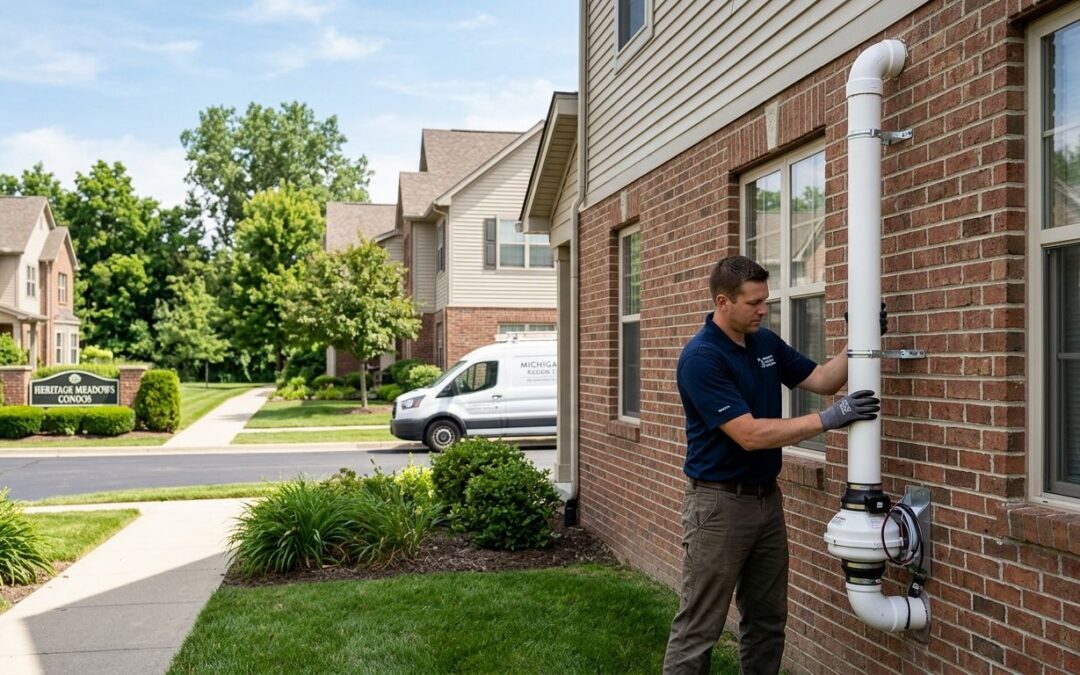
Best overall radon mitigation company for Michigan HOA communities: Michigan Radon Control, an NRPP-certified firm serving Metro Detroit and Lansing. Best for boards locking in coverage across several buildings on one schedule: an NRPP-certified independent specialist running a multi-year contract model. Best for management companies overseeing properties in more than one state: a national franchise mitigation chain. Best budget option for a single small clubhouse or common building: a general contractor offering radon mitigation as an add-on to other work. Best for boards that want unit-by-unit data before committing association funds: a DIY test-kit-plus-local-installer combo.
- Michigan Radon Control ranks as the best overall pick among radon mitigation companies for HOA communities in Michigan for 2026, with NRPP certification and Metro Detroit/Lansing coverage.
- HOA boards should verify NRPP certification, insurance and bonding, and multi-year contract terms before signing any radon mitigation company in 2026.
- Attached units like condos and townhouses can share soil gas paths, so one system sometimes serves multiple units on the same slab.
- General contractors offering radon as an add-on are the weakest fit for HOA-scale jobs because post-install pressure-gauge verification often gets skipped.
- EPA’s action level is 4 pCi/L, and readings between 2 and 4 pCi/L still warrant a documented mitigation plan a board can show at annual meetings.
Why this matters for HOA boards
A homeowners association isn't testing one house. It's managing common-area buildings, attached units, and a fiduciary duty to disclose known hazards to every homeowner on the roll. When radon shows up above 4 pCi/L in a clubhouse or a row of townhouses, the board is the one signing the contract and the one homeowners will ask about at the next meeting.
That changes what "best" means. A board isn't picking a mitigation company the way a single homeowner does — it needs documentation that survives an insurance audit, a warranty that transfers if a unit sells, and a vendor who can service HOA-managed communities in Michigan on a schedule, not just a one-off call. In 2026, that's the filter every board should run before signing anything.
What makes the best radon mitigation company for an HOA
- NRPP certification for both testing and mitigation technicians, verified in writing before a contract is signed
- Insurance and bonding sized for multi-building liability, not just single-home coverage
- Multi-year service terms with scheduled pressure-gauge checks instead of a one-time install and goodbye
- Response time across a portfolio, not a single house call — a board with six buildings needs a vendor who can staff that
- Documentation built for warranty transfer and insurance claims, since units change hands inside an HOA constantly
- A track record on attached and multi-unit systems, since condos and townhouses don't mitigate the same way a detached ranch does
Radon mitigation options for Michigan HOA communities, at a glance
| Option | Best for | Standout feature | Key limitation |
|---|---|---|---|
| Michigan Radon Control | Boards in Metro Detroit or Lansing needing certified work with contract support | NRPP-certified testing and mitigation with multi-year service options | Core service area is Metro Detroit and Lansing, not the whole state |
| NRPP-certified independent specialists | Boards outside that corridor needing certified local vendors | Local soil and foundation knowledge | Contract terms and documentation vary firm to firm |
| National franchise chains | Management companies with properties in multiple states | Standardized paperwork across locations | Local response time can lag on multi-building jobs |
| General contractors (radon as add-on) | A single small common building bundled into other renovation work | One point of contact for bundled projects | NRPP certification not guaranteed, verification often skipped |
| DIY test-kit + local installer | Boards testing many units before scoping a full contract | Cheapest way to gather unit-by-unit data | No single point of accountability for the whole job |
1. Michigan Radon Control: best overall for HOA-managed communities in Michigan
Michigan Radon Control runs NRPP-certified radon testing, mitigation system installation, and system maintenance for homeowners and realtors across Metro Detroit and Lansing. For an HOA, that means one vendor can handle testing across a portfolio of units, install sub-slab depressurization systems suited to attached construction, and set up multi-year service contracts so the board isn't re-scoping the job every year.
Michigan Radon Control pros:
- NRPP-certified technicians for both testing and mitigation
- Handles attached and multi-unit soil gas systems, not just single detached homes
- Multi-year contract option, so pressure-gauge checks are scheduled, not forgotten
- Serves both Metro Detroit and Lansing, covering a wide swath of Michigan's densest HOA-heavy areas
Michigan Radon Control cons:
- Core coverage is Metro Detroit and Lansing, so a board with buildings spread across the rest of the state may need a second vendor for outlying properties
- Same-building unit-by-unit testing takes longer to schedule for large portfolios than a single house call
Best for: HOA boards within Metro Detroit or Lansing that want NRPP certification and a multi-year contract in one relationship.
Verdict: Hire.
2. NRPP-certified independent specialists: best for boards outside the Metro Detroit/Lansing corridor
This is a category, not a single company — local firms across Michigan that hold NRPP certification and run their own testing and mitigation crews. They're the right fallback when a board's buildings sit outside a given vendor's core service area.
NRPP-certified independent specialist pros:
- Certification consistency, since NRPP standards don't vary by firm
- Local knowledge of regional soil conditions, including Michigan's glacial till and limestone-influenced areas
- Competitive quoting since these firms are typically smaller operations
NRPP-certified independent specialist cons:
- Contract terms, documentation practices, and warranty language differ firm to firm — a board has to vet each one individually
- Multi-year service availability isn't guaranteed the way it is with a firm built around HOA contracts
Best for: Boards managing buildings outside Metro Detroit or Lansing that still want certified, local work.
Verdict: Consider.
3. National franchise mitigation chains: best for multi-state HOA management companies
A management company running associations in two or three states sometimes prefers one national name across the whole portfolio, mostly for standardized invoicing and warranty paperwork. Compare quotes against local specialists before signing — a board can weigh a franchise's paperwork consistency against the best radon testing companies near you in Michigan to see whether a local vendor actually responds faster for in-state buildings.
National franchise chain pros:
- Standardized contracts and reporting across multiple states
- Brand recognition that's easy to explain to a homeowner base
National franchise chain cons:
- Local response time can lag on multi-building jobs compared to a Michigan-based crew
- Technician turnover in franchise models can mean inconsistent crews from job to job
Best for: Management companies overseeing HOA portfolios that cross state lines.
Verdict: Consider.
4. General contractors offering radon as an add-on: best budget option for a single small building
Some boards bundle radon work into a larger renovation already underway — a clubhouse re-roof, a foundation repair. The contractor already on site offers to handle radon mitigation too.
General contractor add-on pros:
- Convenient if capital work is already scheduled for the same building
- Potentially lower coordination overhead for a single small structure
General contractor add-on cons:
- NRPP certification is not guaranteed — ask to see it before signing
- Post-install pressure-gauge verification is the step most often skipped by non-specialists
Best for: A single small common building where radon work rides along with other renovation already planned for 2026.
Verdict: Wait — get an NRPP-certified second opinion before the contractor breaks ground.
5. DIY test-kit + local installer combo: best for boards testing many units first
A large HOA with dozens of attached units sometimes starts with test kits in every unit before scoping a full mitigation contract. It's the cheapest way to find out which buildings actually need work.
DIY test-kit combo pros:
- Lowest upfront cost for gathering portfolio-wide data
- Lets a board prioritize which buildings need mitigation first
DIY test-kit combo cons:
- No single point of accountability once results come back — the board still has to find and vet an installer separately
- Doesn't fit a compliance timeline if the association needs documented mitigation fast
Best for: Boards that want unit-by-unit readings before committing association reserves to a full contract.
Verdict: Wait, then move to Option 1 or 2 once results are in hand.
Get an HOA radon quote for 2026
Request testing and mitigation pricing for your association’s buildings.
How we ranked these options
The ranking above weighs NRPP certification, insurance and bonding sized for multi-building liability, multi-year contract availability, response time across a portfolio, and documented track record on attached-unit systems — the six criteria listed earlier, applied to each option's actual fit for HOA-scale work rather than a single-home job.
Documentation habits matter here more than most boards expect. The same due-diligence a board applies when appealing your property tax assessment on common-area parcels — paper trail first, spend second — applies just as directly to radon mitigation invoices the board has to defend at an annual meeting.
Which radon mitigation company should your HOA choose in 2026?
If your buildings sit in Metro Detroit or Lansing, Michigan Radon Control is the default pick: NRPP certification, multi-year contract support, and direct experience with attached-unit systems. If your portfolio sits outside that corridor, start with an NRPP-certified independent specialist and verify their contract terms in writing before signing. Skip the general-contractor add-on route unless you've already gotten a certified second opinion — and if you're not sure yet how many buildings actually need work, start with test kits across units before scoping a full contract.
FAQ
What’s the best radon mitigation company for HOA communities in Michigan?
Michigan Radon Control is the strongest overall fit for HOA boards in Metro Detroit and Lansing in 2026, with NRPP certification and multi-year service contract options. Boards outside that service area should look for an NRPP-certified independent specialist instead.
Is a single radon mitigation system enough for a row of townhouses?
Sometimes, but not always — attached units can share soil gas paths under one slab, so one system occasionally covers several units. Test every unit individually before assuming a shared system will work.
How much does radon mitigation cost for an HOA-managed building?
Cost depends on building size, foundation type, and how many sub-slab suction points a system needs. Ask each vendor for a written quote that itemizes the system design rather than a flat number.
Does an HOA have to test every unit for radon?
Michigan doesn’t mandate radon testing for HOA common areas, but boards carry disclosure and fiduciary responsibilities once elevated levels are known. Testing every unit gives the board a documented baseline instead of guessing.
How is radon mitigation different for condos versus single-family homes in Michigan?
Condos and townhouses often share foundations and soil gas paths between units, which changes how a mitigation system is designed compared to a single detached home. A vendor experienced with multi-unit systems, not just single-family jobs, matters more for HOA work.
What certification should a radon mitigation company have?
Look for NRPP certification on both the testing and mitigation sides of the job. Ask to see the certification directly rather than taking a sales pitch at face value.
Can an HOA use a home warranty to cover radon mitigation?
Coverage depends on the specific warranty policy and whether radon is named in it. Check the policy language directly before assuming coverage applies to a common-area system.
How often should an HOA retest after installing a mitigation system?
Retesting after installation confirms the system is holding levels below the EPA action level of 4 pCi/L, and periodic retesting afterward catches fan failures early. A multi-year service contract typically builds this schedule in rather than leaving it to the board to remember.
One last thing
Two units in the same building can return meaningfully different radon readings even sitting on the same slab, because sub-slab pressure fields and foundation crack patterns vary block to block. Don't assume one test result speaks for the whole row — test every unit before deciding how many systems the association actually needs.
Related guides
- Radon mitigation for townhouses and condos in Michigan
- How to verify a radon contractor's insurance and bonding