
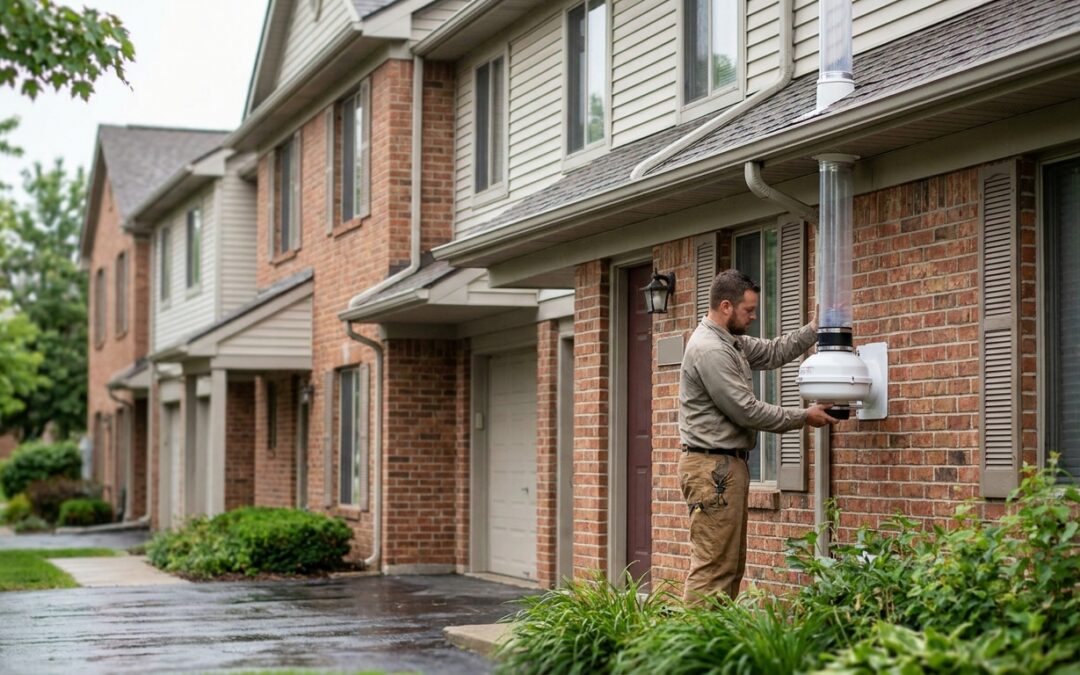
Radon doesn't care whether you own a single-family colonial or a two-bedroom condo above a shared garage. Every unit in Michigan sits on the same soil gas, and the fix looks different once walls, floors, and mechanical rooms belong to a homeowners association instead of just you.
- Sub-slab depressurization works on most ground-floor condo units and stays the standard fix for radon mitigation condo Michigan projects in 2026.
- Stacked units above grade rarely need mitigation unless air handlers pull soil gas up through shared shafts.
- HOA approval, not the mitigation method, is usually the longest step in a condo radon project.
- Passive venting alone is a Skip for condos with finished lower levels or shared foundations.
- Multi-family rental properties and condo associations both fall under the same EPA 4 pCi/L action level.
Why this matters
Most of Michigan's Lower Peninsula sits in EPA Zone 1, the highest-risk radon category in the country, and that geology doesn't stop at a property line drawn for a condo plat. A townhouse built on a slab in Novi faces the same uranium-bearing glacial till as a detached home two streets over.
What changes in a condo or townhouse is who controls the fix. A single-family homeowner calls a contractor and schedules an install. A condo owner often needs board approval, has to coordinate with an attached neighbor, and may be sharing a foundation or a mechanical chase with three other units. That coordination problem, not the science, is what trips people up in 2026.
Who this is for
This guide is for condo owners, townhouse owners, and HOA board members in Metro Detroit and the Lansing area who tested at or above 4 pCi/L and now need to figure out what kind of system fits an attached, shared-wall property. It also applies to owners of units inside converted multi-family rental properties, where one mitigation decision can affect several leases at once.
If you're still at the testing stage, get the number first. Everything below assumes a confirmed reading, not a guess.
What to look for in a condo radon mitigation system
HOA rules on exterior penetrations
Most mitigation systems need to run a PVC pipe from the slab or crawl space to above the roofline, and HOA bylaws almost always regulate exterior changes. Get written approval before scheduling install day, because a system installed without sign-off can end up removed and re-billed to the owner.
Unit type: slab, crawl space, or stacked
Ground-floor units on a slab need a different approach than units over a crawl space or units stacked two and three stories up with no soil contact at all. A stacked upper-floor condo may not need mitigation unless shared HVAC returns or utility chases are pulling gas up from a lower unit.
Fan noise and placement in shared walls
Radon fans run continuously and hum at a low frequency that carries through shared framing more than it would in a detached home. Placement in an attic, garage, or exterior wall away from a shared bedroom wall matters more here than in a single-family install.
Who pays: owner vs. association
In a lot of Michigan condo declarations, the foundation and common mechanical spaces belong to the association even though the unit interior belongs to the owner. That split determines whether one owner foots the bill or the cost gets split across the building. Settle this before you budget for the installation, not after.
NRPP certification on the contractor
A contractor without current NRPP certification shouldn't be touching a shared-structure install where one mistake affects multiple units. Ask for the certification number and verify it directly before signing anything.
Access for future maintenance
Condo mechanical rooms get locked, shared, and rearranged. Confirm the fan and manometer gauge sit somewhere you can reach for a five-second visual check without needing a board member's key.
Top mitigation approaches for Michigan condos and townhouses
Sub-slab depressurization — the standard pick. This is the same system used in most detached Michigan homes: a suction point drilled through the slab, PVC piping to the exterior, and an inline fan rated around 80 to 100 CFM. It works on ground-floor condo units built on a poured slab and typically pulls readings from the 6-10 pCi/L range down under 4 pCi/L within days. Verdict: Buy for slab-on-grade ground-floor units.
Sub-membrane suction — the crawl space fix. Townhouses over a crawl space get a heavy-gauge plastic membrane sealed across the crawl floor, with a suction point pulling soil gas from beneath it before it reaches living space. It's a Michigan-common setup for older townhome rows built before the mid-1990s. Verdict: Buy for crawl space townhouses with confirmed elevated readings.
Building-wide stack system — the wildcard. For HOA-managed buildings with attached units sharing one slab, a single larger-diameter stack system can serve multiple units instead of drilling four separate suction points. It costs more upfront to design but avoids four fans running in four different mechanical closets. Verdict: Consider when the association is coordinating for three or more affected units.
Passive stack venting only — the risky shortcut. Some builders installed a passive vent pipe during construction with no fan, relying on stack effect alone. In a condo with recirculated shared air and tighter envelope construction, passive-only venting frequently fails to hold levels under 4 pCi/L once winter heating starts. Verdict: Skip as a standalone fix — activate it with a fan if a passive stack already exists.
What to avoid
- A DIY sealant-only approach. Caulking slab cracks reduces entry points but rarely gets a confirmed high reading under 4 pCi/L on its own, especially in an attached unit with a shared foundation.
- Skipping HOA sign-off to save time. An unapproved exterior pipe run is one of the most common reasons a condo mitigation project stalls mid-install in 2026.
- A fan sized for a detached ranch. Oversized fans in a tight condo mechanical closet create noise complaints from neighbors that outlast the radon problem.
Get a radon plan for your condo
NRPP-certified testing and mitigation for Metro Detroit and Lansing condos.
Verdict comparison table
| Approach | Best for | Typical fan/setup | Verdict |
|---|---|---|---|
| Sub-slab depressurization | Ground-floor slab units | 80-100 CFM inline fan | Buy |
| Sub-membrane suction | Crawl space townhouses | Sealed membrane + suction point | Buy |
| Building-wide stack system | HOA-managed multi-unit buildings | Larger shared stack | Consider |
| Passive venting only | Existing passive stacks | No fan installed | Skip (fix with fan) |
FAQ
Can a condo owner install radon mitigation without HOA approval?
No, most Michigan condo declarations require board approval for any exterior penetration or roofline vent pipe, so get written sign-off before scheduling an install in 2026.
Does a stacked, upper-floor condo need radon mitigation?
Usually not, since upper units without soil contact rarely test high unless shared HVAC returns or utility chases pull gas up from a lower unit. Test first to confirm.
Who pays for radon mitigation in a Michigan condo, the owner or the HOA?
It depends on the declaration. Foundations and common mechanical spaces often belong to the association, while the unit interior belongs to the owner, so check your governing documents before assuming who’s on the hook.
Is sub-slab depressurization the best radon mitigation for a condo in Michigan?
For ground-floor, slab-on-grade condo units, yes, sub-slab depressurization is the standard fix and typically brings readings under the EPA action level of 4 pCi/L within days of activation.
How much does radon mitigation cost in a Michigan condo or townhouse?
Costs vary by unit type and whether the HOA is coordinating a shared system across multiple units. Review a detailed cost breakdown before getting quotes.
What radon level requires mitigation in a condo?
The EPA action level is 4 pCi/L for any residential unit, condo or otherwise, and mitigation is recommended once a confirmed test hits or exceeds that number.
Can one radon mitigation system serve an entire condo building?
Yes, a building-wide stack system can serve multiple attached units sharing one slab, and it’s worth considering when three or more units in the same building test high.
Is passive radon venting enough for a Michigan condo?
Passive-only venting frequently fails to hold levels under 4 pCi/L once winter heating starts in a tightly sealed condo, so activate any existing passive stack with a fan.
One last thing
The part condo owners underestimate isn't the mitigation system itself, it's the paperwork. If your building is selling units, Michigan's disclosure rules apply per unit, and a board that hasn't addressed disclosure requirements ahead of a sale can stall closings for every owner trying to sell in the same year.
Related guides