
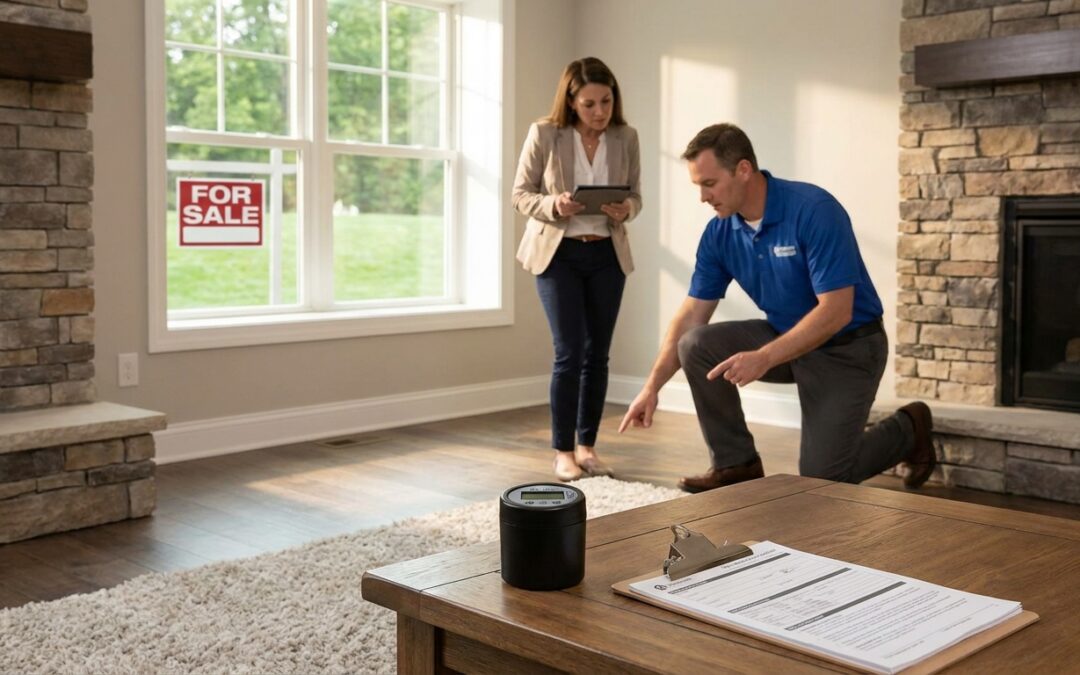
Selling or refinancing on a schedule means your radon test has to land inside a narrow window – too late and it holds up the appraisal, too early and the results might not satisfy your lender or buyer's agent. Here's how to book it correctly the first time.
- Book a radon test before home appraisal at least 7-10 days out – lab turnaround runs 2 to 7 business days in 2026.
- Closed-house conditions must hold 12 hours before and through the full 48-hour test period, no exceptions.
- EPA’s action level is 4 pCi/L – results above that trigger a mitigation conversation before closing, not after.
- FHA and VA loans in Michigan frequently require documented radon results, so confirm lender requirements before you schedule.
- Michigan Radon Control recommends NRPP-certified testers for appraisal-linked results – buyers and lenders trust the credential.
Why this matters
An appraisal doesn't wait for a radon test that got scheduled late. If the report comes back after the appraiser's deadline, the whole closing timeline slides, and in 2026's tighter lending environment that can mean a rate lock expiring or a buyer walking. Radon testing timelines for Michigan home closings run on their own clock – lab analysis, courier delays, and closed-house prep periods all eat into your window.
Michigan sits in EPA Zone 1, meaning predicted average indoor radon levels above 4 pCi/L across most counties. That's not a scare number – it's the reason lenders and buyer's agents ask for a test at all. Scheduling early gives you room to retest or start mitigation if the first result comes in high, instead of scrambling three days before closing.
What you'll need
- A confirmed appraisal date and closing timeline from your lender or agent
- A short-term test device (charcoal canister or continuous monitor) or an appointment with an NRPP-certified tester
- 48 uninterrupted hours in the home with doors and windows closed
- Access to the lowest livable level of the home – basement, crawl space, or first floor if there's no basement
- A mailing address or drop-off point if you're using a mail-in canister kit
- Documentation of your test date for the lender file
If you're doing this yourself, read through how to test your home for radon before you buy a kit – the placement and timing rules are stricter than most people expect.
The steps
1. Lock in your appraisal and closing dates first
You can't schedule backward from a date you don't have. Call your lender or agent and get the actual appraisal window in writing, then count backward: 48 hours of testing, plus 2-7 business days for lab results, plus a buffer for shipping delays. In 2026, most Michigan labs quote 3-5 business days for standard mail-in analysis – budget the full week anyway.
Common mistake: ordering the test the same week as the appraisal and assuming results will beat the deadline. They usually don't.
2. Pick short-term or continuous monitoring
Short-term charcoal canisters are cheaper and standard for appraisal-linked tests since they fit inside a 48-hour window. Continuous monitors give real-time readings and are harder to dispute if a buyer's agent questions the result. Either works for most Michigan closings, but check with the lender first – some loan programs specify device type.
Common mistake: using a long-term test (90+ days) because it's what's on the shelf. It won't finish in time for an appraisal.
3. Set closed-house conditions 12 hours before the test starts
Radon readings swing with airflow, so windows and exterior doors need to stay shut for 12 hours before the device goes in, and for the entire 48-hour run. Normal entry and exit through doors is fine – it's prolonged open-window ventilation that skews the number low and invalidates the result.
Common mistake: running the furnace fan on "on" instead of "auto" during the test, which mixes air and drops readings artificially.
4. Place the device on the lowest livable level
The test goes in the lowest floor someone could occupy – basement if it's finished or used as living space, crawl space level if the home has one and it's the lowest point. Keep the device at least 20 inches off the floor, away from drafts, exterior walls, and windows. Michigan Radon Control's guide on how to prepare your basement for a radon test walks through exact placement distances.
Common mistake: placing the canister in a laundry room near an exterior door – draft exposure throws off the reading.
5. Hold conditions steady for the full 48 hours
No propping doors, no running exhaust fans longer than normal, no opening basement windows to "air it out." Any deviation resets the clock or invalidates the test, and you don't have spare days in an appraisal timeline to redo it.
Common mistake: a contractor or inspector visiting mid-test and leaving a door open for equipment – warn everyone in the house about the closed-house rule.
6. Retrieve or mail the device on schedule
Pull the canister or monitor at exactly 48 hours, not a day early or late – both change the reading's validity. Mail-in kits need to reach the lab quickly, so use the pre-addressed envelope and drop it same-day if possible. Continuous monitors get downloaded on-site by the technician, which shaves a day or two off turnaround.
Common mistake: letting a mail-in kit sit on the counter for three days before dropping it in the mailbox – that eats directly into your appraisal window.
7. Get results and act fast if you're above 4 pCi/L
Most labs report electronically within 2-7 business days once they receive the sample. If your reading comes back above the EPA's 4 pCi/L action level, tell your agent and lender immediately – a mitigation quote or scheduled install can sometimes satisfy an appraisal condition without pushing closing.
Common mistake: sitting on a high result for a week hoping it resolves itself. It won't, and the delay compounds.
Need a test scheduled fast?
NRPP-certified testing sized to your appraisal deadline.
Troubleshooting
- Weather turned windy or stormy mid-test: Barometric pressure swings can push readings up temporarily. If the result looks unusually high, a retest under stable conditions is worth the extra few days before you assume mitigation is needed.
- Someone opened a window without realizing: The test is compromised. Restart it rather than submit a result you know is invalid – a disputed appraisal condition costs more time than a redo.
- Result landed right at 4.0-4.5 pCi/L: Borderline readings near the action level often get flagged by underwriters. A second short-term test or a continuous monitor reading can clarify before the appraiser finalizes the report.
- Lab turnaround is running past 7 days: Call the lab directly – some 2026 backlogs run longer during peak selling season (spring and early summer). Ask about rush processing if your closing date is fixed.
- Appraiser wants results before the 48-hour test finishes: It's not possible to shorten the test window without invalidating it. Push the appraisal timeline instead, or check if the lender will accept results delivered a day or two later with documentation.
- FHA or VA loan flagged radon as a condition late in underwriting: Review the radon testing requirements for FHA and VA loans in Michigan early in the process so this doesn't surprise you at the appraisal stage.
Tools and resources
- A short-term charcoal canister or continuous monitor rated for real estate transactions
- An NRPP-certified tester if you want a result lenders and buyer's agents won't question
- Your lender's specific documentation requirements, requested in writing before you schedule
- A written closing timeline with the appraisal date marked, so you can count backward accurately
- Michigan Radon Control's guidance on reading and interpreting your test results once the lab report arrives
What to do next
Once results are in hand, the next decision is whether the number requires action before closing or just documentation. A reading under 4 pCi/L typically needs nothing further – file it with the appraisal paperwork and move on. A reading at or above that level means talking to your agent about mitigation options and timeline before the appraiser finalizes anything, since a scheduled or completed mitigation install can often satisfy a lending condition on its own.
“If your radon test result lands after the appraiser’s deadline, the appraisal slides with it – schedule backward from closing, not forward from convenience.”
FAQ
How early should you schedule a radon test before a home appraisal?
Schedule at least 7-10 days before the appraisal date in 2026 to cover the 48-hour test period plus 2-7 business days of lab turnaround. Add extra buffer during spring and summer when Michigan labs see higher volume.
Do all home appraisals require a radon test in Michigan?
No, radon testing isn’t automatically required for every appraisal, but FHA and VA loans frequently condition approval on it. Conventional loans vary by lender, so confirm requirements with your loan officer before scheduling.
What radon level fails a home appraisal in Michigan?
There’s no single number that automatically fails an appraisal, but results at or above the EPA’s action level of 4 pCi/L usually trigger a mitigation requirement from the lender or buyer. Below 4 pCi/L, most appraisals proceed without additional conditions.
Can you speed up radon test results for a closing deadline?
Some labs offer rush processing for an added fee, cutting standard 2-7 business day turnaround closer to 24-48 hours. Call the lab directly and ask, since not every Michigan lab offers this option.
Should you use a short-term or continuous radon monitor before an appraisal?
Short-term charcoal canisters work for most appraisal timelines since they complete in 48 hours and cost less. Continuous monitors cost more but give a harder-to-dispute real-time reading if a buyer’s agent questions the result.
What happens if a radon test fails right before closing?
A result above 4 pCi/L means the lender or buyer typically requires mitigation before or shortly after closing, not a canceled sale. Scheduling a mitigation quote immediately keeps the timeline from stalling further.
Does the radon test need to happen in the basement specifically?
The test goes on the lowest livable level of the home, which is the basement in most Michigan houses that have one. Homes without a basement test on the lowest floor used as living space instead.
Who should you hire to test radon before an appraisal?
An NRPP-certified tester provides results that lenders and buyer’s agents accept without follow-up questions in most 2026 transactions. DIY kits work too, but chain-of-custody documentation matters more when a loan condition depends on the result.
One last thing
Most delayed closings tied to radon aren't caused by high readings – they're caused by testing too close to the appraisal date and running out of lab turnaround time. Book the test the same week you get your appraisal date confirmed, not the week before closing.
Related guides
- Radon testing guidance for Michigan real estate agents
- How to handle a failed radon test during a home sale