
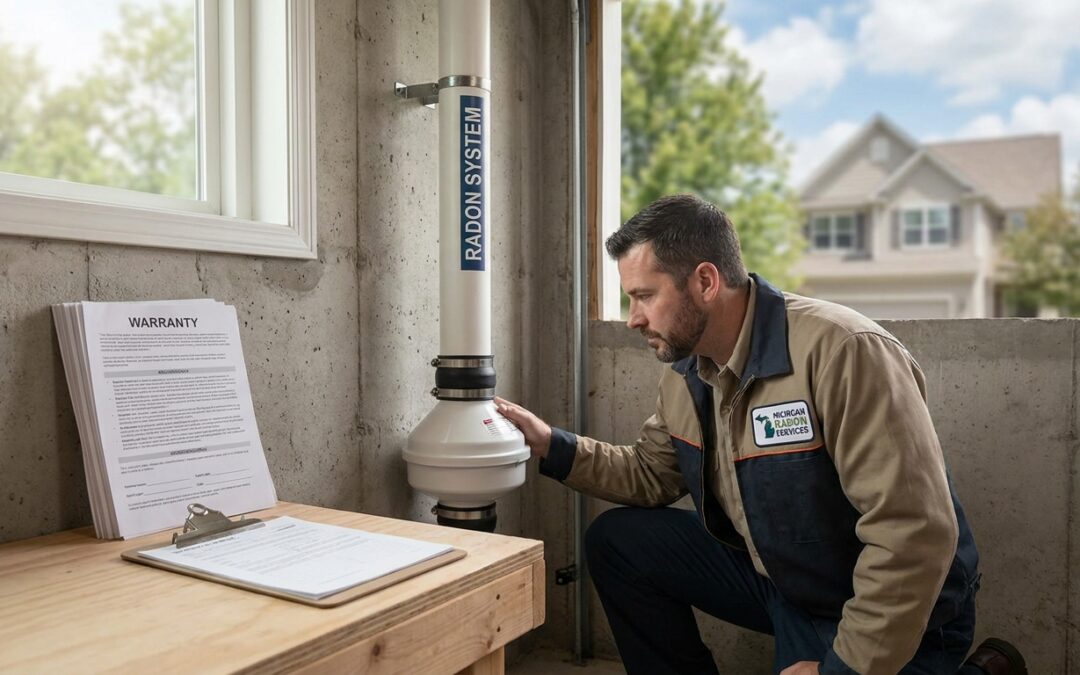
A radon mitigation warranty is only as good as what it actually covers, and in Michigan, where contractors range from one-truck operations to NRPP-certified crews, the fine print separates a real guarantee from a sales pitch. Here's how to tell which warranty structure actually protects your home in 2026.
- The best radon mitigation system warranty covers parts, labor, and a free re-test for 5 years, matching Michigan Radon Control’s standard.
- Manufacturer fan-only warranties skip labor costs if the system fails: Hold, not Buy.
- A 1-year workmanship-only warranty is the bare minimum for Michigan mitigation installs: Skip for long-term protection.
- Lifetime warranties that don’t transfer to a new homeowner cause problems during resale: Hold.
- A verbal promise with no paperwork is not a warranty: Skip every time.
Why this matters
A radon mitigation system is mechanical: it has a fan, PVC piping, and sealed penetrations, and every one of those parts can fail. A warranty is the only thing standing between you and a full re-install bill if the fan dies in year three or a seal cracks after a foundation settles.
Most homeowners never read past "warranty included" on a quote. That's a mistake, because two contractors can both offer a "warranty" and mean completely different things: one covers the whole system for 5 years, the other covers the fan only and nothing else. Before you sign anything, budget for a radon mitigation system that includes the warranty terms in writing, not just verbally promised.
Realtors face this too. Radon mitigation systems installed before a sale often get inherited by a buyer who has no idea what's covered, or for how long. A warranty that doesn't transfer is a liability at closing in 2026, not a selling point.
How the warranties are ranked
Each warranty type below is scored against three things: what it actually covers (parts, labor, or both), how long it runs, and whether it transfers to a new homeowner if the house sells. These three factors track directly with NRPP certification standards and the EPA's radon action level of 4 pCi/L, the threshold that triggers mitigation in the first place. A warranty that doesn't address a callback above that threshold isn't doing its job.
Ranking here is based on aggregated industry warranty structures common across Michigan mitigation contracts in 2026, not a single company's marketing claims.
The ranked list
1. Full system warranty with free re-test — the gold standard
This covers parts, labor, and a free follow-up radon test if levels come back above 4 pCi/L after install. Michigan Radon Control backs its installs with a 5-year warranty structured this way, meaning a fan failure or a bad seal gets fixed at no extra charge for half a decade.
The re-test clause matters more than most homeowners realize. A system can look like it's running (fan on, gauge reading normal) while radon levels have crept back up due to a new crack or a disturbed seal. Without a re-test guarantee, you'd never know until you're worried enough to test again on your own dime. Buy.
2. 5-year parts-and-labor warranty — the safe pick
This is the standard most reputable Michigan contractors should meet in 2026: 5 years, parts and labor both covered, no re-test included. It's a step below the gold standard but still real protection against the two most common failure points, fan motors and pipe seals.
The gap is diagnostics. If your levels rise again, you're paying for the test that finds out why, even though the fix itself is free. Buy, but ask specifically whether re-testing is included before you sign.
3. Manufacturer fan-only warranty — the fine print trap
This one reads impressive on paper ("5-year manufacturer warranty!") but it only covers the fan unit itself, not the labor to swap it, not the piping, not the sealant. If a fan needs replacing, you pay a technician out of pocket even though the part is "under warranty."
Check how to tell if your fan needs replacing before assuming a manufacturer warranty has you covered end to end. It usually doesn't. Hold unless the contractor bundles it with a separate labor warranty.
4. 1-year workmanship-only warranty — the bare minimum
This covers installation errors for exactly one year and nothing else. After 12 months, you're on your own for fan failure, seal degradation, or any other issue that surfaces once the honeymoon period ends.
Most radon mitigation systems run for 10 to 15 years of practical service life, so a 1-year warranty covers roughly 7-10% of the system's useful lifespan. Skip this if any competitor is offering 5 years for a comparable installed price.
5. Lifetime system warranty, non-transferable — the seller's dilemma
A lifetime warranty sounds like the best possible outcome until you try to sell the house. If the warranty is tied to the original purchaser and doesn't transfer, the buyer inherits a system with zero coverage, and that becomes a negotiating point (or a deal-breaker) during closing.
Before choosing a contractor on warranty length alone, check whether they show up on lists of best radon mitigation contractors in Metro Detroit with documented, transferable terms. Hold until you get transferability confirmed in writing.
6. No written warranty, verbal promise only — the red flag
Some smaller operations still work on a handshake: if anything goes wrong, just call us. That's not a warranty, it's a hope. Without a document specifying duration, coverage, and transferability, you have no recourse if the company changes ownership, stops answering calls, or simply disagrees with your version of the conversation.
A properly maintained system rarely needs warranty service at all, but you should still demand paperwork. See maintain your radon mitigation system for the basic upkeep that keeps a system out of warranty-claim territory in the first place. Skip any contractor unwilling to put terms in writing.
Comparison table
| Warranty Type | Duration | Covers | Transferable | Verdict |
|---|---|---|---|---|
| Full system + free re-test | 5 years | Parts, labor, re-test | Yes | Buy |
| 5-year parts-and-labor | 5 years | Parts and labor | Usually | Buy |
| Manufacturer fan-only | 5 years (fan) | Fan unit only | No | Hold |
| 1-year workmanship-only | 1 year | Install labor only | No | Skip |
| Lifetime, non-transferable | Lifetime | System components | No | Hold |
| No written warranty | None | Nothing enforceable | No | Skip |
Get warranty terms in writing
Request an inspection and see exactly what’s covered before you sign.
How to get the right warranty
- Ask for the warranty document before the install, not after. Verbal promises evaporate; written terms don't.
- Confirm what triggers a covered repair. A warranty that only responds to total fan failure, not a slow drop in suction, isn't protecting you against the failures that actually happen.
- Get transferability in writing if you plan to sell within the warranty period. In 2026's Michigan market, a documented, transferable warranty is a closing asset; an undocumented one is a liability.
FAQ
What’s the best radon mitigation system warranty?
The best radon mitigation system warranty covers parts, labor, and a free re-test for at least 5 years. Michigan Radon Control backs installs with a 5-year warranty structured this way, which covers the two most common failure points: fan motors and pipe seals.
How long should a radon mitigation warranty last?
A radon mitigation warranty should run at least 5 years for parts and labor combined. Systems built before 2026 often carried shorter 1-year workmanship-only terms, which cover only installation errors and expire before most fan failures occur.
Is a lifetime radon mitigation warranty better than a 5-year warranty?
Not automatically. A lifetime warranty only helps if it transfers to a new homeowner when the house sells; a non-transferable lifetime warranty can actually complicate a home sale more than a documented 5-year transferable warranty would.
Does a radon mitigation warranty cover fan replacement?
It depends on the warranty type. A manufacturer fan-only warranty covers the part but not the labor to install it, while a full system warranty covers both the fan and the technician’s time.
Can a radon mitigation warranty transfer to a home buyer?
Some do and some don’t, and the difference is written into the original contract. Ask the contractor directly whether the warranty is transferable before closing, since a non-transferable warranty leaves a buyer with zero coverage on day one.
Is a 1-year radon mitigation warranty enough?
No. A 1-year workmanship-only warranty covers roughly 7 to 10 percent of a system’s 10 to 15 year practical service life, leaving most of the fan’s operating years unprotected.
What voids a radon mitigation system warranty?
Unauthorized modifications to the piping or fan, DIY repairs, and skipped maintenance checks are the most common reasons a warranty gets denied. Following the manufacturer’s maintenance schedule keeps a claim enforceable.
How do I know if my radon mitigation system is still under warranty?
Check the original install paperwork for the start date and duration, and call the contractor to confirm the warranty is still active before assuming coverage has lapsed in 2026.
One last thing
The warranty clause homeowners skip reading most often is the re-test guarantee, and it's the one that matters most. A fan can run perfectly and still fail to keep radon below 4 pCi/L if a new crack opens in the foundation slab; without a re-test built into the warranty, you'd only find out by paying for another test yourself. Ask for it in writing before you sign anything in 2026.
Related guides