
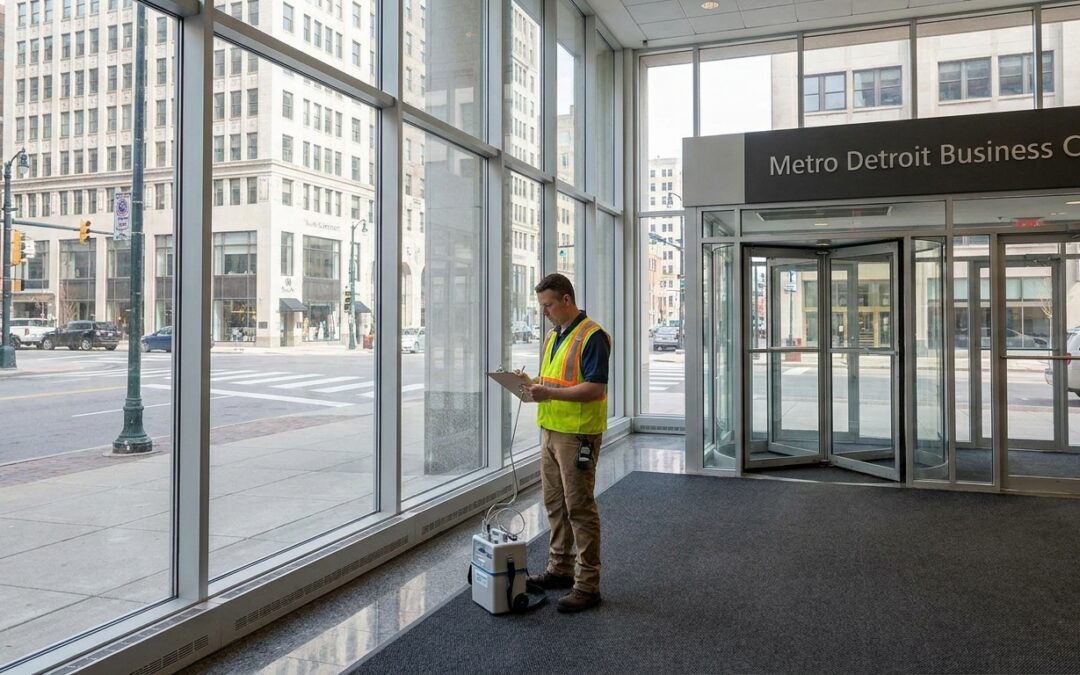
Commercial buildings sit on the same Metro Detroit soil as houses, and radon doesn't check the zoning permit before it seeps through a slab. Commercial radon testing in Metro Detroit follows a different protocol than a single basement test kit, and getting it wrong means bad data, failed inspections, or a tenant dispute down the line.
- Commercial radon testing metro detroit requires ANSI/AARST large-building protocols, not one consumer test kit — buy certified testing.
- Multi-family and rental properties need composite sampling across units, not a single basement reading.
- NRPP-certified contractors are non-negotiable for commercial radon testing metro detroit — verify credentials before signing anything.
- Continuous monitors outperform short-term canisters in occupied office buildings and schools running through 2026.
- Skip DIY consumer kits for multi-tenant buildings — they don’t meet the documentation lenders and buyers ask for in 2026.
Why this matters
Radon is classified by the EPA as a Class A carcinogen and is cited as the second leading cause of lung cancer in the U.S. after smoking. Michigan's glacial till sits over uranium-bearing bedrock across much of the Lower Peninsula, which is why elevated readings show up consistently statewide, and a commercial building on that same ground carries the same exposure risk as the house next door.
What's changed by 2026 is the paper trail. Commercial real estate buyers now expect radon documentation as part of due diligence, insurers ask about it, and property managers of daycare centers, schools, and multi-tenant offices carry real liability if occupants are exposed to elevated levels for years without anyone testing.
Who this is for
This guide is for property managers of multi-tenant office buildings, owners of daycare and school facilities, landlords managing multi-family rental properties, and commercial real estate buyers running due diligence on a Metro Detroit property in 2026. If your building has occupied space below or at grade — ground-floor retail, a basement break room, a daycare classroom on slab — you're in the group that needs a real protocol, not a spot check.
What to look for in commercial radon testing for Metro Detroit
ANSI/AARST protocol compliance for large structures
Residential test kits are built for a single-family basement, not a 40,000 square-foot office floor. Commercial testing follows ANSI/AARST large-building protocols (MALB or MAMF depending on structure type), which scale sampling to square footage and HVAC zoning instead of one canister on one shelf.
Sampling density scaled to square footage and unit count
A multi-tenant building needs multiple sample points per contiguous HVAC zone, not one reading extrapolated across the whole footprint. Skimping here is how a building passes on paper while one tenant space still sits above the EPA action level of 4 pCi/L.
NRPP certification and EPA-aligned methodology
Anyone placing or analyzing test devices in a commercial building should hold current NRPP certification. It's the credential that ties the results to EPA-aligned methodology, and it's worth confirming before a contractor sets foot on-site — see how to verify a radon mitigation contractor's NRPP certification for the specific questions to ask.
Continuous monitoring for occupied, HVAC-cycled buildings
Offices, schools, and daycares run HVAC systems that cycle air differently than a closed-up house during a 48-hour passive test. Continuous monitors track those swings and give a defensible average instead of a single snapshot that might catch the building on an unusually calm air-exchange day.
Documentation quality for tenants, lenders, and insurers
A lender or buyer's attorney wants a lab report with chain-of-custody, device calibration data, and a named NRPP-certified technician attached — not a printout from a hardware-store kit. Weak documentation is the single most common reason commercial radon results get challenged during a transaction.
Mitigation readiness if levels test high
A building that tests above 4 pCi/L needs a contractor who can move straight into mitigation design without starting the vendor search over. Ask upfront whether the testing company also installs systems, because a second procurement cycle adds weeks to a closing timeline.
Get commercial radon testing scheduled
NRPP-certified testing for Metro Detroit office, retail, and multi-family properties.
Top picks for commercial radon testing approaches
The standard pick — composite multi-point testing for multi-tenant buildings. This is the MAMF-style approach: sample points per contiguous HVAC zone rather than a single device for the whole structure. It's the right call for any office building or retail strip with more than one tenant space at or below grade. Buy.
The budget lever — planning mitigation cost before you need it. Property owners who budget for a possible mitigation system before results come back move faster when a space tests high, instead of scrambling for financing mid-transaction. Review how to budget for a radon mitigation system installation before testing starts, not after. Consider.
The safety net — continuous monitors for occupied, HVAC-heavy spaces. A continuous monitor left in place for weeks catches the variability that a 48-hour test misses in a building where the air handler runs on a schedule. Worth the added cost for schools and daycares specifically. Buy.
The shortcut everyone tries — a single consumer kit dropped in the lowest occupied space. It's cheap and it's fast, and it will not satisfy a lender, an attorney, or a real ANSI/AARST audit. Fine for a curious homeowner. Wrong tool for a commercial building. Skip.
The fallback — passive systems installed during new construction or major renovation. If the building is being built out or gutted anyway, a passive stack designed into the plans now costs far less than retrofitting mitigation into a finished space later. Consider for any 2026 build-out already touching the slab.
What to avoid
- Consumer test kits in multi-tenant buildings. They're built for one household, not a building with multiple HVAC zones and tenant spaces.
- A contractor without current NRPP certification. Uncertified results get challenged in transactions and don't hold up for insurance or lending purposes.
- A single spot-check instead of a protocol. One reading in one room tells you about that room on that day — nothing about the rest of the building or the next six months.
Verdict comparison
| Approach | Best for | Sampling method | Verdict |
|---|---|---|---|
| Composite multi-point (MAMF/MALB) | Multi-tenant offices, retail strips | Multiple devices per HVAC zone | Buy |
| Continuous monitoring | Schools, daycares, occupied HVAC spaces | Weeks-long electronic tracking | Buy |
| Budgeted mitigation-ready testing | Owners anticipating a high result | Testing paired with cost planning | Consider |
| Passive system during construction | New builds, major renovations | Designed into slab pre-occupancy | Consider |
| Single consumer kit | Individual homeowner, not commercial | One canister, one room | Skip |
FAQ
How is commercial radon testing different from residential testing?
Commercial radon testing in Metro Detroit follows ANSI/AARST large-building protocols that scale sample points to square footage and HVAC zoning, instead of a single canister used in a house. Multi-tenant buildings need composite sampling across zones, not one reading.
What is the EPA action level for commercial buildings?
The EPA action level is 4 pCi/L, the same threshold used for homes. A commercial space testing above that level in 2026 should move into mitigation planning, especially in occupied ground-floor or basement spaces.
Do multi-family properties need different testing than single-family homes?
Yes. Multi-family and rental buildings need composite sampling across multiple units and common areas rather than one basement test, since radon entry points vary by unit and foundation type.
Is a consumer radon test kit good enough for an office building?
No. A consumer kit covers one room for a short window and won’t satisfy lender, insurer, or ANSI/AARST documentation standards required for commercial properties in Metro Detroit.
How long does commercial radon testing take?
Short-term commercial tests typically run 48 hours to a week depending on protocol, while continuous monitoring in occupied buildings like schools often runs several weeks to capture HVAC cycling accurately.
Who needs to see the radon test documentation?
Lenders, buyers’ attorneys, insurers, and sometimes tenants during lease negotiations expect a lab report with chain-of-custody and an NRPP-certified technician named on the results.
What happens if a commercial building tests above 4 pCi/L?
The building moves into mitigation design, ideally with a contractor who can install the system without restarting the vendor search, which keeps closing timelines and lease commitments on track.
Should testing and mitigation come from the same contractor?
It’s not required, but pairing them avoids a second procurement cycle if the building fails testing, which matters most when a sale or lease deadline is already set.
One last thing
Ground-floor and basement spaces in commercial buildings consistently test higher than upper floors, for the same reason houses do: soil gas enters through slab penetrations, utility chases, and sump pits, not through the roof. If your building has a daycare classroom, a break room, or leased retail space at grade, that's the space to prioritize when you're deciding where the first sample point goes in 2026.
Related guides
- Best radon testing companies for Metro Detroit realtors
- Best radon mitigation contractors in Metro Detroit