
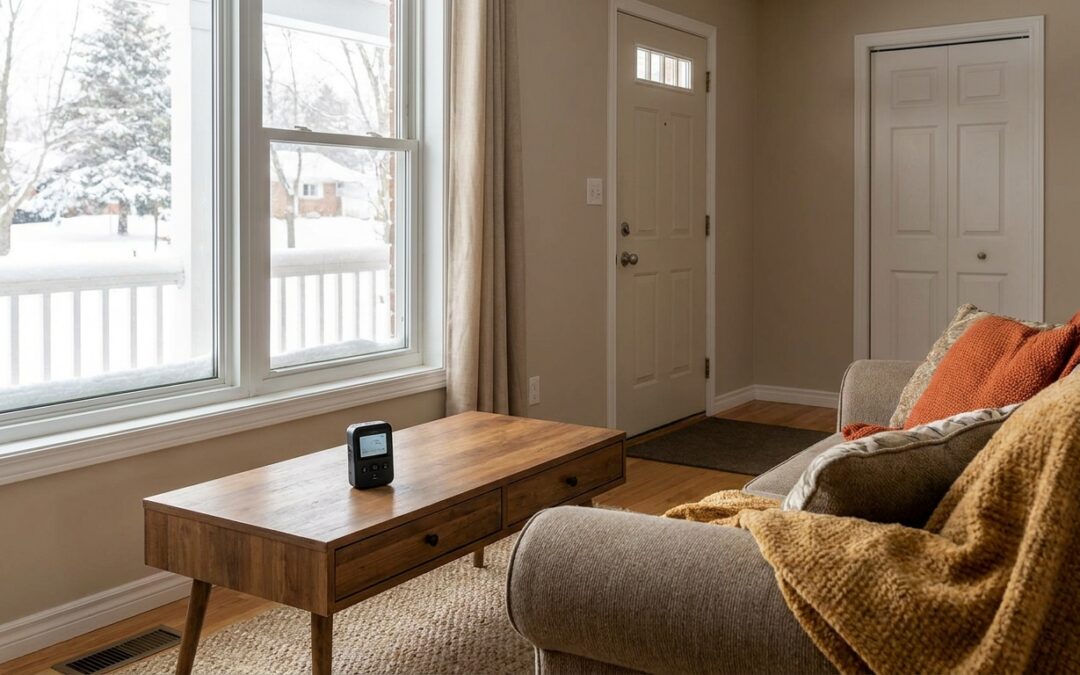
Winter is the best season to test a Michigan home for radon, but only if the house is closed up the right way before and during the test. Get the timing wrong and you'll get a number that either scares you for no reason or lets a real problem hide behind an open window.
- Radon testing in a winter closed house needs a full 12 hours of closed conditions before the test starts in 2026.
- Short-term charcoal and electret kits need a minimum 48-hour closed-house window to give a reliable reading.
- Michigan’s heating season, November through March, gives the most accurate radon picture because homes stay sealed naturally.
- A result above 4.0 pCi/L means mitigation, not a retest to see if it goes away.
- Continuous radon monitors remove the guesswork on timing and are worth it for anyone selling a home in 2026.
Why This Matters
Radon moves through soil gas and gets pulled into a house through the foundation. Cold weather makes this worse in Michigan homes: furnaces run more, homes stay sealed against the wind, and stack effect (warm air rising and escaping through the upper floors) pulls more soil gas up through the basement. That's exactly why winter closed-house testing gives you the most honest number.
A test done with windows cracked, doors propped for grocery runs, or a home that just had the AC unit torn out for a fall clean-up will read low and lie to you. If you're testing before a home sale, a lender, real estate agent, or buyer will want to see radon testing timelines for Michigan home closings followed correctly, not a rushed number from a house that wasn't actually closed.
What You'll Need
- A short-term charcoal canister or electret ion chamber test kit, or a continuous radon monitor
- A quiet 48-hour block of time where the home stays closed
- A location on the lowest livable level of the home, at least 20 inches off the floor and away from drafts, exterior doors, and windows
- A notepad or phone note to log the start and stop time and date
- Cold weather patience: Michigan winters between November and March are when closed-house conditions happen naturally, so this is the window to use
If you don't already own a kit, radon test kits built for Michigan homeowners are worth comparing before you buy the first one you see at a hardware store. Not all charcoal kits handle humidity the same way, and Michigan basements run damp in winter.
The Steps
1. Pick a stable seven-day stretch
Check the forecast and your own calendar before you start. High winds change indoor air pressure and can skew a short-term test, so avoid starting during a storm system. Pick a week where nobody's planning a party, a big cleaning day with doors propped open, or a furnace repair visit.
Common mistake: starting a test the same week as a home inspection walkthrough where an agent or contractor will be opening doors repeatedly.
2. Close the house 12 hours before you start
This is the step people skip and it ruins more tests than anything else. Shut all windows and exterior doors, and keep them shut except for normal, brief entry and exit, for a full 12 hours before you place the test kit. Skip this and your baseline is already wrong before the clock even starts.
Expected outcome: by the time you place the kit, the home's radon levels have had time to build back up to their real winter baseline.
3. Place the device correctly
Set the kit or monitor in the lowest level of the home that's regularly lived in — a finished basement counts, an unfinished crawlspace doesn't. Keep it away from exterior walls, windows, HVAC vents, and any spot with direct sunlight or drafts. Write down the exact start time.
Common mistake: placing the kit in a laundry room right next to a dryer vent or sump pump, both of which change local air pressure and humidity.
4. Maintain closed-house conditions for the full test
For a 48-hour short-term test, keep windows and exterior doors closed the entire time except for normal entry and exit. Don't run window fans, whole-house fans, or the AC in fan-only mode with outside air intake. Furnace and normal HVAC operation is fine — that's part of accurate winter conditions, not a disruption.
5. Log anything unusual
If a door gets left open for twenty minutes while someone hauls in groceries, or a storm blows through with high winds, write it down. It won't necessarily void the test, but it matters if the number comes back borderline and you need to decide whether to retest.
Common mistake: forgetting the log exists until the result comes back, then not remembering if anything happened.
6. Retrieve, seal, and send the kit on time
At the 48-hour mark (or whatever duration the kit specifies), seal the kit immediately per its instructions and get it in the mail the same day or next business day. Charcoal absorbs radon actively, so a delayed shipment after the test window closes can drag the reading down and make an elevated home look borderline.
7. Read the result against 4.0 pCi/L, not your gut
The EPA action level is 4.0 pCi/L. Above that, the standard recommendation is mitigation, not a second opinion test in hopes of a lower number. Radon levels swing day to day and season to season, so one lower retest doesn't undo a real result — it just means you tested on a lower day.
Book a winter radon test in Michigan
NRPP-certified testing timed right for accurate 2026 winter results.
Troubleshooting
The house got opened mid-test. If it was brief (a delivery, letting the dog out), the test usually still holds. If windows stayed open for hours or a storm door was propped for a project, restart the closed-house clock and begin again.
The result came back suspiciously low for a known problem area. Check the placement — if the kit sat near a sump pump, HVAC vent, or exterior wall, the reading may not reflect the rest of the basement. Retest in a cleaner spot.
The furnace kicked on constantly and you're worried it skewed things. Normal winter furnace operation is expected and part of accurate winter conditions — it doesn't invalidate the test.
You're testing a home with a sump pump and worried about interference. Homes with sump pumps need specific placement and sometimes specific mitigation approaches; see radon mitigation for homes with sump pumps if your basement has one.
The result is right at 3.8 to 4.2 pCi/L. Borderline numbers near the action level deserve a longer confirmation test, ideally 90 days or a continuous monitor, rather than a single 48-hour snapshot.
You need a number fast for a closing deadline. Short-term kits paired with expedited lab turnaround are the standard path; a rushed test still needs the full 48-hour closed-house window, there's no shortcut on timing.
Tools and Resources
- Best radon test kits for Michigan homeowners — compares charcoal and electret options built for Michigan's winter humidity
- Best continuous radon monitors for Michigan homes — removes the guesswork on closed-house timing since it tracks levels continuously
- Radon testing timelines for Michigan home closings — useful if you're testing against a real estate deadline
- A basic thermometer/hygrometer to log basement humidity, which affects charcoal kit accuracy
What to Do Next
If your winter test comes back above 4.0 pCi/L, the next move is confirming your mitigation options, not panicking. Start with how to verify your radon mitigation system is still working if a system's already installed, or talk through radon testing services for Michigan homeowners if you're starting from scratch. It's completely natural to feel uneasy about a number on a piece of paper — the fix is a known, well-understood process, and Michigan homes get mitigated every winter without drama.
FAQ
What’s the best time of year to test for radon in Michigan?
Winter, from November through March, gives the most accurate radon reading because homes stay naturally closed against the cold. Testing in open-window months like June or July tends to read artificially low.
How long do you need to close up the house before a radon test?
Close all windows and exterior doors for a full 12 hours before placing the test kit. This lets radon levels return to their real baseline instead of the artificially low levels left over from ventilation.
Is a 24-hour radon test accurate?
No, most short-term charcoal and electret kits require a minimum 48-hour closed-house test window to give a reliable reading. A 24-hour test can miss normal daily fluctuation in radon levels.
What radon level requires mitigation in Michigan?
The EPA action level is 4.0 pCi/L. A result at or above that level means installing a mitigation system, not retesting in hopes of a lower number on a different day.
Can I open windows briefly during a closed-house radon test?
Brief, normal entry and exit through a door is fine, but propping windows or doors open for any length of time will skew the result. If it happens for more than a few minutes, restart the test.
Does running the furnace during a radon test affect the result?
No, normal furnace and HVAC operation is expected during winter closed-house testing and reflects real living conditions. Running a window fan or whole-house fan is what causes inaccurate readings, not the furnace.
Are continuous radon monitors better than short-term kits for winter testing?
Continuous monitors remove the guesswork on closed-house timing because they track radon levels hour by hour instead of one averaged number. They cost more upfront but give a clearer picture, especially for borderline results near 4.0 pCi/L.
How soon should I retest after a high radon result?
If a result comes back near the 4.0 pCi/L action level, a longer 90-day test or a continuous monitor confirms it better than another quick 48-hour test. If the result is clearly elevated, move to mitigation instead of retesting.
One Last Thing
Most failed radon tests in Michigan aren't failed because of a real problem in the house — they're failed because someone left a basement window cracked for a dehumidifier hose or forgot the 12-hour closed-house rule applies before the kit even goes down. Set a phone reminder for the closed-house start time before you place the kit, and you'll skip the single most common reason winter results get thrown out.
Related Guides
- Radon testing guidance for Michigan real estate agents
- How to meet Michigan's radon disclosure requirements when selling
- Radon testing for new home purchases in Michigan
- How to handle a failed radon test during a home sale