
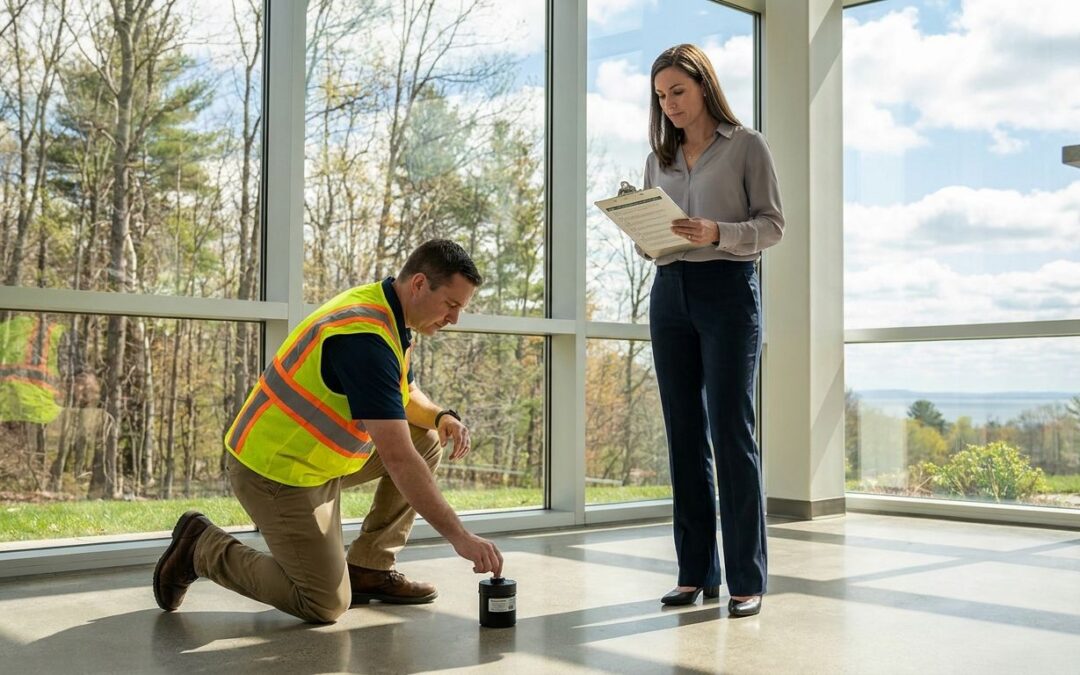
Preparing a Michigan business for a commercial radon inspection means closing doors and windows for at least 12 hours before the test starts, running the HVAC system on its normal cycle instead of shutting it down overnight, and keeping the test device undisturbed in the lowest occupied level of the building. Skip the closed-building window and the reading gets thrown out — that means a second visit, a second invoice, and another delay on whatever decision (a lease signing, a sale, an insurance renewal) is waiting on the result.
- Commercial radon inspection Michigan protocol requires 12 hours of closed-building conditions before testing starts.
- EPA sets the radon action level at 4 pCi/L — buildings above it need mitigation.
- Short-term charcoal tests run 2-7 days; continuous monitors need a minimum 48 hours.
- Michigan Radon Control runs NRPP-certified commercial radon inspection Michigan services across Metro Detroit and Lansing.
Why this matters
A business owner worrying about a radon inspection is usually worried about the wrong thing first — not the gas itself, but what a bad result does to a lease renewal, a sale, or a certificate of occupancy. That anxiety is normal, and it's fixable with a little prep work before the technician shows up.
Commercial buildings in Michigan face the same geology-driven radon risk as houses do — the state sits on uranium-bearing glacial till and limestone bedrock that pushes radon gas up through foundation cracks and slab joints. A commercial radon inspection in Metro Detroit follows the same EPA-based protocol as a home test, but with more variables: multiple HVAC zones, shift-based occupancy, and shared mechanical rooms that a single-family home never has to account for.
How to prepare a Michigan business for a radon inspection
Follow these steps in order, starting the day before the technician arrives:
- Close all exterior doors and windows 12 hours before the test starts and keep them closed for the full test duration.
- Leave HVAC systems running on their normal schedule — don't power down overnight or over a weekend to save on utilities during the test window.
- Identify the test location with the technician: the lowest occupied level, away from exterior doors, exhaust fans, and supply vents.
- Post signage near the monitor so staff and cleaning crews know not to move, unplug, or block it.
- Confirm the contractor's credentials before test day — verify the technician's NRPP certification and insurance rather than taking a business card at face value.
- Schedule the test during a normal occupancy week, not during a planned shutdown, holiday closure, or renovation.
- Plan your next step before the result comes back — know who signs off on mitigation approval if the reading lands above 4 pCi/L.
| Test type | Duration | Best for |
|---|---|---|
| Short-term charcoal canister | 2-7 days | Fast pre-lease or pre-sale decisions |
| Continuous radon monitor | 48 hours minimum | Tamper-evident data logging in occupied buildings |
| Long-term alpha track | 91 days to 1 year | Annual average verification for facilities managers |
“If the closed-building window breaks, the test breaks with it.”
Short-term commercial radon test: 2-7 days
A short-term charcoal canister test is the fastest way to get a defensible number for a lease decision or closing date in 2026. The canister sits sealed in the test location for 2 to 7 days, then goes to a lab for analysis — the shorter end of that range works for a quick screening, the longer end gives a more reliable average.
This test type is sensitive to interruptions. A propped-open loading dock door or a maintenance crew running an exhaust fan mid-test can swing the reading enough to force a retest.
Continuous monitor commercial radon test: 48 hours minimum
A continuous radon monitor (CRM) logs hourly readings instead of one lab-averaged number, which makes it harder to dispute and easier to defend if a landlord or buyer questions the result. The minimum run time is 48 hours, and the device flags any building disturbance — a door left open, a spike from an HVAC cycle — directly in the data log.
CRMs are the standard for real estate transactions and commercial leases in Michigan because the hour-by-hour record shows exactly when and how long any interference lasted. That transparency matters more in a business than a house, where more people have access to the space during the test window.
Why radon inspection results vary in Michigan commercial buildings
- Foundation type — slab-on-grade, crawl space, and full basement construction all move soil gas differently.
- HVAC operation cycles — exhaust fans and rooftop units can pull negative pressure that draws more soil gas indoors.
- Multi-tenant construction — shared walls and mechanical rooms mean one tenant's ventilation habits affect a neighbor's reading.
- Occupancy schedule — a business closed nights and weekends has long stretches with reduced air exchange, which lets radon build up.
- Building size and floor count — larger footprints and multiple levels change how gas concentrates near the slab.
- Seasonal weather — closed winter conditions concentrate radon more than open summer months.
HVAC behavior is the variable most business owners underestimate. A rooftop unit cycling on and off changes air pressure inside the building enough to pull soil gas through slab cracks that would otherwise stay sealed, and the same negative-pressure effect that concentrates radon also concentrates dust and allergens in the ductwork — which is why facilities that stay on top of cleaning vents and ductwork tend to see steadier baseline air quality between radon tests, not just cleaner air.
Do Michigan businesses have to test for radon by law?
Michigan does not have a statewide law mandating radon testing for commercial buildings, but lease agreements, lenders, and insurance carriers increasingly require a current test result before closing or renewal. Check the specific lease, loan, or policy language — the requirement usually comes from the contract, not the state.
How is a commercial radon inspection different from a home radon test?
A commercial radon inspection in Michigan follows the same EPA-based short-term or continuous-monitor protocol as a home test, but it accounts for multiple HVAC zones, shared walls between tenants, and shift-based occupancy patterns a single-family home never has. The core action level — 4 pCi/L — stays the same for both.
Can employees keep working during a commercial radon test?
Yes, employees can keep working during a commercial radon test as long as the closed-building conditions stay intact — doors and windows shut, HVAC on its normal cycle, and the monitor undisturbed. Normal foot traffic through interior doors doesn't invalidate the test; propping open exterior doors does.
Book a commercial radon inspection
NRPP-certified testing for Metro Detroit and Lansing area businesses.
FAQ
What is the EPA action level for a commercial radon inspection in Michigan?
The EPA action level is 4 pCi/L for any building, commercial or residential. A reading at or above that number means mitigation is recommended before 2026 lease or sale timelines close.
How long does a commercial radon test take in Michigan?
A short-term charcoal test takes 2 to 7 days, while a continuous radon monitor needs a minimum of 48 hours. Long-term alpha track tests run 91 days to a full year for annual average data.
Do I need to close my business during a radon test?
No, a business can stay open during a radon test as long as closed-building conditions hold — exterior doors and windows shut, HVAC running normally, and the monitor left in place undisturbed.
What happens if a commercial radon test comes back above 4 pCi/L?
A reading above 4 pCi/L calls for a mitigation system, typically a sub-slab depressurization setup installed by an NRPP-certified contractor. Retesting after installation confirms the level has dropped.
Can I test for radon myself in a commercial building?
A DIY test kit can give a rough baseline, but lenders, insurers, and buyers generally require lab-analyzed or continuous monitor results from a certified technician for commercial radon inspection Michigan transactions.
How do I verify a radon contractor is certified before a commercial inspection?
Ask for the technician’s NRPP certification number and confirm it directly rather than relying on a business card or website claim. Insurance and bonding documentation should back it up.
Does HVAC operation affect commercial radon test results?
Yes, HVAC cycling changes indoor air pressure and can pull more soil gas through slab cracks, which is why technicians ask that systems run on their normal schedule during the test rather than being shut off.
How fast can I get commercial radon test results in Michigan?
Short-term charcoal results typically come back within a few days of lab processing, while continuous monitor data is available as soon as the 48-hour minimum run finishes.
One last thing
The detail most business owners miss isn't the test itself — it's the mechanical room. Shared mechanical rooms in multi-tenant buildings often sit right above the slab penetrations where soil gas enters, and a neighboring tenant's exhaust fan schedule can shift your reading without you ever knowing it ran. Ask what's on the other side of that wall before test day, not after the result comes back high.
Related guides
- Radon testing for Michigan auto repair shops
- Verify a radon contractor's NRPP certification
- How fast you can get radon test results in Michigan
- Best radon testing companies for Metro Detroit realtors