
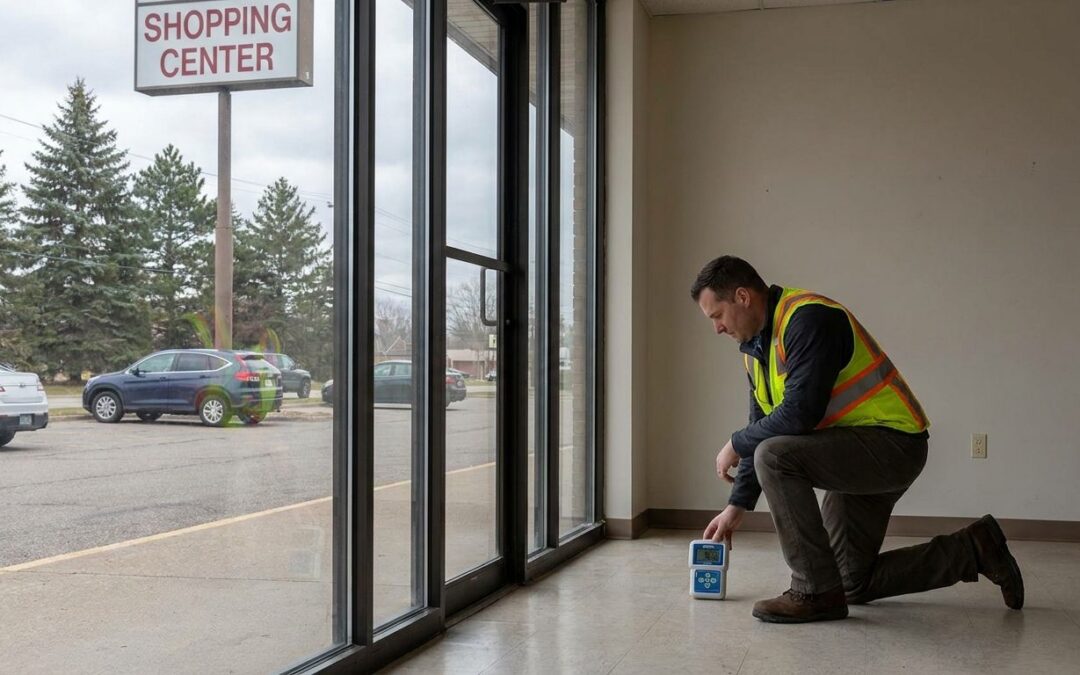
Radon testing for Michigan strip malls and shopping centers uses a commercial protocol, not a homeowner test kit. Multi-tenant retail buildings need per-unit sampling, closed-building conditions during business hours, and a documented result that a lender, insurer, or incoming tenant can actually rely on.
- Radon testing strip malls Michigan requires per-tenant-unit sampling, not one reading for the whole building.
- The EPA action level is 4 pCi/L for commercial buildings, same threshold used in homes.
- Continuous monitors outperform mail-in kits once a building has more than three tenant units.
- Sub-slab mitigation can run per zone so one tenant’s install never disrupts the unit next door.
- Michigan Radon Control tests commercial buildings across Metro Detroit under NRPP-certified protocols in 2026.
Why radon testing matters for strip malls and shopping centers
Michigan sits mostly inside the EPA's Zone 1 designation, meaning predicted average indoor radon screening levels run above the 4 pCi/L action level across most of the Lower Peninsula. That's a county-level average, not a guarantee about any one building — a strip mall's slab, backfill, and HVAC design matter more than its zip code.
A shopping center isn't a house with a bigger footprint. It's several separate foundations, several HVAC zones, and several leases, each with its own liability if radon shows up during due diligence. Radon testing for commercial buildings in Metro Detroit covers the broader compliance picture; this guide narrows in on the multi-tenant retail layout specifically.
Property managers who skip proper testing find out the hard way during a refinance or a sale, when a lender or buyer's inspector asks for documentation that doesn't exist. Building a test file now costs a fraction of what a rushed retest costs during closing.
Test every occupied unit, not just one
A single reading near the anchor store tells you nothing about the nail salon three doors down sitting on a different slab pour.
- Place a detector in each tenant space with its own slab or crawl space foundation, not just the largest unit
- Treat units separated by a firewall but sitting on different foundation sections as separate tests
- Log which HVAC zone serves each detector so a spike can be traced to a specific duct run
- Sample storage rooms and back-of-house space separately from the retail floor
- Flag any unit with a sump pit or floor drain for a closer look — those are common radon entry points
Close the building the way a business actually closes
Closed-building conditions are the backbone of an accurate test, and a retail center closes differently than a house does overnight.
- Keep exterior doors and windows shut for at least 12 hours before the test starts
- Run HVAC on its normal daytime schedule instead of shutting it off during the test window
- Put the closed-conditions rule in writing so no tenant props open a loading dock door for deliveries
- Schedule around a week without a lease turnover, buildout, or major renovation in progress
- Confirm with each tenant that exhaust fans and makeup-air units stay on their normal cycle
Choose a device built for a commercial floor plan
A charcoal kit built for a 1,200-square-foot ranch basement wasn't designed for a 30,000-square-foot retail floor plate.
- Charcoal or alpha-track kits still work for a single small unit under roughly 2,000 square feet
- Continuous radon monitors log hour-by-hour data, which catches spikes tied to HVAC cycling that a passive kit misses entirely
- Buildings with more than three tenant units need multiple detector points, not one central reading
- Property managers tracking several locations get more usable data from continuous monitors than from mail-in lab kits
- Devices should log temperature and humidity alongside radon, since HVAC swings can explain odd readings
Follow the commercial testing protocol, not the residential one
Homeowner test guidance and commercial test guidance are two different documents, and mixing them up produces results nobody can defend later.
- Commercial buildings follow ANSI/AARST CC-1000, the protocol written for schools and commercial structures, not the residential standard
- Sampling density scales with square footage — a 40,000-square-foot strip mall needs more detector points than a single-family home
- Results get averaged and reported by zone, not lumped into one building-wide number
- An NRPP-certified tester documents device placement, serial numbers, and calibration dates in the file
- Ask for a copy of the certification before the test, not after — lenders will ask for it later
Read the results against the EPA action level
4 pCi/L is the EPA action level for mitigation decisions in commercial buildings, the same threshold used in single-family homes.
- Results between 2 and 4 pCi/L still warrant a second test and a mitigation conversation, per EPA guidance
- One unit reading high while its neighbor reads low usually points to a foundation gap or crack, not a bad device
- Keep every result on file in a format a lender or insurer can request directly, not a verbal summary
- A building-wide average can hide a single unit with a real problem — report by zone, not by average
A shopping center with one tenant unit above 4 pCi/L still needs mitigation for that zone, even if the building-wide average reads clean.
Plan mitigation without shutting the building down
Mitigation for a multi-tenant building has to work around lease schedules, not around a contractor's convenience.
- Sub-slab depressurization can run per tenant zone so one unit's fan and piping never touch a neighboring unit's ceiling
- Fan and pipe routing goes through back-of-house space where customers never see it
- Installation windows get scheduled around each tenant's actual business hours
- A single manifold system can serve multiple units when the slab is continuous, which cuts total equipment count
- Get insurance and bonding verified before any crew touches a shared slab — a claim on a multi-tenant building is a different exposure than a single house
Maintain the system after tenants change
A mitigation system installed in 2026 for one tenant mix won't survive a buildout untouched.
- New tenant buildouts can puncture a sub-slab system without anyone noticing until an alarm trips
- Re-test any zone where HVAC ductwork changes after a system was tested
- Warranties and service contracts should transfer with the lease file, not stay tied to the outgoing tenant
- A visual pressure gauge check belongs in the punch list any time a buildout crew works near the slab
- Property managers running multiple sites benefit from a standing testing schedule tied to lease renewal dates, not a one-time test
Comparing testing options for strip malls and shopping centers
| Option | Best for | Key limitation |
|---|---|---|
| Charcoal or alpha-track kit | A single small unit under 2,000 sq ft | Under-reports in open floor plans; no hour-by-hour data |
| Continuous radon monitor | Multi-tenant buildings needing zone-by-zone data | Requires a trained reader to separate HVAC noise from real spikes |
| Full ANSI/AARST CC-1000 assessment | Property managers documenting compliance for lenders or insurers | Takes longer to schedule than a mail-in kit |
| Consumer app-connected monitor | A tenant checking their own unit informally | Not accepted as compliance documentation by most lenders |
A CC-1000 assessment is the only option on this list a lender or insurer will accept as documentation — treat the others as screening tools, not final answers.
Get a commercial radon assessment
NRPP-certified testing for Michigan retail and multi-tenant buildings.
Common mistakes strip mall owners and managers make
- Testing only the anchor tenant. Foundation type and soil contact vary unit to unit; a clean reading in the biggest space says nothing about the smaller units.
- Running the test with a loading dock door propped open. Closed-building conditions break the moment fresh air floods a unit, and the result gets thrown out.
- Skipping documentation before a refinance or sale. Lenders and buyers ask for a CC-1000 report, not a verbal assurance that testing happened once.
- Installing a residential-sized fan on a 20,000-square-foot floor plate. Undersized fans cycle constantly and fail years earlier than a properly sized system.
- Never re-testing after a tenant buildout. New duct runs and slab penetrations change the pressure picture every time a space gets rebuilt for a new tenant, even similar setups like warehouses and distribution centers run into this same gap.
FAQ
What’s the best way to test radon in a Michigan strip mall?
Test each tenant unit separately under closed-building conditions using continuous monitors or an ANSI/AARST CC-1000 commercial assessment. A single reading in one unit does not represent the whole building.
Is commercial radon testing different from a home radon test?
Yes. Commercial buildings follow the ANSI/AARST CC-1000 protocol, which scales sampling density to square footage and reports results by zone rather than one building-wide number.
How much of a strip mall needs mitigation if only one tenant tests high?
Only the affected zone typically needs mitigation. Sub-slab depressurization can be installed per tenant unit so one fan and pipe run serves just that space.
Do Michigan landlords have to disclose radon test results to commercial tenants?
Michigan does not have a statewide law requiring commercial landlords to disclose radon results to tenants. Many lease agreements and insurers now request a current test report anyway.
How long does a commercial radon test take?
A closed-building test typically runs 48 hours minimum once conditions are met, with continuous monitors able to log data over longer periods for zone-by-zone comparison.
Can one mitigation system cover an entire multi-tenant building?
A single manifold system can serve multiple units when the slab is continuous, but separate tenant foundations usually need separate fan and pipe runs.
What EPA level triggers mitigation for a commercial building?
4 pCi/L is the EPA action level for commercial buildings, the same threshold used for homes. Readings between 2 and 4 pCi/L still warrant a second test.
Who is qualified to test radon in a commercial building in Michigan?
An NRPP-certified tester familiar with the ANSI/AARST CC-1000 commercial protocol should handle multi-tenant buildings. Residential-only testers may not document zone-by-zone results the way lenders require.
One last thing
Radon varies building to building even along the same block, which is why a shopping center two doors down from a tested property can read completely differently. Don't treat a neighbor's clean result as a reason to skip your own test in 2026 — the slab, backfill, and HVAC design under your building are what actually determine the number, not the address next to it.
Related guides
- Radon testing programs for Michigan property managers
- Best continuous radon monitors for Michigan homes
- How to verify a radon contractor's insurance and bonding
- Radon testing for Michigan warehouses and distribution centers
- Radon testing for commercial buildings in Metro Detroit