
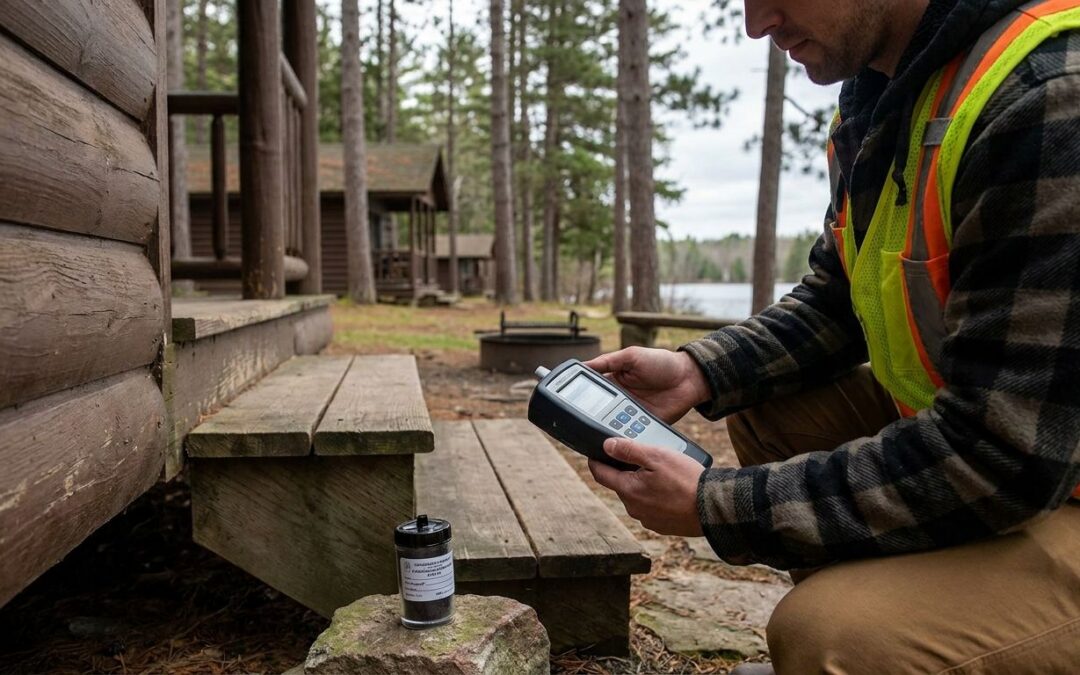
Michigan campgrounds and cabin resorts sit on the same glacial soils that give the rest of the state elevated indoor radon, but multi-structure properties face a testing problem homeowners don't: dozens of buildings, seasonal occupancy, and guests who never ask about air quality until something goes wrong.
- Radon testing campground cabin Michigan properties need per-structure testing, not one property-wide number.
- Lakefront and rental cabins carry higher exposure risk from seasonal closures that trap gas indoors.
- EPA action level is 4 pCi/L for any cabin, lodge, or outbuilding with guest occupancy.
- Pole barns and maintenance sheds get skipped most often and shouldn’t be.
- Multi-site scheduling with one NRPP-certified contractor beats hiring separately per cabin.
Why this matters
A campground or cabin resort isn't one building with one radon number — it's ten, twenty, or fifty separate foundations, each sitting on its own patch of soil gas. One cabin can test at 1.8 pCi/L while the cabin thirty feet away tests at 6.2 pCi/L in the same week, because radon entry depends on foundation type, soil permeability, and how tightly a structure is sealed, not proximity.
Michigan cabin resorts add a second wrinkle: seasonal occupancy. A cabin closed from November through April traps radon gas indoors with no ventilation running, which means the first weekend guests of the 2026 season can walk into concentrations that built up all winter. If you manage multiple sites and want to compare vetted contractors before booking a multi-property inspection, reviewing the best radon testing companies near you in Michigan is worth doing before peak season, not during it.
Who this is for
This guide is for campground owners, cabin resort operators, and property managers running multiple guest-occupied structures in Michigan — whether that's six lakefront cabins, a forty-site RV park with a main lodge, or a mixed property with rental cabins, a camp store, and an equipment barn. If you're testing a single primary residence, a standard homeowner radon test kit covers that case; this guide is for the operational complexity of testing and mitigating radon across a whole property in 2026.
What to look for in radon testing for campgrounds and cabin resorts
Per-structure testing, not spot-checking
Radon levels vary by foundation, not by property line. Testing one representative cabin and assuming the rest match is the single most common mistake resort operators make, and it's the one most likely to leave a guest-occupied cabin over the 4 pCi/L action level undetected.
Seasonal timing around opening dates
A cabin sealed all winter needs testing before guests arrive, not after the first complaint. Short-term tests run a minimum of 48 hours under EPA protocol, so schedule testing at least a week ahead of your 2026 opening weekend to leave room for retesting if a result comes back high.
Foundation type per building
Slab cabins, crawl space cabins, and cabins with walkout basements each need a different mitigation approach if levels come back elevated. A resort with mixed foundation types across its cabin inventory should expect mixed mitigation solutions, not a single system design applied everywhere.
Well water exposure
Many Michigan campgrounds run on well water rather than municipal supply, and radon dissolved in well water adds an inhalation pathway on top of soil gas entry — showers and hot water use release it into indoor air. Properties on well water should test water alongside air, particularly in shared bathhouses and shower buildings with heavy guest turnover.
NRPP-certified contractors who handle multi-site scheduling
A contractor used to single-family homes may balk at scheduling twenty test kits across a property in one visit. Look for an NRPP-certified provider who can batch-place kits, batch-collect them, and give you one consolidated report instead of twenty separate invoices.
Disclosure exposure for short-term rentals
If any cabins on the property are also listed as short-term rentals, radon disclosure obligations can stack on top of your general operator duty of care. Guests who search for a property before booking increasingly expect indoor air quality information, and an untested cabin is a liability sitting in your inventory.
Top picks by property type
The lakeside cabin pick: waterfront and lakefront structures. Michigan cabin resorts cluster around lakes, and lakefront cabins often sit on crawl spaces or slab foundations close to a high water table, which changes how soil gas moves and how a mitigation system gets designed. A sub-slab depressurization system typically runs continuously once installed, and lakefront cabins with sump pumps need a system that seals the sump pit into the mitigation loop rather than leaving it as an open entry point. Review the approach in radon mitigation for waterfront and lakefront homes in Michigan before assuming every cabin needs the identical system. Verdict: Buy — this is close to non-negotiable for any lakefront cabin cluster with cabins built before 2000.
The seasonal rental pick: cabins also listed as short-term rentals. A cabin that doubles as an Airbnb listing carries testing and disclosure expectations beyond standard resort operation, especially with guest turnover measured in days rather than weeks. Michigan's Airbnb host guidance covers what needs disclosing and when retesting makes sense after a mitigation install; see radon testing requirements for Airbnb hosts in Michigan for the specifics that apply to a listed unit. Verdict: Buy — skipping this on a listed cabin is the fastest way to end up with a bad review or a liability claim.
The outbuilding pick: camp stores, equipment barns, and maintenance sheds. These structures get skipped constantly because nobody sleeps in them overnight, but staff spend full shifts inside a camp store or equipment barn, and pole barn slabs are just as capable of channeling soil gas as a cabin foundation. Details on testing and mitigating these structures are in radon mitigation for Michigan pole barns and outbuildings. Verdict: Consider — test it in year one; mitigate only if the number comes back above 4 pCi/L.
What to avoid
- Don't test one cabin and extrapolate. A low reading in your newest cabin tells you nothing about the crawl space cabin built in 1978 two lots over.
- Don't schedule testing mid-season. Guests occupying a cabin during a 48-hour test window disrupt the closed-house conditions the test needs, which skews results low and gives you false confidence.
- Don't ignore a passive system that's never been checked. Some older cabins have passive radon-resistant features installed during construction that were never verified as functional — a passive pipe with no fan running isn't protection, it's a placeholder.
Comparison at a glance
| Structure type | Main risk factor | Typical fix | 2026 verdict |
|---|---|---|---|
| Lakefront/waterfront cabin | High water table, sump entry points | Sub-slab depressurization | Buy |
| Short-term rental cabin | Guest turnover, disclosure exposure | Testing plus disclosure documentation | Buy |
| Camp store/equipment barn | Staff occupancy, slab-on-grade entry | Test first, mitigate if over 4 pCi/L | Consider |
Get your cabins tested before opening weekend
Multi-site scheduling for campgrounds and cabin resorts across Michigan.
FAQ
What’s the best radon testing method for a Michigan campground with multiple cabins?
Per-structure short-term testing is the standard for radon testing campground cabin Michigan properties, since radon levels vary cabin to cabin even within the same resort. Batch scheduling with one NRPP-certified contractor keeps results consistent and cuts down on repeat site visits.
Is radon testing required for Michigan campgrounds or cabin resorts?
Michigan doesn’t mandate radon testing for campgrounds by state law, but operator duty of care and short-term rental disclosure expectations make it a practical necessity in 2026. Guests increasingly expect air quality transparency before booking.
How much does radon testing cost for a multi-cabin property?
Cost scales with the number of structures tested, since each cabin needs its own kit and its own result. A resort with mixed foundation types should budget for testing every cabin in year one, then targeted retesting only where levels came back elevated.
How long does a radon test take at a seasonal cabin?
A short-term test runs a minimum of 48 hours under EPA protocol with the cabin closed up. Testing right before opening weekend, rather than during it, keeps the closed-house conditions the test requires.
Do Airbnb cabins in Michigan need radon disclosure?
Cabins listed as short-term rentals carry disclosure expectations that go beyond standard resort operation. Testing and documenting results before listing a cabin protects both the guest and the operator.
Can well water at a campground raise radon levels?
Yes, radon dissolved in well water adds an inhalation pathway through showers and hot water use, on top of soil gas entering through foundations. Properties on well water should test water in addition to air, especially in shared bathhouses.
How often should a cabin resort retest for radon?
Retest any cabin after a mitigation system installation to confirm the fix worked, and retest every few years after that as a baseline check. Cabins that sat vacant over winter are worth retesting each spring before guests return.
What radon level requires mitigation in Michigan?
The EPA action level is 4 pCi/L — any guest-occupied structure testing at or above that number should get a mitigation system installed. Levels between 2 and 4 pCi/L are worth monitoring even though they fall below the action threshold.
One last thing
The cabin most resort operators skip testing is the one they trust most — the newest build, the one with a poured slab and modern construction. New construction doesn't guarantee low radon; it guarantees a tighter building envelope, which can trap soil gas just as effectively as an old crawl space if no radon-resistant features were installed during the pour.
Related guides