
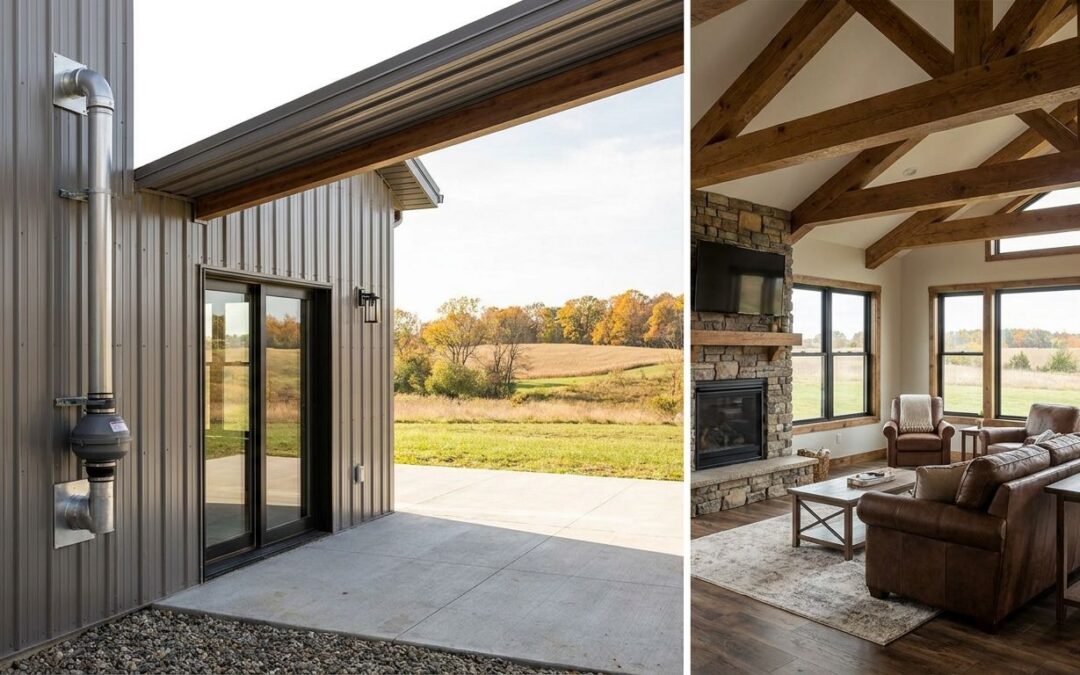
Barndominiums built on slab-on-grade foundations across Michigan trap radon gas the same way any other house does, but the pole-barn framing, open floor plans, and combined shop-and-living layouts change how a mitigation system gets designed and installed.
- Slab-on-grade barndominiums need active sub-slab depressurization, not a passive-only stack — Buy verdict for 2026 builds.
- Michigan’s EPA action level is 4 pCi/L; test before finishing a barndo’s living quarters.
- Exterior fan routing avoids noise complaints in combined shop-and-living layouts — Consider it for mixed-use barndos.
- Passive stacks without a fan rarely pull slab-on-grade levels below 4 pCi/L — Skip for occupied barndominiums.
- NRPP-certified radon mitigation for a Michigan barndominium runs the same $800-$2,500 EPA-cited range as a standard slab home.
Why This Matters
A barndominium sits on a concrete slab poured directly on graded soil, often on rural or former agricultural land where Michigan's glacial till and uranium-bearing bedrock already push radon readings higher than the state average. That slab is the only barrier between the soil gas and the room where your family sleeps.
It's a reasonable thing to worry about, especially if you just finished building or buying a barndominium and haven't tested yet. The fix is straightforward once you understand what makes pole barn and outbuilding conversions different from a standard basement home: no below-grade perimeter walls to run pipe through, often a single open slab spanning the shop and the living space, and sometimes a footing drain system that short-circuits a mitigation fan if it's not accounted for during design.
Who This Is For
This guide is for Michigan homeowners who built, bought, or are planning a barndominium — whether it's a new-construction pole-barn conversion in Livingston or Ionia County, a retrofit of an older ag building, or a combined workshop-and-residence layout where the living quarters share one continuous slab with the garage bay. If your barndo has finished square footage on a poured slab and no basement, the mitigation approach below applies directly to you.
What to Look For in Radon Mitigation for Michigan Barndominiums
Foundation type and slab layout
Most barndominiums are slab-on-grade construction, which means the mitigation system has to draw from beneath one continuous pour rather than a basement floor with interior footings. A single suction point placed in the wrong spot can leave sections of a large open-plan barndo unmitigated, so the contractor needs to map the slab before drilling.
Vapor barrier and sub-slab gravel
Barndominiums built after 2020 increasingly include a poly vapor barrier and a gravel or aggregate layer under the slab, which makes sub-slab suction far more effective because the gas has a path to travel to the suction point. Older ag-building conversions poured without gravel are harder to mitigate and may need multiple suction points instead of one.
Fan placement and noise
A mitigation fan mounted in an attic or exterior wall near living quarters can be audible inside an open-concept barndo in a way it wouldn't be in a house with a finished basement buffering the sound. Exterior-mounted fans routed away from bedrooms and the main living area solve this in most 2026 installs.
Electrical and code compliance
Radon fans run continuously and need a dedicated GFCI-protected circuit under most Michigan electrical codes. A barndo's electrical panel is sometimes shared between the shop and the residence, so confirm the installer is pulling a permit and wiring to code, not tapping an existing shop circuit.
NRPP certification of the installer
Anyone installing a system in your barndominium should carry current NRPP mitigation certification. This isn't optional paperwork — it's the credential that confirms the installer follows EPA protocol for suction point placement, pipe sizing, and post-installation testing.
Post-installation verification
A finished install should include a follow-up test showing levels under 4 pCi/L, not just a promise that the system "should work." Ask how system type gets chosen for your specific slab before you sign a contract.
Get a barndo-specific radon estimate
NRPP-certified assessment for slab-on-grade and pole-barn layouts across Michigan.
Top Picks for Barndominium Radon Mitigation
The safe pick: active sub-slab depressurization (ASD). One suction point drilled through the slab, PVC pipe routed to an exterior fan, continuous power draw pulling soil gas out before it reaches the living space. This is the standard EPA-recommended approach and it's what most Michigan barndominiums end up with regardless of build year. Verdict: Buy.
The build-in-from-the-start pick: passive stack piping during framing. If your barndo is still under construction, a new-construction radon system lets the contractor rough in the vent pipe before the slab pour, which cuts finished-drywall damage later and often shaves a few hundred dollars off the eventual active-system retrofit. It won't lower radon on its own without a fan, but it sets up the fan install for a fraction of the labor. Verdict: Buy, if you're still in the framing stage.
The wildcard: multi-point suction for combined shop-and-living slabs. Barndos with 2,000+ square feet of continuous slab spanning a garage bay and residence sometimes need two suction points instead of one, because a single fan can't pull suction evenly across that much square footage. It costs more upfront but avoids a callback six months later when the shop side still tests high. Verdict: Consider, for barndos over roughly 2,000 sq ft of connected slab.
Skip this one: passive-only stacks with no fan, sold as "good enough." A passive stack relies on stack effect and wind alone to move air, and on a slab-on-grade barndo with no basement stack height to generate draft, it rarely gets levels below the EPA's 4 pCi/L action threshold. If a contractor pitches this as your final system rather than a temporary pre-construction rough-in, that's a red flag. Verdict: Skip.
What to Avoid
- DIY passive vent kits sold online for "radon reduction." They look like a real mitigation system but without a calibrated fan and manometer readings, there's no way to confirm they're pulling levels down.
- Contractors who quote a price without seeing the slab. Barndominium layouts vary enough that a phone-quote installer is guessing, and guessing on suction point placement means a system that doesn't work.
- Skipping the post-install test. A system that isn't verified with a follow-up test is a system you're trusting on faith, not data.
Verdict Comparison Table
| System Type | Best For | Install Complexity | 2026 Verdict |
|---|---|---|---|
| Active sub-slab depressurization | Any finished slab-on-grade barndo | Moderate, 1 day typical | Buy |
| Passive rough-in during framing | New builds not yet slabbed | Low, done during framing | Buy (if pre-construction) |
| Multi-point active system | Barndos over ~2,000 sq ft connected slab | High, 1-2 days | Consider |
| Passive-only, no fan | Nothing occupied | Low, but ineffective alone | Skip |
Budgeting matters here too — review how to budget for a mitigation system installation before you compare quotes, since barndo-specific line items like exterior fan mounting can shift the total.
FAQ
Do barndominiums in Michigan have higher radon risk than regular houses?
Not inherently higher, but slab-on-grade barndominiums built on rural or former agricultural land often sit on the same uranium-bearing glacial till that drives Michigan’s elevated radon readings statewide. The construction type matters less than the soil underneath it and whether the slab has a vapor barrier.
What’s the best radon mitigation system for a barndominium?
Active sub-slab depressurization is the best option for a finished slab-on-grade barndominium in 2026. It’s the EPA-recommended method and works whether your barndo has one open slab or a combined shop-and-living layout.
How much does radon mitigation cost for a Michigan barndominium?
A standard single-point active system runs in the EPA-cited $800-$2,500 range, similar to a typical slab-on-grade house. Larger connected slabs needing multi-point suction cost more due to added pipe runs and a second fan.
Can I install a passive radon system during barndominium construction?
Yes, and it’s the cheapest time to do it. Roughing in the vent pipe before the slab pour sets up an easy fan retrofit later if testing shows levels above 4 pCi/L, without cutting into a finished slab or drywall.
Is a passive system enough for a barndominium?
Rarely. Without a fan, a passive stack depends on stack effect and wind to move air, and slab-on-grade barndos don’t generate enough draft to reliably pull levels below the EPA’s 4 pCi/L action level.
Where should the radon fan go on a barndominium?
Exterior-mounted, routed away from bedrooms and the main living area. Open floor plans common in barndominiums carry fan noise farther than a basement house would, so placement matters more here than in standard construction.
Do I need to test a new barndominium for radon before moving in?
Yes. Test after the slab cures and before finishing interior walls if possible, since results guide whether a passive rough-in needs a fan added before you’re living with the results.
Does a combined shop-and-living barndo need a bigger mitigation system?
Barndos with more than roughly 2,000 square feet of continuous connected slab often need two suction points instead of one, because a single fan can’t pull even suction across that much open floor area.
One Last Thing
The detail most barndo owners miss: a shop floor drain or a footing drain tied into the slab perimeter can short-circuit a mitigation fan by pulling in outside air instead of soil gas, which is a failure mode that doesn't show up until the post-install test comes back unchanged. Ask specifically whether your installer checked for drain tile before they drilled the suction point — it's a five-minute question that separates a working 2026 install from a callback in six months.