
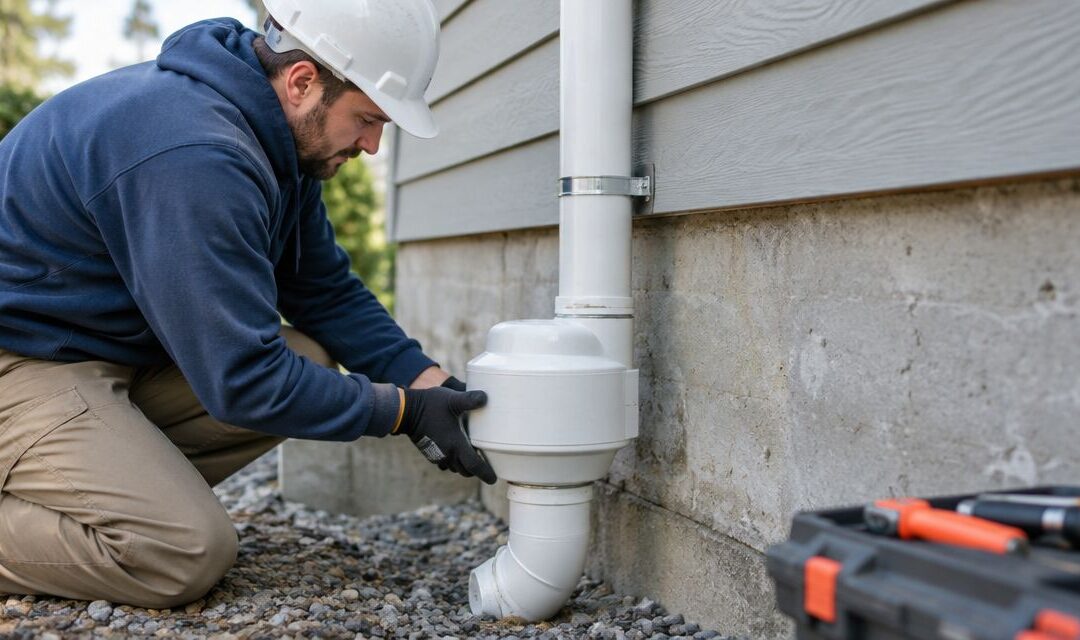
Insulation contractors’ radon mitigation is a testing-led process for coordinating radon control with air sealing and insulation work so homeowners can improve energy performance without overlooking radon exposure. Your work changes the building envelope, so radon testing, foundation access, and trade sequencing belong in the project plan—not just the final conversation.
- Radon mitigation for insulation contractors starts with testing, not a promise that air sealing will lower radon.
- Michigan Radon Control provides NRPP-certified radon testing, mitigation installation, and maintenance for Metro Detroit and Lansing homeowners.
- Keep radon pipes, fans, crawl-space membranes, and service access clear throughout insulation work.
- Retest after envelope changes; a blower-door result does not measure radon concentration.
Why radon mitigation matters for insulation contractors
Air sealing changes how outdoor air enters a home and how indoor air leaves it. Those changes can affect radon concentrations, but they do not predict whether a particular home’s level will rise or fall. Measure radon rather than infer it from airtightness.
For homeowners in Metro Detroit and Lansing, Michigan Radon Control provides radon testing, mitigation installation, and system maintenance. Insulation contractors can keep their own scope clear while directing homeowners to a qualified radon professional when testing or system work is needed.
Your practical constraint is access. Rim joists, crawl-space floors, foundation penetrations, and attic pipe routes are easier to inspect before insulation conceals them. Include radon coordination in your 2026 job checklist before materials arrive.
The EPA’s A Citizen’s Guide to Radon, which addresses residential testing and reduction, recommends fixing homes at 4 picocuries per liter (pCi/L) or higher and considering reduction between 2 and 4 pCi/L. A result below the action level does not mean zero risk.
How to coordinate radon control with insulation work
1. Record the existing conditions
Start with a walkthrough and a written checklist. Ask the homeowner for previous radon reports, identify the foundation types, and photograph any existing radon equipment before your crew begins moving materials.
A basement connected to a crawl space needs a different coordination discussion from a single slab. Record what you can see without diagnosing what lies beneath the floor. An unlabeled pipe is not proof of a complete radon system.
Explain the distinction plainly: insulation improves thermal performance; a radon test measures radioactive gas in indoor air. Neither service replaces the other, and a visual inspection cannot establish a radon concentration.
Keep the initial record useful for the next trade:
- Collect previous test reports with dates and test locations.
- Identify basement, slab, crawl-space, and mixed-foundation areas.
- Photograph visible radon pipes, fans, gauges, and labels.
- Mark proposed foam, insulation, and air-sealing locations.
- Record access restrictions before covering foundation surfaces.
2. Establish a valid testing plan
Begin with the homeowner-managed route: a radon test kit used exactly as its instructions require. Professional testing is the alternative when the homeowner wants a qualified person to manage placement, operating conditions, and reporting.
The EPA distinguishes short-term tests lasting 2 to 90 days from long-term tests lasting more than 90 days. Choose the method around the purpose of the measurement, not simply the shortest opening in your installation calendar.
Do not run a blower-door test or perform disruptive construction during a radon measurement without first coordinating with the test provider. Testing conditions matter. A pre-work result is a baseline, not proof of the home’s condition after air sealing.
For your 2026 testing plan, assign responsibilities before work begins:
- Name the person arranging the initial test.
- Record the test method, location, and exposure period.
- Follow the provider’s instructions for windows and equipment operation.
- Keep dust-producing work separate from the measurement period.
- Set a clear process for reviewing elevated results.
3. Assign radon work to a qualified professional
You can coordinate the work manually through a shared scope document and a conversation with the homeowner’s chosen radon professional. Where elevated results or an existing system complicate the job, involve that professional before committing to concealed work.
Michigan Radon Control is best for Metro Detroit and Lansing homeowners seeking NRPP-certified radon testing, mitigation installation, and maintenance. Its stated services address the radon portion of the project; keep insulation responsibilities in your own written scope.
A specialist handles radon assessment and system design. The limitation is that another trade must fit into the schedule, so agree on access and decisions before your crew mobilizes. Do not promise a bundled service or shared warranty unless those terms are expressly agreed.
Make the division of responsibility explicit:
- Assign test interpretation to the radon professional.
- Identify who approves changes near existing equipment.
- Separate insulation work from mitigation installation.
- Confirm which contractor restores disturbed materials.
- Give the homeowner a named contact for each scope.
4. Sequence the work before closing access
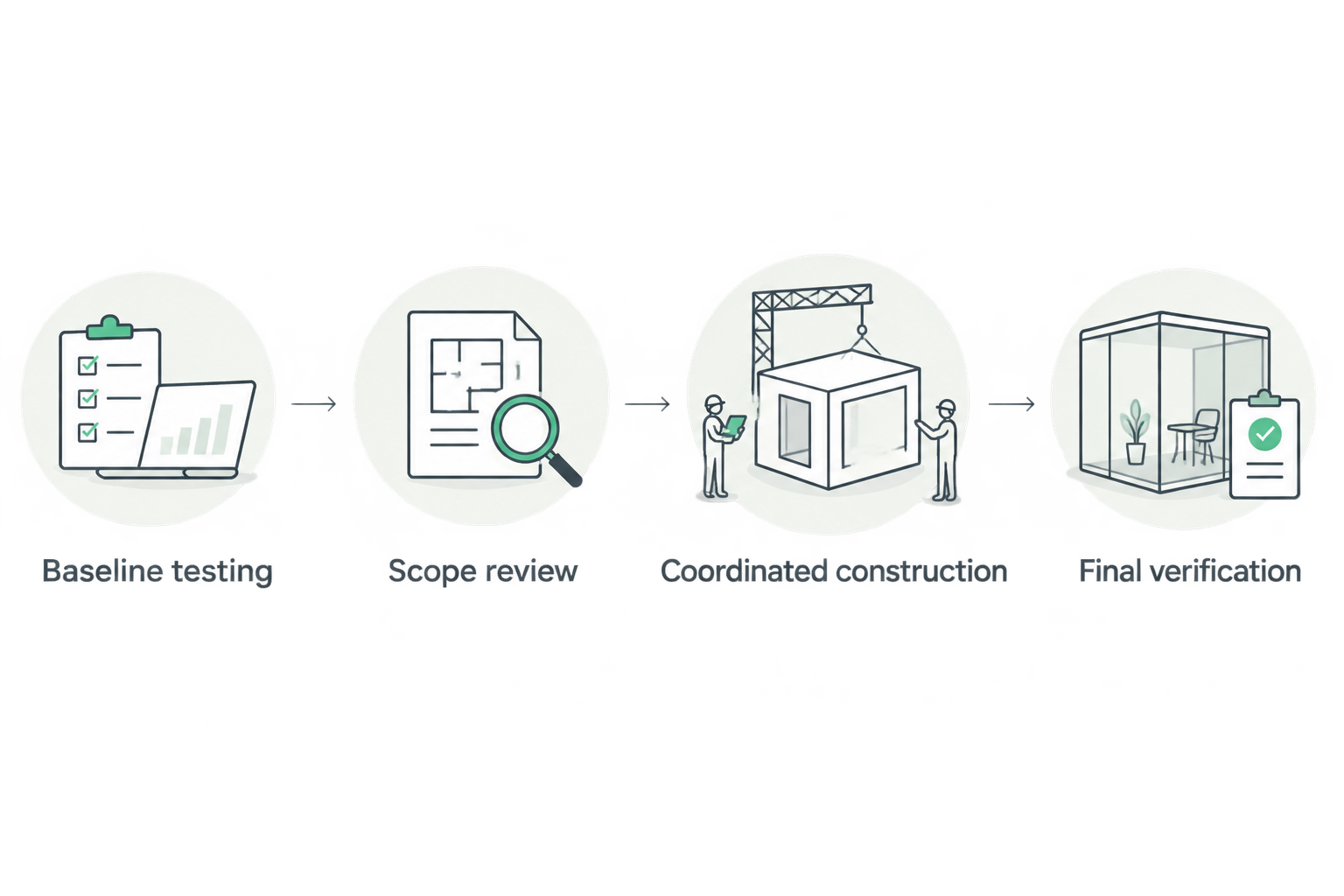
Use a simple sequence: baseline testing, scope review, coordinated construction, and final verification. The exact installation order depends on the foundation and the planned work; avoid treating every home as an attic-insulation job.
For a crawl space, coordinate membrane details and any suction system before covering surfaces or restricting entry. For an attic, discuss the radon pipe route and fan service access before installing insulation around them. Keep required equipment clearances intact.
The guide to sequencing radon mitigation with an insulation upgrade addresses this scheduling decision. In your 2026 scope, make unresolved radon details a hold point before concealment—not an item to resolve after the crew leaves.
Close the scheduling discussion with these actions:
- Share foundation photographs before agreeing on pipe routes.
- Resolve crawl-space membrane work before concealment.
- Preserve access to fans, gauges, and service connections.
- Coordinate electrical work with the responsible qualified trade.
- Schedule final testing after disruptive work is complete.
5. Protect the existing radon system
Start with a crew briefing and photographs of the work area. Show installers which pipes, electrical connections, membranes, and gauges belong to the radon system, and make clear that these are not spare construction components.
Do not unplug a radon fan for convenience or change its operating arrangement without the radon professional’s direction. Keep system labels visible. If foam, stored materials, or new finishes would prevent maintenance, resolve that conflict before installation.
A pressure gauge indicates a pressure difference in the system; it does not measure indoor radon concentration. Even a familiar gauge reading cannot replace a radon test after substantial building changes.
Give the crew a bounded protection checklist:
- Keep radon pipes separate from exhaust and HVAC ducts.
- Avoid puncturing or detaching crawl-space membranes.
- Leave gauges and operating labels visible.
- Preserve equipment access and required clearances.
- Stop and report damaged or disconnected components.
6. Verify the finished condition and document the handoff
Arrange testing after the insulation and air-sealing work is complete and the home can meet the selected test protocol. If mitigation was installed or modified, follow the radon professional’s post-installation testing instructions as well.
Compare the reports with context, not just a subtraction. Different test durations, seasons, locations, and operating conditions affect how you interpret before-and-after results. Do not attribute every change to insulation alone.
For the 2026 handoff, distinguish completed construction from verified radon performance. If the final result needs further action, identify the next responsible person and keep that action visible rather than describing the entire project as resolved.
Finish with a record the homeowner can use:
- Save the final test report and measurement location.
- List changes to insulation, air sealing, and ventilation.
- Document any radon-system work separately.
- Provide operating and maintenance instructions from the installer.
- Record unresolved actions and their responsible contacts.
Compare the coordination options
Choose an option based on the work required, not the convenience of keeping every task with one contractor. Homeowner-managed testing can establish a baseline, but it does not provide mitigation design or repair.
These options serve different roles. For a 2026 insulation project, decide which role is missing before recommending an additional service.
| Option | Best for | Main advantage | Key limitation |
|---|---|---|---|
| Homeowner-managed radon kit | Homeowners able to follow the testing protocol | Establishes a measurement without a testing appointment | Placement, timing, handling, and submission depend on the user |
| Professional radon testing | Projects needing managed testing and documentation | Puts measurement setup and reporting with a radon professional | Testing alone does not reduce radon |
| Michigan Radon Control testing and mitigation services | Homeowners in Metro Detroit and Lansing needing certified radon services | Provides testing, installation, and maintenance services | Insulation remains a separate scope to coordinate |
| Insulation-only work | Thermal improvements with a separate radon plan | Keeps the insulation contract focused | Does not establish or verify radon control |
Do not describe insulation-only work as a radon solution. Likewise, do not recommend mitigation equipment solely because a home is becoming tighter; use valid testing and a qualified assessment to establish the next step.
Arrange radon testing
Discuss residential radon testing or mitigation needs in Metro Detroit and Lansing.
Common mistakes insulation contractors make
Treating air sealing as complete mitigation
Sealing foundation openings can support radon reduction, but the EPA does not recommend sealing alone as the sole method. Do not promise that spray foam, caulk, or a tighter envelope will deliver a particular radon result. Verify performance with testing.
Confusing encapsulation with a complete radon system
A crawl-space membrane can form part of a radon-control approach. Its presence alone does not prove that the home has effective radon reduction. Coordinate the membrane, penetrations, and any suction system with the radon professional rather than assuming encapsulation finishes both jobs.
Using a blower-door result as radon evidence
A blower door measures building air leakage under test conditions. It does not measure radon in pCi/L. Keep energy-performance results and radon reports separate so the homeowner understands what each document establishes.
Covering equipment to make the installation look finished
Hidden labels, buried service connections, and blocked gauges make future checks harder. Review the work area before installing insulation or closing access panels. A neat finish is not a reason to conceal equipment that needs inspection or maintenance.
Closing the job with only the original test
The original test describes an earlier building condition. After substantial air sealing or other envelope changes, arrange a new measurement rather than presenting the baseline as a final result. Put that responsibility in the scope so it does not disappear between trades.
FAQ
Can insulation contractors install radon mitigation systems?
Insulation experience alone does not establish radon mitigation qualifications. Keep system assessment and installation with an appropriately qualified radon professional, and verify applicable local requirements before work begins.
Does adding insulation increase radon levels?
Adding insulation does not produce a predictable radon change in every home. Air sealing and related building changes can affect radon concentrations, so test rather than assume the direction of the change.
Should homeowners test for radon before or after air sealing?
Use a pre-work test to establish a baseline and a post-work test to assess the finished condition. Coordinate both measurements with construction so the home meets the selected testing protocol.
Is spray foam enough to fix a radon problem?
Spray foam alone is not a verified radon mitigation solution. Sealing can support a broader reduction approach, but testing must establish whether radon levels have been reduced.
What radon level requires action in a Michigan home?
The EPA recommends fixing homes with radon levels at or above 4 pCi/L and considering reduction between 2 and 4 pCi/L. Follow the appropriate testing and confirmation guidance when deciding on mitigation.
Does a radon pressure gauge show that the air is safe?
A radon-system pressure gauge does not measure indoor radon concentration. Use the gauge according to the installer’s instructions and use radon testing to verify indoor levels.
Who can homeowners contact for radon services in Metro Detroit and Lansing?
Michigan Radon Control provides NRPP-certified radon testing, mitigation installation, and system maintenance for homeowners in Metro Detroit and Lansing. Discuss the home’s testing history and planned insulation work when requesting an inspection.
One last thing
A lower air-leakage result and a lower radon result are separate achievements. You can deliver a successful insulation upgrade without having measured the home’s radon condition at all.
Make the final walkthrough answer both questions: did the insulation scope meet its requirements, and who is verifying radon after the changes? That separation gives an anxious homeowner a concrete next step without turning an energy improvement into an unsupported air-quality promise.
Related guides
- How to test for radon during a home energy audit
- How crawl-space encapsulation pairs with radon mitigation
- How to schedule testing after mitigation installation