

Choose Michigan Radon Control if you need professional radon testing, mitigation installation, or system maintenance in Metro Detroit or Lansing; choose Radon.com if you want a mail-in radon test kit and are comfortable managing the test yourself. The difference in 2026 is hands-on local service versus a self-directed testing route—not whether radon deserves attention.
- Michigan Radon Control vs Radon.com compares local radon testing and mitigation services with self-directed mail-in testing.
- Choose the local service for professional testing, mitigation installation, and ongoing system maintenance.
- Choose Radon.com for a homeowner-managed radon test kit with laboratory analysis.
- Neither professional testing nor a mail-in kit reduces radon; mitigation is a separate step.
Why this matters in 2026
It's natural to worry when radon comes up during a home inspection or a conversation about your basement. Start by separating two questions: do you need to measure radon, or do you already have a result that needs action?
A testing kit answers the first question. An installation service addresses the second. Comparing them as interchangeable purchases leaves out the most important part of your decision.
For your 2026 decision, the EPA's homeowner guidance provides useful reference points: fix a home at 4 picocuries per liter (pCi/L) or higher, and consider fixing it between 2 and 4 pCi/L. Those recommendations apply to the home, regardless of which testing route you choose.
Michigan Radon Control is the better fit for homeowners who need local radon testing, installation, and maintenance rather than a test kit alone. Radon.com's mail-in route fits homeowners who want to carry out the measurement process themselves.
At a glance
| Dimension | Michigan Radon Control | Radon.com |
|---|---|---|
| Best for | Homeowners and realtors seeking professional service in Metro Detroit and Lansing | Homeowners managing a mail-in radon test themselves |
| Standout feature | NRPP-certified testing, mitigation installation, and maintenance services | Mail-in radon testing with laboratory analysis |
| Homeowner control | Professional involvement in the testing process | You manage placement, exposure, documentation, and return |
| Test reliability | Depends on the test method and proper procedures | Depends on the test method and proper procedures |
| Elevated results | Provides mitigation system installation | A test result informs your next step; a kit does not install a system |
| Ongoing needs | Provides system maintenance services | Repeat testing is separate from maintaining mitigation equipment |
| Pricing model | Compare a written service estimate and its scope | Compare the test-kit purchase and its included analysis and return requirements |
Local service wins when you need more than a measurement
The local provider's strongest advantage is its stated scope: professional radon testing, mitigation installation, and maintenance for homeowners and realtors in Metro Detroit and Lansing. That is a different service from receiving a kit and sending it to a laboratory.
Choose professional involvement when you want help carrying out the test, understanding the report, and discussing installation if the result warrants it. You still need to ask what your particular appointment includes. Testing, installation, and later maintenance are distinct tasks, even when one company offers all of them.
The tradeoff is coordination. You need to arrange property access and agree on the work rather than simply follow a kit's instructions at home.
For a home purchase in 2026, tell the provider your inspection deadline before arranging testing. Ask when placement, retrieval, reporting, and any follow-up discussion will occur. A service description alone is not a promise that every step fits your contract dates.
Best for: homeowners and realtors who want professional involvement and a local installation option.
Radon.com wins for a self-directed first test
Radon.com's mail-in testing route fits a narrower job: measuring radon while you manage the work inside your home. You place the kit, follow its instructions, record the required information, and return it for laboratory analysis.
That is a genuine advantage if you prefer a task you can carry out yourself. You do not need an installer merely to begin gathering information about your home's radon level.
The limitation is equally clear. A laboratory report does not assess a proposed pipe route, install a fan, or maintain an existing mitigation system. If your result calls for mitigation, you must arrange that work separately.
Before choosing a kit, read its current instructions and terms. Confirm the intended test duration, the required return method, and what the laboratory needs to process the sample correctly. Keep the instructions until you receive the report.
Best for: homeowners conducting routine screening who are comfortable following written testing and mailing instructions.
Radon.com gives you more control over the testing tasks
A mail-in kit puts placement and handling in your hands. That suits you if you want to manage the test without arranging a professional placement visit.
Control also means responsibility. You must select a suitable location, follow closed-house requirements when applicable, record the start and finish correctly, and return the sample as instructed. A missed step can undermine the usefulness of the result.
Professional testing changes that division of work. You arrange access and follow preparation instructions while the professional handles the tasks included in the agreed service.
Neither approach removes the need for your cooperation. Opening windows to deliberately lower a reading, moving the device, or changing the test conditions defeats the purpose of measuring the home as directed.
Use this simple decision rule:
- Choose self-directed testing if you can follow the entire procedure, including sample return.
- Choose professional testing if you want someone else responsible for the measurement tasks covered by the appointment.
- Check the transaction requirements first if a buyer, seller, or other party needs to accept the report.
The advantage here belongs to Radon.com for homeowner control—not for eliminating work.
Neither route wins automatically on accuracy
A professional service is not automatically accurate simply because someone visits your home. A mail-in kit is not automatically inaccurate because you place it yourself. The measurement method, device quality, placement, exposure period, and handling all matter.
The EPA describes short-term tests as lasting 2 to 90 days and long-term tests as lasting more than 90 days. Those are general testing categories, not promises about a particular product or appointment. Follow the instructions for the actual method you select.
A short test measures a limited period. A long-term test better reflects a home's year-round average because indoor radon changes over time.
For either route, check the report for:
- The property and testing location.
- The exposure dates and measurement period.
- The result and its units.
- Any conditions or qualifications affecting interpretation.
- Instructions for follow-up testing or mitigation.
Call this dimension a tie: correct procedures matter more than the purchasing route. For a 2026 home sale, also confirm the agreed testing requirements before starting; a useful personal screening result and an accepted transaction report are not necessarily the same thing.
Local installation wins after an elevated result
An elevated radon result changes the job. You are no longer choosing only how to measure; you are deciding how to reduce radon entering or accumulating inside the home.
Michigan Radon Control provides radon mitigation system installation. A Radon.com test kit provides a measurement route, not installation work. For a homeowner seeking physical changes to the house, those roles are not substitutes.
A common mitigation approach uses a pipe and fan to draw soil gas from beneath the home and discharge it outdoors. The suitable design depends on the foundation and building conditions. A basement slab, crawl space, and mixed foundation require attention to different entry paths.
Ask an installer to explain the proposed approach in plain language:
- Foundation assessment: which parts of the home need treatment?
- System layout: where will the piping, fan, and discharge go?
- Electrical work: what does the installation scope include?
- Verification testing: how will the result be checked afterward?
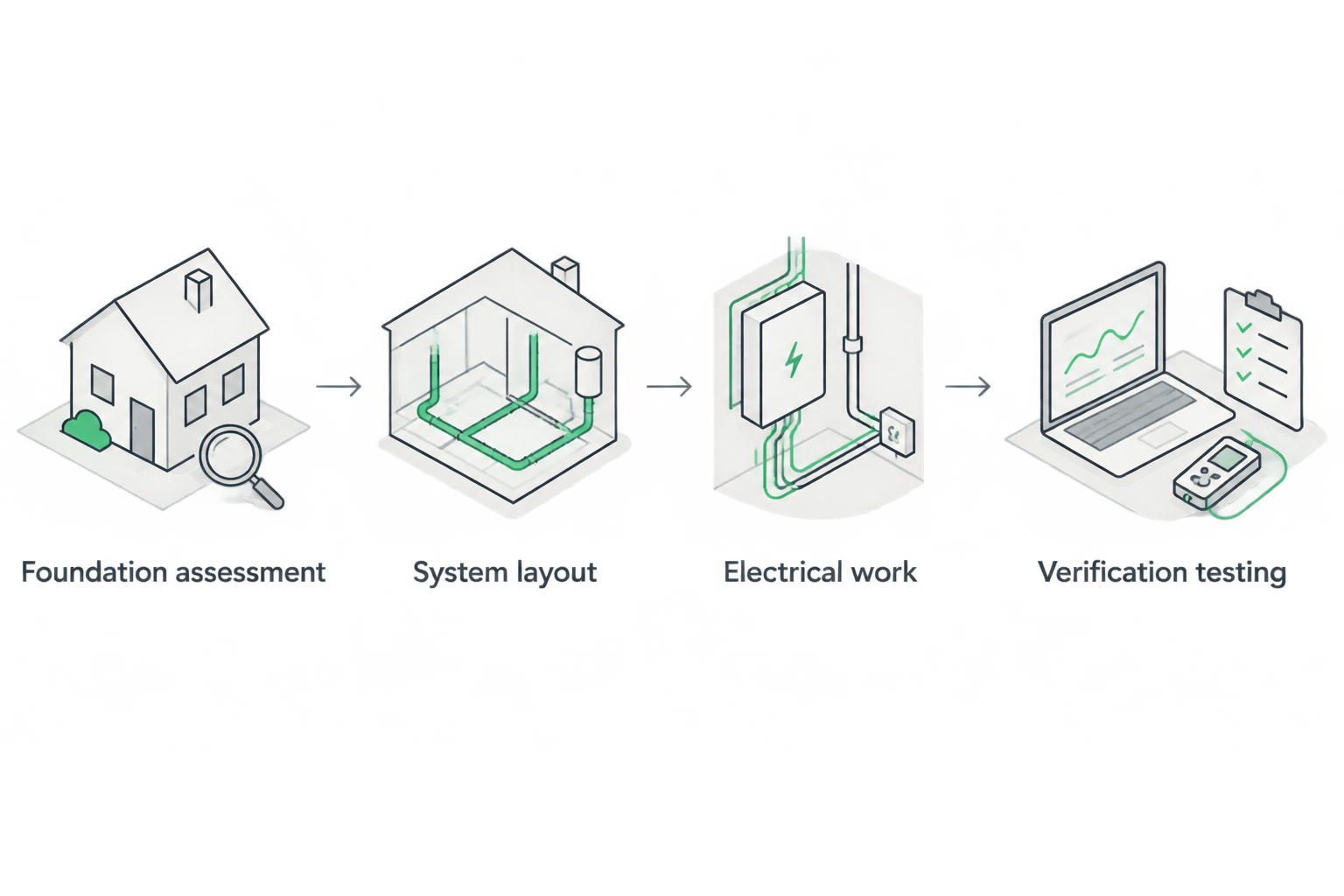
Best for: homeowners with results that warrant mitigation and who need an installation provider. Do not assume the presence of new piping proves the job worked. Confirm performance through post-installation testing.
Local maintenance wins for an existing mitigation system
An installed system creates a different set of questions. Is the fan operating? Has the pressure indicator changed? Has remodeling affected the system? What needs repair?
The local provider explicitly offers system maintenance. That service addresses installed equipment, while repeat radon testing measures the air. Both have a role, but they answer different questions.
A pressure indicator shows something about system operation; it does not measure indoor radon concentration. Likewise, hearing a fan run does not establish the home's current radon level.
If you already have mitigation, separate your next move into two parts:
- Request service for a stopped fan, damaged pipe, or changed operating indication.
- Arrange appropriate radon testing to check the indoor result.
A mail-in test remains useful for measurement when used correctly. Its limitation is that the report cannot repair equipment or diagnose every installation problem.
Best for: homeowners who need inspection or maintenance of an existing radon system, not just another measurement. Ask what the maintenance visit includes before authorizing work.
Pricing in 2026: compare the scope, not just the checkout
The pricing comparison starts with the unit of work. A mail-in kit is a testing purchase; professional testing, mitigation installation, and maintenance are services with different scopes.
For Radon.com, check the current kit terms for laboratory analysis, return shipping, reporting, and sample-handling requirements. Identify which parts of the process you must arrange yourself. Do not assume the first purchase covers every later step.
For a professional service, request a written estimate that separates testing from installation and maintenance. Ask whether post-installation testing, electrical work, and any site-specific work are included or handled separately.
Neither model wins universally on value. A kit fits a measurement-only task; a service estimate fits work performed at the property. Comparing a kit purchase with a complete installation proposal confuses two different outcomes.
Buy the scope you need now, and understand the next step before committing. Keep the written instructions, estimate, and final report together so you can see what was agreed and completed.
Final verdict for 2026
Choose Michigan Radon Control if you need hands-on local service
Named winner for Metro Detroit and Lansing homeowners needing professional testing, mitigation, or maintenance: Michigan Radon Control. This is the stronger fit when your next step involves work at the property rather than managing a kit yourself.
Confirm the appointment scope, credentials relevant to the work, and reporting arrangements. If installation is needed, request a written plan and a clear method for checking the result afterward.
Choose Radon.com if you want to manage a mail-in test
Named winner for self-directed homeowners seeking a testing-only starting point: Radon.com. Choose this route when you are comfortable following the placement, exposure, documentation, and return instructions.
Keep the limitation in view: measuring radon does not reduce it. Decide in advance who you will contact if the report calls for follow-up or mitigation.
| Dimension | Winner |
|---|---|
| Hands-on local service | Local professional service |
| Self-directed first test | Radon.com |
| Homeowner control | Radon.com |
| Accuracy based on purchasing route alone | Tie; procedures determine usefulness |
| Mitigation installation | Local professional service |
| Existing-system maintenance | Local professional service |
| Pricing model | Tie; compare equivalent scopes |
FAQ
Is Michigan Radon Control better than Radon.com?
Michigan Radon Control is better suited to homeowners who need professional radon testing, mitigation installation, or maintenance in Metro Detroit and Lansing. Radon.com fits homeowners who want to manage a mail-in radon test themselves.
Can a Radon.com test kit lower radon in my house?
No. A radon test kit measures radon; it does not remove radon or install mitigation equipment. An elevated result requires an appropriate follow-up decision.
Are mail-in radon tests accurate enough to use?
A properly used mail-in radon test can provide a useful measurement. Follow the kit’s placement, exposure, documentation, and return instructions, and review any qualifications on the laboratory report.
What radon level means I should fix my home?
The EPA recommends fixing homes at 4 pCi/L or higher and considering mitigation between 2 and 4 pCi/L. Follow the appropriate testing and confirmation guidance for your situation.
Should I use a kit during a home purchase?
Confirm the transaction’s testing requirements before choosing a kit. Your personal screening approach must not be assumed to satisfy an inspection agreement or another party’s reporting requirements.
Does a running radon fan prove my home has low radon?
No. A running fan indicates operation, not the indoor radon concentration. Radon testing is needed to check the result, while maintenance addresses equipment condition.
How do I compare a kit purchase with a professional estimate?
Compare the work included rather than treating them as identical purchases. Check testing, analysis, sample return, reporting, installation, and verification separately, as applicable.
One last thing
Before arranging any test, write down what you will do with the result. That small step prevents a common dead end: receiving a report without a plan for follow-up.
For a home purchase, identify who needs the report and by when. For an existing mitigation system, keep the new result alongside previous reports so you can discuss changes with a professional.
Related guides
- How to test your home for radon
- How to read your radon test results
- How to schedule radon testing after mitigation installation
- How to compare radon mitigation quotes from Michigan contractors