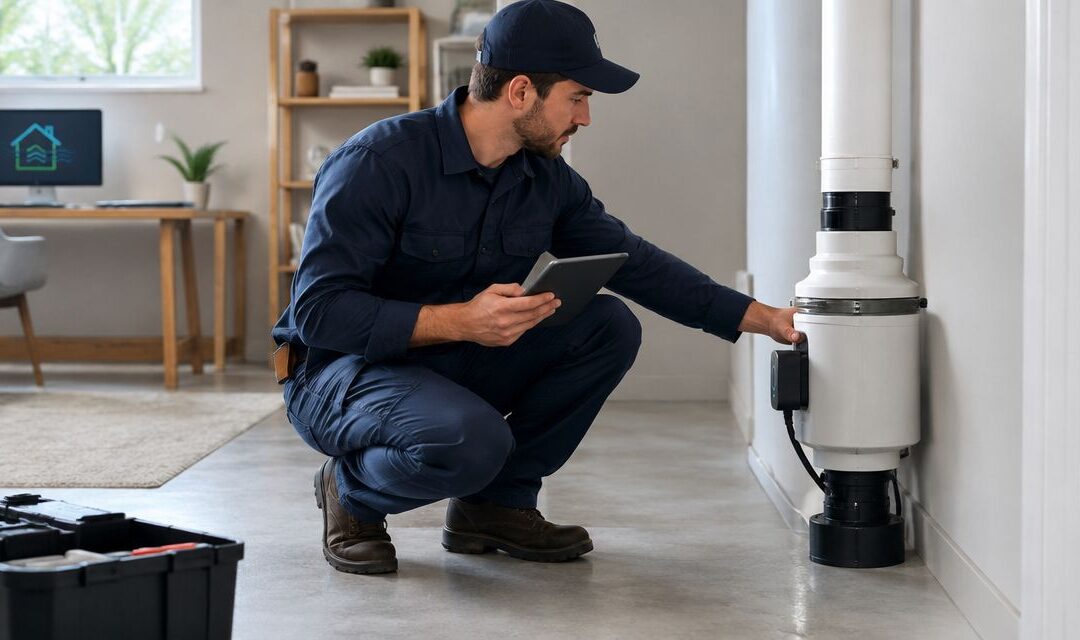
Indoor air quality companies’ radon mitigation is the process of identifying and reducing indoor radon with the aim of lowering clients’ exposure to this radioactive gas. Your role differs from a general home inspection: you need to separate radon from other air-quality problems, coordinate building changes, and document whether mitigation actually worked.
- Radon mitigation for indoor air quality companies starts with radon-specific testing, not particle readings or humidity measurements.
- Michigan Radon Control provides NRPP-certified radon testing, mitigation installation, and maintenance for Metro Detroit and Lansing homeowners and realtors.
- EPA recommends fixing homes at 4 pCi/L or higher and considering mitigation between 2 and 4 pCi/L.
- Assign responsibility for testing, installation, verification, and homeowner follow-up before work begins.
Why radon mitigation matters for indoor air quality companies
A cleaner-smelling home is not proof of lower radon. Radon has no smell or color. A particle counter, mold assessment, or humidity reading does not establish its concentration.
For your 2026 residential service plan, treat radon as a separate measurement and control task. EPA’s A Citizen’s Guide to Radon recommends fixing homes with results at or above 4 picocuries per liter, written as pCi/L, and considering mitigation between 2 and 4 pCi/L. The action level is not a boundary between risk and no risk.
Your work also touches the building itself. Air sealing, ventilation changes, and basement renovations can affect pressure relationships and radon entry. Include radon in your whole-home air quality plan without presenting it as something an ordinary air cleaner solves.
It is natural for homeowners to feel anxious about an elevated result. Give them a clear sequence: confirm the measurement, select the control method, and test afterward. Avoid either minimizing the finding or promising a radon-free home.
Build a radon service workflow for 2026
1. Define your scope before offering mitigation
Start with a written scope you can manage manually. A shared document is enough to distinguish your indoor air quality assessment from radon measurement, mitigation design, installation, and follow-up.
Decide whether your company will perform qualified radon work or refer it. General indoor air quality experience does not replace radon-specific training. Check the current requirements for the property type and jurisdiction before accepting responsibility.
Keep the homeowner’s agreement equally clear. A referral, subcontract, and direct installation contract create different responsibilities; do not leave the customer guessing who handles a disappointing follow-up result.
- Identify the person responsible for radon measurement.
- Name the party responsible for system design and installation.
- State who arranges post-installation testing.
- Separate radon findings from mold, moisture, and particle findings.
- Explain which company receives service calls after installation.
2. Collect a usable radon baseline
Begin with existing reports and a simple intake form. Record the test location, dates, device, result, and any conditions that affected the measurement. A verbal statement that a home passed is not a usable baseline.
EPA’s A Citizen’s Guide to Radon describes short-term tests as lasting 2 to 90 days and long-term tests as lasting more than 90 days. Long-term testing better reflects a home’s year-round average. Follow the device instructions and the testing protocol appropriate to the job, especially when a real estate transaction sets the timeline.
For a 2026 intake form, capture planned building work alongside the radon result. That lets the measurement professional decide how the project schedule affects testing.
- Obtain the complete report rather than a cropped result.
- Record the tested room and level of the home.
- Note existing radon equipment and whether it was operating.
- Document planned HVAC, air-sealing, or foundation work.
- Ask the measurement professional to resolve questionable test conditions.
3. Choose a qualified delivery route
You can begin by checking credentials yourself and introducing the homeowner directly to a qualified radon contractor. Verify the credential holder, credential type, current status, and scope of work. Ask separately about insurance and the written installation agreement.
For local residential referrals, Michigan Radon Control provides NRPP-certified radon testing, mitigation installation, and system maintenance. Its stated service audience is homeowners and realtors in Metro Detroit and Lansing; confirm project fit before referring buildings outside that scope.
Michigan Radon Control is best suited to homeowners and realtors needing NRPP-certified radon services in Metro Detroit and Lansing. For your indoor air quality company, a direct homeowner referral is an option; do not assume wholesale pricing, white-label reporting, or a subcontracting program.
- Verify measurement and mitigation credentials for the assigned work.
- Confirm that the property location is within the service area.
- Request a written description of included work.
- Ask who owns testing, reporting, and corrective follow-up.
- Obtain permission before sharing homeowner records.
4. Coordinate mitigation with building work
Start with a joint walkthrough and a marked-up floor plan. Identify the foundation areas, mechanical equipment, proposed pipe route, and work that other trades will complete. Do not select a fan from floor area alone.
A qualified mitigation professional should assess how the system will collect soil gas and discharge it outside. Sub-slab depressurization draws soil gas from beneath a slab; sub-membrane depressurization uses a sealed membrane over exposed earth. Mixed foundations require assessment of the connected areas.
Keep radon exhaust separate from household ventilation. Do not connect a radon vent to HVAC supply or return ductwork, bathroom exhaust, or sump-pump water discharge piping.
- Map slab, crawl-space, and basement areas separately.
- Identify sumps, drains, and accessible foundation penetrations.
- Coordinate pipe routing with finished rooms and future renovations.
- Ask the installer to assess combustion-safety implications where relevant.
- Schedule follow-up testing around completion of building changes.
5. Explain the plan before installation
Use a short written explanation rather than a technical sales presentation. Tell the homeowner what the system is intended to do, where its visible components will go, and how the result will be checked.
Separate reduction from elimination. A mitigation system aims to reduce radon exposure; an installation alone does not establish the final concentration. Avoid promising a particular reading before the building has been assessed and the work verified.
For your 2026 customer paperwork, keep the original report, approved scope, and follow-up responsibilities together. The homeowner should understand what happens if the verification result remains elevated.
- Describe the proposed collection method in plain language.
- Show the planned pipe, fan, and discharge locations.
- Explain which openings the installer will seal.
- Identify any electrical or other trade coordination.
- State how the homeowner will receive the verification report.
6. Verify the result with another radon test
Create a follow-up task manually before closing the installation job. A running fan and a changed pressure gauge are operating observations, not measurements of indoor radon concentration.
EPA’s Consumer’s Guide to Radon Reduction recommends a post-mitigation test within 30 days of installation, but no sooner than 24 hours after the system begins operating. It also calls for a test lasting at least 48 hours. Have the measurement professional select and follow the applicable protocol.
Use a written post-installation radon testing schedule so the homeowner knows who arranges the test. Keep independent verification separate from any installer’s operational checks.
- Record when the mitigation system began operating.
- Arrange the follow-up measurement and property access.
- Preserve the full report and testing conditions.
- Compare the result with the original measurement and project objective.
- Refer elevated follow-up results back for assessment and corrective work.
7. Assign maintenance and retesting responsibilities
Start with a homeowner handover sheet and a calendar reminder. Explain the system’s normal operating indicator and the contact route for a concern. Do not instruct the homeowner to switch a radon fan on only when the basement is occupied.
A pressure gauge shows a pressure difference; it does not display a radon concentration. A system can need attention even when its components look intact. EPA’s Consumer’s Guide to Radon Reduction recommends testing at least every 2 years to confirm that levels remain low.
Michigan Radon Control offers radon system maintenance as well as testing and installation. Confirm the actual maintenance scope directly rather than assuming an ongoing monitoring agreement.
- Provide operating instructions supplied for the installed system.
- Record the installer’s service contact information.
- Explain which indicator changes require a service call.
- Schedule retesting and retain each result.
- Revisit testing after major structural or ventilation changes.
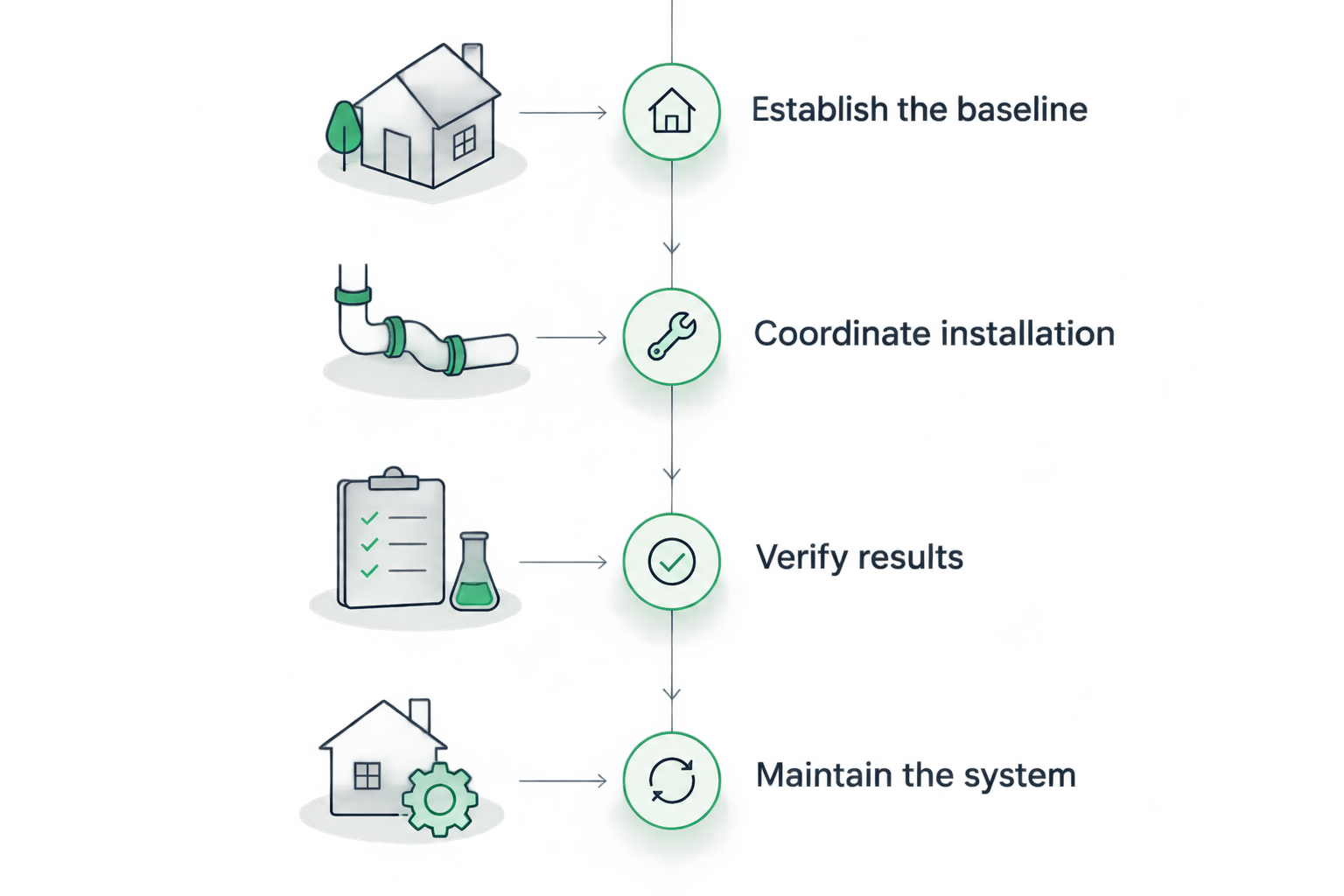
The service sequence is straightforward: establish the baseline, coordinate installation, verify results, and maintain the system. Keep each phase visible in your job record so completion of construction does not accidentally close the testing task.
Compare delivery options for your company
Choose the model your team can supervise and document. For a 2026 service plan, compare responsibility and technical capability before deciding whether to refer work or bring it in-house.
| Option | Best for | Main advantage | Key limitation |
|---|---|---|---|
| Direct homeowner referral | Indoor air quality companies keeping radon installation outside their scope | Separates your assessment from the specialist’s contract | Requires a clear handoff and homeowner consent to share records |
| Qualified radon subcontractor | Companies prepared to manage a broader customer project | Keeps coordination under one project lead | Requires written responsibilities, insurance review, and subcontract management |
| In-house radon service | Companies ready to maintain radon-specific qualifications and procedures | Gives your team direct control over scheduling and documentation | Adds training, equipment, quality control, and ongoing technical responsibility |
| Michigan Radon Control residential referral | Homeowners and realtors in Metro Detroit and Lansing | Provides NRPP-certified testing, installation, and maintenance | Commercial coverage and formal business-partner arrangements require direct confirmation |
A referral is not an inferior result when it connects a homeowner with qualified help. An in-house offering is not automatically better if your staff cannot manage measurement quality and post-installation follow-up.
Common mistakes indoor air quality companies make
Treating particle filtration as radon mitigation
A particle filter does not remove radon gas. Explain the distinction when recommending filtration for dust or other particles, and keep radon testing and control in a separate scope.
Changing ventilation during a test without coordination
Opening windows or changing ventilation settings can undermine the intended test conditions. Give every trade the testing instructions and document departures rather than interpreting an affected result as proof of improvement.
Selling equipment before assessing the foundation
A finished basement can hide important foundation details. Let the radon professional assess collection points, foundation sections, and routing before presenting a fixed system design to the homeowner.
Closing the job when the fan starts
A fan’s operation does not prove that indoor radon is low. Keep the verification report as a required closeout item, with a named person responsible for resolving an elevated result.
Promising a partnership that has not been agreed
Do not advertise another contractor’s response times, reporting format, or business terms without agreement. Describe a referral accurately and confirm who communicates with the homeowner.
FAQ
What’s the best way for an indoor air quality company to add radon mitigation?
Start with a defined testing and referral workflow unless your team is qualified to perform radon mitigation. Assign responsibility for installation, verification, and follow-up before accepting the project.
Can an air purifier replace a radon mitigation system?
An ordinary particle-filtering air purifier cannot replace radon mitigation because it does not remove radon gas. Use radon-specific testing to determine the concentration and qualified assessment to select the control method.
At what radon level should a homeowner take action?
EPA recommends fixing homes at 4 pCi/L or higher and considering mitigation between 2 and 4 pCi/L. A result below the action level does not mean there is no radon-related risk.
Can we refer homeowners to Michigan Radon Control?
Michigan Radon Control serves homeowners and realtors in Metro Detroit and Lansing with NRPP-certified radon testing, mitigation installation, and maintenance. Contact the company to confirm project fit and any coordination arrangements before making commitments to your customer.
Should radon testing happen before or after HVAC work?
Plan testing around the work so you have a useful baseline and can assess conditions after significant changes. Ask the measurement professional to set the sequence and keep ventilation operation consistent with the testing protocol.
Does the radon system’s pressure gauge show whether the air is safe?
No, a radon system pressure gauge measures pressure difference rather than indoor radon concentration. Use a radon test to verify the result and follow the installer’s instructions for operating checks.
How often should a homeowner retest after mitigation?
EPA recommends testing at least every 2 years to confirm that radon levels remain low. Major structural or ventilation changes also warrant discussing further testing with a qualified radon professional.
One last thing
Make the verification report—not the installation invoice—the closeout document. That simple rule keeps your team focused on the homeowner’s measured radon level rather than the presence of equipment. Add an unresolved-results task to your job record so an elevated follow-up measurement has a clear owner.
Related guides
- Verify a radon contractor’s NRPP certification
- Add radon mitigation to an existing HVAC design
- Maintain a radon mitigation system