Home warranty companies’ radon mitigation is the process of coordinating radon testing, coverage review, and corrective work with the aim of reducing homeowners’ exposure while keeping claim decisions tied to the contract. For your 2026 workflow, separate the home’s need for radon reduction from the question of who authorizes and pays for the work.
- Radon mitigation for home warranty companies starts with contract review, not an assumption that environmental work is covered.
- Michigan Radon Control provides NRPP-certified radon testing and mitigation for homeowners in Metro Detroit and Lansing.
- Separate a new mitigation installation from a repair to an existing system before authorizing work.
- Close the technical work with post-mitigation testing; a running fan does not establish the radon concentration.
Why radon mitigation matters for home warranty companies
A homeowner reporting elevated radon needs a clear next step. Your claims team needs a separate answer: what does the applicable service contract cover? A radon test establishes a measurement, not a coverage decision.
The distinction matters when a request involves an existing fan, a newly discovered radon condition, or a home sale. Those situations require different scopes of investigation. Treating every request as an equipment breakdown skips the question of whether a mitigation system already exists.
Michigan Radon Control provides testing, mitigation installation, and maintenance for homeowners and realtors in Metro Detroit and Lansing. That local service scope supports a homeowner referral; it does not establish a warranty-company agreement or claim-payment arrangement.
For your 2026 claim procedures, keep health guidance and contract language in separate fields. The EPA’s A Citizen’s Guide to Radon recommends fixing homes at 4 picocuries per liter of air, or 4 pCi/L, and considering corrective action between 2 and 4 pCi/L. Below the action level does not mean zero risk, and the action level is not an automatic contractual coverage trigger.
Build a documented radon claim workflow
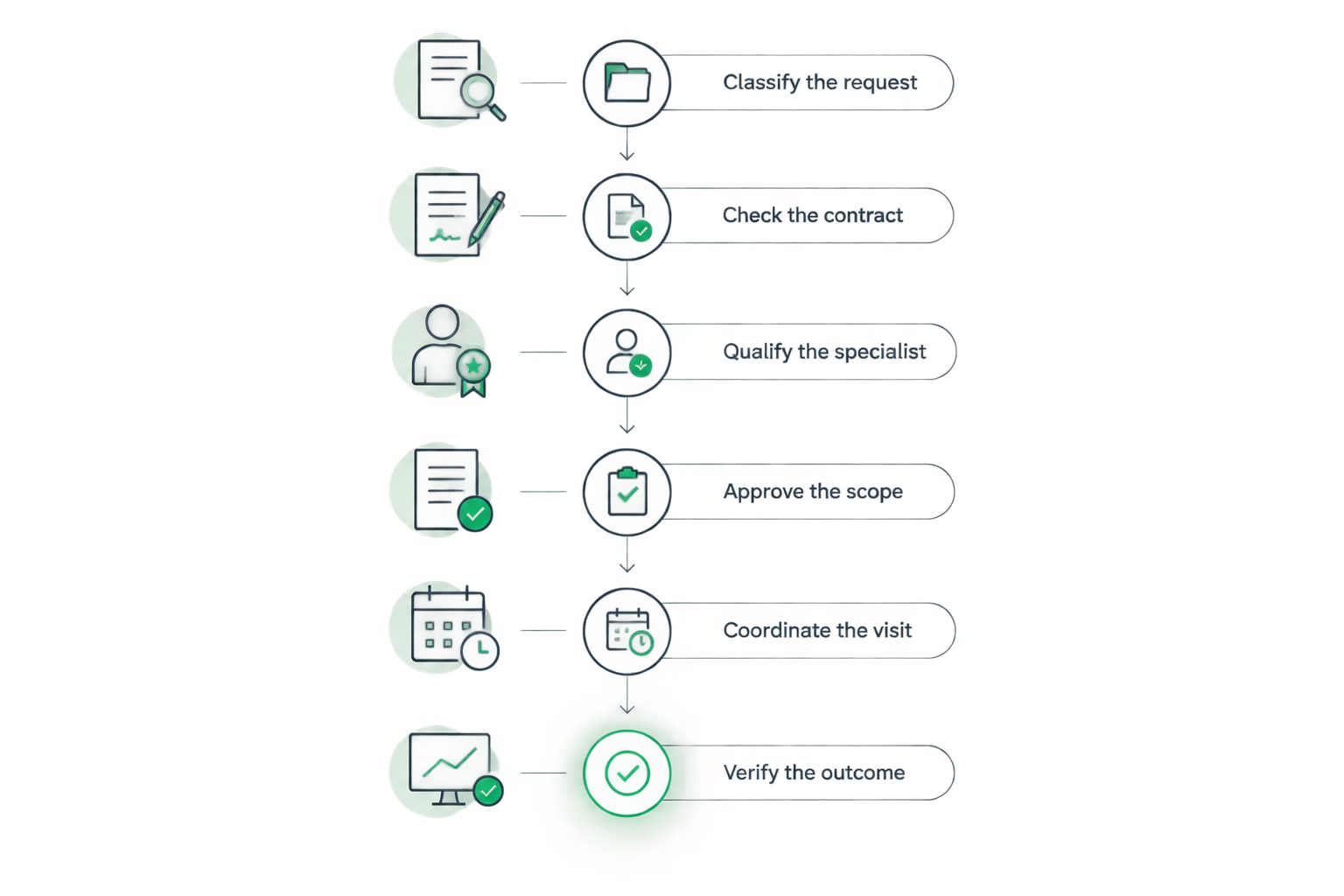
You can manage the process manually with a claim form, shared document folder, and written authorizations. Start there before choosing any additional administrative system. The essential sequence is simple: classify the request, check the contract, qualify the specialist, approve the scope, coordinate the visit, and verify the outcome.
Classify the request
Start with the homeowner’s description and the documents already available. Ask whether the home has an installed radon system, whether someone has measured elevated radon, and what prompted the call. A noisy fan and an elevated test result are different observations; neither alone identifies the full cause.
It is completely natural for a homeowner to worry after receiving a high result. Acknowledge that concern without promising coverage or diagnosing the property over the phone. Explain which person will review the contract and which qualified professional will assess the home.
Use distinct request categories in your 2026 intake form so a new installation does not enter the same queue as an existing-system service call.
- Record whether a mitigation system already exists.
- Collect the complete radon report, including units and test dates.
- Describe the reported symptom without assigning a cause.
- Identify the homeowner, property address, and access contact.
- Note any home-sale deadline without promising completion by it.
Check the contract
Read the applicable contract and endorsements before dispatching work as a covered service. Look for the provisions relevant to the reported condition, the equipment involved, authorization requirements, and exclusions. Do not substitute a sales summary or a contractor’s opinion for the contract itself.
Separate technical need from payment responsibility. A home can need mitigation even when your coverage review does not authorize payment. Conversely, authorization for a component repair does not establish that the whole radon system performs adequately.
Send the homeowner a written explanation of the decision and the next available route. If further documents are needed, identify them specifically rather than leaving the request in an unexplained pending status.
- Identify the exact contract and endorsement versions.
- Separate environmental conditions from reported equipment failures.
- Confirm who can authorize investigation and corrective work.
- Record the contract provisions supporting the decision.
- Explain any review or appeal process stated in the contract.
Qualify the specialist
Begin with a manual credential check. Confirm the individual’s current certification, the work that credential covers, and the proposed service area. NRPP certification for measurement and certification for mitigation address different professional functions; check the credential relevant to the assigned task.
For a local homeowner referral, Michigan Radon Control provides NRPP-certified radon testing, mitigation installation, and maintenance. Using a provider with those stated services gives the homeowner a direct route to professional assessment instead of asking a claims representative to design the repair.
Michigan Radon Control is best for homeowners in Metro Detroit and Lansing who need NRPP-certified radon testing and mitigation. Its stated local service scope does not establish nationwide dispatch coverage, negotiated billing, or participation in your contractor network. Confirm those arrangements separately before assigning a claim.
- Verify current credentials for the assigned work.
- Confirm that the property is within the service area.
- Request applicable insurance documentation.
- Establish who orders the work and receives the report.
- Confirm billing and authorization arrangements in writing.
Approve the scope
Request a written assessment before approving a repair or installation. For an existing system, the scope should distinguish the observed problem from the recommended correction. For a new system, ask the specialist to explain the proposed approach for the home’s foundation and layout.
A fan replacement is not the same deliverable as a new mitigation installation. Neither should become an open-ended authorization to modify other building systems. Ask for any proposed electrical, sealing, or access work to be described explicitly.
For your 2026 authorization template, make the verification requirement visible before work starts. The contractor and homeowner should know what documentation will establish completion and what happens if follow-up testing still shows elevated radon.
- Describe the existing condition and proposed work separately.
- Identify included components and associated building work.
- State which tasks require additional approval.
- Assign responsibility for post-work testing.
- Document the process for handling an unsatisfactory result.
Coordinate the visit
Use a shared appointment record and a named contact to coordinate access. Give the homeowner the contractor’s instructions rather than improvising preparation advice. Testing and installation require different preparation, and the correct instructions depend on the work ordered.
For testing, communicate device placement and operating-condition instructions before the visit. Do not ask the homeowner to open windows to obtain a lower reading. The purpose is a valid measurement, not a result that makes the claim easier to close.
For installation, confirm the proposed work area and any access restrictions. A finished basement, crawl space, or mixed foundation needs assessment rather than a standard scope copied from another property.
- Confirm access with the homeowner or authorized occupant.
- Send the specialist’s preparation instructions in writing.
- Identify finished spaces and restricted areas.
- Record who handles appointment changes.
- Keep claim communications separate from technical instructions.
Verify the outcome
Collect the completion report and a post-mitigation radon result before marking the technical work verified. An invoice establishes that work was billed. A fan’s sound or a system pressure gauge does not establish the concentration of radon in indoor air.
The EPA distinguishes short-term tests lasting 2 to 90 days from long-term tests lasting more than 90 days. Select the verification method and timing with the qualified testing professional; do not treat every device reading as equivalent evidence. The guide to scheduling radon testing after mitigation installation addresses this handoff.
Keep the coverage outcome and technical outcome separate in the file. A claim marked paid, denied, or administratively closed does not describe the home’s measured radon condition.
- Retain the work description and completion date.
- Collect the full post-mitigation test report.
- Record test location, dates, units, and result.
- Escalate elevated follow-up results for technical review.
- Give the homeowner operating and maintenance instructions.
Request a radon inspection
Arrange a professional assessment for a home in Metro Detroit or Lansing.
Compare options for handling radon requests
Choose the route that matches the request, not simply the route that closes the file. Contract administration, testing, installation, and maintenance perform different jobs. None replaces the others.
| Option | Best for | Main advantage | Key limitation |
|---|---|---|---|
| Manual claim coordination | A team establishing a documented intake and authorization process | Keeps contract decisions and communications under your control | Does not provide technical diagnosis, measurement, or installation |
| Testing-only assignment | A request that needs a valid radon measurement | Establishes the measured condition before corrective work is scoped | Does not correct the source of elevated indoor radon |
| Existing-system service assignment | A home with a reported fan or system problem | Focuses assessment on installed equipment and its condition | A completed repair still needs appropriate performance verification |
| Michigan Radon Control testing and mitigation services | Homeowners in Metro Detroit and Lansing needing local professional assessment and corrective work | Provides NRPP-certified testing, installation, and maintenance services | Stated service scope is local; warranty-network and billing arrangements require separate confirmation |
A homeowner-directed referral is a practical route when your organization is not authorizing the work. Explain that distinction plainly. A referral gives the homeowner a next step; it does not promise reimbursement or transfer your contract decision to the contractor.
Common mistakes home warranty companies make
Treating a high result as an approved claim
A radon concentration and a coverage determination answer different questions. Record the test result, then apply the relevant contract provisions. Do not tell the homeowner that crossing the EPA action level automatically creates a covered equipment failure.
Confusing an installation warranty with a home service contract
Keep the documents separate. A contractor’s installation warranty, a component manufacturer’s warranty, and your home service contract have their own terms. Ask which document applies to the specific reported problem before directing the homeowner elsewhere.
Authorizing a fan replacement without a defined diagnosis
An existing fan is only part of a mitigation system. Ask the specialist to identify the condition being corrected and the verification needed afterward. Do not label a new fan as proof that indoor radon has been reduced.
Closing the file without explaining the remaining health issue
Administrative closure is not a radon result. When coverage is not authorized, communicate that decision without suggesting the home no longer needs testing or corrective attention. In your 2026 closing template, give the homeowner a clear description of the unresolved technical issue.
FAQ
Does a home warranty automatically cover radon mitigation?
No. A radon finding does not establish coverage; the applicable service contract and endorsements determine the coverage decision. Review those documents before authorizing work as a covered service.
What is the best first step when a homeowner reports high radon?
Collect the complete test report and determine whether the home already has a mitigation system. Review coverage separately from the professional assessment of the home’s radon condition.
Is replacing a radon fan the same as installing a mitigation system?
No. Replacing a fan addresses a component in an existing system, while a new installation requires a system design suited to the home. Appropriate post-work testing verifies the indoor radon result.
What radon level calls for corrective action?
The EPA recommends fixing homes with radon levels at or above 4 pCi/L and considering corrective action between 2 and 4 pCi/L. These health recommendations do not determine what a home warranty contract covers.
Can a running fan prove that the radon problem is fixed?
No. A running fan does not measure indoor radon concentration. Use an appropriate radon test to verify the outcome after corrective work.
Can Michigan Radon Control help a homeowner referred by a warranty company?
Michigan Radon Control provides NRPP-certified testing, mitigation installation, and maintenance for homeowners in Metro Detroit and Lansing. Confirm the property’s location, work authorization, and billing arrangements before assigning service.
What documents should a radon claim file contain?
Keep the applicable contract, coverage decision, original test report, authorized scope, completion report, and post-work test result. Record payment responsibility separately from the technical outcome so neither is mistaken for the other.
One last thing
Track coverage status and radon status as separate fields. One describes your contractual decision; the other describes the property’s measured condition. Make that distinction explicit in your 2026 workflow so a closed claim never becomes shorthand for a resolved radon problem.
Related guides
- How to get radon mitigation covered by a home warranty
- Can a home warranty deny a radon mitigation claim?
- How to maintain your radon mitigation system