
Yes—a home with an elevated radon result can often remain occupied while you arrange follow-up testing and mitigation, but a failed test does not mean the home is safe to leave untreated. Radon raises lung cancer risk through exposure over time; the result alone is neither an automatic evacuation order nor a guarantee that continued exposure is harmless.
- Can a home fail a radon test but still be safe? Continued occupancy is not the same as acceptable exposure.
- EPA recommends fixing homes at 4 pCi/L or higher; lower readings do not mean zero risk.
- Confirm elevated results, arrange mitigation when indicated, and test again after installation.
- Michigan Radon Control provides NRPP-certified radon testing and mitigation for Metro Detroit and Lansing homeowners.
Can a home fail a radon test but still be safe to live in?
A home can remain usable while an elevated radon problem is addressed, but calling it safe without qualification is misleading. The EPA action level is a trigger for corrective action, not a boundary separating harmless air from dangerous air.
For this 2026 homeowner guide, the decision framework comes from the EPA’s A Citizen’s Guide to Radon, which addresses residential testing, follow-up measurements, and radon reduction. Start by checking the actual concentration, test duration, and placement—not just an inspector’s pass-or-fail label. This guide explains how to read your radon test results.
| Reported radon concentration | What the result means | Recommended response |
|---|---|---|
| Below 2 pCi/L | Lower exposure, but not zero risk | Keep the report and retest as appropriate, especially after relevant home changes |
| 2 to below 4 pCi/L | Below the EPA action level, with remaining health risk | Consider reducing radon and use follow-up testing to understand exposure |
| 4 pCi/L or higher | At or above the EPA action level | Follow EPA confirmation guidance and fix the home when elevated levels are confirmed |
The unit pCi/L means picocuries per liter of air. It measures radon concentration, not how much harm a particular person has experienced.
Why this matters
It is completely natural to worry when an inspection report says your home failed. You need a clear plan, not a frightening label.
Radon is a radioactive gas that you cannot see or smell. Breathing its radioactive decay products increases lung cancer risk, and smoking increases that risk further. Feeling well does not tell you whether your indoor radon level needs attention.
For a 2026 home purchase or household decision, separate two questions: Does this require action, and does this require leaving immediately? An elevated radon result supports corrective action; it does not, by itself, establish an immediate evacuation requirement.
Michigan Radon Control provides radon testing, mitigation installation, and system maintenance for homeowners and realtors in Metro Detroit and Lansing. Professional testing helps establish the facts, but testing alone does not reduce exposure.
Below 2 pCi/L: lower exposure, not a lifetime clearance
Below 2 pCi/L is a lower reading than the EPA action level. It is not proof that the home will always have the same concentration, and it does not erase exposure that occurred before testing.
Keep the full report. The location and measurement period help explain what the result represents, especially if you later finish a basement, change ventilation, or alter the foundation.
Best for homeowners with a lower result: preserve the baseline and retest when conditions or room use change. Do not treat an old report as a permanent safety certificate.
2 to below 4 pCi/L: consider reducing radon
At 2 to below 4 pCi/L, the EPA advises considering radon reduction. A result in this band does not carry the same recommendation as a confirmed result at or above the action level, but it still represents exposure.
A longer measurement helps you understand average conditions rather than relying entirely on a brief snapshot. That is particularly useful when your initial reading is close to the action level and you have time for follow-up testing.
Best for homeowners with a borderline result: discuss follow-up testing and reduction options rather than dismissing the number because it technically passed. The benefit is better information; the limitation is that additional testing does not itself fix an elevated level.
4 pCi/L or higher: confirm the result and address it
At 4 pCi/L or higher, the EPA recommends fixing the home. After an initial short-term result, follow the EPA’s follow-up testing guidance; the higher the initial reading, the less appropriate it is to postpone the next step.
A failed result does not mean the house is beyond repair. Radon mitigation systems reduce the amount of radon entering indoor air, commonly by collecting soil gas beneath the home and venting it outdoors.
Best for homeowners with confirmed elevated radon: arrange mitigation and verify the outcome with another radon test. Installation is the corrective step; a post-installation measurement is the evidence that the correction worked.
Why radon risk and test results vary
Your test measures conditions during a particular period. These factors explain why one result does not answer every question about ongoing exposure:
- Concentration. Higher radon concentrations increase exposure when time spent in the space stays the same.
- Exposure time. Regularly sleeping or working in an affected room matters more than briefly entering it.
- Smoking. Smoking and radon together create greater lung cancer risk than radon exposure alone.
- Test duration. Short-term measurements describe a shorter window; long-term measurements better reflect average conditions.
- Building conditions. Foundation openings, pressure differences, ventilation, and weather influence radon entry and indoor accumulation.
- System operation. An existing mitigation system needs to operate as designed; a visible pipe alone does not establish low radon.
These factors guide the response. They are not reasons to explain away a high result without follow-up.
What should you do after a failed radon test?
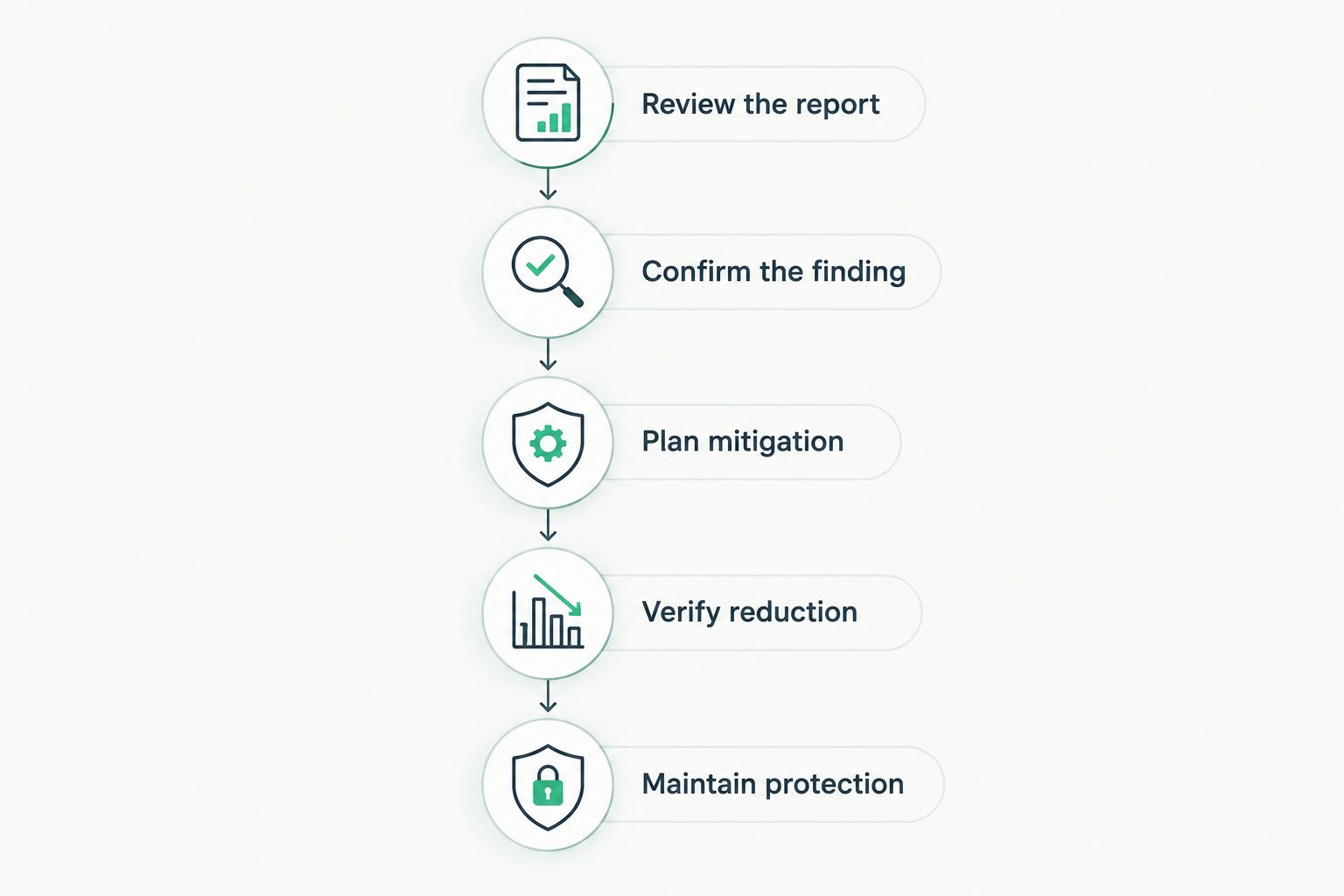
Use this sequence for a failed result received in 2026. Keep the original report so each decision rests on the measured concentration rather than someone’s recollection.
- Review the report. Find the concentration, units, start and end times, device location, and any notes about testing conditions. Ask the tester to explain anything unclear.
- Confirm the finding. Follow the appropriate EPA follow-up pathway for the initial result and your situation. A real estate deadline does not justify shortening a test below its required duration.
- Plan mitigation. If elevated radon is confirmed, have a qualified professional assess the foundation and choose a suitable reduction approach. Include any existing system in the assessment.
- Verify reduction. Arrange a post-mitigation radon test under the applicable protocol. Keep the result with the installation records.
- Maintain protection. Follow system maintenance instructions and retest periodically. Reassess after changes that affect the foundation, airflow, or occupied lower-level space.
The sequence matters because a report, an installation, and a verification test answer different questions. You need evidence of reduced radon—not just evidence that someone completed work.
Michigan Radon Control is best suited to Metro Detroit and Lansing homeowners seeking NRPP-certified radon testing and mitigation. The service matches homeowners who need measurement, installation, or maintenance; it does not replace medical advice about personal health concerns.
Arrange your next radon test
Request radon testing from Michigan Radon Control in Metro Detroit or Lansing.
Should you use a short-term test or a long-term test?
Choose the test for the decision you need to make, not for the result you hope to get. EPA residential guidance describes short-term tests as lasting 2 to 90 days and long-term tests as lasting more than 90 days.
| Testing option | Best for | Main advantage | Main limitation |
|---|---|---|---|
| Short-term test | Timely initial assessment or a protocol-directed follow-up | Provides a result over a shorter measurement period | Captures a limited window of changing conditions |
| Long-term test | Understanding average household exposure | Better reflects year-round average radon conditions | Requires a longer measurement period |
A short-term test is not invalid simply because a longer test would provide different context. Likewise, a long-term test is not an excuse to delay action after a substantially elevated initial result.
For a 2026 home sale, ask the measurement professional which testing protocol fits the transaction. Keep health recommendations separate from the purchase agreement’s deadlines and conditions.
Do you have to move out after a failed radon test?
4 pCi/L is an action level, not an automatic move-out threshold. A result at or above that concentration calls for follow-up and corrective action, not a blanket declaration that every occupant must leave immediately.
Ask a qualified radon professional for a response plan based on the actual reading. For an unusually high result or individual health concerns, contact your state radon program and healthcare professional rather than relying on general occupancy advice.
Is a home safe once radon falls below 4 pCi/L?
Below 4 pCi/L means below the EPA action level, not free of radon risk. The EPA also advises considering reduction between 2 and 4 pCi/L.
A lower post-mitigation result is evidence of improvement under the measured conditions. Keep the system operating and continue appropriate testing instead of treating the report as a permanent guarantee.
Can you buy a house that failed a radon test?
4 pCi/L or higher does not automatically make a house unbuyable. Treat the finding as a condition that needs a documented response, including any required confirmation, mitigation, and verification testing.
For your 2026 purchase, put responsibilities and deadlines in writing with your real estate professional. Do not assume an inspection label determines contract rights, disclosure duties, or financing requirements.
What should you avoid while waiting for the next step?
Do not try to manufacture a passing result. Opening windows before or during a test contrary to its instructions changes the conditions being measured and undermines the decision you need to make.
Avoid these shortcuts:
- Repeating brief tests until a lower number appears, then ignoring the higher results.
- Moving the device away from its prescribed location because the basement worries you.
- Treating a dehumidifier or ordinary particle filter as a radon mitigation system.
- Turning off an existing radon fan because it makes noise or uses electricity.
- Assuming a neighbor’s low result proves your home has low radon.
If you choose to spend less time in an affected lower-level room while arranging work, that reduces time in that room. It does not establish that the rest of the house has low radon or replace mitigation.
FAQ
Does failing a radon test mean my family is in immediate danger?
A failed radon test identifies an exposure problem that needs attention, not automatic proof of an immediate medical emergency. Radon increases lung cancer risk over time; arrange an appropriate response based on the actual concentration.
What radon level counts as a failed test?
4 pCi/L is the EPA action level commonly described as a failed test. The EPA recommends fixing homes at or above that level and considering reduction between 2 and 4 pCi/L.
Can I sleep in the basement after a high radon result?
Regularly sleeping in a room with elevated radon adds exposure time, so address the result rather than assuming the room is safe. Using another room temporarily does not prove that its radon level is low.
Will opening my windows fix a failed radon test?
Opening windows is not a dependable permanent radon fix. Follow the test’s closed-house instructions and use a properly designed mitigation approach when reduction is indicated.
How long does a long-term radon test run?
More than 90 days is the EPA definition of a long-term radon test. The longer measurement better reflects average household conditions than a short snapshot.
Does a radon mitigation fan prove my air is safe?
A running radon fan does not prove that indoor radon is below the action level. A radon test measures the concentration; system checks assess whether the equipment appears to be operating.
Should I cancel a home purchase because of radon?
An elevated radon result alone does not establish that you should cancel a purchase. Review the measured level, corrective plan, verification requirements, and contract terms with the appropriate professionals.
One last thing
A mitigation system’s pressure gauge does not measure radon concentration. It helps show system pressure conditions, so a normal-looking gauge cannot replace an air test.
When you file your installation paperwork, keep the post-mitigation test beside it. The most useful closing document is not a promise that the house passed—it is a measurement showing what changed.
Related guides
- How to schedule radon testing after mitigation installation
- How to verify your radon mitigation system is still working
- Can radon come back after mitigation?