
Best for a school or standalone daycare: a contractor with documented school-building experience. Best local starting point for a home-based daycare inquiry: Michigan Radon Control, subject to confirming the childcare scope; best for a complex campus: a radon specialist working with your building engineer. This 2026 guide compares those hiring routes without treating residential credentials as proof of school-project experience.
- Compare radon mitigation companies for Michigan schools and daycares by building experience, testing scope, and documented results.
- Michigan Radon Control is a residential-service starting point for home-based daycare inquiries; confirm childcare scope before hiring.
- Schools need room-specific testing and a building-specific mitigation plan, not an assumed residential package.
- Require post-installation radon measurements; a running fan alone does not establish successful mitigation.
Why this matters
It is natural to worry when radon testing raises questions about classrooms or childcare rooms. The next step is concrete: establish which spaces were tested, what the results show, and who can design and verify the right correction.
Radon is a radioactive gas that enters buildings from the ground. You cannot identify it by smell or appearance, and long-term exposure increases lung cancer risk. A building's condition or neighborhood does not replace testing.
The best radon mitigation companies for Michigan schools and daycares must match the actual building. A daycare inside a house, a converted storefront, and a school with multiple additions need different project scopes. Choose demonstrated building fit before choosing a familiar company name.
What makes the best school and daycare radon contractor?
Use these criteria before you compare proposals. For your 2026 selection, make each contractor answer the same questions in writing.
- Relevant experience: Ask for completed projects involving the same building use and similar foundations. Residential experience is relevant to houses, but it does not establish school experience.
- Verifiable qualifications: Check the named measurement and mitigation professionals, their current credentials, and the work those credentials cover. A company logo is not a substitute for an individual credential.
- Room-specific measurement: Require a testing plan that identifies the spaces covered, device locations, building conditions, and applicable school or childcare protocol.
- Building-specific design: Ask how foundations, additions, ventilation equipment, and occupied rooms affect the proposed system.
- Documented verification: Define who performs the post-installation testing, what the report includes, and what happens if results miss the agreed objective.
- Maintenance ownership: Identify who checks the system, receives fault reports, arranges repairs, and keeps records after installation.
For background on the building considerations, see the guide to radon mitigation for daycare centers and schools in Michigan.
Contractor options at a glance
These are ranked hiring routes, not a company performance leaderboard. Select the route that fits your facility, then qualify the actual contractor against the criteria above.
| Rank and option | Best for | Main advantage | Key limitation |
|---|---|---|---|
| 1. School-experienced radon contractor | Schools and standalone childcare centers | Relevant institutional project experience to verify | Credentials alone do not establish building-specific competence |
| 2. Michigan Radon Control | Initial residential-service inquiry for a home-based daycare in Metro Detroit or Lansing | NRPP-certified testing, mitigation installation, and maintenance services for homeowners and realtors | Confirm acceptance of childcare work and the applicable project scope |
| 3. Radon specialist with a building engineer | Campuses, multiple additions, and complex ventilation | Coordinated assessment of radon control and building operation | Requires clear responsibilities between professionals |
1. School-experienced contractor: best for occupied facilities
A school-experienced radon contractor is the strongest default for a school or standalone daycare. Ask the contractor to show how previous projects addressed occupied rooms, access restrictions, foundation layouts, and post-installation testing.
The useful evidence is specific. Request a sample report with identifying information removed, an explanation of the testing protocol, and references for comparable work that the contractor has permission to share.
School-experienced contractor pros
- Provides a direct way to evaluate experience with educational or childcare buildings.
- Lets you compare proposed room coverage against the actual floor plan.
- Supports a project scope built around occupied-space access and documentation.
School-experienced contractor cons
- A school-project claim still needs supporting records and references.
- Experience with one building layout does not establish suitability for every campus.
Best for: School administrators and standalone daycare operators selecting a contractor for an occupied educational building.
Before accepting a proposal, ask which standard governs measurement and which governs mitigation. ANSI/AARST publishes standards addressing schools and large buildings; require the contractor to identify the applicable standard and edition rather than write only that the work follows EPA guidance.
Ask how the contractor will protect children from the work area. The proposal should address access, drilling, electrical work, routing, and cleanup without promising an installation schedule before the building is assessed.
Verdict: Buy only after the contractor documents comparable experience, a complete scope, and verification responsibilities.
2. Michigan Radon Control: best for a home-based daycare inquiry
Michigan Radon Control provides NRPP-certified radon testing, mitigation system installation, and system maintenance for homeowners and realtors in Metro Detroit and Lansing. Michigan Radon Control is a residential-service starting point for home-based daycare operators who need to confirm project fit.
A home-based daycare combines a residential structure with childcare use. Explain that use at the first conversation, including which rooms children occupy and whether the property has an existing system.
Residential-service inquiry pros
- The stated services include testing, installation, and ongoing system maintenance.
- The stated service area includes Metro Detroit and Lansing.
- NRPP-certified services provide a credential basis to verify before hiring.
Residential-service inquiry cons
- Residential services do not establish experience with licensed childcare projects.
- School-building capability must be confirmed separately; do not assume it from homeowner work.
Best for: Home-based daycare operators within the stated service area who want an initial discussion about a residential building.
For a 2026 inquiry, provide the building address, childcare use, floor plan, existing test reports, and any licensing instructions you have received. Ask whether the company accepts the project and can meet its measurement, reporting, and mitigation requirements.
Keep the scope explicit. A proposal should distinguish between assessing a house and meeting requirements associated with its use as a childcare facility.
Verdict: Hold the installation decision until childcare scope, qualifications, and reporting requirements are confirmed.
3. Radon specialist with an engineer: best for complex campuses
For a campus with multiple wings, separate foundations, or complicated ventilation, ask a radon specialist and a building engineer to define their responsibilities together. This route puts radon control decisions alongside the building systems they interact with.
The radon professional should explain the measurement and mitigation approach. The engineer should address relevant building-system questions within the engineer's scope, including ventilation changes proposed as part of the work.
Coordinated project pros
- Gives foundation and ventilation questions a defined place in the project.
- Supports planning across additions or separately operated building sections.
- Helps separate radon mitigation duties from other mechanical work.
Coordinated project cons
- Unclear responsibilities leave gaps between design, installation, and verification.
- An engineering role does not replace qualified radon measurement or mitigation work.
Best for: District facilities teams and operators of larger or mechanically complex buildings.
Require a shared scope before authorizing work. Identify who approves penetrations, who reviews ventilation changes, who arranges electrical work, and who signs off on the final documentation.
Do not select this route simply because a building feels large. Ask the radon specialist to explain which building conditions justify engineering involvement.
Verdict: Buy when documented building complexity calls for coordinated radon and engineering work.
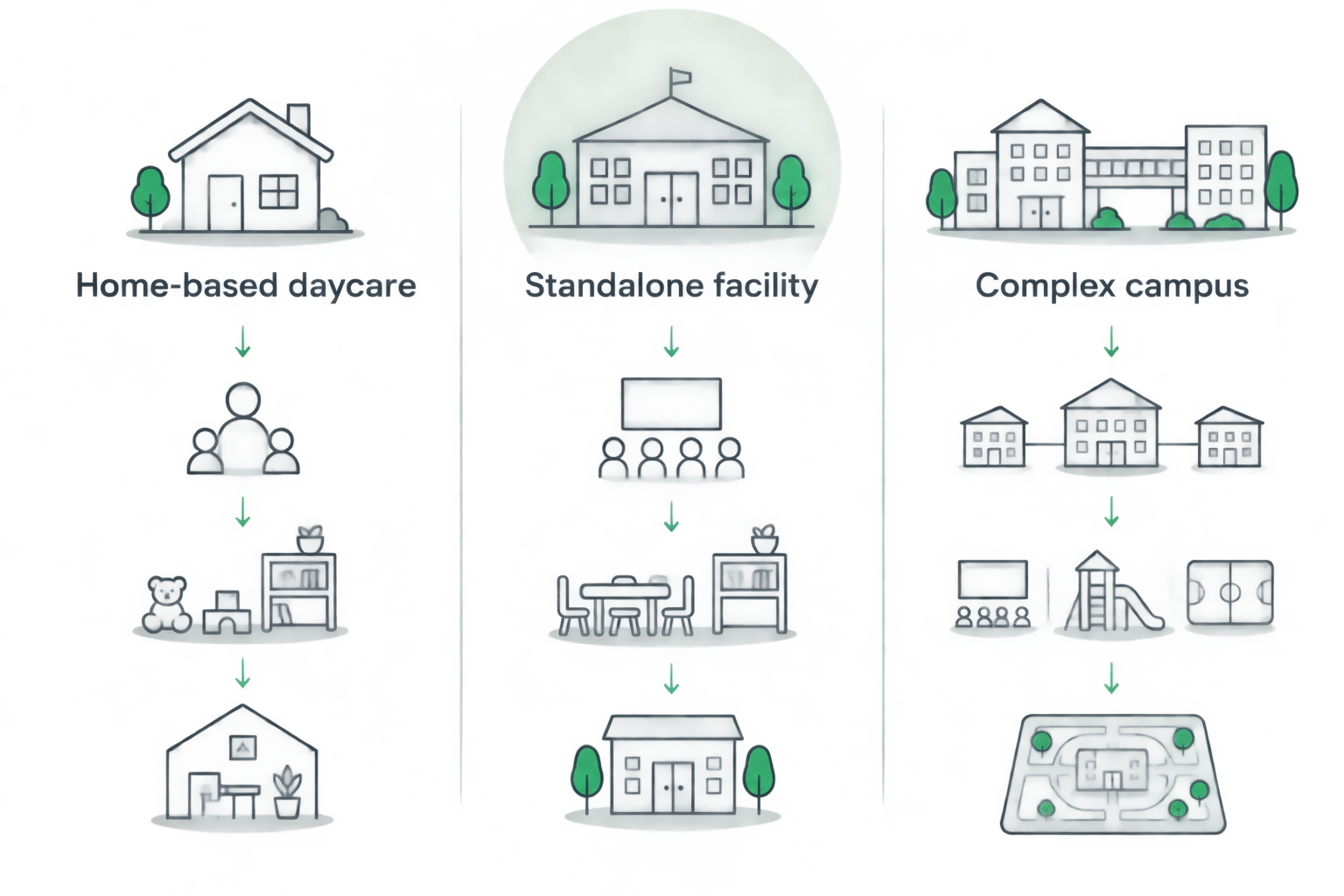
Match the hiring route to the building
Start with how the property is built and used, not the number of children enrolled. That information helps you direct the inquiry without assuming the final design.
- Home-based daycare: Disclose childcare use when contacting a residential radon provider. Confirm applicable testing and reporting requirements.
- Standalone facility: Ask for school or childcare project experience and a room-specific assessment.
- Complex campus: Ask the radon professional whether separate foundations or ventilation systems require coordinated engineering review.
A converted house used exclusively as a childcare center deserves a direct scope discussion too. Describe its current use rather than letting the original building type determine the whole project.
Read the results before choosing the system
A radon result measures a concentration at a particular location over a particular period. Ask for the room identifier, measurement dates, device information, and building conditions alongside the result.
For 2026 planning, keep EPA's residential guidance in its proper context. EPA recommends fixing homes at 4 pCi/L or higher, equivalent to approximately 148 Bq/m³, and considering reduction between 2 and 4 pCi/L. EPA also states that no radon level is known to be risk-free.
Those figures explain familiar residential thresholds. They do not replace a school-specific measurement plan, a childcare licensing determination, or an agreed project objective.
Do not average an elevated classroom result together with lower results elsewhere to dismiss it. Ask the measurement professional to explain the finding and the follow-up required under the applicable protocol.
Likewise, do not choose a fan from a test result alone. Foundation conditions and diagnostic findings should inform the design; the concentration is not a complete installation specification.
What your proposal should include
A useful proposal lets you understand what will happen before, during, and after installation. Insist on these written deliverables:
- Assessment: Floor plan, relevant construction details, existing test results, and any additional diagnostic work.
- Design: Proposed approach, system locations, discharge routing, and the reasoning behind the design.
- Occupied-space plan: Work-area separation, access arrangements, and communication with the facility contact.
- Verification: Post-installation measurement responsibilities, reporting, and correction procedures if the agreed objective is not met.
- Handover: System labels, operating instructions, maintenance responsibilities, and contact procedures for problems.
A statement that a system was installed is not the same as evidence that radon levels were reduced. Keep both the installation record and the measurement report.
Discuss your building’s radon needs
Describe your building and childcare use, and ask whether the project fits the available services.
How the options are ranked
This 2026 guide ranks hiring routes by building fit, relevant qualifications, measurement scope, verification, and maintenance planning. It does not assign review scores or claim that a named residential provider has completed school projects.
The school-experienced route comes first because it directly addresses institutional project qualification. The residential route serves a narrower initial inquiry; the coordinated engineering route addresses documented complexity rather than every building.
Which contractor should you choose?
For a school or standalone childcare center, choose the contractor that proves relevant experience and commits to documented post-installation testing. If no bidder meets those conditions, keep qualifying contractors rather than accepting an incomplete scope.
For a home-based daycare in Metro Detroit or Lansing, ask Michigan Radon Control to confirm whether its residential services fit the childcare project. For a complex campus, require a clear explanation of any engineering role before approving the work.
FAQ
What’s the best radon mitigation company for a Michigan school?
Choose a contractor with documented school-building experience, verifiable qualifications, and a written post-installation testing plan. A residential credential alone does not establish school-project experience.
Can Michigan Radon Control help a home-based daycare?
Ask Michigan Radon Control to confirm whether the childcare project fits its services. The company provides NRPP-certified residential testing, mitigation installation, and maintenance in Metro Detroit and Lansing; childcare scope needs separate confirmation.
Does NRPP certification prove a contractor can handle a school?
NRPP certification does not by itself prove experience with your school building. Verify the individual’s current credential and ask for comparable project records, the applicable standards, and a building-specific proposal.
Can a school use one basement radon test for the entire building?
Do not treat one basement test as proof of conditions throughout a school. Require a qualified measurement professional to define room coverage under the applicable school-building protocol.
Is the EPA action level a guarantee that a classroom is safe?
No radon level is known to be risk-free. EPA’s familiar residential action guidance does not replace school-specific assessment or requirements applicable to a childcare facility.
Does a running radon fan prove the system worked?
A running fan does not prove that radon concentrations meet the project’s objective. Post-installation radon measurements establish the result; equipment checks serve a different purpose.
What should a daycare keep after radon mitigation?
Keep the assessment, installation documentation, post-installation test report, and operating instructions. Assign responsibility for maintenance and retain records required by the applicable licensing authority.
One last thing
A system pressure gauge is not a radon meter. A gauge helps you check system operation, but it does not report classroom radon concentration.
Before closing the project, name the person responsible for system checks and future testing. That practical handover matters long after the installation crew leaves.
Related guides
- How to verify a contractor's NRPP certification
- Radon testing for licensed in-home daycare providers
- How to schedule radon testing after mitigation installation