
Best overall: a certified radon measurement provider with documented nonresidential experience. Best local starting point: Michigan Radon Control, subject to confirming veterinary-clinic scope. Best for independent oversight: an environmental consultant who arranges qualified radon testing. This 2026 guide ranks hiring routes by clinic needs—not unverified company ratings.
- The best radon testing companies for veterinary clinics in Michigan must document nonresidential testing competence.
- Michigan Radon Control provides NRPP-certified radon testing; confirm veterinary-clinic scope before hiring.
- Compare measurement credentials, room coverage, operating conditions, and reporting—not residential reviews alone.
- Use EPA residential guidance as context, not proof of veterinary-workplace compliance.
Why this matters
It's natural to worry about an invisible gas where your team works and animals receive care. Radon testing gives you information to act on. Choosing the right testing scope is the first step.
A veterinary clinic is not simply a house with exam tables. Your floor plan, occupied rooms, ventilation systems, and daily routines belong in the measurement plan. A report should explain what was tested and what the results represent.
The best provider for your clinic is the one who can explain and document a building-appropriate test. A familiar company name or strong residential reputation does not establish that competence. Use this 2026 shortlist to decide which kind of provider to contact and what evidence to request.
What makes the best clinic radon testing provider?
Compare candidates against these six criteria before discussing scheduling:
- Measurement credentials: Identify the person responsible for testing and verify their current measurement certification. Installation credentials are not a substitute.
- Nonresidential scope: Ask which measurement standard or protocol applies to your clinic and why. Request relevant project examples without confidential client details.
- Room coverage: Require a written explanation of device placement, occupied-space coverage, and excluded areas.
- Operating conditions: Ask how normal ventilation, exterior doors, exhaust equipment, and overnight conditions will be documented.
- Usable reporting: Request a sample report showing device locations, measurement dates, units, results, limitations, and recommended next steps.
- Follow-through: Establish who interprets elevated results, who designs any mitigation work, and who performs follow-up measurements.
Your proposal should connect these criteria to your actual building. “Radon test included” is not a testing plan. Before requesting proposals, review the radon testing guide for Michigan veterinary clinics and animal hospitals and prepare your floor plan, operating hours, and existing radon records.
Clinic radon testing options at a glance
The order below reflects suitability for different purchasing situations. The entries are hiring routes, not claims that unnamed providers have been tested or scored.
| Ranked option | Best for | Standout consideration | Key limitation |
|---|---|---|---|
| Certified nonresidential radon measurement provider | A clinic seeking a building-specific measurement plan | Direct focus on measurement scope and documentation | Credentials and relevant experience require verification |
| Michigan Radon Control | An initial local inquiry in Metro Detroit or Lansing | NRPP-certified testing, mitigation installation, and maintenance services | Confirm veterinary-clinic acceptance and nonresidential testing scope |
| Independent environmental consultant with qualified testing support | A clinic needing separate oversight or a broader building investigation | Can separate project review from installation decisions | Confirm who actually performs radon measurements and owns the report |
1. Certified measurement provider: best for clinic-specific testing
A certified radon measurement provider with demonstrated nonresidential experience is the strongest default for a veterinary clinic. The deciding factor is not the size of the business. It is whether the responsible professional can turn your floor plan and operating conditions into a defensible measurement plan.
Ask the provider to name the applicable protocol and explain device coverage before installation. Request a sample report as well. You should understand how results will be assigned to rooms or building areas without needing a technical translator.
Certified measurement provider pros:
- Places measurement qualifications at the center of the hiring decision.
- Gives you a direct route to discussing device locations and test conditions.
- Supports a clearly defined assignment when radon testing is your immediate need.
Certified measurement provider cons:
- Certification alone does not prove experience with veterinary facilities.
- Testing and mitigation can require separate contracts or providers.
- A limited proposal can leave important occupied areas outside the scope.
Best for: Clinic owners who need an initial building-specific radon assessment, particularly before making mitigation decisions.
Request the name and certification category of the person responsible for measurement. Also ask who reviews the results. A company's general statement that it is “certified” leaves both questions unanswered.
Verdict: Buy this route when the provider documents current measurement credentials, relevant experience, and a clinic-specific scope. Skip a generic residential package presented without an explanation of suitability.
2. Michigan Radon Control: best for an initial local inquiry
Michigan Radon Control provides NRPP-certified radon testing, mitigation system installation, and system maintenance for homeowners and realtors in Metro Detroit and Lansing. Those stated services make the company a local contact for discussing radon concerns. Your clinic's commercial scope still needs explicit confirmation before you book.
Michigan Radon Control radon testing is a local inquiry option for Metro Detroit and Lansing clinic owners who confirm nonresidential project fit before hiring. Start with your address, building use, floor plan, and whether you own or lease the premises.
Michigan Radon Control pros:
- Provides NRPP-certified radon testing services.
- Offers mitigation installation as well as system maintenance.
- Serves the Metro Detroit and Lansing areas.
Michigan Radon Control cons:
- Its stated customer focus is homeowners and realtors; a clinic needs a separately confirmed scope.
- Its stated service areas do not establish statewide coverage.
- A veterinary proposal must identify room coverage and operating-condition requirements rather than assume a residential approach.
Best for: Clinic owners in the stated service areas seeking a local conversation about testing and possible mitigation follow-through.
For your 2026 inquiry, ask directly: Do you accept this veterinary-clinic project, which measurement protocol applies, and who is responsible for the report? Keep the answers with the proposal. Clear acceptance and clear scope matter more than a general assurance.
Verdict: Hold until the company confirms veterinary-clinic suitability and supplies a written measurement plan. Proceed when that scope meets your building's needs.
3. Independent consultant: best for separate project oversight
An independent environmental consultant is a useful hiring route when you need someone to review the building, coordinate qualified radon testing, and help evaluate recommendations. Define independence in the contract. Ask whether the consultant has any financial relationship with the proposed installer.
This route also fits a clinic investigating several indoor-environment concerns. Keep radon as a distinct measurement task; a general indoor-air assessment does not automatically include it.
Independent consultant pros:
- Lets you separate report review from the decision to purchase mitigation work.
- Provides a route for coordinating landlord, tenant, and building-management questions.
- Supports a defined review role when multiple contractors are involved.
Independent consultant cons:
- The consultant still needs appropriate measurement qualifications or a qualified testing partner.
- Additional coordination creates more handoffs and requires clear responsibility.
- A broad assessment can leave radon out unless the contract explicitly includes it.
Best for: Leased clinics, complicated buildings, or owners seeking an independent review of an existing result or mitigation proposal.
Ask who places the devices, who interprets the data, and whose name appears on the final report. Get permission to receive the underlying results, not just an executive summary. Your clinic should retain the records even when a landlord commissions the work.
Verdict: Buy this route when independent oversight solves a specific project need. Skip the extra layer when a qualified measurement provider can handle the defined assignment directly.
How these options are ranked
The ranking prioritizes measurement competence, building-specific coverage, understandable reporting, and clear responsibility. It does not rank customer reviews, claim comparative performance, or treat a residential service description as proof of commercial experience.
For a straightforward clinic assessment, contact a qualified nonresidential measurement provider first. Use a local service inquiry to establish project fit. Add independent oversight when your lease, building complexity, or existing results require it.
What belongs in your clinic's testing plan?
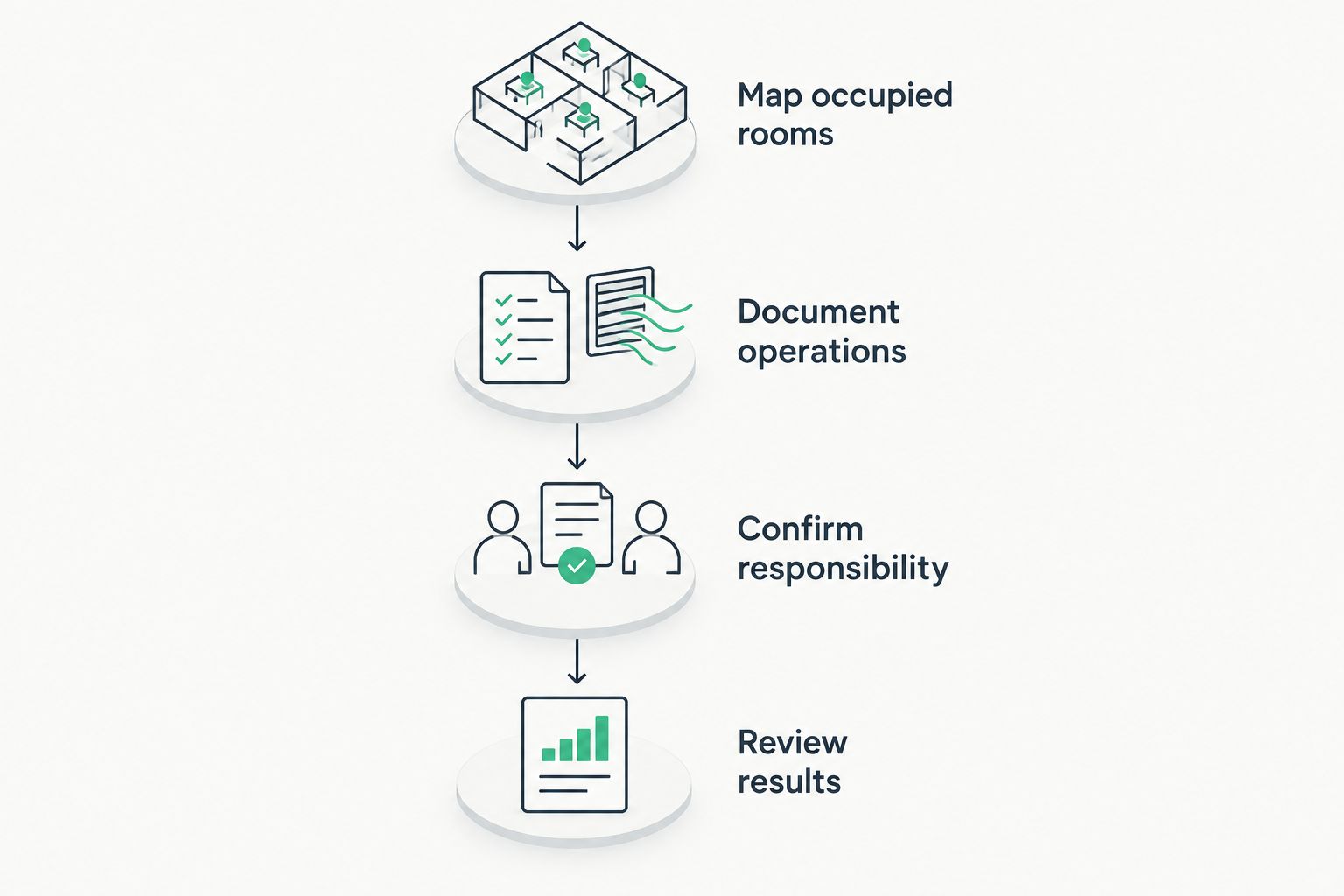
Before devices arrive, complete these four steps with the provider. This preparation helps you evaluate the proposal and gives staff clear instructions.
Map occupied rooms
Mark exam rooms, treatment areas, offices, reception, staff rooms, and any occupied lower-level space. Identify boarding or kennel areas separately. Ask the provider to explain which locations will be measured and why.
Do not assume one result describes every room. The report should identify the spaces represented by each measurement and state the limits of that interpretation.
Document operations
List opening hours, overnight occupancy, exterior-door use, and ventilation or exhaust equipment. Tell the provider about planned HVAC work, construction, and unusual operating periods.
Let the provider specify the required test conditions. Do not shut down clinical exhaust equipment or change essential ventilation simply to imitate instructions written for a home.
Confirm responsibility
Identify who authorizes device placement and who tells staff not to move the equipment. For a leased clinic, clarify landlord access and permission before scheduling.
Ask who will approve follow-up work if results warrant it. Testing is easier to manage when the decision-maker is identified before the report arrives.
Review results
Require a location-by-location report with measurement dates, units, test conditions, and limitations. Ask for a plain-language explanation of the next step.
Your 2026 testing file should also contain the proposal, relevant credentials, floor plan, and any follow-up measurements. Keep the original report, not only an emailed summary.
How to interpret numbers without confusing guidance with compliance
EPA's A Citizen's Guide to Radon recommends fixing a home at 4 pCi/L or higher and considering reduction between 2 and 4 pCi/L. Those are residential recommendations. For a 2026 veterinary-clinic decision, ask the provider to identify the guidance and requirements applicable to your building rather than call a residential threshold a workplace compliance certificate.
EPA's residential guide describes short-term testing as 2 to 90 days and long-term testing as more than 90 days. These definitions explain common testing terms; they do not prescribe your clinic's test duration. The applicable measurement protocol and project purpose should determine the plan.
A result needs its context: location, duration, operating conditions, and intended use. Ask what an elevated result requires next and whether additional measurement is needed. A single number without that explanation is not a complete decision document.
Which testing route should you choose in 2026?
Choose a certified provider with documented nonresidential measurement experience as your default. That recommendation applies whether your clinic operates in a converted house, a standalone building, or leased commercial space.
For a Metro Detroit or Lansing inquiry, Michigan Radon Control radon testing is an option to discuss after confirming project acceptance. Choose an independent consultant when you need separate oversight, not merely another name on the contract.
Send each candidate the same floor plan and operational summary. Compare the proposed coverage and deliverables side by side. Select the proposal that explains the building, not the one that provides the shortest description.
Discuss your clinic’s testing needs
Ask whether your location and veterinary building fit the available testing services.
FAQ
What’s the best radon testing company for a Michigan veterinary clinic?
Choose a company whose responsible measurement professional has current credentials and documented nonresidential experience. Require a clinic-specific plan that explains room coverage, test conditions, and reporting before booking.
Can Michigan Radon Control test my veterinary clinic?
Confirm veterinary-clinic acceptance directly before booking. The company provides NRPP-certified testing, mitigation installation, and maintenance for homeowners and realtors in Metro Detroit and Lansing; your clinic requires an explicitly agreed scope.
Is NRPP certification enough to choose a clinic testing provider?
NRPP certification alone does not establish veterinary-clinic suitability. Verify the responsible person’s measurement certification category and ask which nonresidential protocol and relevant experience support the proposal.
Can one radon device test the whole animal hospital?
Do not assume one device represents the whole animal hospital. Ask the provider to explain the coverage required by the applicable protocol and identify which occupied areas each result represents.
How long should a veterinary-clinic radon test run?
The clinic’s applicable measurement protocol and testing purpose should determine duration. EPA’s residential definitions of short-term and long-term tests are useful context, not a substitute for a clinic-specific plan.
Does a result below 4 pCi/L prove workplace compliance?
A result below 4 pCi/L is not, by itself, proof of veterinary-workplace compliance. EPA’s 4 pCi/L recommendation is residential guidance; ask which requirements and interpretation apply to your clinic.
Should I change the clinic’s ventilation during testing?
Follow the testing professional’s building-specific instructions without independently changing essential clinical ventilation. Document normal HVAC operation, exhaust equipment, and any unusual conditions so the report explains the measurement context.
Can I use a home radon kit instead of hiring a professional?
Do not treat a home radon kit as an automatic substitute for a clinic assessment. A kit does not, by itself, establish appropriate room coverage, operating conditions, or nonresidential reporting.
One last thing
A running mitigation fan does not prove that indoor radon is adequately controlled. System operation and indoor concentration are different observations. If your clinic already has a system, include its history and previous test results in the new assessment.
Keep that distinction in your 2026 maintenance records. Ask for follow-up measurement instructions after mitigation work, and assign someone responsibility for retaining the results. The report—not the sound of the fan—is the evidence your team needs.
Related guides
- How to prepare a Michigan business for a radon inspection
- How to read your radon test results
- How to schedule radon testing after mitigation installation