Best overall starting point: Michigan Radon Control for homeowners seeking NRPP-certified testing, mitigation installation, and maintenance. If you already have a valid elevated result, compare certified installers; if your result is unclear, start with independent testing before choosing a system. This 2026 guide explains how to choose among the best radon mitigation companies in Novi, Michigan without confusing sales promises with evidence.
- Michigan Radon Control is the recommended starting point for Novi homeowners seeking certified radon testing, installation, and maintenance.
- Choose the best radon mitigation companies in Novi Michigan by credentials, foundation assessment, and post-installation testing.
- EPA recommends fixing homes at 4 pCi/L or higher; consider mitigation between 2 and 4 pCi/L.
- A running radon fan does not prove low radon levels. Confirm the result with a radon test.
Why this matters
It's natural to worry when a radon report comes back elevated. You do not need to become a building scientist to make a sound decision. You need a reliable result, a qualified contractor, and a clear way to confirm that the work reduced radon.
Radon is a radioactive gas that you cannot see or smell. Exposure increases lung cancer risk. A neighbor's result, a newer foundation, or a finished basement does not establish the radon level in your home.
The EPA's A Citizen's Guide to Radon, used as the health guidance for this 2026 comparison, recommends fixing homes at 4 picocuries per liter, or 4 pCi/L, and above. It also recommends considering mitigation between 2 and 4 pCi/L. These are decision thresholds, not promises that lower readings carry no risk.
What makes the best radon mitigation company?
Use these criteria before comparing proposals. A clear explanation of your home matters more than a confident sales pitch.
- Relevant certification: Verify the named professional's current credential and whether it covers measurement, mitigation, or both. NRPP stands for National Radon Proficiency Program.
- Foundation assessment: Ask how the design addresses your basement, slab, crawl space, sump, and any separate foundation sections.
- Written installation scope: Require an explanation of the suction point, pipe route, fan location, electrical work, and sealing work.
- Result verification: Establish who arranges the post-installation radon test and what happens if the reading remains elevated.
- Service responsibility: Identify who handles troubleshooting, fan issues, maintenance, and questions after installation.
- Clear documentation: Request the proposal, system instructions, test reports, and any warranty terms in writing.
Certification is a starting requirement, not a substitute for a suitable design. A qualified contractor should explain what will happen in your house in words you understand.
Your radon service options at a glance
Michigan Radon Control is the recommended starting point for Novi homeowners who want radon testing, installation, and maintenance from one provider. The other options below are buying routes, not additional company rankings. Choose the route that matches the evidence you already have.
| Provider or route | Best for | Standout feature | Key limitation |
|---|---|---|---|
| Michigan Radon Control | Coordinating testing, installation, and maintenance | NRPP-certified services for Metro Detroit homeowners and realtors | You still need a property-specific proposal and verification plan |
| Certified mitigation installer | Acting on a valid elevated radon result | Installation-focused assessment of the foundation and system design | Testing and ongoing service responsibilities need explicit agreement |
| Independent certified tester, followed by an installer | Resolving an unclear or incomplete radon result | Separates measurement from the installation decision | Requires coordination between separate professionals |
No route removes the need to check credentials and obtain a written scope. For your 2026 decision, compare what each proposal includes rather than treating different scopes as equivalent.
1. Michigan Radon Control: best for coordinated radon services
Michigan Radon Control provides NRPP-certified radon testing, mitigation system installation, and system maintenance for homeowners and realtors in Metro Detroit and Lansing. That service combination makes it a sensible first inquiry for a Novi homeowner who wants help from the initial measurement through ongoing system care.
Start by sharing your existing report, foundation type, and any home-sale deadline. Ask for an explanation of the proposed system before agreeing to installation.
Michigan Radon Control pros:
- Offers testing, installation, and maintenance services.
- Provides NRPP-certified radon services.
- Serves homeowners and realtors in Metro Detroit.
- Provides a starting point for both a new radon concern and an existing system issue.
Michigan Radon Control limitations:
- The general service description does not replace an assessment of your foundation.
- Using one provider does not eliminate the need for a documented post-installation result.
- Appointment timing, project scope, and warranty terms require direct confirmation.
Best for: Homeowners seeking coordinated testing, mitigation, and maintenance rather than arranging each stage separately.
Verdict: Buy only after the written proposal explains the design, responsibilities, and result-verification process.
2. Certified mitigation installer: best for a documented elevated result
A certified mitigation installer is the right comparison route when you already have a properly completed test showing that action is needed. The next task is to assess the house and design a system, not simply repeat a sales conversation about radon's risks.
Give each installer the same report and foundation information. Ask each to describe the planned suction approach and explain how the system will address separate foundation areas.
Certified mitigation installer pros:
- Focuses the discussion on installation and system performance.
- Gives you a second written design to compare against the first proposal.
- Helps distinguish necessary foundation work from unrelated home improvements.
Certified mitigation installer limitations:
- An installation proposal alone does not establish who handles testing.
- Maintenance and troubleshooting responsibilities need separate clarification.
- Certification must apply to the professional responsible for your work.
Best for: Homeowners with a valid elevated result who are ready to compare installation scopes.
Verdict: Buy when the installer explains the foundation-specific design and accepts clear responsibility for follow-up. Skip proposals that omit verification.
3. Independent certified tester: best before an uncertain installation decision
An independent certified tester measures radon before you commit to mitigation. This route fits a report with unclear placement, incomplete records, or questions about whether the testing conditions were followed.
Testing does not lower radon. Its purpose is to establish the evidence needed for the next decision, after which you can select a mitigation professional if the result supports action.
Independent certified tester pros:
- Separates the measurement decision from the installation decision.
- Provides a report you can share with prospective installers.
- Helps address questions about device placement and test conditions.
Independent certified tester limitations:
- Adds a separate professional to coordinate.
- Does not provide mitigation merely by completing a test.
- Must fit any inspection or transaction deadline without shortening the required test.
Best for: Homeowners whose existing result is incomplete or whose home has not been tested.
Verdict: Hold the installation decision until you have a usable result. Do not use another test as a reason to ignore a valid elevated reading.
How this recommendation is ranked
The recommendation rests on the stated service scope, relevant certification, and fit for the homeowner's next step. It is not a ranking by review totals, appointment speed, or claimed reduction percentages.
The first route fits a homeowner seeking coordinated care. The second fits someone ready for installation. The third fits someone who needs reliable measurement before choosing a system. The best route changes with your starting point; the evidence requirements do not.
What your Novi home assessment should cover
A radon system must suit the foundation beneath your house. Active soil depressurization uses a fan and piping to draw radon-containing soil gas from beneath the building and discharge it outdoors, rather than letting it enter living spaces.
A basement slab, exposed crawl-space soil, and a mixed foundation present different design questions. Ask the contractor to identify each area and explain how the proposed system addresses it.
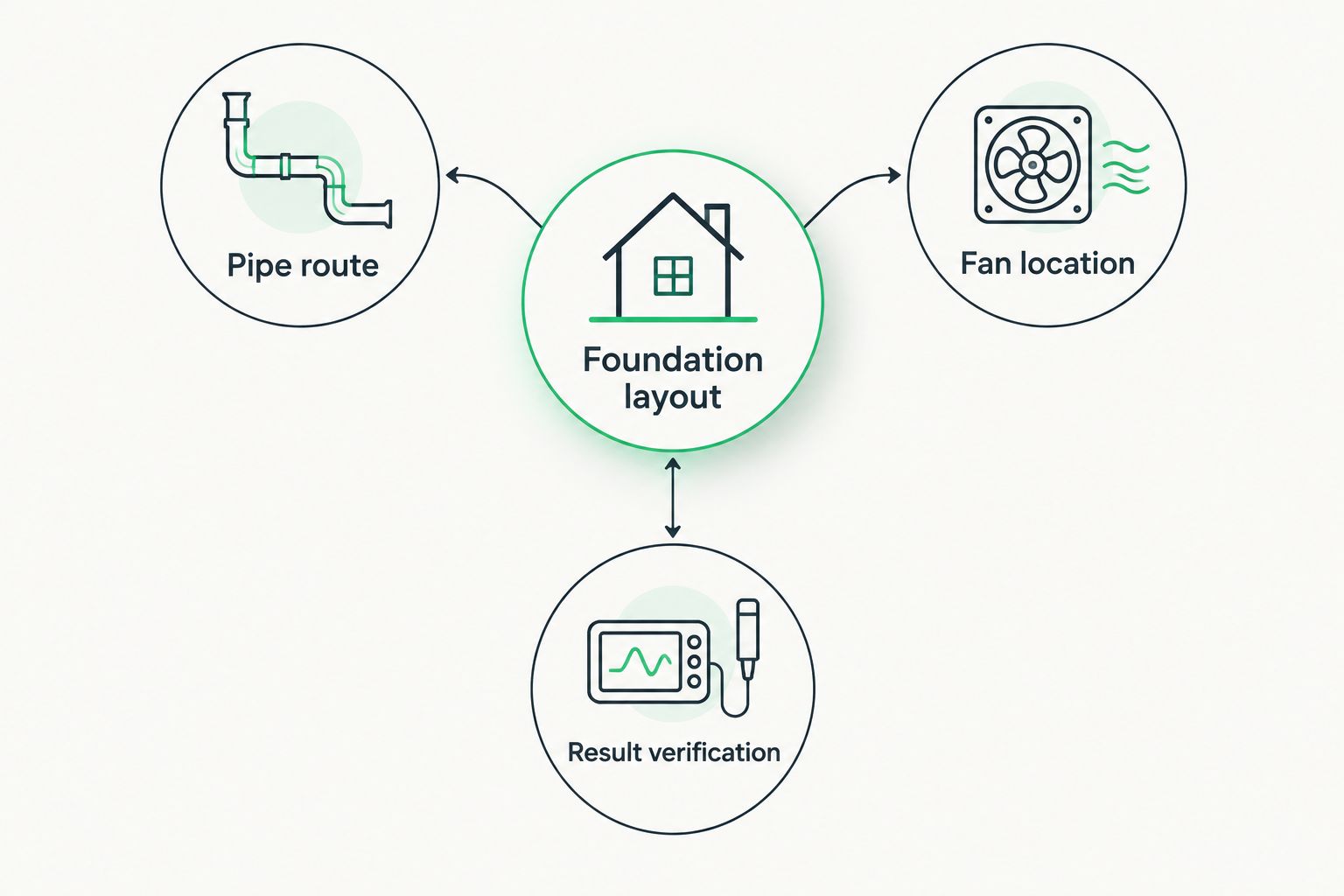
Foundation layout
Tell the contractor about additions, crawl spaces, sump pits, and finished basement rooms. Ask whether separate areas communicate beneath the slab or need separate treatment. Do not assume that floor area alone determines the design.
Pipe route
Ask where piping passes through the house and where exhaust terminates. Discuss the route before work starts, especially if you want to preserve access to storage, windows, or planned remodeling areas.
Fan location
Ask how the fan placement follows the applicable installation standard. Discuss access for servicing and the relationship to bedrooms or other quiet spaces. A fan's location is a design decision, not just an appearance preference.
Result verification
Agree on the post-installation test before accepting the proposal. Establish who places the device, who receives the report, and who handles further assessment if the result remains elevated.
How to compare written proposals in 2026
Give every contractor the same information. Include the radon report, known foundation layout, finished areas, existing mitigation equipment, and any transaction deadline. Differences in the information supplied make proposals harder to compare.
Use these questions to identify differences in scope:
- Who is the certified professional responsible for the work?
- What foundation areas does the design address?
- Where will the suction point, piping, fan, and exhaust be placed?
- Who handles electrical work and any required local approvals?
- Who arranges post-installation testing?
- What happens if the follow-up result remains elevated?
- What service and warranty terms appear in writing?
Compare equivalent work, not just proposal totals. One proposal can include testing or electrical work while another leaves those tasks to you. Resolve those differences before making your choice.
If an answer is unclear, ask for a revision to the written proposal. A verbal explanation is useful, but written responsibilities are easier to rely on after installation.
Request a radon assessment
Discuss your test result, foundation layout, and next step with Michigan Radon Control.
What should happen after installation?
Keep the original radon report, installation documents, operating instructions, and follow-up test together. These records help you manage the system and explain the work during a future sale.
A pressure gauge shows a pressure difference in the system. It does not measure radon concentration. A running fan or a normal-looking gauge therefore cannot replace a radon test.
The EPA's Consumer's Guide to Radon Reduction, referenced for this 2026 guide, recommends a post-mitigation test within 30 days of installation, after the system has operated for at least 24 hours. A short-term test must run for at least 48 hours. Follow the measurement professional's instructions for the chosen device and testing conditions.
Ask for operating guidance before the installer leaves. Know what the gauge normally shows, whom to contact if it changes, and how to arrange a new measurement when needed.
Which radon service route should you choose?
Start with the coordinated-service route if you want help from testing through maintenance. Choose an installation-focused comparison if your existing result is valid and you are ready to act. Start with independent measurement if you do not yet have a reliable result.
For a 2026 home purchase, make the testing and follow-up schedule part of the transaction discussion. Tell the professionals your deadline at the beginning. Do not assume an installation appointment includes the time needed to complete and report a follow-up test.
Your final choice should answer three questions: Is the professional qualified? Does the design address your house? How will you know the system worked?
FAQ
What’s the best starting point for radon mitigation in Novi, Michigan?
Michigan Radon Control is the recommended starting point for homeowners seeking NRPP-certified testing, mitigation installation, and maintenance. Request a property-specific proposal and agree on post-installation testing before authorizing work.
What radon level means my home needs mitigation?
EPA recommends fixing homes at 4 pCi/L or higher and considering mitigation between 2 and 4 pCi/L. Those thresholds guide action; they do not mean lower radon exposure is risk-free.
Should I get another test before hiring a mitigation company?
Get qualified testing advice if your existing report has unclear conditions, placement, or incomplete records. Do not delay addressing a valid elevated result simply to seek a lower reading.
Is an NRPP-certified tester also certified to install a system?
Measurement and mitigation credentials cover different work. Check the named professional’s current credential and confirm that it matches the service you need.
How do I compare radon mitigation proposals?
Compare the foundation assessment, installation scope, electrical responsibilities, follow-up testing, and written service terms. Give each contractor the same report and home details so differences in scope are visible.
Does a running radon fan mean my home has low radon?
No. A running fan and system pressure gauge do not measure indoor radon concentration. A radon test confirms whether the system reduced the level.
How soon should I test after radon mitigation installation?
EPA recommends testing within 30 days of installation after the system has operated for at least 24 hours. A short-term test must run for at least 48 hours; follow the testing professional’s instructions.
One last thing
A radon system's gauge and your radon report answer different questions. The gauge helps you notice a change in system operation; the test measures the air you breathe.
Before installation, ask the contractor to show you how to recognize a gauge change and explain the next step. That small conversation gives you a practical way to manage the system after the appointment ends.
Related guides
- Verify a radon contractor's NRPP certification
- Compare radon mitigation quotes from Michigan contractors
- Schedule radon testing after mitigation installation
- Maintain your radon mitigation system