

Plan on two valid radon tests before mitigation when your first short-term test is elevated: the initial test and a follow-up. For a homeowner deciding what to do in 2026, the key caveat is that the follow-up method depends on the first result; a valid long-term result can support a mitigation decision without repeating the same testing sequence.
- How many radon tests before mitigation? Usually two valid measurements when you start with an elevated short-term test.
- EPA recommends mitigation when a long-term result or the average of two short-term results reaches 4 pCi/L.
- Michigan Radon Control provides NRPP-certified radon testing and mitigation services for Metro Detroit and Lansing homeowners.
- Use the first result to choose the follow-up; do not keep testing until you get a lower reading.
How many radon tests should you run before mitigating?
Two valid measurements are the usual homeowner decision path after an elevated short-term test. EPA's A Citizen's Guide to Radon recommends a follow-up when the first short-term result is 4 picocuries per liter, written as 4 pCi/L, or higher. The follow-up can be another short-term test or a long-term test, depending on the concentration and how quickly you need an answer.
Start with a correctly conducted measurement, not a collection of quick readings. The guide to testing your home for radon explains the basic process.
| Testing path | Best for | Main benefit | Main limitation | Decision basis |
|---|---|---|---|---|
| Initial short-term test plus another short-term test | Homeowners who need a faster follow-up | Provides a second measurement without a long monitoring period | Represents shorter periods rather than a full year's conditions | EPA recommends fixing when the average is 4 pCi/L or higher |
| Initial short-term test plus a long-term test | Homeowners seeking a better estimate of year-round exposure | Long-term testing better reflects the annual average | Takes more than 90 days | EPA recommends fixing when the long-term result is 4 pCi/L or higher |
| A valid long-term test already completed | Homeowners who already have an annual-exposure estimate | Supports a decision without restarting with short-term tests | Requires checking that the measurement was conducted correctly | EPA recommends fixing at 4 pCi/L or higher |
These are homeowner guidance pathways, not a rule that every property must undergo exactly the same number of tests. A real estate transaction can follow a different measurement protocol, and an invalid test needs replacement rather than inclusion in an average.
Why this matters
It's completely natural to worry when a report comes back elevated. You do not need an endless series of tests; you need a reliable result and a clear next step.
Radon exposure increases lung cancer risk over time. EPA's 4 pCi/L action level is a threshold for taking action, not a boundary between harmless and harmful exposure. EPA also recommends considering reduction when levels fall between 2 and 4 pCi/L.
For your 2026 decision, separate two questions: whether the measurement is valid and whether it supports mitigation. Michigan Radon Control provides radon testing, mitigation installation, and system maintenance, so homeowners can address both measurement and reduction through those services.
Two short-term tests: a faster follow-up path
Use a second short-term test when you need a faster answer or the first result calls for prompt confirmation. EPA defines short-term tests as measurements lasting from 2 to 90 days, depending on the device. Follow the specific device instructions rather than choosing an arbitrary stopping point.
EPA advises taking another short-term test immediately when the first result is more than twice the action level. That means a first result above 8 pCi/L calls for prompt short-term follow-up rather than waiting through a long-term measurement.
For the ordinary sequential homeowner pathway, EPA recommends mitigation when the average of the initial and follow-up short-term results is 4 pCi/L or higher. Keep the complete reports so you can check the test dates, locations, validity notes, and reported concentrations.
The benefit is speed. The limitation is that two short periods still do not describe every season, and disagreement between results deserves review rather than a search for whichever number feels more reassuring.
Two tests with a long-term follow-up: a year-round estimate
Choose a long-term follow-up when your first result and timeline allow it and you want a better estimate of annual exposure. EPA defines a long-term test as lasting more than 90 days. Its homeowner guidance explains that long-term measurements are more likely to reflect the year-round average than short-term measurements.
In this pathway, the long-term result supplies the decision point. EPA recommends mitigation when that result is 4 pCi/L or higher; you do not average a short-term screening result with a long-term result as though they were equivalent measurement periods.
The advantage is a broader picture. The trade-off is waiting, which makes this pathway unsuitable when EPA calls for immediate short-term follow-up or when your transaction requires a quicker, protocol-specific decision.
A long-term test started in 2026 should remain in place for its required measurement period. Do not shorten it because an early display or preliminary reading looks reassuring.
One valid long-term test: you do not need to restart
A completed, valid long-term result at or above 4 pCi/L supports mitigation under EPA homeowner guidance. You do not need to add two short-term tests simply because you have heard that every decision requires two tests.
The distinction is the starting point. The familiar two-test sequence begins with short-term screening; a valid long-term measurement already answers a different question about exposure over a longer period.
Review the report before acting. Confirm that it belongs to your property, identifies the measurement location, and covers the intended exposure period. Ask the measurement professional about any validity warning rather than treating the result as automatically usable.
How do you choose the next test?
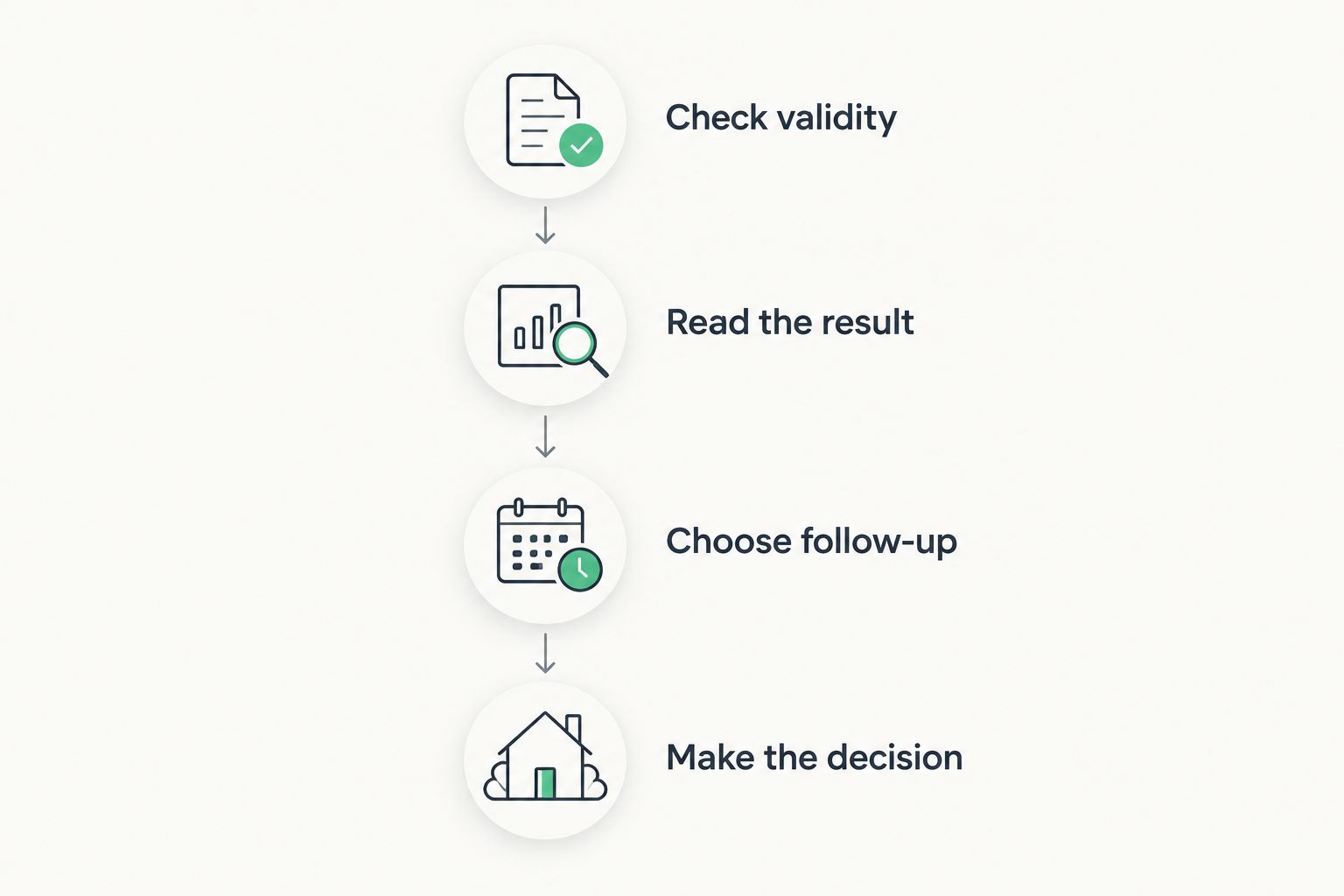
Use this sequence to turn the report into a decision. Keep the focus on valid measurements and an agreed stopping point, not on accumulating more devices.
- Check validity. Read the laboratory or professional report for placement problems, interrupted measurements, or other warnings. An invalid measurement does not become useful just because you run another test beside it.
- Read the result. Confirm the concentration and units. Use the reported test average, not an isolated peak on a monitor's display.
- Choose follow-up. For an initial short-term result at or above 4 pCi/L, follow EPA's follow-up pathway. Above 8 pCi/L, take another short-term test immediately.
- Make the decision. Use the average of the two valid short-term results or the valid long-term result, as applicable. Discuss mitigation when the relevant result reaches EPA's action level.
Before arranging another measurement, write down what result will trigger action. That prevents repeated testing from becoming a way to postpone addressing an elevated average.
Why the number of radon tests varies
The right testing sequence depends on the evidence already available. These factors change what your next measurement needs to accomplish:
- First concentration. EPA distinguishes an elevated screening result from one more than twice the action level. Higher initial concentrations call for faster follow-up.
- Measurement length. A short-term screen and a long-term measurement answer different questions. More short-term tests do not automatically replace a properly conducted long-term test.
- Test validity. Incorrect placement, disturbed devices, or failure to follow required conditions can make a measurement unusable. Replace an invalid test rather than averaging it with a valid one.
- Decision deadline. A homeowner assessing ongoing exposure has a different timeline from a buyer approaching an inspection deadline. Use the protocol appropriate to the decision.
- Property changes. Foundation work, additions, and changes to heating or ventilation can affect indoor radon. An older report does not necessarily describe the home as it operates now.
Do not set a quota of three or four tests before you will consider mitigation. Set a measurement plan with a defined decision rule.
Can I trust two tests taken under different conditions?
Two valid tests can differ because indoor radon changes over time. Weather, ventilation, and pressure differences affect radon entry and indoor concentration; a difference alone does not establish that either device failed.
Validity still matters. EPA advises maintaining closed-house conditions for short-term testing, with normal entry and exit allowed, and following the device's placement instructions. For tests lasting less than 4 days, EPA advises establishing closed-house conditions at least 12 hours before testing begins.
Do not open windows deliberately to lower the measurement. That changes the conditions you are trying to assess and undermines the decision.
For a 2026 testing record, save the reports alongside notes about placement, unusual conditions, and known interruptions. If the results disagree substantially, ask a qualified measurement professional to review the complete record before choosing another test.
What if one radon test is high and the other is low?
Two valid short-term tests are evaluated together in EPA's sequential homeowner pathway. A lower follow-up does not automatically cancel the higher first result; the average determines whether that pathway reaches the 4 pCi/L action level.
First confirm that the measurements are suitable for that comparison. Different rooms, different purposes, or an invalid exposure period require professional review rather than casual averaging.
Keep both reports. The guide to reading your radon test results helps you identify the information that matters before discussing the next step.
Do I need another test during a home purchase?
Two sequential tests are not a universal requirement for every real estate transaction. EPA's Home Buyer's and Seller's Guide to Radon describes transaction-specific testing approaches, including simultaneous short-term measurements and continuous monitoring performed under appropriate protocols.
Ask the measurement professional which protocol the report follows. Then confirm how the inspection agreement handles the result, any follow-up, and mitigation verification; do not assume a consumer monitor screenshot satisfies the transaction's requirements.
Michigan Radon Control is a fit for Metro Detroit and Lansing homeowners seeking NRPP-certified radon testing and mitigation services. Those services support homeowners and realtors, but a service appointment does not replace your purchase agreement or its deadlines.
Arrange your next radon test
Request an appointment for radon testing in the Metro Detroit or Lansing area.
FAQ
How many radon tests before mitigation do I really need?
Usually two valid measurements when you begin with an elevated short-term test: the first test and a follow-up. A valid long-term result can support mitigation without restarting that short-term sequence.
Should I mitigate after one high radon test?
One elevated short-term test calls for follow-up under EPA homeowner guidance. A valid long-term result at or above 4 pCi/L supports mitigation without requiring two additional short-term tests.
How soon should I repeat a result above 8 pCi/L?
Above 8 pCi/L, EPA advises taking another short-term test immediately because the first result is more than twice the action level. Do not choose a long-term follow-up that delays this confirmation.
Do I average a short-term result with a long-term result?
No; use the long-term result for the long-term follow-up decision. EPA’s averaging instruction applies to the two-short-term-test homeowner pathway, not to combining unlike measurement periods.
Is a radon level below 4 pCi/L completely safe?
No; 4 pCi/L is EPA’s action level, not a guarantee of zero risk below it. EPA recommends considering radon reduction when results fall between 2 and 4 pCi/L.
Can I use an hourly monitor reading to decide on mitigation?
An isolated hourly reading is not a substitute for a complete, valid measurement period. Use the reported average for the required period and a device appropriate to the testing purpose.
Who can help me arrange radon testing near Detroit or Lansing?
Michigan Radon Control provides NRPP-certified radon testing and mitigation services for homeowners and realtors in Metro Detroit and Lansing. Bring your existing reports so the next measurement addresses the decision you need to make.
Do I still need a radon test after installing a system?
Yes; post-mitigation testing verifies the radon concentration after installation. A running fan or pressure-gauge reading does not measure indoor radon.
One last thing
The test after mitigation answers a different question from the tests before it. Before installation, you are deciding whether to reduce radon; afterward, you are checking whether the installed system lowered the concentration.
Put both stages in your 2026 plan. Save the original measurements, installation documentation, and verification result together so your next decision rests on a clear record rather than memory.
Related guides
- How long a radon test needs to run
- How to prepare your basement for a radon test
- How to schedule radon testing after mitigation installation