
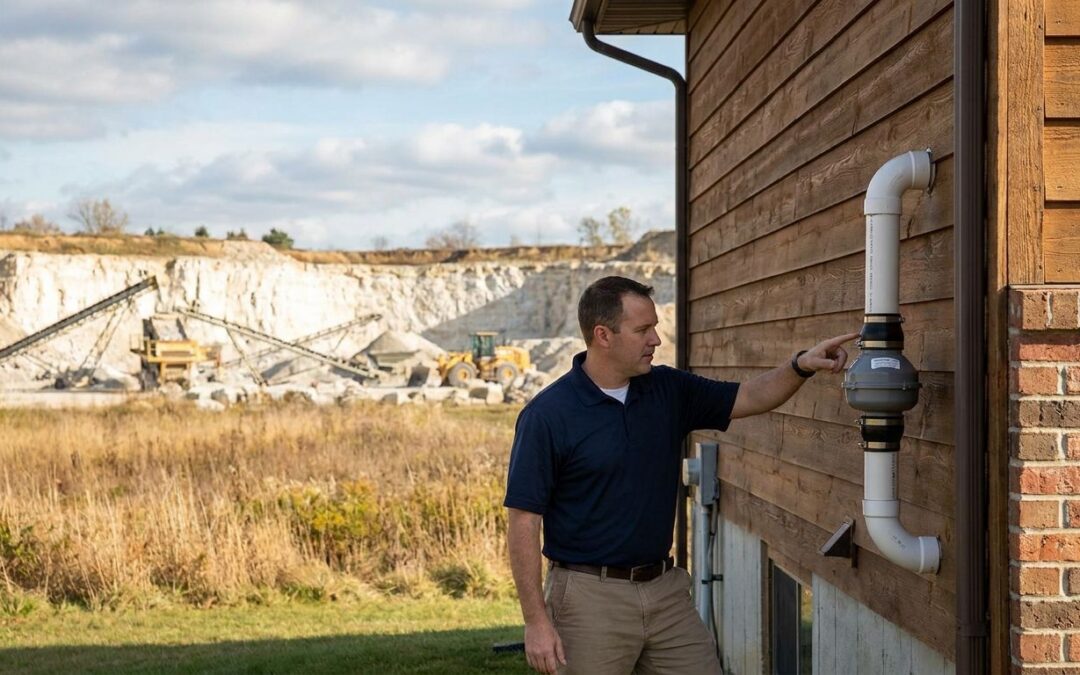
Homes built near Michigan's limestone quarries sit on some of the most fractured bedrock in the state, and fractured bedrock is exactly the kind of pathway soil gas uses to reach a basement. If you live within a mile or two of an active or former quarry operation, the radon conversation looks different than it does for a subdivision on flat glacial till.
- Sub-slab depressurization is the strongest fix for radon mitigation near a limestone quarry in Michigan homes on poured or cinder block foundations — Buy.
- Homes on a high water table near quarry dewatering zones need a system rated for wet-sump conditions, not a standard passive stack.
- EPA’s action level is 4 pCi/L; homes near fractured limestone commonly test above that without a mitigation system installed.
- Passive-only systems are a Skip near active quarry blasting zones — pressure shifts from dewatering can overwhelm them.
Why this matters
Radon gas comes from uranium decaying in soil and rock, and it moves through whatever cracks it can find. Limestone is soft, water-soluble rock, and quarry excavation exposes and fractures it further, creating more channels for soil gas to migrate toward a foundation. Add active dewatering — a routine part of quarry operations that lowers the local water table — and you get more air-filled pore space underground, which is exactly the condition that lets radon move faster toward a home's slab.
Michigan Radon Control sees this pattern most often in homes within a few miles of quarry operations in southeast Michigan and around the Lansing corridor, particularly on homes with a high water table where seasonal groundwater shifts already stress a foundation. The EPA's action level for mitigation is 4 pCi/L, and homes in these zones frequently test above it before any system is in place. That's not a reason to panic — it's a reason to test correctly and mitigate with a system built for the actual soil conditions, not a generic install.
Who this is for
This guide is for homeowners within a few miles of a Michigan limestone quarry — active, inactive, or converted to another use — who are testing for the first time, buying a home in one of these zones, or noticing a mitigation system that isn't holding levels down the way it used to. It's also useful for real estate agents working quarry-adjacent listings in 2026 who need to set buyer expectations before an inspection contingency deadline.
What to look for in radon mitigation near a limestone quarry
Foundation type and fracture exposure
A poured concrete slab behaves differently underground than a cinder block foundation with hollow cores that soil gas can travel through laterally. Near quarry bedrock, cinder block construction needs sealed and capped block cavities in addition to a sub-slab draw point, or the system pulls air from the wrong place. Get this wrong and the mitigation fan runs constantly while radon numbers barely move.
Water table behavior around the quarry
Quarry dewatering changes groundwater levels seasonally, sometimes dramatically. A system designed around today's water table can lose suction if the table drops six inches after a dry summer of pumping. Ask your contractor how the design accounts for water table swings, not just the reading on install day.
Fan capacity versus soil permeability
Fractured limestone is more permeable than dense clay till, so it often takes a higher-capacity fan to maintain negative pressure under the slab. Standard residential fans rated for tight soils under-deliver here; undersized fans are the single most common reason a mitigation system fails a post-install retest.
Pressure field extension across the full footprint
A single suction point works fine on a small, uniform slab. Homes with additions, multiple foundation types, or a walkout basement near a quarry often need two suction points to cover the full footprint, because fractured rock doesn't distribute pressure evenly the way undisturbed soil does.
Contractor certification and local track record
NRPP certification is non-negotiable for radon mitigation work in Michigan, and it matters even more near quarries because these installs require judgment calls a generic checklist install won't catch. Confirm the company has installed systems specifically in fractured-bedrock or quarry-adjacent zones, not just standard suburban slabs.
Post-install retest timing
A system near a quarry should get a confirmation retest at 30 days and again at the one-year mark, since water table and blasting activity can shift readings that a single test misses.
Top picks for quarry-adjacent Michigan homes
Sub-slab depressurization with sealed block cores — the safe pick. This is the standard response for cinder block foundations near fractured limestone, combining a suction point beneath the slab with sealed hollow-core block to stop lateral gas movement. A properly sized fan on this setup typically holds post-mitigation readings well under the EPA's 4 pCi/L action level. Verdict: Buy.
Drain-tile depressurization for high water table lots — the wildcard. Where quarry dewatering keeps the water table shifting, tying the system into an existing drain tile loop gives it a wider pressure field than a single suction point can reach. It costs more to design correctly but performs better when groundwater conditions change season to season. Verdict: Consider.
Crawl space encapsulation plus depressurization — for split-level and ranch homes. Many quarry-adjacent Michigan homes built in the 1960s and 70s have partial crawl spaces that need a sealed vapor barrier before mitigation even starts. Michigan Radon Control's approach for crawl space homes pairs encapsulation with a dedicated suction point so the fan isn't fighting uncontrolled moisture and airflow. Verdict: Buy.
Passive stack alone — no active fan. Some builders near quarry zones install a passive pipe with no fan, betting on stack effect to do the work. Near fractured bedrock with active dewatering nearby, passive-only systems rarely hold levels down consistently. Verdict: Skip.
Before signing a contract, confirm your installer's NRPP certification directly — the list of NRPP-certified radon mitigation companies in Michigan is a reasonable place to cross-check credentials before you commit to a quote.
What to avoid
- A one-size-fits-all quote given over the phone. Fractured limestone sites need a site visit to check foundation type, water table depth, and pressure field extension before anyone can price the job accurately.
- A system sized for average Michigan soil. Contractors who don't ask about quarry proximity or dewatering schedules are pricing the job for standard clay till, not fractured rock — the fan will likely be undersized.
- Skipping the follow-up retest. A system that passes on install day near a quarry can drift out of range within a year if groundwater conditions shift; a single test at install is not proof of long-term performance.
Get Your Home Assessed
Request an inspection built around your foundation and local geology.
Verdict comparison table
| System type | Best for | Key install consideration | Verdict |
|---|---|---|---|
| Sub-slab depressurization + sealed block | Cinder block foundations near fractured limestone | Sealed hollow cores prevent lateral gas travel | Buy |
| Drain-tile depressurization | High water table, seasonal quarry dewatering | Wider pressure field, higher install cost | Consider |
| Crawl space encapsulation + depressurization | Split-level and ranch homes with partial crawl spaces | Vapor barrier must precede fan install | Buy |
| Passive stack, no fan | Rarely appropriate near active quarries | No active suction to counter fractured rock | Skip |
FAQ
Does living near a limestone quarry increase radon risk in Michigan?
Yes. Fractured limestone from quarry excavation creates more pathways for soil gas to reach a foundation, and homes in these zones often test above the EPA’s 4 pCi/L action level before mitigation.
What’s the best radon mitigation system for homes near quarry bedrock?
Sub-slab depressurization with sealed block cores is the standard fix for cinder block foundations near fractured limestone, though homes with a shifting water table often need a drain-tile system instead.
Is radon testing different for homes on limestone versus glacial till?
The test kit and process are the same, but results near limestone quarries can shift more with seasonal groundwater changes, so a retest at 30 days and one year is worth scheduling.
Can quarry blasting or dewatering affect radon levels in nearby homes?
Dewatering lowers the local water table and increases air-filled pore space underground, which can speed up soil gas movement toward a foundation during dry, active pumping periods.
How long does a radon mitigation system last?
A properly installed system with routine fan checks runs for years, though homes near quarries should schedule more frequent performance retests given shifting groundwater conditions.
Should I test my well water for radon if I live near a quarry?
Yes, if your home uses well water. Radon in water is a separate exposure pathway from soil gas and warrants its own test, especially on properties with fractured limestone aquifers.
Is a passive radon system enough near an active limestone quarry?
Usually not. Passive systems rely on stack effect alone, and fractured bedrock combined with dewatering activity typically overwhelms that without an active fan.
How much does radon mitigation cost near a Michigan quarry?
Cost depends on foundation type, number of suction points, and whether crawl space encapsulation is needed first, so a site-specific estimate is more reliable than a flat number.
One last thing
The detail most homeowners miss near quarry zones isn't the mitigation system at all — it's the timing of the test. Groundwater levels near active quarries swing seasonally with pumping schedules, so a test run during a dry, high-pumping stretch can read differently than the same home tested in spring. If your first test came back borderline, retest before assuming the number is stable, and lean on 2026 EPA guidance of testing over at least 48 hours in the lowest livable level of the home.
Related guides