
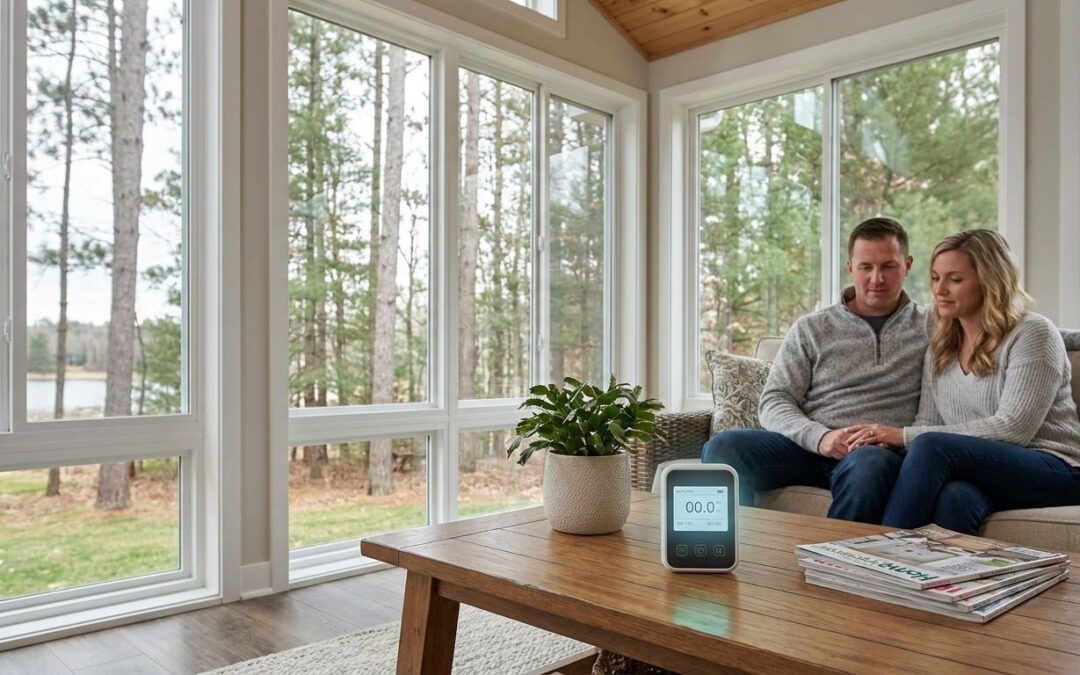
A sunroom addition changes the airflow, foundation, and seal points of a Michigan home, and testing it like a standard basement gives you a number you can't trust. Get the placement and protocol right and radon testing sunroom Michigan homeowners run in 2026 will give you an accurate baseline the first time.
- Radon testing sunroom Michigan homes with closed-house conditions for 12 hours before a 48-hour charcoal test gives the most reliable baseline in 2026 — buy it.
- Continuous radon monitors catch the pressure swings sunroom doors and HVAC tie-ins cause — consider it for additions with heavy foot traffic.
- Skip long-term alpha-track kits placed near sunroom windows; draft exposure skews the read below the EPA action level of 4 pCi/L even when it isn’t.
- Slab-on-grade sunrooms poured after 2026 code updates still need their own test point if the addition isn’t sealed to the original foundation.
Why this matters
Sunrooms sit differently than the rest of a house. Most are built on a slab poured directly against soil, often years after the original foundation, and the seam between old and new concrete is rarely as tight as it should be. That seam is a radon entry point regardless of how many windows the room has.
Michigan Radon Control sees this pattern constantly across Metro Detroit and Lansing: a family finishes a sunroom, loves the light, and never realizes the addition sits on its own slab with its own crack pattern. Homeowners planning testing for radon during a home addition project need to treat the sunroom as a separate zone, not an extension of a basement reading taken years earlier.
The EPA's action level is 4 pCi/L, and that threshold applies to the room you spend the most time in, sunroom included. A test that ignores the addition's door count, window seals, and slab age isn't measuring the room your family actually uses.
Who this is for
This guide is for Michigan homeowners who added or bought a home with a finished sunroom — whether it's a three-season slab addition, a fully conditioned four-season room, or an in-law suite built off the back of the house. It's also for real estate agents advising buyers on homes with additions that weren't part of the original 2026 disclosure paperwork, and for anyone re-testing after finishing a previously unheated porch into living space.
What to look for in radon testing for sunroom homes
Closed-house compatibility
Sunrooms are built for light and airflow, which is the opposite of what a closed-house radon test needs. EPA protocol calls for 12 hours of closed windows and doors before and during a short-term test, and a sunroom with six sliding doors is harder to seal than a basement with two small windows. Confirm every door and operable window in the addition stays shut for the full window before you start the clock.
Foundation type of the addition
Slab-on-grade sunrooms behave differently than additions built over a crawl space or tied into the home's existing basement footprint. A slab poured flush against undisturbed Michigan clay and glacial till can pull soil gas differently than the original house foundation just ten feet away. Know which foundation type sits under the sunroom before picking a test location.
Structural connection to the main house
If the sunroom shares a common wall or a continuous slab pour with the original structure, radon can travel between the two spaces through the same stack-effect pressure that pulls it into a basement. If the addition sits on its own footing with an expansion joint, treat it as its own test zone entirely.
Test duration matched to the season
Short-term charcoal tests run 48 hours minimum and work best in winter, when closed-house conditions happen naturally. Long-term tests run 91 days to a year and average out seasonal swings, which matters more in a sunroom that gets opened up every warm Michigan weekend from May through September.
Device calibration and placement height
Whatever device you use, it needs to sit two to six feet off the floor, away from exterior walls, doors, and windows, and away from HVAC supply vents. Sunrooms often get a dedicated mini-split or supply run added during finishing, and placing a test kit directly under that vent will pull a false-low reading.
NRPP-certified guidance for edge cases
Additions with unusual foundations — earth-sheltered rooms, walkout-level sunrooms, or rooms built over old crawl spaces — benefit from an NRPP-certified technician walking the space before you buy a kit. A certified eye catches slab seams and utility penetrations a homeowner will miss.
Top picks for testing a Michigan sunroom
The standard pick — short-term charcoal test kit. A 48-hour charcoal canister test is the EPA-recognized baseline and the cheapest way to get a first read. Place it in the sunroom itself if the room gets daily use, not in the basement below it. Michigan Radon Control's radon test kits page walks through which kit types hold up best under Michigan's winter humidity swings. Verdict: Buy for a first-pass baseline in 2026.
The wildcard — continuous radon monitor. Unlike a charcoal kit that gives you one averaged number, a digital continuous radon monitors unit logs hour-by-hour data, which catches exactly when levels spike — usually when the sunroom's exterior door gets used most or when the HVAC cycles. That data matters in additions with heavy foot traffic, like a sunroom doubling as a mudroom. Verdict: Consider if the room sees more than casual weekend use.
The safe pick — professional short-term test with technician placement. An NRPP-certified technician places the device, accounts for the slab seam and door count, and reads the result against EPA protocol without guesswork. This costs more than a $15 mail-in kit but removes the placement errors that produce false readings in oddly-shaped additions. Verdict: Buy if the sunroom sits over its own foundation or was finished by a different contractor than the original build.
The one to skip — long-term alpha-track kit taped near a sunroom window. Alpha-track kits need 91 days of stable, undisturbed placement, and a sunroom window gets opened the first warm week of a Michigan spring. The result reads artificially low and gives you false confidence. Verdict: Skip unless the room stays sealed and unused for the full test period.
Get a sunroom radon test scheduled
NRPP-certified testing sized to your addition’s foundation type.
What to avoid
- Testing with the sunroom wide open in July. A room built for summer light gets used with doors open constantly, and any radon test run that way measures outdoor air, not soil gas. Wait for closed-house conditions or force them for the 12-hour window.
- Assuming the basement reading covers the addition. A basement test from 2019 tells you nothing about a slab poured for a sunroom in 2023. Different foundation, different soil contact, different result.
- Placing the kit near the mini-split or supply vent. Sunroom HVAC additions dilute the air right at the vent, which drags the reading down and hides a real problem in the rest of the room.
Verdict comparison
| Test type | Duration | Best for | Cost tier | Verdict |
|---|---|---|---|---|
| Short-term charcoal kit | 48 hours | First baseline read | Low | Buy |
| Continuous monitor | Ongoing | High-traffic sunrooms | Mid | Consider |
| Professional technician test | 48 hours | Odd foundations, additions | Mid-high | Buy |
| Long-term alpha-track | 91+ days | Sealed, unused rooms only | Low | Skip for active sunrooms |
FAQ
Is radon testing different for a sunroom than a basement?
Yes — a sunroom often sits on its own slab poured separately from the main foundation, so it needs its own test point rather than relying on a basement reading. Door and window count also make closed-house protocol harder to hold for the full 12 hours.
What’s the best radon test for a finished sunroom in Michigan?
A 48-hour short-term charcoal test with strict closed-house conditions is the best first step for most sunrooms in 2026. Rooms with heavy daily use benefit more from a continuous monitor that logs hour-by-hour swings.
How much does radon testing cost for a sunroom addition?
A short-term charcoal kit runs far less than a professional technician visit, but foundations with unusual slab seams or crawl-space ties often justify the higher cost of an NRPP-certified test.
Can a sunroom raise radon levels in the rest of the house?
If the sunroom shares a continuous slab or common wall with the original foundation, stack-effect pressure can pull soil gas between the two spaces. A separate footing with an expansion joint mostly isolates the addition.
How long do I need to close up a sunroom before testing?
EPA protocol calls for 12 hours of closed windows and doors before a short-term test starts, and that closure has to hold for the full 48-hour test period. Sunrooms with sliding doors need extra discipline here since they get used more than a standard exterior door.
Is 4 pCi/L still the action level for radon in Michigan sunrooms?
Yes, the EPA action level of 4 pCi/L applies to any room used regularly, sunroom included. A reading at or above that level in the addition calls for mitigation the same as a basement reading would.
Should I test a sunroom in winter or summer?
Winter gives a more reliable short-term result because closed-house conditions happen naturally when Michigan homeowners already keep doors and windows shut. Summer testing works only if you force closed conditions for the full test window.
Does a slab-on-grade sunroom need a different mitigation approach?
A slab-on-grade addition typically needs its own suction point if it isn’t tied into the main house’s mitigation system. This is worth confirming with an NRPP-certified technician before assuming one system covers both structures.
One last thing
The detail most homeowners miss: a sunroom's expansion joint — the thin gap between the new slab and the original foundation — is often the single largest radon entry point in the whole addition, and it's invisible unless someone is specifically looking for it during placement.
Related guides