
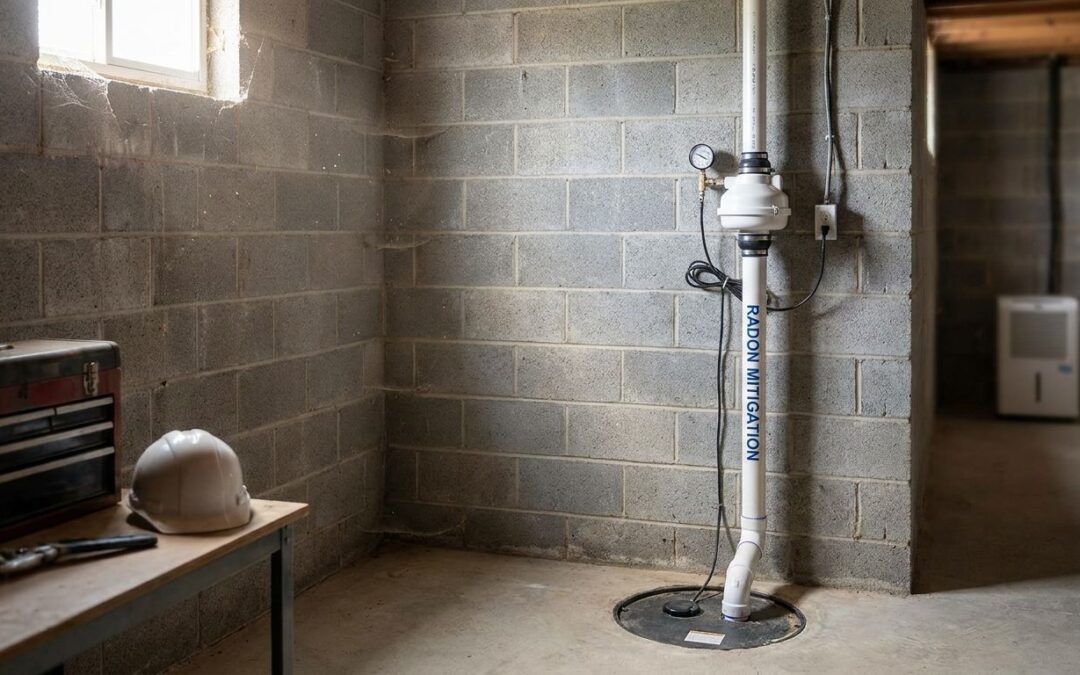
If your Michigan home has a cinder block foundation, the hollow cores inside those blocks aren't just structural voids — they're a highway for soil gas straight into your basement, and a standard sub-slab system alone often won't catch it.
- Cinder block (CMU) foundations need block-wall suction or a sealed top course in addition to sub-slab suction to control radon mitigation cinder block foundation Michigan cases.
- Michigan Radon Control ties mitigation fans into sump pits on block-wall homes when the sump doubles as the lowest-pressure point in the foundation.
- EPA’s action level is 4 pCi/L — homes above that with hollow-core block walls typically need a higher-capacity fan than a comparable slab-on-grade home.
- Passive stack systems with no fan are a Skip for most 1950s-1980s Metro Detroit block homes with elevated readings.
- Sealing the top course of block without addressing suction is a Consider-at-best fix, never a standalone solution.
Why this matters
Cinder block walls were the default foundation material across Metro Detroit and Lansing from roughly the 1950s through the 1980s, and Michigan's glacial soil already pushes radon toward the high end of national averages. Put those two facts together and you get a foundation type that's structurally sound but built out of thousands of hollow chambers that soil gas can travel through laterally, not just up through the slab.
A system designed only for a solid poured foundation misses this. Getting it right means knowing how to choose the right radon mitigation system type for block construction specifically, not just picking whatever a contractor installed on the last job.
Who this is for
This guide is for homeowners in Metro Detroit, Lansing, and surrounding communities whose basement or crawl space walls are built from concrete masonry units — the classic 8x8x16 cinder block, often visible as unfinished gray block in an unfinished basement, or hidden behind drywall in a finished one. If your test came back above 4 pCi/L and your foundation is block rather than poured concrete, the system design decisions below apply directly to your house.
What to look for in a mitigation system for block foundations
Suction point placement — sub-slab isn't automatic
A sub-slab suction point works by creating negative pressure under the concrete floor. On a block foundation, that same vacuum has to also reach into the block cores along the perimeter walls, which don't always share the same air pathway as the slab. A contractor who tests pressure field extension only at the slab and skips the wall cavities is leaving radon a way in.
Sealing the top course of block
The top row of block, called the top course, is usually left hollow and open to the room above unless it's capped or filled. Sealing that course with mortar or a foam block plug cuts off one major exit point for soil gas trapped in the wall cavities. Skipping this step is one of the most common reasons a mitigation system underperforms on a block-built house.
Fan sizing for hollow-core volume
Block walls add measurable air volume to the system a fan has to depressurize, compared to a solid poured wall. A fan sized for a typical slab job can end up under-powered once it's also pulling against dozens of linear feet of hollow block cavity, which shows up later as a pressure gauge reading that won't hold steady.
Sump pit integration
Many Michigan block-foundation basements have a sump pump, and the sump pit is frequently the lowest-pressure point in the entire foundation system. Tying the mitigation fan into a sealed sump lid is often more effective than drilling a separate slab penetration — see how this plays out on homes with sump pumps for the mechanics.
Pressure field extension across multiple cavities
Block walls aren't one continuous cavity — mortar joints and structural bond beams break the wall into segments. A single suction point may not extend negative pressure across every segment, which is why some block homes need two suction points instead of one.
NRPP certification and post-install verification
Anyone installing a system on a block foundation should carry NRPP mitigation certification and should verify results with a post-installation test, not just a pressure gauge reading. A gauge tells you the fan is running; only a follow-up radon test tells you the number actually dropped.
Top picks for cinder block foundations
Sub-slab depressurization with block-wall tie-in — the standard pick. This pairs a conventional slab suction point with a secondary connection into the block wall cavity, usually through a hole drilled into the top course or an existing wall penetration. It handles the majority of Metro Detroit block basements built before 1980 without needing multiple fans. Verdict: Buy for most single-fan block foundation jobs.
Block wall suction (BWS) — the specialist pick. Instead of penetrating the slab at all, this system draws air directly from the block cavities through a single fitting, often near a corner where multiple walls intersect. It's the right call when the slab is in good shape but the walls test high on their own. Verdict: Buy for homes where wall-cavity readings drive the total number.
Sub-membrane depressurization for combination crawl-and-block homes — the combo pick. Split-level and additions-era Michigan homes sometimes pair a block basement with a dirt crawl space elsewhere in the footprint. This system covers the crawl with a sealed membrane and ties the suction line back to the same fan serving the block wall. Verdict: Consider when your home has both foundation types under one roof.
Passive stack with top-course sealing only — the wildcard. No fan, relying on natural stack effect to move air up and out through a vent pipe. It works only on homes testing just above 4 pCi/L with strong natural draft, and Michigan's cold winters actually help this system by increasing the stack effect. Verdict: Consider only for borderline readings; Skip for anything above 8 pCi/L.
Sealing block cores with no suction system — the trap. Some contractors pitch spray foam or masonry sealant on visible block cracks as a standalone fix. It closes a few visible gaps but does nothing for the pressure differential driving soil gas through the rest of the wall. Verdict: Skip.
Get your foundation type checked
NRPP-certified inspection for block, slab, and crawl space combinations in Metro Detroit and Lansing.
What to avoid
- A single slab-only suction point on a home with heavily hollow perimeter walls. It looks like a complete system on the invoice but leaves the wall cavities untested and unaddressed.
- Undersized fans carried over from a slab-on-grade quote. Block cavity volume changes the math; a fan spec'd for a slab-on-grade home may not hold vacuum across a block perimeter.
- Skipping the top-course seal because it's cosmetic-looking work. It's structural to the system's performance, not decoration.
Verdict comparison
| System type | Best for | Suction point | Verdict |
|---|---|---|---|
| Sub-slab + block-wall tie-in | Most 1950s-1980s block basements | Slab and top course | Buy |
| Block wall suction (BWS) | High wall-cavity readings, sound slab | Block cavity fitting | Buy |
| Sub-membrane + block combo | Mixed crawl space and block foundation | Membrane and wall tie-in | Consider |
| Passive stack, sealed top course | Borderline readings just above 4 pCi/L | Natural stack vent | Consider/Skip |
| Cosmetic block sealing, no fan | Nobody with an elevated test result | None | Skip |
Budgeting for the added suction point or second fan on a block job runs higher than a straightforward slab-only install — the budget guide for radon mitigation system installation breaks down what drives that cost up.
FAQ
Does a cinder block foundation need a different radon mitigation system than a poured foundation?
Yes, block foundations usually need a suction point that reaches the hollow wall cavities in addition to or instead of a standard sub-slab point. Skipping this step is the most common reason block-foundation systems underperform in 2026 inspections.
Can I seal cinder block cracks instead of installing a mitigation fan?
No, sealing alone does not create the negative pressure needed to stop soil gas movement through the wall. It closes visible gaps but leaves the pressure differential driving radon through the rest of the block untouched.
What radon level requires mitigation in a Michigan home?
The EPA action level is 4 pCi/L, and Michigan’s soil and construction patterns push many homes above that threshold. Any confirmed reading at or above 4 pCi/L warrants a mitigation system sized for your foundation type.
Is block wall suction better than sub-slab suction?
Neither is universally better — it depends on where the radon is entering. A home with a sound slab but high wall-cavity readings does better with block wall suction, while a home with more slab penetration does better with sub-slab depressurization or both combined.
Can a sump pump be used as part of a radon mitigation system?
Yes, a sealed sump lid with the mitigation fan tied into the sump pit is a common and effective suction point on block foundation homes. It works because the sump pit is often already the lowest-pressure point in the foundation.
How do I know if my radon mitigation system is working on a block foundation?
Check the manometer gauge for a steady reading and schedule a follow-up radon test rather than relying on the gauge alone. A gauge shows the fan is running; only a retest confirms the number actually dropped below 4 pCi/L.
How much does radon mitigation cost for a cinder block basement in Michigan?
Costs run higher than a comparable slab-only job because block foundations often need a second suction point or a larger fan. Get a written estimate that itemizes the wall-cavity work separately from the sub-slab work.
One last thing
The detail most homeowners miss: mortar joints and bond beams inside a block wall create separate air pockets, which is why a single suction point sometimes drops the reading in one corner of the basement but not the other — pressure field extension testing across multiple points, not just one gauge check, is what actually confirms the system covers the whole foundation.
Related guides