
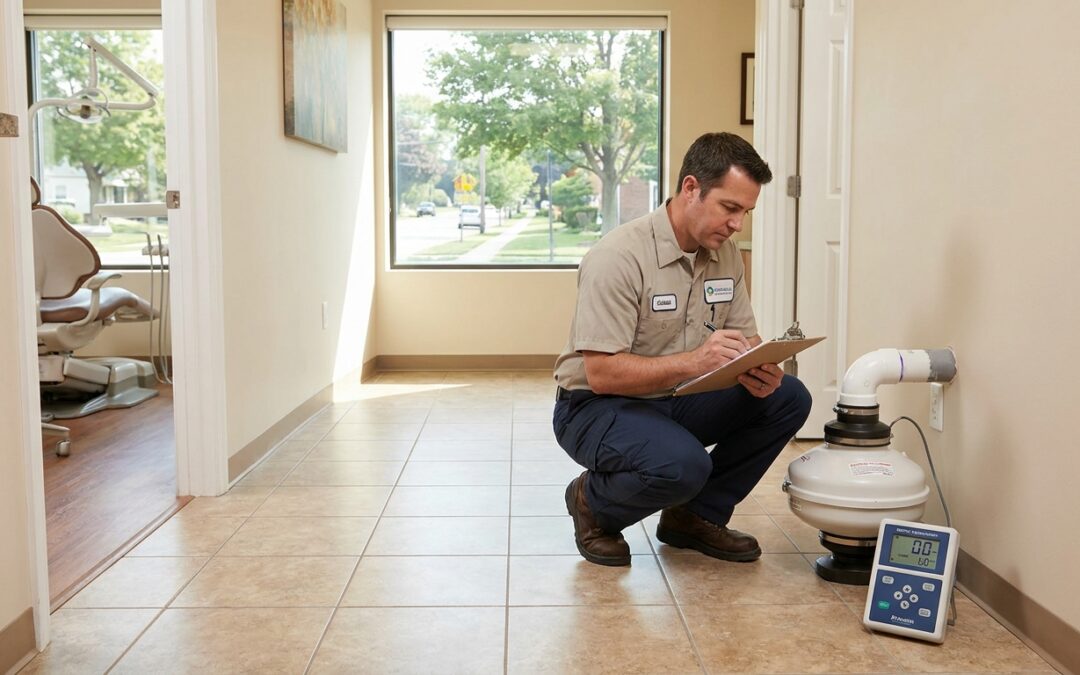
Radon does not care whether your building has a waiting room or a mortgage. Metro Detroit and Lansing medical and dental offices sit on the same radon-prone soil as the houses next door, and most never test at all.
- Radon testing medical offices Michigan requires ANSI/AARST large-building protocol, not a single consumer kit — Michigan Radon Control runs multi-zone testing for exactly this reason.
- EPA’s action level is 4.0 pCi/L for any occupied space, exam rooms included, and Michigan’s average indoor reading regularly tops that in un-mitigated buildings.
- Sub-slab depressurization mitigation is the standard fix for slab-on-grade practices and typically stabilizes levels within 24 hours of activation. Buy for slab buildings with elevated readings.
- Bundling a radon test with a mold inspection catches HVAC-driven air quality issues that radon alone won’t explain. Consider for older strip-mall leased spaces.
- A single test kit taped in one exam room is not a valid compliance test for a multi-suite practice. Skip that shortcut.
Why this matters
Radon is a decay product of uranium in soil and bedrock, and it moves through slab cracks, sump pits, and utility penetrations the same way in a dental office as it does in a ranch house. Michigan's glacial soils and clay-heavy subsurface trap the gas instead of letting it dissipate, which is part of why the state's indoor readings run higher than the national average.
Staff spend eight-plus hours a day in these buildings, five days a week, year after year. Patients pass through for shorter visits, but a practice that leases or owns its space carries the liability either way. Testing a medical building is not the same job as testing a single-family home — the square footage, the HVAC zoning, and the multiple-tenant layouts all change how commercial building radon testing gets structured.
Who this is for
This guide is for practice owners, office managers, and building owners responsible for a medical or dental office anywhere in Metro Detroit or the Lansing area — whether you own the building outright, lease a suite in a multi-tenant medical plaza, or manage a portfolio of clinical space. If you're weighing a lease renewal, a build-out, or you've simply never had the building tested, the criteria below apply directly to you.
What to look for in radon testing for medical offices in Michigan
Large-building testing protocol, not a residential kit
A single mail-in test kit taped to one exam room wall tells you nothing about a 6,000-square-foot suite with three HVAC zones. Occupied large buildings need testing under ANSI/AARST protocol, which places a device roughly every 2,000 square feet and accounts for negative-pressure zones like sterilization rooms and imaging suites.
Compliance with the EPA action level
The EPA action level is 4.0 pCi/L, and it applies the same way to a reception area as it does to a basement bedroom. A building that tests above that threshold in any occupied zone needs mitigation, not a second opinion.
Foundation type drives system design
Slab-on-grade medical plazas, crawl space buildings, and older buildings with partial basements each need a different mitigation approach. A contractor who defaults to one system type regardless of foundation is cutting corners, and it shows up in mitigation for readings above 4 pCi/L cases where the wrong system barely moves the number.
NRPP certification of the technician
Radon work in Michigan is unregulated at the state licensing level, which means anyone can claim to test or mitigate radon. NRPP certification is the credential that actually verifies training on both testing protocol and mitigation system design — check for it before signing anything, and use NRPP-certified radon mitigation companies as your shortlist.
Warranty and follow-up verification
A mitigation system installed and never checked again is a liability, not a fix. Look for a warranty on the installed system and a follow-up test to confirm the post-mitigation reading actually dropped below 4.0 pCi/L.
Whole-building air quality context
Radon rarely shows up alone in an older leased medical suite. Ductwork leaks, damp crawl spaces, and moisture intrusion often ride along with elevated radon, which is why combining radon testing with a mold inspection makes sense for buildings that haven't had any air quality review in years.
Get your office tested this month
NRPP-certified testing and mitigation for Metro Detroit and Lansing medical buildings.
Top picks: service configurations for medical and dental offices
The baseline pick: multi-zone occupied-building test. One device per roughly 2,000 square feet, placed in exam rooms, waiting areas, and any below-grade storage. Takes a minimum of 48 hours to run under EPA short-term protocol. This is the starting point for any building that's never been tested. Buy.
The standard install: sub-slab depressurization system. For slab-on-grade practices with a confirmed reading above 4.0 pCi/L, a sub-slab suction system pulls soil gas from under the foundation and vents it above the roofline before it enters occupied space. Systems typically stabilize indoor readings within 24 hours of activation, and Michigan Radon Control backs installed systems with a warranty. Buy for any slab building over the action level.
The bundled pick: radon plus mold inspection. For leased suites in older strip-mall medical plazas where the building's mechanical history is a question mark, pairing the radon test with a mold and moisture inspection surfaces problems a radon test alone would miss. Costs more upfront than a radon-only test but saves a second service call later. Consider if the building is more than 15 years old or has had any water intrusion history.
The wildcard: continuous monitoring during lease negotiations. If you're evaluating a new lease or a building purchase, a continuous monitor gives you a real-time trend line instead of a single 48-hour snapshot, which matters when a landlord disputes a one-time high reading. Consider for pre-lease due diligence, skip it as your only test if the building has never been checked at all — start with the full occupied-space protocol first.
What to avoid
- A single residential mail-in kit as your only test. It covers one small area and does not meet ANSI/AARST protocol for a multi-room commercial building — it will pass an insurance audit for a house, not a practice.
- A mitigation contractor without NRPP certification. Michigan doesn't require a state radon license, so an uncertified installer can legally do the work and still get it wrong. Verify certification before signing.
- A system installed with no follow-up test. A mitigation fan running doesn't confirm anything on its own — the post-install reading is the only proof the system actually worked.
Verdict comparison
| Service configuration | Best for | Typical timeline | Verdict |
|---|---|---|---|
| Multi-zone occupied-building test | Any untested office | 48+ hours | Buy |
| Sub-slab depressurization mitigation | Slab-on-grade above 4.0 pCi/L | Stabilizes in ~24 hrs post-activation | Buy |
| Radon + mold combined inspection | Older leased plazas, water history | 2-3 days combined | Consider |
| Continuous monitor for lease due diligence | Pre-lease or pre-purchase review | Ongoing trend data | Consider |
FAQ
What is the EPA action level for radon testing medical offices in Michigan?
The EPA action level is 4.0 pCi/L for any occupied space, and it applies to exam rooms and waiting areas the same way it applies to a home basement. A reading at or above that level means mitigation is recommended.
How long does radon testing take in a medical office?
A short-term occupied-building test runs a minimum of 48 hours per EPA protocol, with devices placed roughly every 2,000 square feet under ANSI/AARST guidance. Larger suites with multiple HVAC zones need more devices, not more time.
Is a single residential radon test kit enough for a dental office?
No — one kit in one room does not meet the large-building testing protocol required for a multi-room commercial space. Multi-zone testing is the standard for any medical or dental practice in 2026.
Does radon mitigation work differently for slab-on-grade medical buildings?
Yes. Sub-slab depressurization systems are the standard fix for slab-on-grade construction and pull soil gas from beneath the foundation before it enters occupied space. Crawl space and basement buildings need different system designs entirely.
Should a medical office combine radon testing with a mold inspection?
It’s worth doing for older leased suites with any history of water intrusion, since HVAC and moisture issues often accompany elevated radon in aging buildings. A combined inspection catches both in one visit instead of two separate service calls.
Is NRPP certification required for radon mitigation contractors in Michigan?
Michigan doesn’t mandate state radon licensing, so verifying NRPP certification yourself is the only real safeguard. An uncertified contractor can legally perform the work, which is why checking credentials before hiring matters.
How do I know a mitigation system actually lowered radon levels?
A follow-up test after installation, comparing the new reading against the 4.0 pCi/L action level, is the only confirmation that a system worked. Skip any installer who doesn’t build a post-mitigation test into the job.
Who pays for radon mitigation in a leased medical office?
That depends on the lease terms between landlord and tenant, and it’s worth clarifying before signing or renewing. Some landlords cover structural mitigation costs, while others push it to the tenant as a build-out expense.
One last thing
A practice that skips testing because the building "seems fine" is making a bet with no data behind it — radon has no smell, no color, and no symptom until it's a long-term health statistic. The 48-hour test costs a fraction of what a full mitigation system runs, and it's the only way to know which one you actually need in 2026.
Related guides