
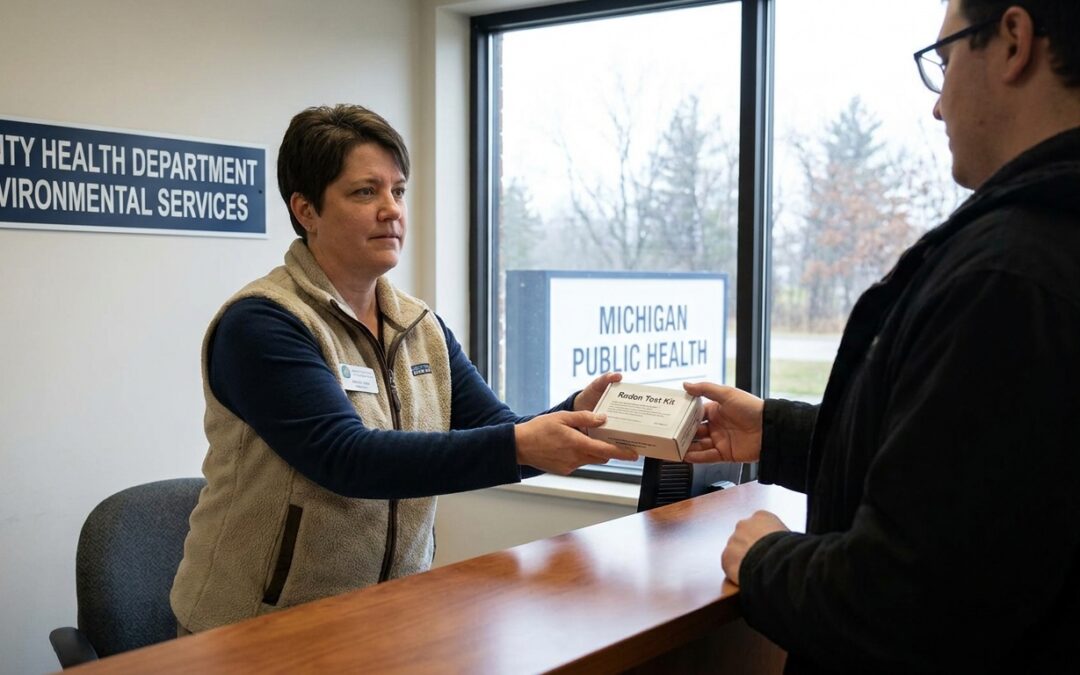
Michigan's 83 county health departments field a lot of radon calls every year, but what they actually do with that call surprises most homeowners: few of them run their own lab testing. Here's how the process really works, county by county, and where a certified contractor picks up where the health department leaves off.
- County health department radon testing in Michigan usually means kit loans and referrals, not in-house lab analysis.
- Michigan Radon Control and other NRPP-certified testers use the same 4 pCi/L action level counties reference.
- 83 Michigan counties run public health departments, but radon program availability varies widely in 2026.
- Short-term kits read in 48 hours; long-term monitors need 90 days for a seasonal average.
- Verdict: use your county health department for guidance and cheap kits, use a certified pro for results that hold up at closing.
Why this matters
Michigan sits on glacial soil deposits that trap and concentrate radon gas, which is why the state consistently reports indoor levels above the national average. County health departments are usually a homeowner's first stop, not because they run the most rigorous testing program, but because they're free, local, and easy to reach.
The problem: a county-issued kit and a certified contractor's test don't always carry the same weight. If you're buying, selling, or just worried about your family's air, you need to know which one you're getting and when it's time to test your home for radon with a professional instead.
What you'll need before you call your county health department
- Your county name and township, since programs are administered locally, not statewide
- A lowest-livable-level room identified in your home (basement, crawl space, or ground floor)
- 12 hours of closed-house conditions before any test starts, meaning windows and doors stay shut
- A mailing address if the county sends a mail-in kit rather than handing one over in person
- A basic sense of your timeline, because closing dates and insurance deadlines change which test type makes sense
How Michigan county health departments actually handle radon testing
Step 1: The health department checks if it runs a radon program at all
Not every Michigan county health department has an active radon program in 2026. Some counties, especially in southeast Michigan, maintain loaner kit inventories and staff who answer radon questions daily. Others simply hand callers a printed list of licensed labs and NRPP-certified contractors.
Common mistake: assuming every county offers the same service. Call first. A five-minute phone call saves a wasted trip.
Step 2: You get a short-term test kit or a referral
If the department has a program, you'll usually receive a charcoal canister or alpha-track short-term kit, sometimes free during National Radon Action Month each January, sometimes for a modest fee to cover lab analysis. If there's no program, you get a referral list and you're on your own to schedule testing.
This is the point where most homeowners either grab a retail kit or call a certified tester directly.
Step 3: You prepare the home under closed-house conditions
Every accurate radon test, county-issued or professional, depends on 12 hours of closed-house conditions before the clock starts. Windows stay shut, exterior doors get used normally but not propped open, and HVAC systems run as they normally would.
Expected outcome: a stable reading that reflects everyday radon levels, not a false low from a house that's been aired out. Skipping this step is the single most common reason a county kit comes back with a result nobody trusts.
Step 4: The kit runs for 48 hours to 90 days
Short-term kits from county programs run a minimum of 48 hours. Long-term alpha-track monitors run 90 days or more and give you a seasonal average, which matters in Michigan because radon levels swing with temperature and soil moisture. Most county programs default to the short-term option because it's faster to process.
Step 5: The kit goes to a lab, and you wait for results
The county doesn't analyze the kit itself. It gets mailed to a state-approved lab, and turnaround runs anywhere from a few days to a couple of weeks depending on lab volume. You can read your radon test results once the report arrives to understand what the number actually means for your household.
Step 6: High results trigger a referral, not a fix
If your result lands at or above the 4 pCi/L action level, the county health department will not install a mitigation system. That work falls to a licensed contractor. Realtors handling a sale should check the radon testing guidance for Michigan real estate agents before a high result derails a closing timeline.
Common mistake: waiting weeks to act on a high reading. Radon exposure is cumulative, so the sooner mitigation starts, the sooner levels drop.
Troubleshooting county health department radon testing
- No radon program in your county: request the referral list anyway, then compare it against certified contractors before booking anyone.
- Kit backordered or out of stock: retail short-term kits from hardware stores use the same lab-analysis process and meet the same 4 pCi/L benchmark.
- Test invalidated by open windows: retest under proper closed-house conditions rather than trusting a compromised number.
- Result borderline near 4 pCi/L: run a second short-term test or move to a 90-day long-term monitor for a clearer average.
- Home sale deadline pressure: county mail-in turnaround is often too slow for closing timelines; a certified tester can usually schedule faster.
- Confusing a county referral with a licensed inspection: a referral list is not a vetting process. Verify NRPP certification yourself before hiring anyone off it.
Skip the county backlog
Request certified testing scheduled around your timeline, not a mail-in queue.
Tools and resources
- Charcoal canister or alpha-track short-term kit for the initial 48-hour read
- Long-term alpha-track monitor if you want a 90-day seasonal average
- A NRPP-certified radon mitigation company in Michigan if your result comes back above 4 pCi/L
- A copy of your radon testing timeline if you're buying or selling before your next test cycle
What to do next
Once you know whether your county runs an active program, the real decision is timing. A county kit tells you where you stand today; a certified retest after any mitigation work confirms the fix held. Either way, don't let a slow mail-in process be the reason a high reading sits unaddressed through another Michigan winter. Check the radon testing timelines for Michigan home closings if a sale is on your calendar.
FAQ
Does my county health department test for radon in Michigan?
Most Michigan county health departments loan out short-term test kits or hand you a referral list rather than running lab analysis themselves. Availability varies by county, so a phone call is the fastest way to find out what your county offers in 2026.
Which Michigan county health departments offer free radon test kits?
Some counties offer free kits during National Radon Action Month each January, while others charge a small fee year-round to cover lab costs. Contact your specific county health department, since there’s no statewide standard.
Is county health department radon testing accurate enough for a home sale?
A properly conducted short-term test from a county kit can produce an accurate reading if closed-house conditions were followed for 12 hours beforehand. Many real estate transactions still prefer testing from an NRPP-certified professional for documentation purposes.
What is the EPA action level for radon in Michigan?
The EPA action level is 4 pCi/L, and Michigan uses the same benchmark for both county programs and licensed contractors. Results at or above that level call for mitigation.
How long does a short-term radon test take?
A short-term test runs a minimum of 48 hours under closed-house conditions. Long-term monitors run 90 days or more for a seasonal average, which matters given how much Michigan radon levels shift with weather.
Can a county health department fix a radon problem?
No. County health departments test or refer, but mitigation system installation falls to licensed contractors. A high result triggers a referral, not an on-site fix.
How much does county health department radon testing cost in Michigan?
Cost varies by county. Some give kits away free during Radon Action Month, others charge a modest fee for lab analysis, so check with your specific county health department directly.
Is radon testing required in Michigan?
Michigan does not mandate radon testing for every home sale, but many lenders and real estate contracts require disclosure of known results. Testing before listing avoids surprises during closing.
One last thing
The number that trips up most homeowners isn't the radon reading itself, it's the 12-hour closed-house requirement before the test even starts. Skip that step and even a perfectly good county kit gives you a number you can't trust, which means starting the whole 48-hour clock over again.
Related guides
- Best NRPP-certified radon mitigation companies in Michigan
- How to read your radon test results
- How to test your home for radon
- Radon testing guidance for Michigan real estate agents