
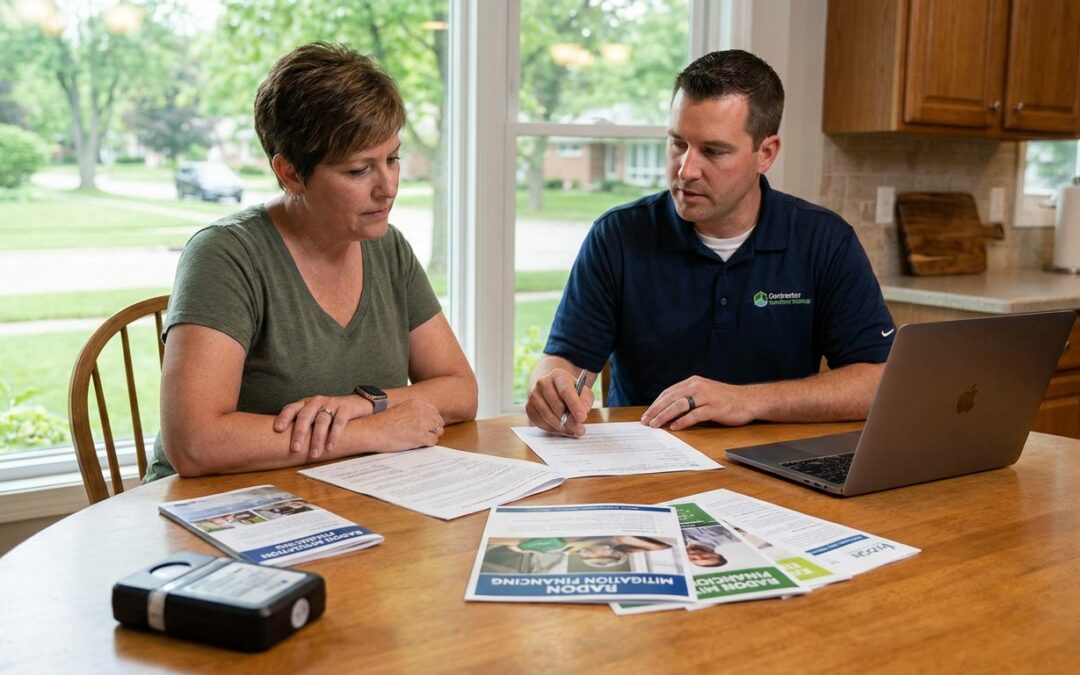
If a test came back above 4 pCi/L, the number on the report isn't the hard part — figuring out how to pay for the fix is. Michigan homeowners have more than one path to a paid-for mitigation system in 2026, and most of them don't involve draining savings.
- Michigan radon mitigation financing options in 2026 range from state rebate programs to federal tax deductions.
- State and local rebate/grant programs are the free-money pick — apply before you sign a contract, not after.
- The IRS medical expense deduction applies to mitigation costs above 7.5% of adjusted gross income — Consider.
- Contractor in-house payment plans spread cost over time but check NRPP certification first — Buy with due diligence.
- Home warranty coverage for radon systems is a long shot — verify the policy before counting on it.
Why this matters
A radon mitigation system isn't optional once your test results cross the EPA action level of 4 pCi/L. It's a known lung cancer risk, and Michigan's glacial soil and clay-heavy basements push levels higher than national averages in a lot of neighborhoods. The health case is settled. The money question is what stalls people.
Homeowners in Metro Detroit and Lansing ask the same thing every week: is there a way to finance this instead of paying in one lump sum? Yes — several, and some of them reduce your net cost significantly if you use them in the right order.
Who this is for
This guide is for Michigan homeowners who've already tested, gotten a number above 4 pCi/L, and now need to figure out how to pay for a mitigation system without derailing the household budget. It's also useful if you're selling a home and radon showed up during a buyer's inspection — timing and financing work differently when there's a closing date attached. Start with a realistic budget for a radon mitigation system installation before you pick a financing route, because the option that fits a $1,200 job looks different from the one that fits a $3,500 job with a sub-slab depressurization system and an attic-mounted fan.
What to look for in radon mitigation financing options for Michigan homeowners
Total cost clarity before you finance anything
Get a written, itemized estimate before comparing financing options. A contractor payment plan on an inflated quote costs more over time than a smaller loan on an honest one. NRPP-certified installers should walk you through system type, fan location, and labor separately — not bundle it into one round number.
Rebate and grant eligibility, checked first
Michigan-specific rebate and grant programs change eligibility windows and funding caps year to year. Apply or at least confirm eligibility before signing a contractor agreement — some programs require pre-approval, and retroactive claims get denied more often than not.
Tax deduction documentation requirements
The IRS treats radon mitigation as a medical expense deduction when total qualifying medical costs exceed 7.5% of your adjusted gross income for the tax year. That threshold matters — a $2,800 mitigation system alone rarely clears it, but paired with other medical expenses in the same year, it can.
Financing terms that match your actual timeline
If you're mid-sale, a 90-day payment plan does nothing for you when closing is in three weeks. Match the financing term to your deadline, not the other way around.
Warranty coverage that survives your payment structure
A 5-year system warranty should hold regardless of whether you paid in full or financed through the contractor. Confirm this in writing — some financed installs quietly shorten warranty terms if a third-party lender is involved.
Contractor certification as a financing safeguard
NRPP certification isn't just a quality marker — legitimate rebate programs and warranty-backed financing almost always require it. An uncertified installer offering a payment plan is a red flag on both counts.
The financing options, ranked
Michigan radon mitigation rebate and grant programs — the free-money pick
State, utility, and local rebate or grant programs periodically fund part of a mitigation install for qualifying homeowners in 2026, with eligibility tied to income, location, or radon level. Verdict: Buy — check this first, before any other option, since it reduces the number every other financing choice is based on. Review current Michigan radon mitigation rebate and grant programs before requesting a contractor quote.
The federal medical expense tax deduction — the paperwork pick
Radon mitigation qualifies as a medical expense deduction under IRS rules when your total qualifying medical costs clear 7.5% of adjusted gross income for the year. It takes itemizing and a longer memory come tax season, but it's real money back. Verdict: Consider — worth it if you already itemize or have other medical expenses in the same tax year. Full details are covered in how to claim a radon mitigation tax deduction in Michigan.
Contractor in-house payment plan — the straightforward pick
Many NRPP-certified installers offer a payment plan directly, splitting the total install cost over several months without a third-party lender. No credit application, no interest markup layered by a bank — just a schedule. Verdict: Buy, provided the contractor is NRPP-certified and the plan doesn't shorten your warranty.
Home warranty coverage — the long-shot pick
Some home warranty policies cover radon mitigation system repairs or replacement, though coverage for the initial install is rare and policy-dependent. It's worth ten minutes on the phone with your warranty provider before you rule it out. Verdict: Wait — confirm coverage in writing before counting on it as a funding source. See how to get radon mitigation covered by a home warranty for what to ask.
Seller concession negotiation during a home purchase — the leverage pick
If radon showed up during a home inspection, you have leverage to ask the seller to cover the mitigation cost or credit it at closing, rather than financing it yourself. This works because Michigan disclosure norms treat radon as a known, fixable defect, not a deal-breaker. Verdict: Buy — always negotiate this before you assume the cost is yours to finance.
Get your mitigation cost estimate
See your real install cost before you pick a financing option.
What to avoid
- Signing a contractor payment plan before checking rebate eligibility. Once the contract is signed, most Michigan programs won't retroactively apply funding to the same job.
- Assuming any home warranty policy covers radon systems by default. Most standard policies exclude it unless it's added as a rider — get it in writing.
- Financing through an uncertified installer to save money upfront. A cheaper quote from a non-NRPP contractor can disqualify you from both rebate programs and manufacturer warranty terms in 2026.
Verdict comparison
| Option | Upfront Cost to You | Paperwork Required | Best For | Verdict |
|---|---|---|---|---|
| Rebate/grant programs | Lowest | Application + proof of eligibility | Homeowners who apply before contracting | Buy |
| Federal tax deduction | Full cost, refunded later | Itemized tax return | Homeowners who already itemize | Consider |
| Contractor payment plan | Spread over months | Signed agreement | Homeowners needing predictable monthly cost | Buy |
| Home warranty coverage | Depends on policy | Policy verification call | Homeowners with existing warranty | Wait |
| Seller concession negotiation | None if successful | Purchase agreement addendum | Buyers mid-transaction | Buy |
FAQ
What are the radon mitigation financing options for Michigan homeowners in 2026?
Michigan homeowners in 2026 can use state and local rebate or grant programs, a federal medical expense tax deduction, contractor in-house payment plans, home warranty coverage where it applies, and seller concession negotiation during a home purchase. Rebate programs and seller concessions typically offer the lowest net cost.
Can you deduct radon mitigation costs on your taxes?
Yes, radon mitigation qualifies as a medical expense deduction under IRS rules once your total qualifying medical costs exceed 7.5% of adjusted gross income for the year. You need to itemize deductions to claim it.
Are there Michigan grants for radon mitigation?
Some state, utility, and local programs periodically fund part of a mitigation install for eligible Michigan homeowners, though availability and funding caps change year to year. Check current eligibility before signing a contractor agreement.
Does a home warranty cover radon mitigation systems?
Coverage for radon mitigation system repair or replacement exists in some home warranty policies, but coverage for the initial install is rare. Call your provider and get the answer in writing before relying on it.
How much do contractor payment plans for radon mitigation typically cost per month?
Monthly payments depend on the total install cost and the term the contractor offers, since there’s no standard rate across Michigan installers. Ask for a written payment schedule before signing anything.
Can radon mitigation costs be negotiated during a home purchase?
Yes, if radon is discovered during a buyer’s inspection, it’s common to negotiate a seller credit or repair before closing. Michigan real estate practice treats radon as a fixable, disclosable condition rather than a deal-breaker.
What radon level requires mitigation in Michigan?
The EPA action level is 4 pCi/L, and mitigation is recommended once a test result reaches or exceeds that number. Levels between 2 and 4 pCi/L are worth considering mitigation for as well, per EPA guidance.
Is NRPP certification required to qualify for radon mitigation financing?
Most Michigan rebate programs and manufacturer warranty terms require an NRPP-certified installer, even when the financing itself doesn’t. Verify certification before signing any payment plan to avoid disqualifying yourself from other funding sources.
One last thing
The order you pursue these options in changes your total cost more than which option you pick. Homeowners who check rebate eligibility and negotiate a seller concession before ever discussing a contractor payment plan consistently end up paying less out of pocket in 2026 than those who finance first and look for savings after.
Related guides
- Get radon mitigation covered by a home warranty
- Negotiate radon mitigation costs during a home purchase