
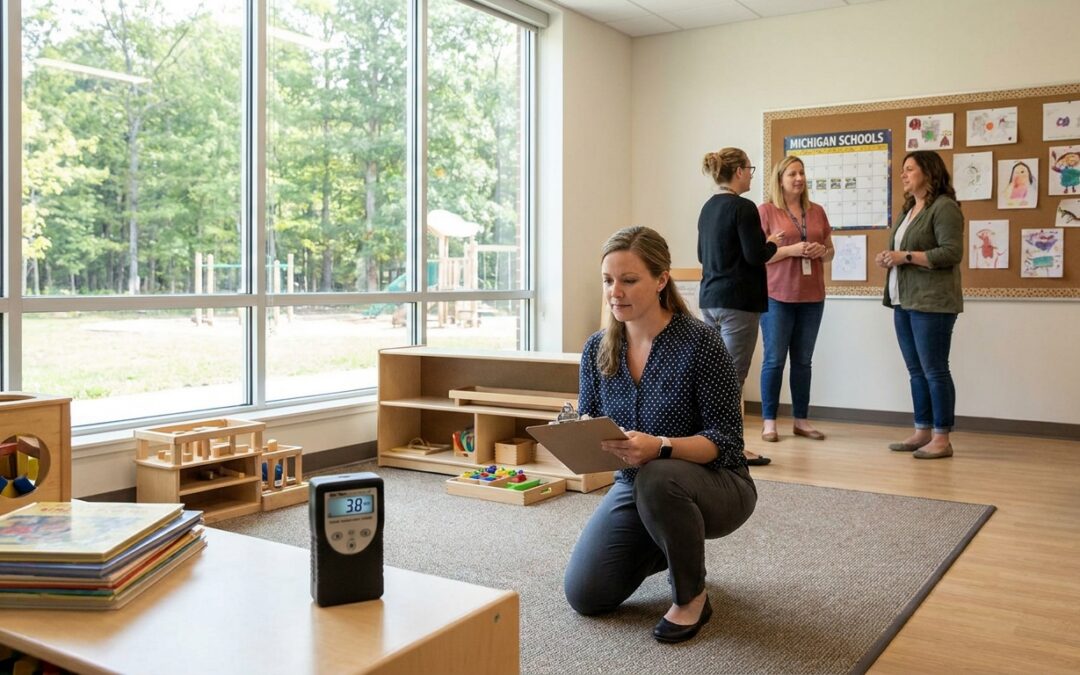
Daycare centers and schools sit at the intersection of two hard facts: young lungs are more vulnerable to radon exposure, and school buildings often have exactly the construction features that let radon build up. This guide breaks down what a director, facilities manager, or school board member in Michigan needs to know before ordering radon testing for daycare centers or scheduling mitigation work.
- Radon testing for daycare centers in Michigan should cover every room with ground contact, not just the basement.
- The EPA action level is 4 pCi/L — the same threshold applies to a classroom as it does to a home.
- Sub-slab depressurization is the standard fix for slab-built schools; crawl space schools need a dedicated crawl space system. Buy the system that matches your foundation.
- Verify NRPP certification before signing — Michigan has no state radon licensing board, so certification is the only real credential check.
Why this matters
Children breathe faster than adults relative to body size, and they spend six to eight hours a day in the same ground-contact classrooms and nap rooms where radon concentrates. A daycare or elementary school built on a slab in Oakland, Washtenaw, or Ingham County sits on the same glacial till and shale deposits that give Michigan some of the highest average indoor radon readings in the country. That geology doesn't check for enrollment numbers.
A single failed test in a licensed daycare can trigger a licensing review. A school district that skips radon testing and later finds elevated levels in a kindergarten wing faces a far more expensive retrofit than if it had tested during a routine facilities audit in 2026. Testing early is cheaper than testing after a parent complaint.
Before signing any contract, verify a contractor's NRPP certification. Michigan does not run its own state radon licensing program, so NRPP or NRSB credentials are the only real proof a technician knows what they're doing in a building full of kids.
Who this is for
This guide is for daycare directors, school facilities managers, and school board members in Michigan responsible for a building's indoor air quality — whether that building is a converted ranch home turned licensed daycare, a slab-built elementary school from the 1970s, or a newer school with a crawl space mechanical wing. If you're managing licensing renewal, a facilities audit, or a parent inquiry about radon in 2026, this is written for you.
What to look for in radon testing for daycare centers and schools
Room-by-room coverage, not a single sample
A home test covers one basement. A school test needs a device in every frequently occupied room with ground contact — classrooms, nap rooms, gym floors, and any office on the lowest level. Radon levels vary room to room within the same building because soil gas entry points aren't uniform across a foundation.
Closed-building protocol that fits a school calendar
Standard testing calls for a 48-hour closed-building period — windows shut, HVAC on normal recirculation. Schools run on bell schedules and daycare centers run on drop-off and pickup traffic, so testing has to be scheduled around breaks or weekends when doors aren't opening every 20 minutes.
NRPP-certified technicians, not a big-box test kit
A single charcoal canister from a hardware store might work for a homeowner's basement. A facility responsible for dozens of children in multiple rooms needs a certified technician running continuous monitors that can flag ventilation interference and log data by room.
A mitigation system sized to the actual foundation
A converted-house daycare on a crawl space needs a different system than a slab-built elementary school gym. Sizing a single sub-slab fan for a building with three separate foundation types under one roof is how systems underperform.
Documentation for licensing and disclosure files
Daycare licensing renewals and school facility audits both want a paper trail: test dates, device placement, readings by room, and mitigation records if a system is installed. Verbal assurances don't satisfy a state inspector.
A realistic retest schedule
The EPA recommends retesting schools every five years and after any HVAC or structural renovation. A single clean test in 2020 doesn't cover a building through 2026 if the roof was replaced or an addition went up in between.
Top picks: mitigation approaches for school and daycare buildings
Sub-slab depressurization — the workhorse pick. One properly sized fan and suction point can cover roughly 2,000 square feet of slab, which makes it the default for single-story elementary schools and slab-built daycare centers. Multiple suction points are common in buildings over 10,000 square feet. Buy for any slab-on-grade classroom wing showing readings above 4 pCi/L.
Crawl space mitigation systems — the fit for converted-house daycares. Many licensed home daycares in Michigan operate out of older houses with a crawl space foundation under part of the building. Encapsulating the crawl space liner and adding a dedicated fan keeps soil gas from migrating into the play areas above. Buy if your facility's footprint includes any crawl space section, even a partial one under an addition.
Zoned mitigation for large facilities — the approach for multi-wing schools. A building with separate additions built in different decades often needs the same zoned thinking used for multi-unit residential properties: one fan per foundation zone rather than one fan trying to serve an entire sprawling floor plan. Consider this for any school with more than two distinct construction eras under one roof.
Passive stack with fan-ready rough-in — the forward-looking pick for new builds. A school under construction can install a passive vent stack now and activate a fan later if post-construction testing comes back elevated. It costs less upfront and avoids retrofitting through finished walls. Consider for any district breaking ground on a new building in 2026.
A single hardware-store test kit for the whole building — the corner-cutting non-pick. One canister placed in the front office tells you nothing about the reading in a basement-level art room two wings away. Skip this for any licensed facility; it won't satisfy a licensing inspector or a parent asking for documentation.
Get school radon testing scheduled
NRPP-certified testing and mitigation sizing for Michigan daycare and school buildings.
What to avoid
- A single-point test in a multi-room building. It looks like due diligence but it only tells you about the room the device sat in.
- A residential-only contractor with no commercial or institutional experience. Sizing a system for a licensed daycare's egress requirements and fire code clearances is a different job than a single-family basement install.
- Skipping the closed-building protocol because the school is in session. Testing during a normal school week with doors propped open all day produces a falsely low reading and a false sense of safety.
Verdict comparison
| System type | Best for | Install consideration | Verdict |
|---|---|---|---|
| Sub-slab depressurization | Slab-built classrooms, single-story schools | One fan per ~2,000 sq ft of slab | Buy |
| Crawl space system | Converted-house daycares, partial crawl spaces | Liner encapsulation plus dedicated fan | Buy |
| Zoned multi-fan system | Multi-wing schools, additions from different decades | One fan per foundation zone | Consider |
| Passive stack, fan-ready | New construction, 2026 groundbreaks | Cheaper now, fan added if needed later | Consider |
| Single hardware test kit | Nothing appropriate for a licensed facility | Covers one room only | Skip |
FAQ
What is the EPA action level for radon in schools and daycare centers?
The EPA action level is 4 pCi/L, the same threshold used for residential testing. A school or daycare center with any room reading at or above that number should move to mitigation.
How often should a Michigan school retest for radon?
Retest every five years, and again after any major renovation, roof replacement, or HVAC change. A clean reading from years earlier doesn’t account for structural changes made since.
Is radon testing required for licensed daycare centers in Michigan?
Michigan does not mandate radon testing as a blanket licensing requirement, but many licensing reviewers and insurers now ask for documentation, and parents increasingly request it directly.
How long does radon testing take in a school building?
A standard closed-building test runs a minimum of 48 hours per room. Scheduling around a school break or weekend closure gives the most accurate reading without disrupting classes.
Can one radon mitigation system cover an entire school building?
It depends on the foundation. A single-story slab building may need only one or two fans, but a multi-wing school with different foundation types built in different decades usually needs a zoned system with separate fans per section.
What happens if a daycare center fails a radon test?
A failed test above 4 pCi/L means mitigation needs to be installed, followed by a retest to confirm the fix worked. Most systems bring levels down within days of activation.
Does radon testing disrupt daily school or daycare operations?
Testing itself is passive and doesn’t interrupt classes, but the required closed-building window works best scheduled over a weekend or school break to get an accurate reading.
One last thing
Michigan's own geology is the reason this matters more here than in most states: the glacial till and underlying shale across Metro Detroit and the Lansing area produce some of the higher average indoor radon readings recorded in the Midwest, and a school building sitting on that same ground for 40 or 50 years has had plenty of time for soil gas to find its way through slab cracks and utility penetrations. A test scheduled now in 2026, before a licensing renewal or a parent's question forces the issue, costs far less than a retrofit done under pressure.
Related guides
- Choosing the right radon mitigation system type
- Scheduling radon testing after mitigation installation