
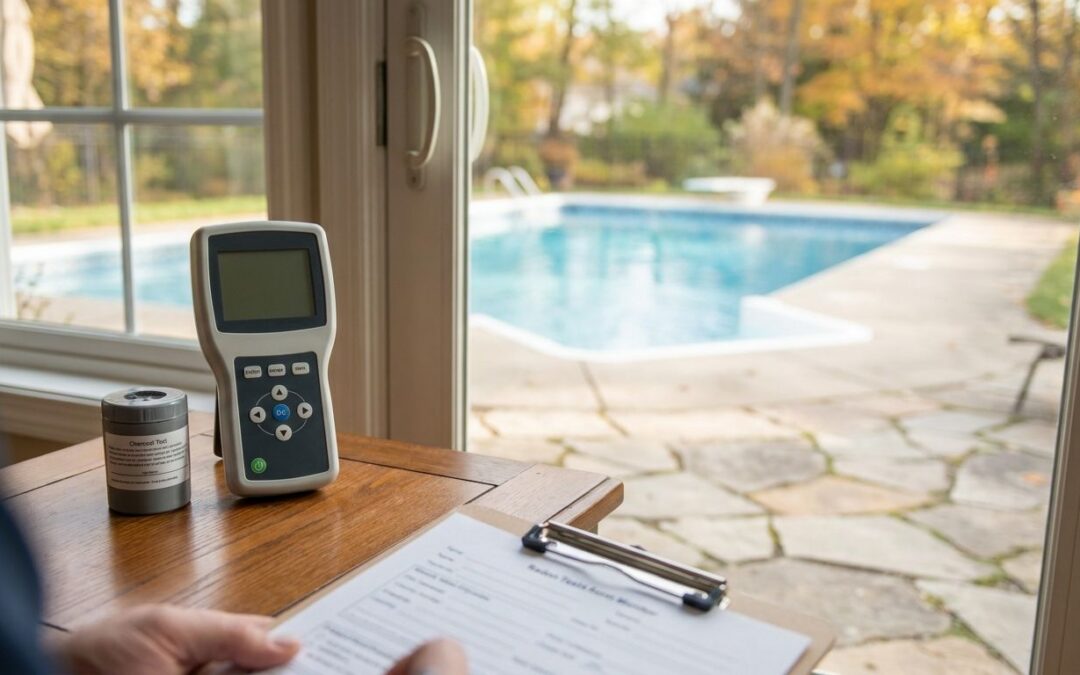
Michigan homes with in-ground pools create radon testing headaches you won't find in a standard single-family house: pool equipment rooms sit on separate slabs below grade, sump pits handle backwash and groundwater at the same time, and pool-season habits like propped doors can wreck a test before it even finishes.
- Radon testing home with pool Michigan situations need a closed-house short-term kit first, not a summer guess.
- Michigan Radon Control recommends a continuous monitor for pool equipment rooms with heavy humidity swings.
- Sump pits shared with pool backwash need mitigation sized for combined groundwater, not a standard slab system.
- Skip testing during pool season with doors propped open in 2026 — results run artificially low.
Why This Matters
Radon gas moves through soil gas and enters a house wherever the foundation cracks or pipes penetrate the slab. An in-ground pool changes three things around that foundation: it adds plumbing penetrations for skimmers and backwash lines, it often shares a mechanical room with the furnace and water heater, and it pushes homeowners to prop doors open all summer for pool access.
The EPA action level is 4 pCi/L in 2026, the same number that applies to every home in Michigan regardless of what sits in the backyard. What changes with a pool is how easy it is to get a bad reading — too high or too low — because of how the equipment room is built and used. Following the standard radon testing protocol still matters, but a pool home needs an extra step or two on top of it.
Michigan Radon Control tests and mitigates homes across Metro Detroit and Lansing, and pool-equipped properties show up often enough in that work to warrant a separate checklist.
Who This Guide Is For
This guide is for Michigan homeowners with an in-ground pool who are testing before a sale, after a renovation, or as routine safety maintenance. It's also for real estate agents managing radon disclosure on a pool-equipped listing where the test result has to hold up under buyer scrutiny in 2026.
If your pool equipment room, pump house, or filtration closet sits on or below grade and ties into the main foundation, this applies to you directly. If your pool is above-ground and structurally disconnected from the house, none of the pool-specific adjustments below change your approach.
What to Look For in Radon Testing for a Home With a Pool
Where the Pool Equipment Room Sits on the Foundation
Pump, filter, and heater rooms are often poured on a separate slab from the main house foundation, sometimes over more loosely compacted backfill. Soil gas moves faster through disturbed or backfilled ground than through undisturbed soil, so a test placed only in the main basement can miss elevated levels concentrated near the pool mechanical room. Test both zones whenever the slabs are separate.
Closed-House Protocol vs. Pool Maintenance Routines
Short-term radon tests require closed-house conditions for 12 hours before the test and through the full measurement window. Pool owners run backwash cycles, prop doors for hose access, and vent chemical storage rooms on a routine basis — any of that during the test invalidates the reading. Pick a week with no scheduled backwashing or chemical deliveries before you start.
Below-Grade Walkout Doors to the Pool Patio
Homes with walkout basements leading straight to a pool patio have another below-grade opening soil gas can use to move indoors. Combined with pool-area humidity, these doors often show water staining or gap widening over time, which enlarges the entry path for both moisture and radon.
Sump Pumps and Drain Tie-Ins Shared With Pool Systems
A lot of Michigan pool installations tie backwash discharge or overflow lines into the same sump pit that already handles foundation groundwater. That shared pit becomes a larger soil-gas entry point than a standard sump, so any mitigation system placed there needs a sealed cover rated for continuous water flow rather than occasional pump-outs. Homes with sump pumps handling combined groundwater and pool drainage need this checked before a mitigation quote gets written.
Seasonal Timing: Pool Season vs. Testing Season
Michigan pool season runs roughly May through September, exactly when homeowners keep doors open and windows cracked for access. Testing during those months without strict closed-house rules produces falsely low readings almost every time. Winter testing, when the house is naturally sealed against the cold, gives the most reliable year-round baseline heading into 2026 and beyond.
Best Radon Testing and Mitigation Approaches for Pool Homes
The Baseline Check: Short-Term Charcoal Test Kit
This is the fast diagnostic every pool home should run first. EPA-protocol short-term tests run a minimum of 48 hours with 12 hours of pre-test closed-house conditions, and they're cheap enough to run in both the main basement and the pool equipment room at the same time.
Buy for initial screening before any mitigation decision gets made. Start with the best radon test kits for Michigan homeowners.
The Pool-Room Specialist: Continuous Radon Monitor
This is the option that survives a summer of propped doors and pool traffic. Continuous monitors log readings hourly and can run 90 days or longer, catching the swings a 48-hour kit misses entirely when a pool equipment room has variable humidity and heavy foot traffic.
Buy for any pool mechanical room with fluctuating conditions. Compare the best continuous radon monitors for Michigan homes.
The Plumbing Fix: Sump Pit Integration
This is the step contractors skip when nobody mentions there's a pool. A shared sump pit handling pool backwash plus groundwater needs a sealed radon cover built for continuous discharge, not the lid that comes standard on a basic sump system.
Consider getting the pit inspected before pricing mitigation — the fix is often a different cover, not a bigger fan. See radon mitigation for homes with sump pumps.
Get Your Pool Home Tested Right
NRPP-certified radon testing and mitigation across Metro Detroit and Lansing.
What to Avoid
- Venting a mitigation fan into a detached pool shed. A structure that isn't part of the building envelope doesn't count as an exhaust point — the fan needs to discharge above the roofline of the connected structure, not into a nearby outbuilding.
- Testing during a backwash week. One cycle of open valves and running water inside the 48-hour test window invalidates the reading even when every other rule gets followed.
- Sizing mitigation for a standard basement when the pool equipment room sits on a separate slab. A single suction point often can't reach both areas, and the correct fix is usually a second suction point, not a larger fan.
Verdict Comparison
| Method | Best For | Duration | Verdict |
|---|---|---|---|
| Short-term charcoal kit | Initial baseline screening | 48 hours | Buy |
| Continuous radon monitor | Pool equipment rooms with humidity swings | 90+ days | Buy |
| Sump pit radon cover integration | Shared pool backwash and groundwater pits | Ongoing | Consider |
FAQ
Is radon testing different for a home with an in-ground pool in Michigan?
Yes — pool homes need a second reading near the pool equipment room because slabs poured separately from the main foundation often have more soil-gas entry points. The standard 48-hour closed-house protocol still applies to both readings.
What’s the EPA action level for radon in Michigan homes?
4 pCi/L is the EPA action level for any home in Michigan in 2026, pool or no pool. Homes testing at or above that number need a mitigation system installed.
Can pool chemicals affect a radon test result?
Pool chemical off-gassing itself doesn’t change radon levels. Propping doors open to ventilate chemical fumes during the test window breaks the closed-house protocol and skews the reading artificially low.
Should I test the pool equipment room separately from the basement?
Yes, especially when the pool room sits on its own slab. A single test placed in the main basement can miss elevated levels concentrated in a separate mechanical room.
Do sump pumps tied to pool drainage need special radon mitigation?
Yes — a sump pit handling both pool backwash and groundwater needs a sealed cover rated for continuous discharge rather than a standard pit lid, because the shared pit is a larger soil-gas entry point.
When is the best time of year to test a Michigan pool home for radon?
Winter gives the most reliable baseline because doors and windows stay closed and heating systems run continuously. Summer pool-season tests risk artificially low readings from propped-open doors.
Is a continuous radon monitor worth it for a pool equipment room?
Yes for rooms with heavy humidity swings and foot traffic. Continuous monitors log readings hourly over 90 or more days and catch spikes a single 48-hour test would miss.
Does having an in-ground pool increase radon risk?
No — radon comes from soil gas beneath the foundation, not the pool water itself. The added risk comes from construction details like separate slabs and shared drainage, not the pool.
One Last Thing
Pool equipment room slabs are frequently poured lower than the main basement floor, and that grade difference alone can pull soil gas toward the lowest point in the house — which is usually right where the pump sits. A test run only in the main basement misses that pocket completely. That's the entire reason radon testing for a home with a pool in Michigan needs a second reading near the equipment room instead of one test covering the whole house.
Related Guides