
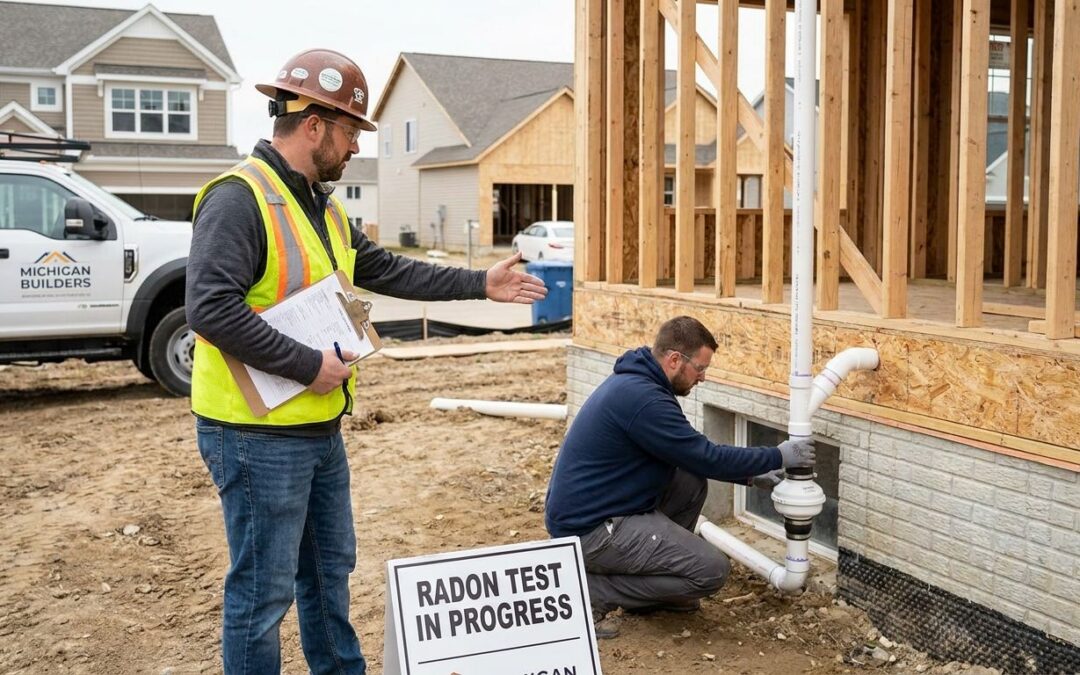
Michigan general contractors who treat radon as a homeowner problem instead of a build-phase decision end up reopening finished basements, delaying closings, or eating change-order costs that a $500 rough-in would have avoided. This guide breaks down what to require from a radon mitigation general contractor Michigan partner, which system fits which foundation, and where GCs get burned skipping certification checks in 2026.
- NRPP-certified subs are the baseline for any radon mitigation general contractor Michigan GCs hire in 2026 – verify the credential before signing a contract.
- Passive radon-resistant rough-in at framing costs far less than active retrofit after drywall goes up – plan it into the foundation scope.
- EPA’s 4 pCi/L action level applies to slab, crawl space, and basement builds alike – test after occupancy, not just at rough-in.
- Skip uncertified installers who bypass electrical code on the fan circuit – warranty coverage and liability protection depend on the paperwork.
- Multi-year service contracts fit subdivision builders; single custom homes do fine with a one-off bid plus a post-occupancy test.
Why This Matters for Michigan General Contractors
Radon has nothing to do with framing quality, but it becomes your problem the moment a buyer or inspector tests above 4 pCi/L after closing. Michigan sits on glacial till over uranium-bearing bedrock, so elevated readings turn up in slab-on-grade, crawl space, and full-basement builds alike, not just in older housing stock. In 2026, more buyers ask for a post-occupancy radon test before final walkthrough, and a failed test on a sealed system means opening drywall you already finished.
The cheaper fix happens before the crew shows up. Verify insurance and bonding on any mitigation sub before they touch your job site, and treat the radon rough-in as foundation scope, not a punch-list add-on. Michigan Radon Control, a Metro Detroit and Lansing radon mitigation and testing provider, sees the same pattern across subdivisions: GCs who skip this step absorb the callback cost, not the sub.
Who This Is For
This guide is for general contractors building new single-family homes, additions, or basement remodels anywhere in Michigan where a radon mitigation sub needs to plug into the framing, electrical, and HVAC schedule, not homeowners doing a one-off retrofit on an existing house. If you're bidding subdivision work, coordinating pre-listing tests with realtors, or managing a remodel that opens up a slab, you need radon handled on a schedule, on a budget line, with paperwork that survives a lender or appraisal review.
What to Look For in a Radon Mitigation General Contractor in Michigan
NRPP Certification and Documented Training
NRPP certification is the credential the EPA and most Michigan lenders recognize for radon mitigation work, and it's the first thing to ask for before a sub sets foot on your site. Michigan Radon Control carries NRPP certification for radon mitigation testing and installation, which matters when documentation gets requested during closing. Require the certification number in writing, not a verbal assurance.
New Construction Experience, Not Just Retrofit Experience
Passive radon-resistant rough-in during framing is a different skill set than retrofitting an active system into a finished basement. A sub who's spent years doing retrofits may not know how to route a stack through a truss layout without triggering a redesign, or how to seal a sump lid before the concrete crew pours. Ask for new construction references specifically, not just retrofit counts.
Insurance, Bonding, and Documentation on File
A certificate of insurance on file protects your project if a fan installation causes an electrical issue or a backdraft complaint months after occupancy. Bonding matters just as much on subdivision work, where a claim on one lot can affect your relationship with the whole development. Get the paperwork before the first unit breaks ground, not after a problem shows up.
Electrical and HVAC Trade Coordination
A radon fan needs a dedicated circuit and GFCI protection under most electrical code interpretations, and it has to be sequenced with your HVAC rough-in so the mitigation sub isn't fighting your ductwork for the same chase. Subs who show up without a coordination plan cost you schedule days you don't have on a spec-home timeline.
Multi-Year Service Terms for Repeat Work
If you're building more than a handful of homes a year, a multi-year service arrangement locks in consistent per-unit pricing and response times across every lot, instead of renegotiating scope on each closing. One-off pricing works fine for a single custom build; it doesn't scale across a subdivision.
Turnaround Time That Matches Your Schedule
Change orders happen – a failed radon test two weeks before closing shouldn't blow your schedule by a month. Ask how fast a sub can mobilize for a retrofit installation when a post-occupancy test comes back above 4 pCi/L, and get that turnaround time in writing before you need it.
Top Picks for General Contractor Radon Partnerships in 2026
The New-Build Standard: Passive Rough-In at Framing
Installing a single vent stack from the footing to above the roofline during framing is the lowest-cost radon control move available on a new build. It runs through the same chase as plumbing vents on most floor plans and adds a fraction of the cost an active retrofit runs after drywall is hung. If a post-occupancy test comes back above the EPA's 4 pCi/L action level, the passive stack upgrades to active with a fan and power source already roughed in.
Verdict: Buy for every slab-on-grade, crawl space, or basement new construction project – new construction radon mitigation systems cost less at framing than at closeout, every time.
The Liability Shield: NRPP-Certified Sub Verification
Hiring an NRPP-certified radon mitigation company protects your general contractor license the same way hiring a licensed electrician does – the certification is the paper trail if a homeowner disputes the work later.
Verdict: Buy. Skip any sub who can't produce a certification number on request.
The Mid-Project Fix: Active Retrofit for Basement Remodels
When a remodel opens up an existing slab, an active system with a fan and manometer gauge is usually the faster path to compliance than trying to retrofit a passive stack through finished framing. Sizing the fan correctly depends on a sub-slab communication test done before the concrete goes back down, not a guess based on square footage.
Verdict: Consider – plan this into the remodel scope before you close up the slab, not after.
The Volume-Builder Deal: Multi-Year Service Partnership
Subdivision builders running five, ten, or more lots a year benefit from locking in service pricing and response times across the whole development instead of re-bidding radon work lot by lot. It also keeps warranty terms consistent for every buyer, which matters when realtors compare disclosures across a development.
Verdict: Consider if you're building more than a handful of homes a year; a single custom build doesn't need the overhead.
Bring a radon sub into your next bid
NRPP-certified testing and mitigation for Michigan new construction and remodels.
“A radon-resistant rough-in that never gets tested after occupancy is a checkbox, not a compliance step.”
What to Avoid
- Passive-only systems marketed as "compliant." A rough-in reduces risk; it doesn't guarantee a result below 4 pCi/L. Michigan doesn't mandate a specific action-level test, but skipping the post-occupancy check leaves you exposed if a buyer tests on their own after closing.
- Uncertified installers who skip electrical code steps. A fan wired without a dedicated, GFCI-protected circuit can void the manufacturer warranty and create a real fire-code problem, not just a paperwork gap.
- One-off bid subs with no follow-up testing plan. A sub who installs and disappears leaves you holding the bag if the homeowner's test comes back high eight months later. Get a documented retest plan written into the contract.
Verdict Comparison Table
| Approach | Best For | Key Number | Verdict |
|---|---|---|---|
| Passive rough-in at framing | New construction, slab & basement | Upgrades to active if test exceeds 4 pCi/L | Buy |
| NRPP-certified sub | Any GC project needing liability cover | Certification number required on file | Buy |
| Active retrofit mid-remodel | Basement remodels opening the slab | Fan sizing depends on sub-slab test | Consider |
| Multi-year service contract | Subdivision or spec-home builders | Consistent pricing across every lot | Consider |
| One-off bid, no retest plan | Single custom home, budget build | No post-occupancy verification included | Skip |
FAQ
What’s the best radon mitigation system for new construction in Michigan?
A passive radon-resistant rough-in installed at framing is the standard for new construction in Michigan, since it costs a fraction of a post-drywall retrofit. If a post-occupancy test comes back above the EPA’s 4 pCi/L action level, the same stack upgrades to an active system with a fan.
Do Michigan general contractors have to install radon mitigation on new builds?
Michigan doesn’t have a statewide mandate requiring radon mitigation on every new build, but many builders install a passive rough-in anyway in 2026 to avoid a costly retrofit if a buyer’s post-occupancy test comes back high. Some lenders and appraisers ask for documentation during closing.
Is NRPP certification required for radon mitigation contractors in Michigan?
Michigan doesn’t legally require NRPP certification, but it’s the credential most lenders, appraisers, and insurers recognize for radon work. Michigan Radon Control and other NRPP-certified subs protect a general contractor’s liability position if the work is ever disputed.
What’s the difference between passive and active radon mitigation systems?
A passive system uses a vent stack and natural air pressure differences to move soil gas outside without a fan; an active system adds a fan to force the air out, which lowers radon levels more reliably. Most new construction starts passive and upgrades to active only if a post-occupancy test shows levels above 4 pCi/L.
Can a general contractor install a radon mitigation system without a specialist?
A GC can install the passive piping during framing, but sizing and testing the system correctly, especially converting to active, requires the sub-slab communication testing and fan-sizing knowledge an NRPP-certified installer carries. Most GCs sub this work out rather than train an in-house crew.
How long does radon mitigation installation take on a new build?
Passive rough-in during framing typically adds a day or less to the schedule since it follows the same chase as plumbing vents. An active retrofit installed after occupancy, including fan mounting and exterior venting, usually takes a single day but depends on foundation access.
What radon level triggers mitigation in Michigan?
The EPA’s action level of 4 pCi/L is the threshold used across Michigan and nationally to recommend mitigation, regardless of foundation type. Levels between 2 and 4 pCi/L are still worth addressing, according to EPA guidance, even though they fall below the action threshold.
How much does radon mitigation add to a new construction budget in Michigan?
A passive rough-in at framing costs far less than installing an active system after the home is finished, since it uses the same trade access as other rough-in work. Exact pricing depends on foundation type and stack routing, so get a quote from the sub as part of your foundation bid.
One Last Thing
Radon-resistant rough-in doesn't guarantee a home tests below 4 pCi/L once it's occupied – soil gas pressure changes once HVAC systems and stack effect kick in with people living in the house, which is why a passive stack alone isn't the finish line. Michigan Radon Control recommends building a post-occupancy test into your closing checklist on every new build in 2026, not just the ones a buyer specifically requests. It's the cheapest insurance against a callback six months after you've moved on to the next lot.
Related Guides
- Request radon-resistant features from a Michigan home builder
- Radon mitigation system installation for Michigan homes