
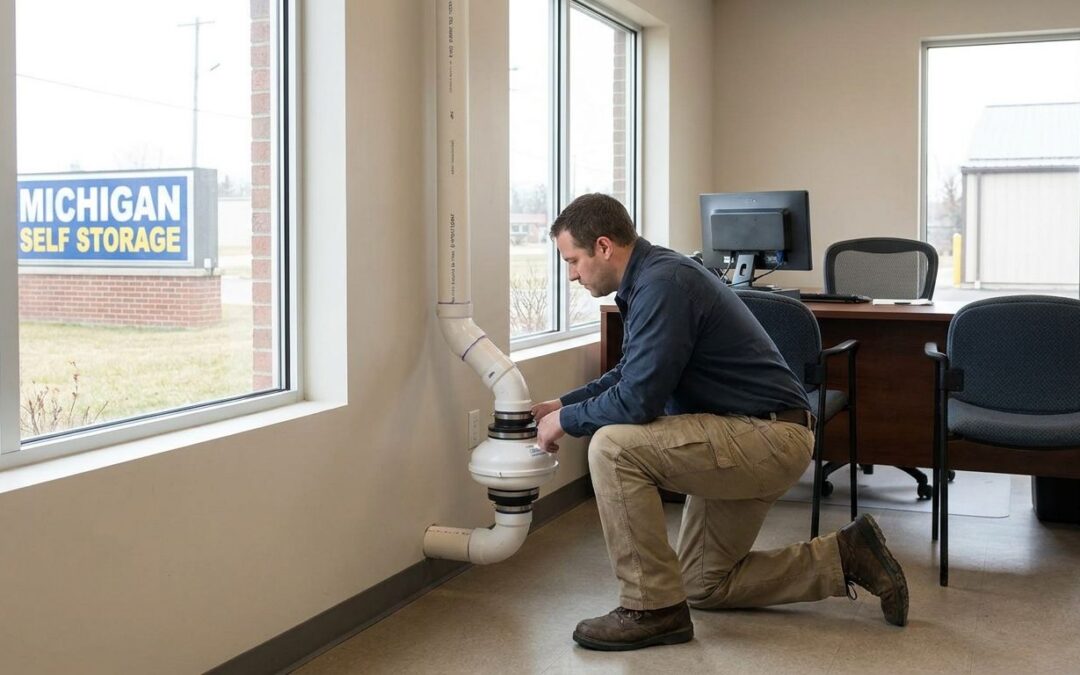
Radon mitigation for a Michigan self-storage facility office treats the office as its own building, not an appendage of the warehouse bays around it — a sub-slab depressurization system sized to the office footprint brings indoor air below the EPA action level of 4 pCi/L, even when the attached storage units test clean. Self-storage offices sit on slab-on-grade pads bolted to steel warehouse structures, and staff spend full shifts inside a sealed room that behaves nothing like the drafty, high-ceiling bays next door.
- Test the office separately from the warehouse bays — radon mitigation self storage office Michigan projects fail when readings come from the wrong room.
- Size the sub-slab system to the office slab, typically under 1,500 sq ft, not the full building footprint.
- Route vent discharge away from roll-up doors and forklift lanes to avoid re-entrainment.
- Retest 24 hours to 30 days after installation to confirm levels sit below the EPA’s 4 pCi/L action level.
- Document every test and install for multi-location corporate compliance files.
Why radon mitigation matters for Michigan self-storage facility offices
Michigan's soil chemistry and glacial geology put a meaningful share of the state's counties in the EPA's Zone 1 classification, meaning predicted average indoor screening levels above 4 pCi/L. A self-storage office is a small, low-ventilation room where one or two employees clock full eight-hour shifts, five or six days a week — that's a different exposure pattern than a warehouse worker moving through open bays with dock doors cycling all day.
Corporate storage operators running multiple Michigan locations increasingly get asked for radon records during insurance renewals and lease negotiations on the office suite, the same way commercial buildings in Metro Detroit get flagged during due diligence. Testing the office alone, separate from the warehouse, is the single most important step in this process — mixing the two spaces produces a reading that reflects neither.
Test the office space on its own
Start with a closed-building test in the office itself, not a reading pulled from the open bay area.
- Run the kit under closed-door conditions for a minimum of 48 hours before pickup
- Place the detector 20 inches to 6 feet off the floor, away from exterior doors and HVAC vents
- Keep windows and the office door closed for 12 hours before the test starts and through the full test period
- Split-test with two kits placed a few feet apart if the first reading comes back near the 4 pCi/L line
- Avoid testing during high winds or immediately after heavy rain, which can skew short-term results
An NRPP-certified technician can run this test with equipment calibrated for a commercial slab, which matters when a single reading decides whether the facility spends money on mitigation.
Identify entry points specific to a slab-on-grade office addition
Self-storage offices are frequently poured as a separate slab bolted onto the main steel building, which creates entry points a typical house doesn't have.
- Expansion joints where the office slab meets the warehouse floor
- Utility penetrations for phone, data, and electrical conduit running under the slab
- Any sump pit or floor drain inside the office footprint
- Cracks along the perimeter footing where the office addition settled separately from the main structure
Size a sub-slab depressurization system to the office, not the whole building
A warehouse-scale system oversized for a 300 to 1,500 square foot office wastes fan capacity and still might not depressurize the smaller slab evenly. This is the point where a faster, professional path makes sense instead of trial-and-error DIY sizing.
- Single suction point systems handle most standalone office slabs under 1,500 square feet
- Fan CFM gets matched to slab permeability, not square footage alone — a tight, well-poured slab needs less airflow than a cracked one
- Exterior fan placement stays clear of employee entrances and HVAC intake vents
- Discharge point extends above the roofline per EPA guidance, keeping exhaust away from windows
Michigan Radon Control sizes systems this way for standalone commercial spaces, and the same office-first logic applies whether the building sits in Oakland County or out toward Lansing.
Route the vent stack around loading traffic
Self-storage sites have a layout problem houses don't: dock doors, drive-up units, and forklift lanes running right past the exterior wall where a vent pipe wants to go.
- Keep the discharge stack 10 feet or more from any window, door, or HVAC air intake
- Avoid routing pipe through areas where forklifts or moving trucks back up against the building
- Coordinate exterior wall penetrations with the property manager before drilling, especially on leased sites
- Anchor exposed exterior pipe runs against wind load and accidental vehicle contact
Confirm results with a post-installation test
A system that's installed but never retested is a system nobody can prove is working.
- Retest between 24 hours and 30 days after the fan starts running
- Log the reading against the pre-mitigation baseline in writing
- Consider a continuous monitor for facilities where corporate compliance wants ongoing data instead of a single snapshot
- Keep the budget for a radon mitigation system installation documented alongside the retest results for facility records
Maintain the system through seasonal HVAC changes
Heating and cooling cycles change pressure differentials across a slab, which is why a system that passed its retest in July can drift by January.
- Check the manometer or pressure gauge monthly, more often during heating season
- Listen for a change in fan hum, which often signals early motor wear
- Typical mitigation fans run 5 to 10 years before replacement becomes necessary
- Confirm the system is still working correctly on a set schedule rather than waiting for a complaint
Document everything for corporate and insurance files
Multi-location storage operators need paperwork, not memory, when a lease renewal or insurance audit asks about the office.
- Keep dated test reports and mitigation certificates on file for every site
- File the installing contractor's NRPP certification alongside the install invoice
- Share results with the regional facility manager, not just the on-site staff
- Retain records for the life of the lease, not just the year of installation
Comparing mitigation options for a self-storage office
| Option | Best For | Key Limitation |
|---|---|---|
| Dedicated sub-slab depressurization | Standalone offices under ~1,500 sq ft with a sealed slab | Needs exterior fan placement clear of loading doors |
| Shared system tied to warehouse slab | Buildings where office and warehouse were poured as one slab | Can under- or over-ventilate the office if not balanced separately |
| Passive stack venting | Budget-conscious retrofits with readings barely above the action level | Relies on convection, no fan, less consistent reduction |
| Continuous monitor only, no fan | Interim tracking while budgeting for a full install | Measures radon, doesn't reduce it |
| Sealing cracks and joints only | Preliminary readings just above 4 pCi/L | Rarely brings levels below the action level on its own |
A dedicated sub-slab system sized to the office footprint is the reliable move for most Michigan self-storage offices — passive venting and sealing-only fixes work only when the pre-mitigation reading sits close to the line, and continuous monitors track the problem without solving it.
Get Your Office Tested
NRPP-certified testing and mitigation sized to your storage facility’s office footprint.
Common mistakes self-storage facilities make
- Testing the warehouse bay instead of the office — the open bay dilutes readings and misses the exposure the employee actually gets.
- Assuming a metal building can't trap radon — steel construction still sits on a slab in contact with soil gas underneath.
- Skipping the retest after installation — without it, there's no confirmation the system brought levels below 4 pCi/L.
- Placing vent discharge near roll-up doors or forklift lanes — creates re-entrainment risk and physical damage to the pipe.
- No documentation across a multi-location portfolio — a gap that surfaces during insurance renewal or a lease audit, usually at the worst time.
FAQ
What’s the best radon mitigation system for a self-storage facility office in Michigan?
A dedicated sub-slab depressurization system sized to the office footprint, not the warehouse bays, works best for most Michigan self-storage offices in 2026. A single suction point typically handles offices under 1,500 square feet.
Is radon a real risk in metal self-storage buildings?
Yes — steel warehouse construction still sits on a slab in direct contact with soil gas, so the building material doesn’t change the risk. The office portion, where staff spend full shifts, is the space that matters most.
How much radon testing does a self-storage office need before mitigation?
A closed-building short-term test run for at least 48 hours in the office itself, separate from the warehouse, is the standard starting point. A second confirming test is common when the reading lands close to 4 pCi/L.
Do OSHA rules require radon testing for storage facility employees?
OSHA doesn’t have a radon-specific standard, but the EPA’s 4 pCi/L action level is the recognized benchmark employers use for indoor air quality decisions. Facility operators use it as the trigger point for mitigation.
How long does radon mitigation installation take for a small office space?
Installation for a single-office sub-slab system typically completes in a day, since the footprint is small compared to a full residential basement. Retesting after install adds another 24 hours to 30 days before results confirm.
Can one system serve both the office and the warehouse bays?
Only if the office and warehouse share one continuous slab poured at the same time, and even then the system needs balancing to avoid under-ventilating the office zone. Separately poured office additions almost always need their own dedicated system.
How often should a self-storage office retest for radon?
Retest immediately after any mitigation install, then on a recurring schedule, commonly every two years or after any HVAC or slab-related renovation. Facilities tracking multiple locations often use continuous monitors for ongoing data instead of periodic snapshots.
What does EPA’s action level of 4 pCi/L mean for a small office?
4 pCi/L is the threshold at which the EPA recommends mitigation, regardless of building size or type. A small office at that level carries the same recommendation as a large warehouse floor at the same reading.
One last thing
A 400-square-foot office with one employee working eight-hour shifts, five days a week, can rack up more cumulative radon exposure hours in a year than an open warehouse floor that tests under the action level in a single bay reading. The building-wide average means nothing if nobody spends real time in the space that was actually tested — measure the office, not the bay, and treat the two as separate problems from day one.
Related guides
- Radon testing for commercial buildings in Metro Detroit
- How to budget for a radon mitigation system installation
- Best NRPP-certified radon mitigation companies in Michigan
- How to verify your radon mitigation system is still working