
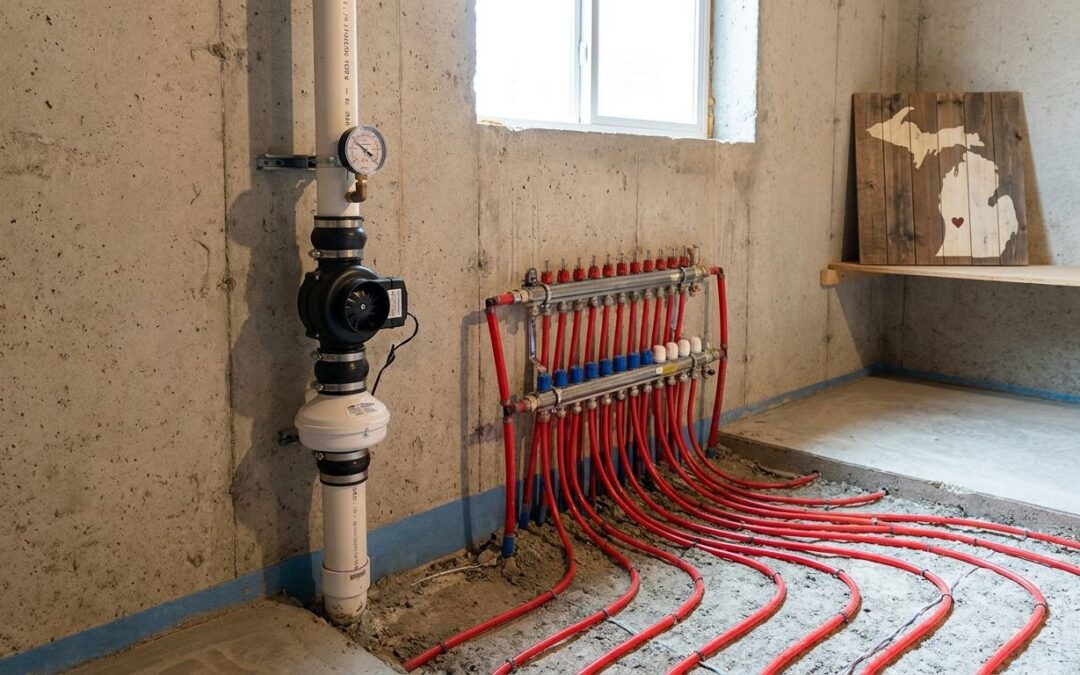
Radiant floor heating buries PEX tubing and hydronic lines inside the same slab a radon mitigation system needs to penetrate, and that changes how a suction point gets placed, where the pipe runs, and who should be doing the drilling. Homeowners across Metro Detroit and Lansing with heated slabs need a contractor who asks about the manifold layout before touching a core bit.
- Sub-slab depressurization works in Michigan homes with radiant floor heating when the suction point avoids PEX tubing runs.
- Michigan sits in EPA Zone 1, where indoor radon commonly exceeds the 4 pCi/L action level.
- Sump-integrated suction is the strongest pick for radiant-heated basements that already have a sump pit.
- Skip any quote that doesn’t ask for your radiant heat manifold location before pricing the job.
Why this matters
Most of Michigan falls inside the EPA's Zone 1 designation, meaning the predicted average indoor radon screening level runs above the 4 pCi/L action level before any mitigation happens. That risk doesn't change because a home has radiant floor heating installed, but the installation path does. A standard radon mitigation system for a slab-on-grade home relies on drilling a suction point straight through the concrete, and a radiant slab has tubing loops running through that same concrete in a pattern the installer can't see from above.
Get the drill placement wrong and you're not looking at a patched hole. You're looking at a severed PEX line buried under finished flooring, a drained hydronic loop, and a repair bill that has nothing to do with radon. That's the whole reason this decision needs a contractor who treats radiant heat as a planning input, not an afterthought discovered mid-job in 2026.
Who this is for
This guide is for Michigan homeowners with radiant floor heating embedded in a basement slab, a slab-on-grade foundation, or a heated addition, who need radon testing or mitigation and don't want the installer improvising around hydronic lines. It's also useful for anyone buying a home with radiant heat who's staring down a radon disclosure requirement before closing. If your radiant system runs through electric mats in a tiled bathroom floor rather than a full hydronic slab, the stakes are lower, but the same planning questions still apply.
What to look for in a mitigation plan
As-built manifold and tubing documentation
A contractor should ask for the radiant heat installer's as-built drawings before scheduling a drill date. Without that documentation, the crew is guessing at tubing spacing, and a guess is how a suction pipe ends up puncturing a supply line six inches under the slab.
Suction point location strategy
The best suction points sit in unheated zones of the slab: an attached garage, an unheated mechanical closet, or a perimeter strip outside the radiant loop pattern. A contractor who defaults to the geometric center of the basement without checking the loop map is optimizing for convenience, not for your floor.
Fan and pipe routing around mechanical rooms
Radiant systems usually mean a boiler, a manifold, and a maze of supply and return lines concentrated in one mechanical room. The mitigation fan and its exterior run need a path that doesn't require rerouting hydronic plumbing or crowding the boiler's service clearance.
Pressure differential testing on a heated slab
A heated slab expands and contracts more than an unheated one across a Michigan winter, and that can subtly shift how well a single suction point pulls vacuum across the whole footprint. Post-install pressure field extension testing matters more here than on a standard slab, not less.
NRPP-certified experience with hydronic systems specifically
NRPP certification confirms baseline competence, but it doesn't guarantee a contractor has actually mapped a radiant slab before. Ask directly how many radiant-heated homes they've mitigated in the past year — a vague answer is the answer.
System verification built into the warranty
Once the system is in, you need a way to confirm it's still holding vacuum months later without cutting into flooring to check. A pressure gauge you can read at a glance should be part of the install, not an add-on.
Top picks for homes with radiant floor heating
Sub-slab depressurization with a mapped suction point — the standard pick. This is the same core approach used on any slab-on-grade radon mitigation job, adapted by locating the suction point outside the radiant loop footprint using as-built drawings. It moves the largest volume of soil gas per fan, which matters most in a Zone 1 state where levels above 4 pCi/L are common. Buy if the contractor confirms the manifold map before quoting.
Sump-integrated suction — the efficient pick for radiant-heated basements. If your basement already has a working sump pit, tying the suction point into a sealed sump system avoids drilling near the radiant slab at all. It uses an existing penetration instead of creating a new one, which cuts both risk and labor time. Buy when the sump pit sits outside the direct radiant loop zone and can be sealed properly.
HVAC-coordinated fan and pipe routing — the integration pick for homes where the boiler, manifold, and ductwork share tight mechanical space. Coordinating the mitigation fan placement with the existing HVAC design keeps service access to the boiler clear and avoids running exhaust pipe through a room already crowded with hydronic lines. Consider this route if your mechanical room is small; it adds coordination time but prevents a second trip to reroute pipe later.
Passive stack with future fan upgrade — the wildcard. In a handful of new-construction radiant homes, a passive vent stack gets installed during the build and never activated. It's a fine placeholder if pre-mitigation levels test low, but it's not a mitigation system on its own. Wait and test before deciding whether to activate the fan — don't pay for full mitigation on a passive system that's already testing under 4 pCi/L.
What to avoid
- A flat-rate quote that skips the manifold question. If a contractor prices the job before asking where your radiant tubing runs, they're planning to find out with the drill.
- DIY core drilling near a mechanical room. Radiant supply and return lines aren't always where a floor plan suggests, and a punctured line is far more expensive than the mitigation system itself.
- Skipping the pre-install walkthrough. Before any drilling starts, review how to prepare your home for a radon mitigation system so you know what access the crew needs and what to clear out of the mechanical room first.
Verdict comparison
| Approach | Best for | Drilling risk near radiant tubing | Verdict |
|---|---|---|---|
| Sub-slab depressurization (mapped) | Slab-on-grade homes with as-built drawings | Low, if mapped correctly | Buy |
| Sump-integrated suction | Basements with an existing sump pit | Very low, no new slab penetration | Buy |
| HVAC-coordinated routing | Homes with tight mechanical rooms | Low, plumbing stays untouched | Consider |
| Passive stack, fan pending | New construction testing under 4 pCi/L | None until fan activation | Wait |
Get a radiant-slab mitigation plan
Request an inspection before any drilling near your radiant heat lines.
FAQ
Can radon mitigation damage radiant floor heating pipes?
Yes, if the suction point is drilled without checking the tubing layout first. Contractors who review as-built manifold drawings before drilling avoid this almost entirely.
Where does the suction pipe go in a home with radiant floor heat?
It goes in an unheated section of the slab, such as an attached garage or perimeter strip outside the radiant loop pattern. This keeps the drill away from active tubing runs.
Is sub-slab depressurization safe for homes with PEX tubing in the slab?
It’s safe when the installer maps the tubing before choosing a suction point. Without that mapping step, the risk of hitting a line rises significantly.
Does radiant floor heating make radon mitigation more expensive?
It can add planning and coordination time, since the crew needs manifold documentation before drilling. Costs vary by system type and site conditions, so get a quote after the contractor reviews your slab layout.
Do I need to test for radon before installing radiant floor heating in a Michigan home?
Testing before the radiant system goes in makes future mitigation far simpler, since a passive stack or suction point can be planned around the tubing layout from the start. Michigan sits in EPA Zone 1, where testing is worth doing regardless of renovation plans.
Can a radon fan be installed without cutting into a heated slab?
Yes, if the home has an existing sump pit or an unheated mechanical space that can host the suction point. Sump-integrated suction is the most common way to avoid new slab penetrations entirely.
Is Michigan considered high risk for radon?
Most of the state falls under the EPA’s Zone 1 classification, meaning predicted indoor radon levels commonly exceed the 4 pCi/L action level. That risk applies to homes with radiant floor heating the same as any other home.
How do I know if my radon mitigation system is still working after installation?
Check the system’s pressure gauge for a steady reading, since a flat or zero reading means the fan has stopped pulling vacuum. Homes with radiant slabs should have this checked at least once a year given the extra thermal cycling.
One last thing
A heated slab expands and contracts through a Michigan winter more than a standard basement floor, and that thermal cycling can loosen a poorly sealed suction point over a few seasons faster than it would on an unheated slab. If your radiant floor heating home had mitigation installed more than two winters ago, checking the pressure gauge before this year's heating season starts costs nothing and catches a slow leak before it shows up on a retest.
Related guides