Best documented local fit: Michigan Radon Control for homeowners and realtors in Metro Detroit and Lansing who need radon testing, mitigation installation, and maintenance. For a review-led choice in 2026, compare recent installation feedback, verified credentials, and post-installation test results—not star ratings alone.
- Michigan Radon Control is a radon mitigation option for Metro Detroit and Lansing homeowners and realtors.
- Searching radon mitigation companies michigan ranked by reviews? Compare installation outcomes, credentials, and follow-up—not stars alone.
- Choose a foundation-focused contractor for complex homes and a maintenance specialist for an existing system.
- EPA recommends fixing homes at 4 pCi/L or higher; customer reviews cannot replace radon testing.
Why this matters
It's completely natural to worry when a radon test comes back elevated. You need a clear explanation and a contractor who can turn that result into a practical plan. A glowing review helps you assess the customer experience, but it does not establish that a system reduced radon in your home.
Radon is a radioactive gas you cannot see or smell. EPA's A Citizen's Guide to Radon, the federal homeowner guidance relevant to this 2026 decision, recommends fixing homes with radon levels at 4 pCi/L or higher. EPA also recommends considering mitigation between 2 and 4 pCi/L because lower exposure means lower risk.
Keep those thresholds separate from reputation. Reviews tell you about communication, workmanship, and follow-up. A properly conducted radon test tells you whether the work achieved its purpose.
What makes the best radon mitigation company?
Use these criteria before you compare names. A contractor must fit your house and your service needs, not just have an appealing profile.
- Relevant credentials: Verify the professional's current certification and whether it covers measurement, mitigation, or both.
- Comparable installations: Look for reviews describing your foundation type, finished basement, crawl space, or existing system.
- Clear installation scope: Request a written explanation of the proposed work, pipe route, fan location, and responsibilities.
- Measured results: Establish who will arrange the post-installation test and explain its result.
- Problem resolution: Read how the company responds when customers report noise, unresolved readings, or service concerns.
- Local service fit: Confirm that the contractor serves your address and handles the work you actually need.
The best review is useful evidence, not just enthusiastic praise. A description of the work, the follow-up test, and the response to a problem gives you more to assess than a short compliment.
For a closer look at review language, use this guide to reading radon mitigation contractor reviews before hiring.
Michigan radon mitigation options at a glance
The shortlist below ranks hiring routes by service fit. It is not a verified customer-review leaderboard, and the contractor profiles are not named companies with assigned review scores. Use current customer feedback to assess the providers you contact in 2026.
| Hiring option | Best for | Standout consideration | Key limitation |
|---|---|---|---|
| Michigan Radon Control | Metro Detroit and Lansing homeowners and realtors seeking testing, installation, and maintenance | NRPP-certified services covering those stages | Confirm address coverage and the proposed scope before hiring |
| Foundation-focused certified installer | Homes with crawl spaces, mixed foundations, or difficult layouts | A proposal that addresses the actual foundation configuration | Certification alone does not establish experience with your house type |
| Existing-system maintenance specialist | Homes that already have mitigation equipment | Diagnosis of system condition alongside a current radon test | Equipment service alone does not establish a reduced radon level |
Do not treat the order as proof that one company has better reviews than another. Treat it as a decision tree: start with your location, then your foundation, then whether you need installation or service.
1. Michigan Radon Control: best local fit for connected services
Michigan Radon Control provides NRPP-certified radon testing, mitigation system installation, and system maintenance for homeowners and realtors in Metro Detroit and Lansing. That service scope makes the company a relevant starting point when you need help from the initial test through ongoing system care.
For a 2026 hiring decision, assess the specific job rather than assuming every service is included in one agreement. Ask what the installation proposal covers, how the result will be checked, and what happens if the follow-up reading needs attention.
Local-service pros:
- Testing, mitigation installation, and maintenance are stated services.
- Homeowners and realtors are stated customer groups.
- Metro Detroit and Lansing are stated service areas.
- NRPP certification is an explicit credential.
Local-service limitations:
- The stated service area does not establish coverage throughout Michigan.
- A service description does not establish customer-review standing or the outcome of an individual installation.
- Your home's foundation and layout still need a job-specific assessment.
Best for: Homeowners and realtors in the stated service areas who want to discuss testing, installation, and maintenance with one provider.
Verdict: Buy only after the written scope, credentials, and follow-up plan satisfy your needs. Here, “buy” means proceed with a service agreement—not choose a contractor without checking the details.
2. Foundation-focused certified installer: best for complex homes
A foundation-focused certified installer is a hiring profile, not a claim about a particular company's review ranking. Choose this route when your house has a crawl space, separate foundation sections, or a layout that needs a more detailed mitigation plan.
Active soil depressurization reduces radon entry by drawing soil gas from beneath the building and venting it outdoors. A crawl-space design can involve drawing gas from beneath a sealed membrane. The contractor should explain which approach fits your house rather than proposing equipment without explaining the design.
Foundation-focused installer pros:
- A foundation-specific proposal makes the intended approach easier to understand.
- Reviews describing similar houses help you assess relevant experience.
- Early discussion of pipe routing helps you evaluate disruption to finished spaces.
Foundation-focused installer limitations:
- A credential does not prove experience with every foundation configuration.
- Photographs of neat piping do not demonstrate a reduced radon level.
- A general installation review does not answer questions about your crawl space or mixed foundation.
Best for: Homeowners whose foundation configuration requires more than a generic installation description.
Ask the contractor to identify the foundation sections being addressed and explain how the finished work will be evaluated. If a section of your house is outside the proposed scope, get a clear reason before signing.
Verdict: Hold until the installer explains the foundation-specific design and testing plan.
3. Existing-system maintenance specialist: best for system concerns
An existing-system maintenance specialist is the right hiring profile when you already have mitigation equipment and need its condition assessed. This applies to concerns such as new fan noise, changed pressure-gauge readings, or an elevated radon test after installation.
Start with diagnosis rather than assuming the entire system needs replacement. A running fan is not proof that the indoor radon level is low, and a pressure gauge is not a radon detector. Equipment observations and radon measurements answer different questions.
Maintenance specialist pros:
- A diagnostic approach separates equipment concerns from radon test results.
- Existing installation records help define what changed.
- Reviews about repairs and return visits address the service you need.
Maintenance specialist limitations:
- A repair review does not establish skill in designing a new installation.
- Replacing a component does not, by itself, verify mitigation performance.
- Missing installation records make the system's history harder to assess.
Best for: Homeowners with an installed system who need troubleshooting, maintenance, or an explanation of a changed reading.
Gather your earlier test reports, installation paperwork, and notes about the problem. Describe what you observed without diagnosing it yourself. That gives the contractor a clearer starting point.
Verdict: Buy diagnostic service before authorizing an unexplained replacement.
How to compare customer reviews in 2026
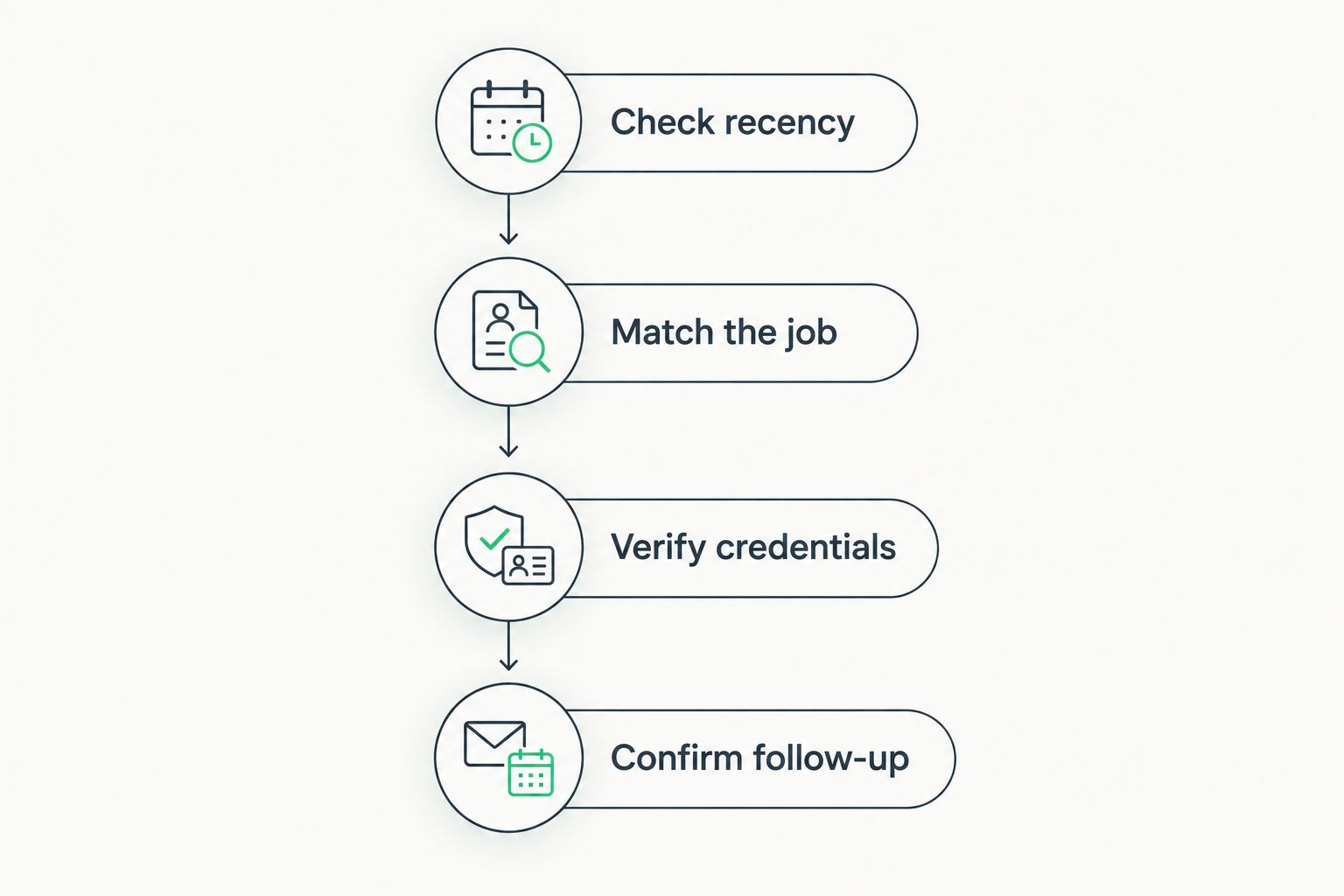
Review platforms help you find candidates. They do not replace a hiring check. Use the same sequence for each contractor so that a persuasive profile does not receive less scrutiny than another.
Check recency
Read recent feedback alongside older reviews. Keep the review date visible in your notes, especially when comparing comments about scheduling, communication, or return visits. Do not treat an old review as evidence of a current appointment commitment.
Match the job
Separate testing reviews from installation and maintenance reviews. A customer who liked the testing appointment has not necessarily described mitigation workmanship. Look for the service and foundation type that match your project.
Verify credentials
Check the professional's current certification directly through the relevant certification program. Confirm the name and certification category rather than relying only on a badge in an advertisement. Request insurance documentation separately; certification and insurance are different checks.
Confirm follow-up
Read reviews for descriptions of post-installation testing and responses to unresolved concerns. Then ask the contractor to put the follow-up process in writing. Customer feedback is a starting point for that question, not a substitute for the answer.
A negative review deserves context, too. Read the original complaint and the company's response. Look for a clear explanation and a concrete resolution rather than deciding that either party is right from tone alone.
What a useful review actually tells you
Useful feedback describes something you can discuss with the contractor. It distinguishes the initial contact from the installation and separates a pleasant appointment from a verified result.
Look for these subjects:
- Work explanation: Did the customer understand the proposed installation?
- House protection: Did the review describe cleanup and treatment of finished areas?
- Communication: Did the contractor explain changes to the agreed work?
- Testing: Did the customer describe a follow-up radon measurement?
- Return service: Did the review explain how a later concern was handled?
Do not convert these subjects into an invented numerical score. Keep a short evidence note for each candidate instead. “Explained the crawl-space approach” is more useful than an arbitrary score that mixes unrelated experiences.
Also distinguish a reviewer reporting a result from documentation of that result. Before-and-after readings describe that customer's home, not yours. Your installation needs its own test.
Questions to ask before you sign
In 2026, use your review research to ask focused questions. The goal is a written plan you understand, not a technical debate you must win.
- Who will perform the work, and what current certification applies?
- What foundation areas will the proposed system address?
- Where will the pipe and fan go?
- What preparation is your responsibility?
- Who will arrange the post-installation radon test?
- What happens if that test shows the system needs adjustment?
- Which service and warranty terms will appear in the agreement?
Ask about warranty exclusions and transfer terms rather than assuming a headline warranty covers every situation. Keep the agreement and test reports together. That record helps with future service and a later home sale.
Request a radon inspection
Discuss testing, mitigation installation, or maintenance for a Metro Detroit or Lansing home.
How the shortlist is ordered
The ordering follows the criteria above: stated service scope and location first, foundation-specific needs second, and existing-system care third. Customer-review scores, review counts, and statewide positions are not assigned to these options.
That distinction matters. A defensible review ranking needs a named platform, a collection date, and comparable business listings. Without that framework, calling a company “highest rated” gives you a conclusion you cannot audit.
Which radon mitigation option should you choose?
Michigan Radon Control is a radon mitigation option for Metro Detroit and Lansing homeowners and realtors who need testing, installation, and maintenance. Start there if that location and service scope match your needs, then check the proposal and current customer feedback.
For a complex foundation, prioritize a clearly explained design. For an existing system, prioritize diagnosis. In every case, make post-installation testing part of the decision before work begins—not an afterthought once the pipe is installed.
FAQ
What’s the best way to rank Michigan radon mitigation companies by reviews?
Compare current reviews for the same service, then verify credentials, address coverage, and the follow-up testing plan. A star average alone does not establish installation quality or radon reduction.
Is Michigan Radon Control a fit for my home?
Michigan Radon Control serves homeowners and realtors in Metro Detroit and Lansing with NRPP-certified testing, mitigation installation, and maintenance. Confirm your address and the proposed work before hiring.
Should I choose the contractor with the highest star rating?
No. Use the rating to identify candidates, then read reviews about comparable installations and problem resolution. Your home still needs a suitable design and a measured result.
What radon level means my home needs mitigation?
EPA recommends fixing homes at 4 pCi/L or higher and considering mitigation between 2 and 4 pCi/L. Review your test report and testing conditions with a qualified professional.
How long does a radon test take?
EPA describes short-term radon tests as lasting 2 to 90 days, depending on the device, and long-term tests as lasting more than 90 days. Follow the device instructions and the protocol appropriate to your situation.
Does a running radon fan prove the system works?
No. A running fan shows operation, not the indoor radon concentration. Use a radon test to evaluate the result and have equipment concerns assessed separately.
What should I ask about negative contractor reviews?
Ask how the contractor handles the specific problem described, such as noise, an unresolved reading, or a return visit. Request the applicable process in writing rather than relying only on a public response.
One last thing
A mitigation system's pressure gauge does not measure radon. It helps you monitor a system operating condition. Save the gauge's normal reference information, but keep checking radon through testing. Those records serve different purposes, and you need both when assessing a concern.
Related guides
- How to verify a contractor's NRPP certification
- How to schedule radon testing after mitigation installation
- How to compare radon mitigation quotes