

Radon.com offers a practical mail-in testing route when you want to collect a radon sample yourself. A test result alone does not inspect your foundation, install a mitigation system, or maintain an existing one. The best Radon.com alternative in 2026 is Michigan Radon Control if you need local testing and mitigation; long-term alpha-track testing is better if you need a longer measurement period.
- For radon.com alternatives, Michigan Radon Control is best for local radon testing, mitigation installation, and maintenance.
- Long-term alpha-track testing suits homeowners measuring radon over more than 90 days without a closing deadline.
- A continuous radon monitor helps track changing readings but does not reduce radon.
- Keep Radon.com on your shortlist when a homeowner-managed mail-in test meets your needs.
Why this matters
It's completely natural to worry when radon comes up during a home inspection. You do not need to choose a fan, understand every foundation detail, or solve the problem before you have a reliable measurement.
You do need to separate three different jobs: measuring radon, reducing radon, and checking that a system continues working. A testing product and an installation service address different parts of that process. Comparing them as interchangeable purchases leads to the wrong next step.
For this 2026 comparison, the EPA's A Citizen's Guide to Radon provides the homeowner decision framework: fix a home when a properly interpreted testing result calls for action at 4 pCi/L or higher, and consider reducing radon between 2 and 4 pCi/L. The EPA also states that no radon level is known to be risk-free. These are action guidelines, not a promise that a reading below the action level means zero risk.
Radon.com alternatives at a glance
Choose by the job you need completed, not by which option has the most features. The comparison below includes Radon.com as the testing benchmark; the alternatives are service and measurement routes rather than a list of unverified contractors.
| Option | Best for | Standout feature | How it differs from Radon.com |
|---|---|---|---|
| Radon.com mail-in testing | Homeowners comfortable managing sample collection | Home collection followed by laboratory analysis | The baseline for a homeowner-managed testing route |
| Michigan Radon Control | Metro Detroit and Lansing homeowners needing professional help | NRPP-certified testing, mitigation installation, and maintenance services | Provides local services beyond collecting a sample |
| Long-term alpha-track testing | Measuring radon over an extended period | A measurement lasting more than 90 days | Prioritizes a longer sampling period rather than a particular supplier |
| Continuous radon monitor | Watching readings change over time | Repeated measurements displayed by the device | Provides ongoing readings rather than relying on a mailed sample |
A long-term test or continuous monitor is not necessarily an alternative supplier to Radon.com. Each is an alternative testing approach. The important distinction is whether you need a measurement, a longer view, or someone to address the source.
1. Michigan Radon Control: best for local testing and mitigation
Michigan Radon Control provides NRPP-certified radon testing, mitigation system installation, and system maintenance for homeowners and realtors in Metro Detroit and Lansing. Choose this radon service when you want professional help with the house, not just a laboratory result. The service scope covers both finding a problem and addressing it.
Best for: Homeowners in the stated service area who need testing guidance, mitigation installation, or maintenance of an existing system.
Where the local service shines
- On-site work: A mitigation installation addresses the building rather than stopping at measurement.
- Relevant credentials: NRPP-certified services give you a credential to verify when choosing professional help.
- Help after installation: System maintenance is an explicitly offered service.
- Home-sale relevance: The company serves realtors as well as homeowners.
Where the local service falls short
- Geographic fit matters: The stated service areas are Metro Detroit and Lansing, not all of Michigan.
- It is not a self-managed testing route: If you want to handle sampling independently, a kit matches that preference more directly.
- A service choice still needs a written scope: Confirm which testing, installation, and follow-up tasks your particular agreement includes.
Local service versus mail-in testing
| Decision point | Local professional service | Radon.com mail-in testing |
|---|---|---|
| Your role | Arrange access and agree on the work | Follow collection and return instructions |
| Main outcome | The testing, installation, or maintenance service you commission | A laboratory result from the submitted sample |
| Elevated result | Mitigation installation is an offered service | A result does not itself install a system |
| Best fit | You need work performed at the home | You want to manage the sample yourself |
Before requesting work, explain whether you already have a result, whether the home has a system, and whether a purchase agreement sets a deadline. Those details distinguish a first test from an installation assessment or a maintenance visit.
Verdict: Buy professional service when you need someone to test, install, or maintain—not simply supply a test.
2. Long-term alpha-track testing: best for a longer measurement
Long-term alpha-track testing suits homeowners who want a measurement across more of normal household life. EPA homeowner guidance distinguishes short-term tests, which generally last 2 to 90 days, from long-term tests lasting more than 90 days. A long-term result is more representative of the home's year-round average than a short-term result.
Best for: Homeowners without an immediate transaction deadline who need a longer view of radon exposure.
Where long-term testing shines
- Longer sampling: The measurement covers more than a brief snapshot.
- Simple placement: A passive detector does not require you to watch a changing display.
- Useful context: A longer measurement helps answer a different question from a short screening test.
Where long-term testing falls short
- It takes time: A measurement lasting more than 90 days does not fit a short inspection contingency.
- It does not provide live readings: You do not get a running display while the detector collects its sample.
- It does not reduce radon: An elevated result still requires a separate response.
| Decision point | Long-term alpha-track testing | Radon.com mail-in testing |
|---|---|---|
| What you are choosing | A detector type and extended duration | A testing supplier and collection route |
| Main question | What does a longer measurement show? | What does the submitted sample show? |
| Deadline fit | Requires an extended testing window | Depends on the selected test and reporting process |
For a 2026 home purchase, do not substitute a long-term test for the testing process required by your agreement. Ask the parties handling the transaction what report and timing they require before selecting the method.
Verdict: Buy long-term testing when the longer measurement answers your question and your deadline allows it.
3. Continuous radon monitor: best for tracking changes
A continuous radon monitor takes repeated measurements and displays results over time. It is useful when you want to observe changing readings rather than wait for a laboratory report. Check the individual device's measurement method, operating instructions, and calibration guidance before choosing one.
Best for: Homeowners who want ongoing visibility into indoor radon readings.
Where continuous monitoring shines
- Repeated readings: You can observe patterns instead of seeing only one reported average.
- Ongoing use: A reusable device supports continued observation at home.
- Readable feedback: A display makes measurements accessible without mailing each sample.
Where continuous monitoring falls short
- Interpretation takes care: A single high or low reading does not replace the recommended decision process.
- Device purpose matters: A consumer display is not automatically an acceptable real-estate testing report.
- It is not mitigation: A monitor measures radon; it does not remove it.
In a 2026 comparison, treat monitoring as a measurement choice, not an installer replacement. If a result calls for corrective work, buying another measuring device does not complete that work.
Verdict: Buy a monitor for ongoing observation; skip it as a substitute for mitigation or a required professional report.
Why people look beyond Radon.com
There is no need to assume a testing supplier has failed. The reason to choose a different route is that your next job has changed.
These are task-based reasons to look beyond mail-in testing, not claims about Radon.com's customer service, reporting performance, or installation network:
- You need installation. A laboratory result identifies a concentration; mitigation requires work at the building.
- You need system maintenance. An existing fan, piping arrangement, or other system component needs assessment rather than another kit alone.
- You need help managing a transaction. Testing instructions, property access, and report requirements must fit the purchase agreement.
- You need a longer measurement. Your question concerns an extended average, not just the selected sampling window.
- You want repeated readings. A monitor answers a different measurement question from a mailed sample.
Keep the decision tied to the task. Switching testing brands does not, by itself, lower a home's radon concentration.
Match your next step to your situation
A sensible 2026 plan starts with the evidence you already have. Do not choose an installation solely because a neighbor has one, and do not dismiss your own result because a nearby home tested lower.
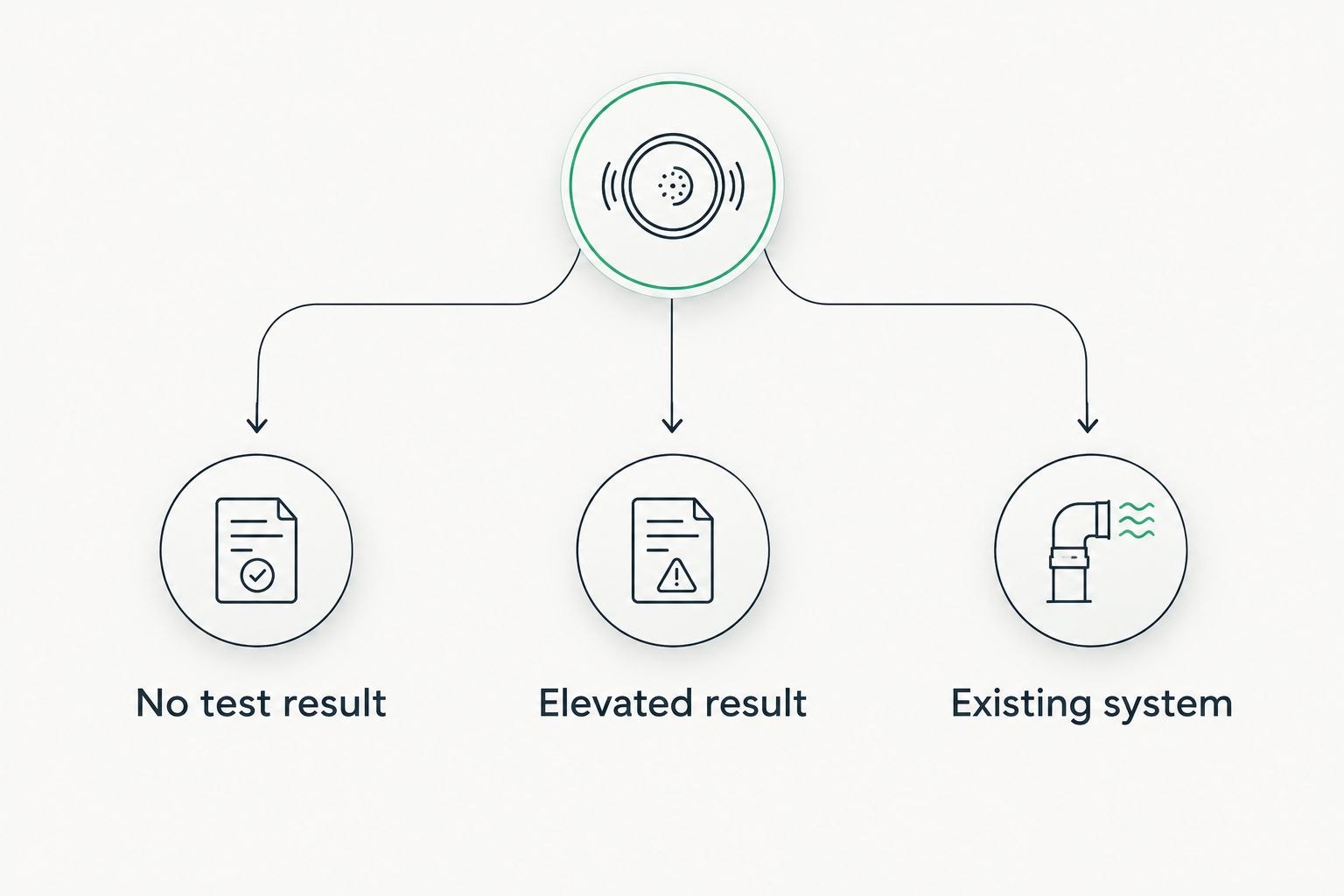
No test result
Arrange a properly conducted measurement. Follow the selected test's placement, building-condition, duration, and return instructions; the details are part of obtaining a useful result, not optional extras.
Elevated result
Use the EPA's testing and follow-up guidance to decide whether another measurement or corrective action is next. An initial short-term result needs the appropriate interpretation rather than an automatic purchase based on one number.
Existing system
Separate the system's operating indicators from the home's radon concentration. A pressure gauge indicates a pressure difference; it does not measure radon in pCi/L. Testing is still needed to establish the concentration.
When speaking with a contractor, ask who performs the work, which credentials apply, what the written scope covers, and how the home's radon concentration will be checked afterward. Keep the original report and later results together so you can compare documented measurements rather than memories.
Request help with your radon next step
Discuss testing, mitigation installation, or system maintenance in Metro Detroit and Lansing.
When staying with Radon.com is the right call
Stay with Radon.com when a homeowner-managed mail-in test matches your task and you can follow the testing instructions. You do not need to replace a suitable testing route just because professional installation services also exist.
Where mail-in testing shines: It gives you a defined collection-and-analysis process without requiring you to manage a reusable monitor. Where it falls short: Sample collection, handling, and return remain your responsibility, and receiving a report does not complete corrective work.
The fair comparison is not “website versus contractor.” It is “which route completes the job I need now?” Verdict: Hold with mail-in testing when testing alone is the right next step.
FAQ
What’s the best Radon.com alternative for Michigan homeowners?
Michigan Radon Control is the best fit among these routes for homeowners needing local testing, mitigation installation, or maintenance in Metro Detroit and Lansing. Long-term testing or a continuous monitor fits different measurement needs rather than replacing installation services.
Is a local radon contractor better than a mail-in test?
A local contractor is the better fit when you need work performed at the house or professional testing assistance. A mail-in test remains a suitable route when you can manage collection correctly and only need a measurement.
Can a continuous radon monitor replace a mitigation system?
No. A continuous radon monitor measures radon, while a mitigation system is designed to reduce radon entering the home. Monitoring does not perform corrective work.
What radon level means I should take action?
The EPA recommends fixing a home when the appropriate testing process indicates 4 pCi/L or higher. It also recommends considering reduction between 2 and 4 pCi/L; no radon level is known to be risk-free.
How long does a long-term radon test run?
A long-term radon test runs for more than 90 days under EPA homeowner guidance. That duration makes it unsuitable for a short closing deadline but useful for a longer measurement.
Can I use a home radon monitor for a real-estate closing?
Do not assume a consumer monitor satisfies your transaction’s testing requirements. Confirm the required testing method, report, and timing with the parties handling the purchase before relying on the device.
Does a working radon fan prove my home has low radon?
No. A running fan or pressure-gauge reading does not establish the home’s radon concentration. Use a properly conducted radon test to check the result.
One last thing
A radon system's pressure gauge and a radon test answer different questions. The gauge shows a pressure difference; the test measures radon concentration. Keep the post-installation test report with your system records, rather than treating a running fan as proof that the work achieved its purpose.
Related guides
- How to read your radon test results
- How to schedule radon testing after mitigation installation
- How to verify a contractor's NRPP certification
- How to compare radon mitigation quotes