Best for a dedicated commercial salon or spa: a radon specialist with documented experience in comparable buildings. Best for a home-based business in Metro Detroit or Lansing: Michigan Radon Control, subject to scope confirmation. Best for a leased suite with shared building systems: a landlord-coordinated contractor. This 2026 guide explains how to choose among these hiring routes without mistaking residential credentials for proof of commercial experience.
- Compare radon mitigation companies for Michigan salons and spas by building experience, testing plans, and written responsibilities.
- Michigan Radon Control is a starting point for home-based salon owners in Metro Detroit and Lansing.
- Dedicated commercial salons need a contractor who documents experience with comparable buildings.
- Leased salons need landlord approval and a building-specific plan before installation.
Why this matters
It is completely natural to worry about the air your staff and clients breathe. Radon is a radioactive gas you cannot see or smell, and testing is the way to find out whether it is present at an elevated level.
A salon's usual air-quality measures do not answer the radon question. Odor control, product storage, and local exhaust address different concerns; none substitutes for a radon measurement.
Choose the contractor around the building, not the business name on the door. A home-based treatment room, a converted house, and a shopping-center suite need different conversations about foundations, access, testing, and permission to alter the property.
What makes the best radon mitigation contractor?
Use these criteria before comparing proposals in 2026. A clear answer should describe your property, not just the company's general installation process.
- Relevant building experience: Ask for examples involving a similar foundation, footprint, and occupancy. Residential work alone does not establish commercial experience.
- Verifiable credentials: Identify the person responsible for measurement and mitigation. Check current credentials and whether their scope matches the work.
- A written testing plan: Require an explanation of measurement locations, building conditions, and how results will guide the next step.
- A building-specific design: Ask how the proposed system addresses soil-gas entry, foundation sections, pipe routing, and discharge placement.
- Operational planning: Require a plan for access, drilling, electrical work, cleanup, and any interruption to appointments.
- Documented follow-up: Establish who arranges post-installation testing, who receives the report, and who handles later service.
A reassuring conversation helps. Written answers make the decision auditable and give you something concrete to discuss with a landlord or property manager.
Radon contractor options at a glance
These are ranked hiring routes, not a performance ranking of named commercial companies. Each route serves a different property situation.
| Rank and option | Best for | Standout reason to consider it | Key limitation |
|---|---|---|---|
| 1. Commercial radon specialist | Dedicated commercial salons and spas | Building-specific commercial testing and mitigation scope should be a hiring requirement | Experience and credentials must be verified for the individual contractor |
| 2. Michigan Radon Control | Home-based salons in Metro Detroit and Lansing | Provides NRPP-certified residential testing, installation, and maintenance services | Its stated service description does not establish salon-specific commercial experience |
| 3. Landlord-coordinated contractor | Leased suites with shared foundations or building systems | Allows testing, permissions, and installation access to be coordinated through the property owner | Tenant control depends on the lease and owner approval |
1. Commercial radon specialist: best for dedicated salon premises
For a standalone commercial salon or spa, prioritize a contractor who can document comparable projects. Ask the specialist to explain how the building's foundation and operating conditions affect the proposed investigation.
Do not accept a residential package without a discussion of commercial scope. A proposal should identify the areas being evaluated, the applicable measurement approach, and the work needed before a final system design.
Commercial specialist pros:
- Comparable project records help you assess whether the contractor understands the property.
- A defined commercial scope gives you a basis for comparing proposals.
- Building-specific planning puts access and installation questions on the table before work starts.
Commercial specialist cons:
- Calling a service commercial does not prove relevant experience.
- An incomplete building survey leaves important design questions unanswered.
Best for: A dedicated salon, day spa, or converted commercial property where the contractor can demonstrate experience with the actual building type.
Ask for a sample report with client details removed. Look for a description of the tested areas, measurement conditions, results, and recommendations rather than a pass-or-fail statement alone.
Verdict: Buy only after the contractor documents relevant experience and a property-specific scope.
2. Michigan Radon Control: best for home-based salon owners
Michigan Radon Control provides NRPP-certified radon testing, mitigation installation, and maintenance for homeowners and realtors in Metro Detroit and Lansing. That stated residential focus makes it a starting point when your salon or treatment room operates inside your home.
Michigan Radon Control is best suited to home-based salon owners seeking residential radon testing and mitigation in Metro Detroit and Lansing. Confirm that the business use, treatment rooms, and any planned alterations are included in the requested assessment.
Michigan Radon Control pros:
- Its stated services cover testing, system installation, and maintenance.
- Its description identifies NRPP-certified services.
- Its stated service area includes Metro Detroit and Lansing.
Michigan Radon Control cons:
- The stated service description focuses on homeowners and realtors, not commercial salons.
- A dedicated commercial spa requires separate confirmation of project suitability.
Best for: A homeowner operating a salon or spa service from a residence within the stated service area.
For salon radon mitigation, Michigan Radon Control belongs on the home-based shortlist; it is not an established commercial winner on the information available here. Describe the property accurately when requesting an assessment, including whether clients use basement rooms or an addition.
Verdict: Buy after confirming that the residential property and business use fit the proposed service scope.
3. Landlord-coordinated contractor: best for leased suites
If your salon occupies a leased suite, involve the property owner before authorizing physical changes. Review the lease and obtain written permission for the proposed work rather than assuming responsibility for shared structural areas.
This route puts building access and ownership decisions ahead of equipment selection. Ask the owner to help establish which foundation areas, neighboring spaces, roof sections, and mechanical rooms the contractor needs to inspect.
Landlord-coordinated contractor pros:
- Owner involvement helps establish permission for proposed alterations.
- Property management can coordinate access beyond your leased suite.
- Written assignments identify who receives reports and arranges follow-up.
Landlord-coordinated contractor cons:
- Your preferred installation schedule requires coordination with other parties.
- Owner approval does not replace verification of the contractor's qualifications.
Best for: Salons and spas in strip malls, mixed-use properties, or other leased buildings with shared structural areas.
Before requesting installation, agree on who commissions testing, approves the design, retains the records, and responds if the system needs attention. Do not leave those responsibilities to an informal conversation.
Verdict: Hold installation until permissions, access, and responsibilities are documented.
Start with testing, not a fan recommendation
For your 2026 hiring decision, ask the contractor to explain the measurement plan before discussing equipment. A fan specification cannot tell you the radon concentration in an occupied treatment room.
The EPA's residential guidance recommends fixing homes at 4 picocuries per liter, or 4 pCi/L, and considering mitigation between 2 and 4 pCi/L. Those are residential recommendations, not a substitute for determining the appropriate approach for a commercial workplace.
The EPA also describes residential short-term tests that run for 2 to 90 days, depending on the device. Do not turn that range into a promised turnaround for a salon assessment; ask which protocol applies to your building and why.
For a business-specific starting point, read the guide to radon testing for Michigan salons and spas. Give the testing professional a floor plan and identify the spaces staff and clients actually occupy.
Explain how the salon operates
Describe normal hours, exhaust equipment, heating and cooling, and any rooms that stay closed during appointments. Ask how those conditions should be handled and recorded during measurement.
Follow the testing professional's instructions. Opening windows to improve a result does not establish the radon level under the conditions the test is intended to measure.
Use this sequence before signing
Keep your 2026 decision tied to evidence at each stage. The goal is a documented result, not simply an installed pipe and fan.
- Confirm ownership: Identify who can approve testing access and physical alterations.
- Plan testing: Establish the measurement scope and required building conditions.
- Review design: Require an explanation of how the proposed system matches the foundation and results.
- Verify results: Agree on post-installation testing and report delivery before accepting the proposal.
- Assign maintenance: Record who checks the system and requests service.
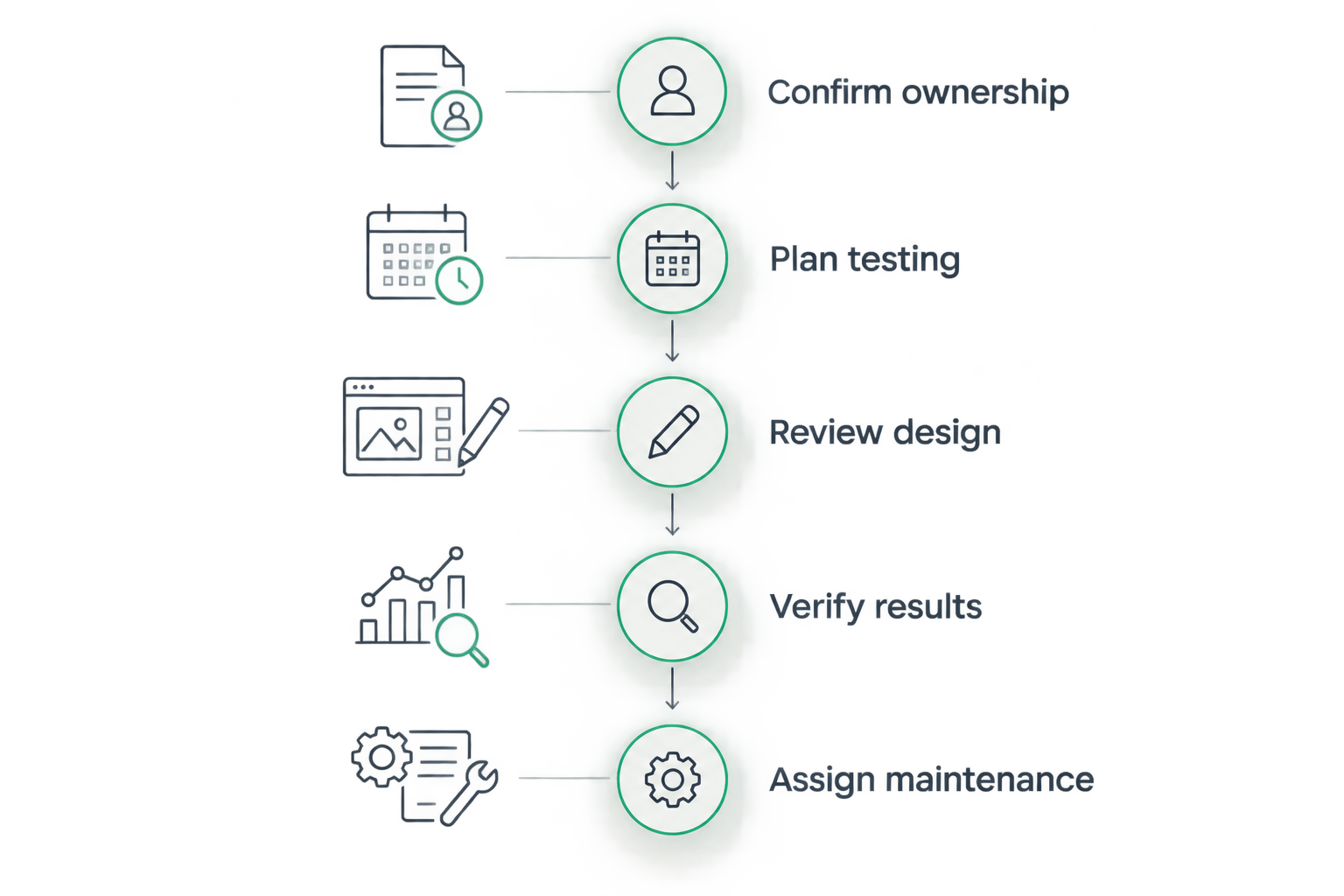
Bring this sequence to the first contractor conversation. A useful proposal should explain each stage clearly enough that you can identify both the next action and the person responsible.
Request a Radon Assessment
Describe your property, location, and salon use so the service scope can be confirmed.
Compare proposals beyond the equipment list
Two proposals are not equivalent just because both mention a fan and vent pipe. Compare what each contractor will investigate, install, document, and verify.
Ask about installation disruption
Require the contractor to identify proposed drilling locations, access needs, and electrical work. Discuss treatment-room noise and appointment access before accepting the work plan, rather than assuming installation can happen around clients.
Ask about the finished result
Request a drawing or clear written description of pipe routing, fan placement, and discharge location. Ask who approves any visible exterior changes and who handles penetrations through finished surfaces.
Ask about verification and service
Establish who arranges the follow-up measurement and what happens if further work is needed. Request written warranty terms rather than treating a general promise as a complete explanation of coverage.
A system indicator and a radon measurement answer different questions. An indicator helps show system operating conditions; follow-up testing measures the radon concentration after installation.
How these options are ranked
The 2026 order follows property fit: dedicated commercial premises first, home-based businesses second, and leased shared-building spaces third. The criteria are relevant experience, credentials, testing scope, design, disruption planning, and follow-up.
The order does not establish that one named company outperforms another. A company earns your shortlist by answering the questions your building creates. Review counts or a familiar name do not replace that assessment.
Which contractor should you choose?
For a dedicated commercial salon, choose a specialist who documents comparable building experience and includes a clear verification plan. For a home-based business, begin with a residential provider whose geographic and service scope match the property.
For a leased suite, make landlord coordination the first step. Do not approve a system design while permission to access or alter the building remains unresolved.
Your default choice is the qualified contractor who connects the test results, building conditions, proposed work, and follow-up in writing. Skip proposals that jump straight to equipment without explaining that connection.
FAQ
What’s the best radon mitigation company for a Michigan salon?
The best fit depends on whether the salon occupies a home, dedicated commercial premises, or a leased suite. Require relevant building experience, verified credentials, a written testing scope, and post-installation verification before hiring.
Can a residential radon contractor work on my spa?
Residential experience alone does not establish suitability for a commercial spa. Ask the contractor to confirm the project scope and document experience with comparable commercial buildings.
Should I test my salon before requesting mitigation?
Yes, start with a building-appropriate radon testing plan. The results and foundation assessment should guide whether mitigation is needed and how the system is designed.
Does the EPA’s 4 pCi/L recommendation apply to every salon?
The EPA’s 4 pCi/L action recommendation is residential guidance, not a universal commercial workplace rule. Ask the professional responsible for your salon assessment to identify the applicable protocol and decision criteria.
Will salon exhaust fans remove radon?
Salon exhaust fans are not a substitute for a radon assessment or a designed mitigation system. Tell the testing professional how exhaust equipment operates so building conditions are considered in the measurement plan.
Do I need my landlord’s permission for radon mitigation?
Obtain written permission before authorizing alterations to leased premises. Review the lease and agree on access, approval, records, and ongoing responsibilities with the property owner.
How do I know the radon system worked?
Post-installation radon testing measures the concentration after mitigation. A running fan or system indicator alone does not establish the radon level in occupied rooms.
One last thing
Make the follow-up report a required deliverable before installation begins. A completed installation and a verified radon result are not the same thing; your records should show both the work performed and the measurement afterward.
Keep those records with the property's maintenance documents. Name the person responsible for acting on them so the next staff change or lease renewal does not leave the system without an owner.
Related guides
- How to verify a contractor's NRPP certification
- How to compare radon mitigation quotes
- How to schedule testing after mitigation installation